
AI in Finance: Use Cases & How To Choose the Right Tools
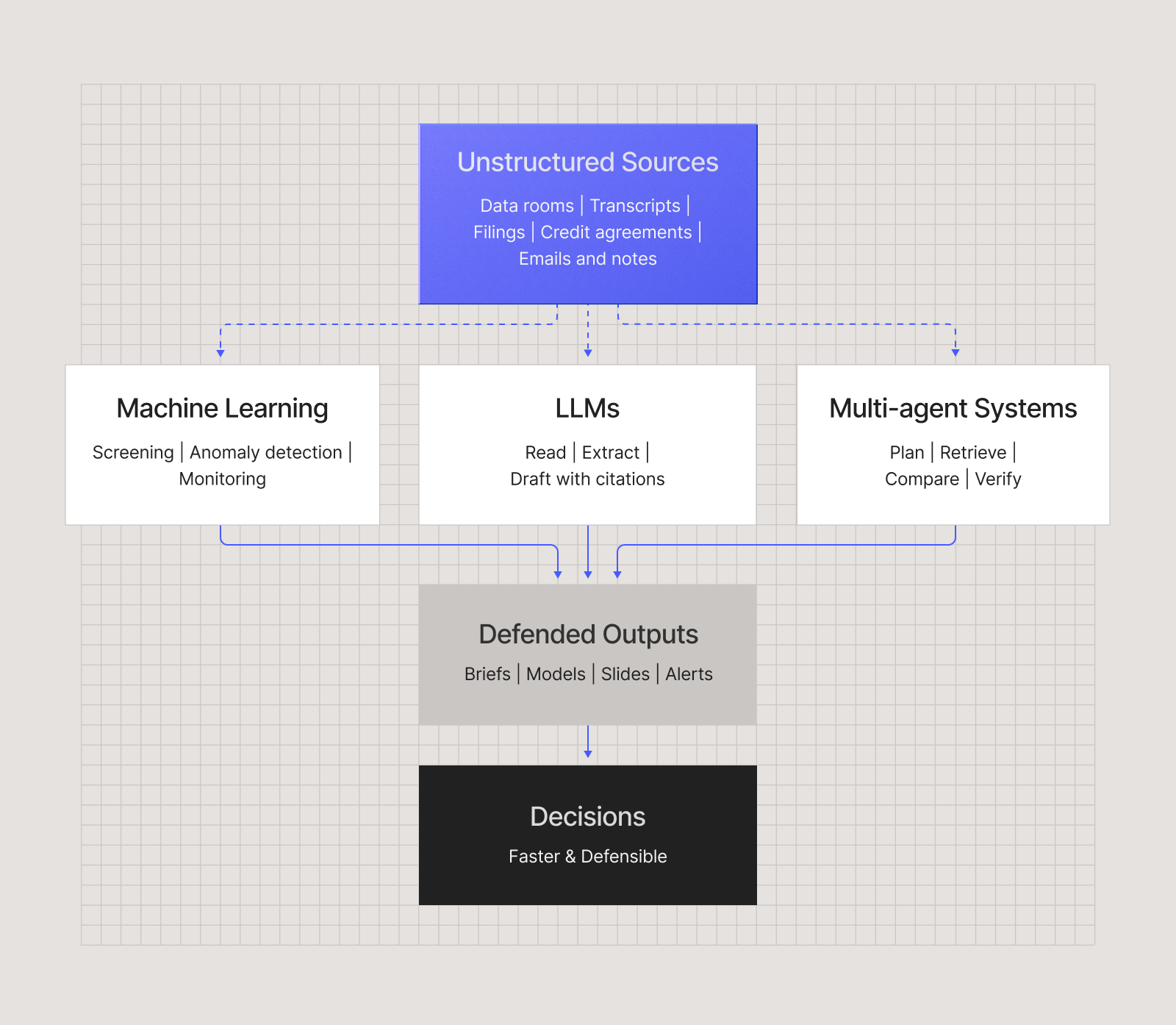
For deal teams, AI in finance uses multi-agent systems to read filings and agreements, surface signals with citations, and compress time from document to decision—without lowering your standard.
Finance professionals—across investment banking, private equity, public equity, and credit—face constant pressure to deliver precise, high-impact work at speed. Manual tasks like wrangling data, updating models, and formatting presentations not only slow teams down but also open the door to errors.
Now, AI is transforming finance—not just by automating repetitive workflows, but by giving investors at all levels the ability to generate new deal ideas and uncover insights others might miss. This shift allows professionals to devote more energy to winning mandates, building trust with clients, and shaping strategy, rather than getting bogged down in manual busywork.
In this article, we’ll explore where AI is driving the biggest changes in finance, highlight real-world use cases, and show how to harness its power for both productivity and insight—while maintaining the accuracy and compliance your firm demands.
What We'll Cover:
- What Is AI for Finance?
- Use Cases for AI in Finance
- How To Choose the Right AI Tools
- The Future of AI in Finance
- How Hebbia Helps
What Is AI for Finance?
AI for finance is about transforming how investors and investment bankers turn huge volumes of unstructured information into actionable insights, all at a scale and speed that simply wasn’t possible before. Acting as an expert research assistant, AI reads and analyzes massive document sets, extracts crucial facts with source citations, and assembles initial financial models, detailed briefs, and formatted presentations. What once took days or weeks can now happen in a fraction of the time.
Humans remain essential throughout the process—reviewing outputs, interpreting insights, deciding where to investigate further, and ultimately communicating and acting on findings. By automating the most manual and repetitive tasks, AI lifts the entire organization to a higher level, enabling more capacity for strategic thinking, creative problem-solving, and impactful decision-making. In effect, AI shortens the distance from raw document to actionable insight, raising the bar for both speed and accuracy across the finance organization.
Use Cases for AI in Finance
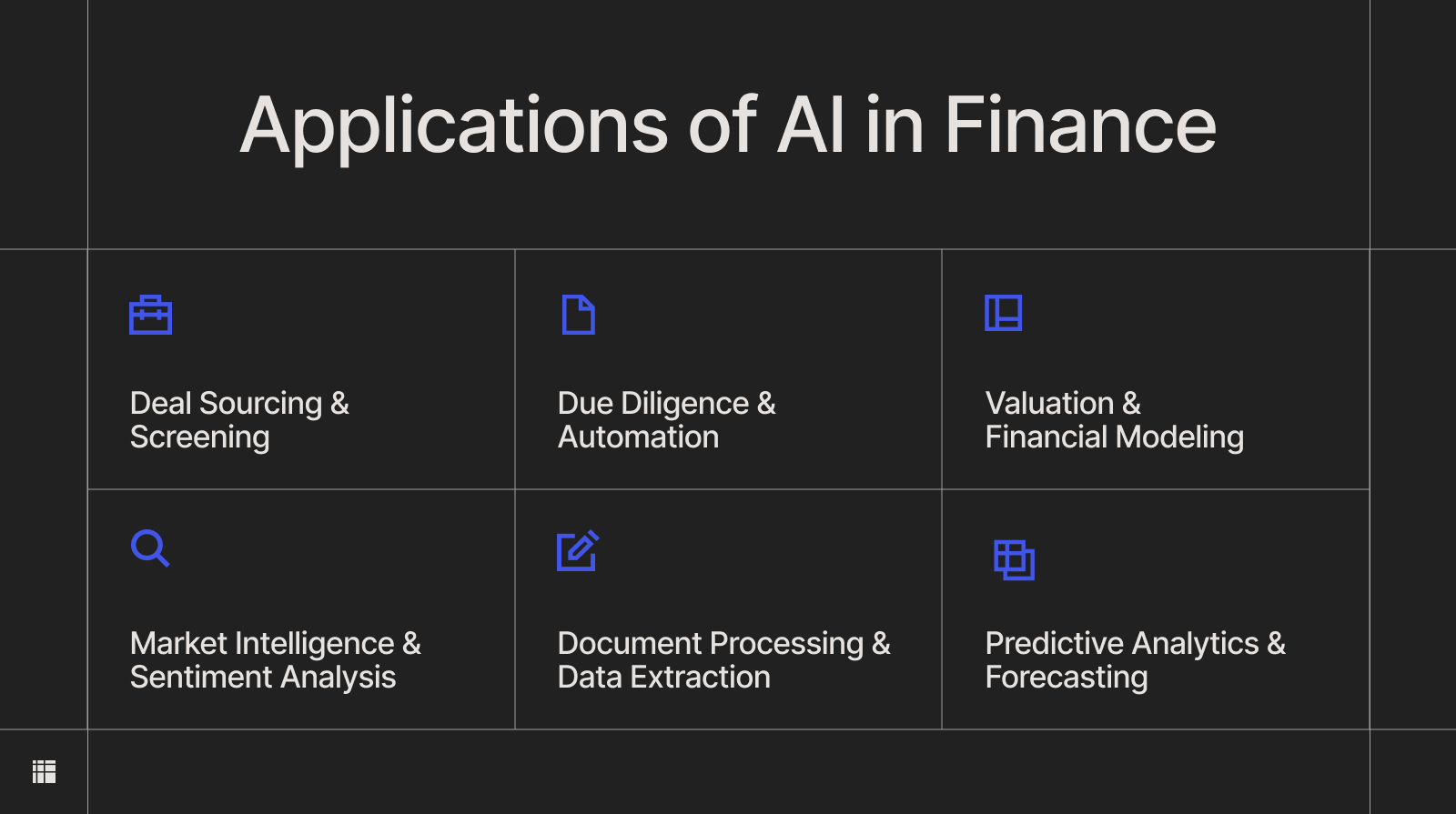
AI applications in finance deliver the most value where workflows are repeatable and prone to human errors, and require synthesis across a lot of information.
Below are industries that are quickly adopting AI to deliver measurable results.
Investment Banking
Investment Banking teams operate under tight deadlines, producing highly detailed, client-facing materials that must be accurate and polished. Each deal requires synthesizing complex information from company filings, prior transactions, and market data—often through repeatable, process-driven workflows.
Today, bankers still spend most of their time updating financial models and formatting presentations, leaving less room for strategic thinking to best differentiate their pitch.
AI streamlines the investment banking workflow by automating data collection, model building, and presentation formatting, freeing bankers to focus on story, strategy, and client preparation.
Here’s how AI can help investment banking teams win more deals:
- Instantly searches and extracts key data from company filings, prior deals, and market research, surfacing the exact lines needed for comparable company analysis (comps), precedent transaction analysis, and benchmarking
- Automates the creation and updating of financial models by pulling assumptions, drivers, and footnotes directly from source documents, ensuring accuracy and traceability.
- Generates first-draft pitch books, confidential information memorandums (CIMs), and investment committee (IC) memos in firm-branded templates, complete with charts, footnotes, and citations for every claim.
- Enables rapid benchmarking and analysis of deal terms, multiples, and structures by searching across internal and external databases, so bankers can quickly position their client’s story.
- Streamlines the question and answer (Q&A) process by making all diligence materials and prior work searchable, allowing teams to respond to client and internal questions with speed and confidence.
- Supports ongoing client preparation by generating tailored talking points, summaries, and market updates, so bankers are always ready for the next meeting.
The result is faster, more accurate deliverables and streamlined workflows, freeing junior team members from manual tasks and giving senior bankers more time to focus on the strategic thinking that differentiates deals.
Credit
Credit teams face the challenge of evaluating multiple opportunities—often with limited information and under intense time pressure. Every deal requires reviewing hundreds of pages of diligence materials, legal agreements, and financials. The real hurdle is quickly identifying the benchmarks and key credit terms to make the best investment decision.
AI empowers credit teams to analyze large volumes of dense documents, standardize inconsistent language across agreements, and surface key risks before they become problems. By automating the extraction, comparison, and monitoring of critical terms, AI allows investors to focus on judgment and negotiation, not manual review.
Here’s how AI can support day-to-day credit workflows:
- Centralizes and makes searchable all past IC memos, enabling benchmarking of deal terms, risks, and highlights against relevant precedents.
- Generates presentation materials from CIMs or decks, extracting business fundamentals and key metrics, and tying every claim to its original source for easy verification.
- Surfaces hidden origination opportunities by scanning filings, transcripts, and news for refinancing signals, upcoming maturities, or covenant relief discussions—building a living pipeline of actionable leads.
- Extracts, benchmarks, and compares covenant terms, baskets, and carve-outs across agreements in minutes, delivering insights on where to focus in negotiations or monitoring.
- Monitors borrower filings and compliance reports for changes that signal risk or breach, flagging early warning indicators with supporting source text for immediate review.
AI uncovers more investable opportunities and enables sharper risk management, so your team can protect capital and act decisively across multiple deals.
Public Equity
Public equity research analysts play a critical role in predicting future financial performance and stock price movements. Unlike investment bankers or private credit investors, equity analysts operate in a continuous feedback loop—constantly learning, iterating, and recalibrating their views based on new data, market movements, and investment outcomes.
AI can streamline this process, enabling investors to focus less on manual transcription, and even uncover novel insights by going through a vast amount of information they otherwise wouldn’t have seen.
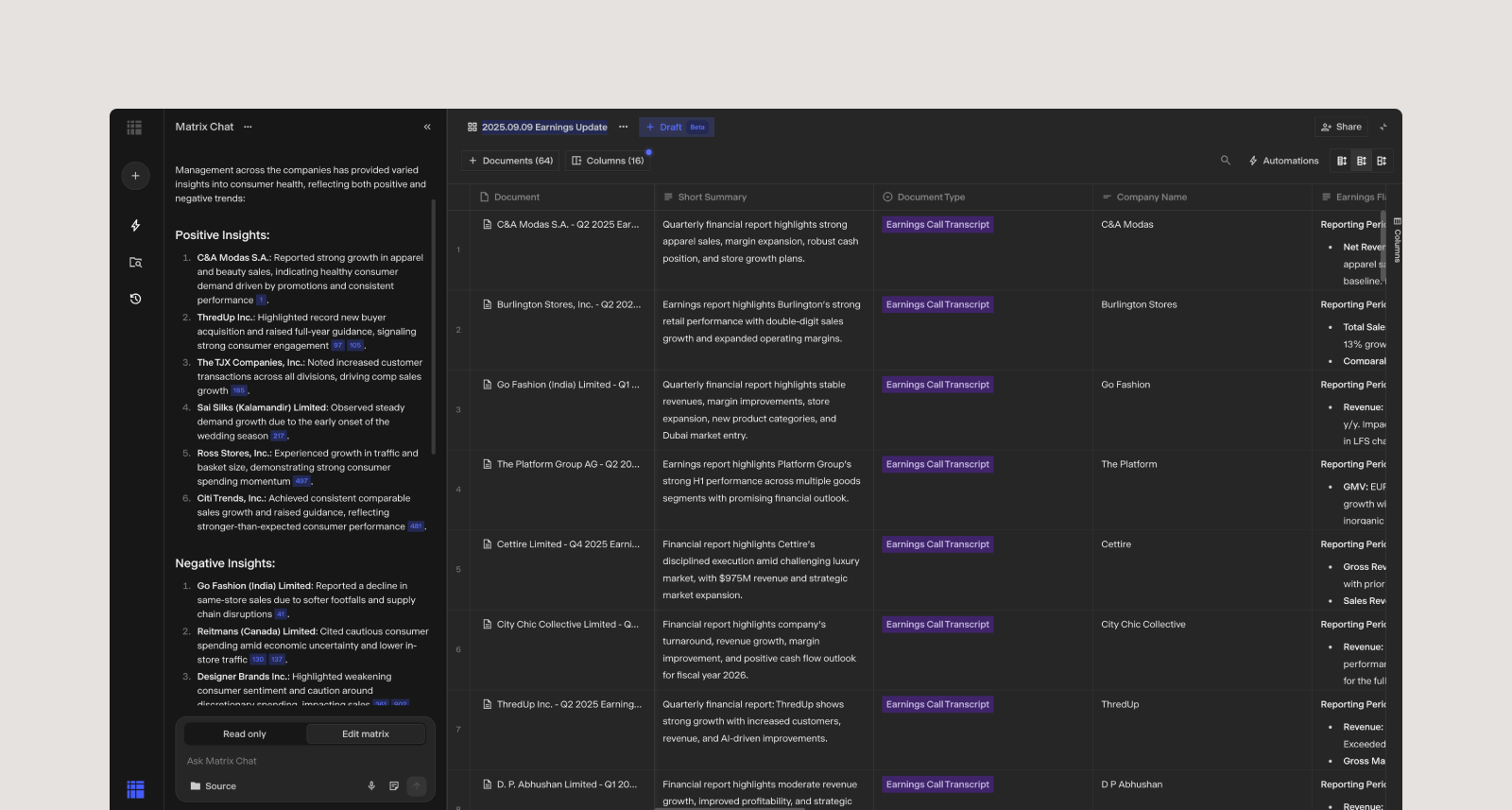
Analyze a sea of complex documents—earnings call transcripts, SEC filings, and more—and build stakeholder-ready financial models in minutes with Hebbia.
Here’s how AI gives public equity teams an edge:
- Instantly reads every earnings call transcript, SEC filing, and research report, surfacing the exact lines that impact financial models or signal changes in guidance and sentiment.
- Lets investors compare language, data, and signals across entire transcripts from multiple quarters or years, enabling deeper textual analysis.
- Retrieves specific data points or metrics—like “gross margin”—while highlighting the surrounding context and sentiment, so investors capture nuance, not just keywords.
- Provides citations for every fact and data point, so investors can quickly verify accuracy before updating models or making recommendations.
- Generates high-quality writeups and decks faster, freeing investors to focus on interpreting insights and refining investment theses instead of compiling data.
The result is faster time to insight, higher confidence in the numbers, and outputs you can defend.
Private Equity
Private equity teams are focused on sourcing, analyzing, and executing investments in private companies. Unlike hedge fund analysts who operate in public markets with rapid trading, private equity investors work with illiquid assets, longer deal cycles, stakeholder management, and complex internal processes.
AI allows investors to move faster by automating the review and synthesis of vast, unstructured data, most of which is in the form of documents for private companies. This enables teams to focus on high-value analysis and communication, rather than manual data gathering and formatting presentations.
Here’s how AI can help private equity teams:
- Scans entire virtual data rooms (VDRs), surfacing key facts and routing them into structured, IC-ready outlines, so investors can quickly identify risks, opportunities, and deal drivers.
- Automates deal sourcing by extracting relevant information from LinkedIn, banker emails, conference materials, and other networks, helping investors proactively find and evaluate new opportunities.
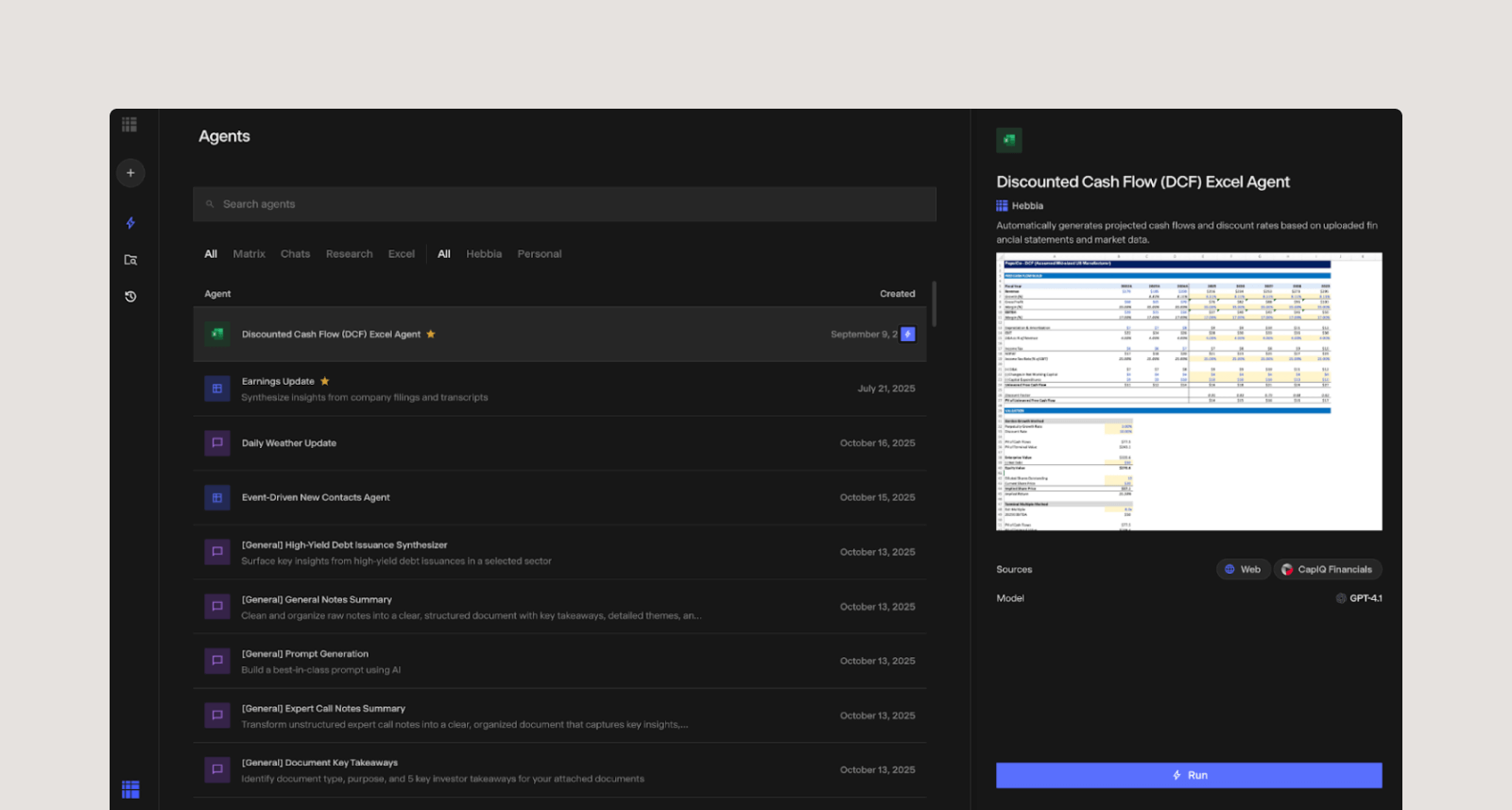
- Connects sources and pulls numbers directly into Excel and financial models, mapping drivers and footnotes to the right cells with sources attached for easy verification.
- Generates exhibits and draft memo sections in your firm’s format, preserving citations and linking every claim to its source, so IC memos are faster to produce and easier to review.
- Tracks rolling updates and version changes in VDRs, ensuring that stale data checks run automatically and that the latest information is always reflected in analysis and reports.
- Streamlines stakeholder communication by enabling rapid iteration on templates, responding to feedback, and supporting ongoing portfolio management with up-to-date, source-linked reporting.
With AI, teams see faster, higher-quality deal analysis and IC memos, less administrative burden, and a workflow that is both structured and flexible—so they can focus on judgment, synthesis, and value creation.
How To Choose the Right AI Tools for Finance
The right AI platform should speed up analyst work without lowering your bar for accuracy, defensibility, or compliance.
What to look for:
- Accuracy you can measure: Expect demonstrated performance on your own documents and tasks, with precision/recall measurements or simple pass/fail evaluations that you can rerun over time.
- Transparency: Best-in-class systems provide line-level citations, display the source in context, and clearly explain what changed, allowing reviewers to verify claims in seconds.
- Security: Requirements should include zero data retention (ZDR) options, least-privilege access, encryption in transit and at rest, and isolated workspaces aligned to firm policies.
- Compliance: There should be complete audit trails capturing prompts, inputs/outputs, versions, approvers, and timestamps, plus watermarking on exports for supervisor review.
- Integration with existing workflows: Smooth handoffs to Excel, slides, and data vendors should be standard, along with single sign-on (SSO) and core IT controls.
- Human-in-the-loop support: Human approval for high-materiality sections, configurable confidence thresholds, and lightweight reviewer checklists should be built in.
- Auditability: You should be able to pin model and tool versions, reproduce any run on demand, and view side-by-side differences when something changes.
Ease of adoption also matters. Look for tools that are easy to start with zero-effort onboarding and browser-based use, so teams see value in the first week. Make sure the tools respect firm standards like templates, glossaries, and definitions, and that admins can manage roles and workspaces without extra overhead.
The Future of AI in Finance
AI can supercharge financial professionals by enabling them to review and analyze vast amounts of data in real time—saving hours and uncovering insights that would otherwise go unnoticed. Beyond that, AI eliminates the manual busywork of gathering raw data, updating financial models, and preparing presentations, allowing teams to focus squarely on the high-level analysis and strategic thinking that set them apart in competitive markets. But this is just the beginning.
Every day, AI models are getting more accurate and sophisticated, new alternative data sources are coming online, and workflow outputs—including slides, memos, and financial models—are achieving levels of speed and polish that rival the best manual work. Soon, investors and deal teams won’t just save time—they’ll have superhuman reach, judgment, and clarity at every stage of the investment process.
The future of finance won’t belong to those who simply have access to more information, but to those who can best synthesize, judge, and act on that information with the help of AI.
How Hebbia Helps
Hebbia is purpose-built for finance. It rises above other financial AI tools by delivering accuracy at scale—processing vastly more data at once, with a larger context window so teams can uncover insights others miss.
Hebbia also offers seamless integrations with a wide range of public and private data sources, generates high-quality Excel models and branded slide decks, and supports fully customizable agentic workflows. Every output is fully auditable with line-level citations, so your team can move fast with confidence.
The result: sharper analysis, faster execution, and client-ready deliverables that give you a decisive edge.
See Hebbia in Action
Ready to turn documents into decisions faster? Book a personalized demo and see how Hebbia accelerates insight generation, lifts coverage, and frees your team to focus on high-value work.


