
AI in Investment Banking: Use Cases, Benefits, and Tools
Investment bankers need to move fast and be accurate to win deals. They must create flawless presentations, verify every number, and synthesize information from countless company documents—all under relentless deadlines.
The hours lost to reviewing PDFs, building financial models from scratch, and achieving immaculate slide polish add up quickly, leaving little time for strategic thinking.
AI is transforming this workflow. By automating document review, extracting key data, refreshing complex models, and generating presentation-ready slides, AI enables bankers to focus on what matters: crafting winning pitches and driving deals forward.
This article explores how top investment banks are adopting AI to speed up deal execution, the most valuable AI-powered workflows in daily banking life, and key considerations for evaluating these solutions.
How AI Is Powering Modern Investment Banking
Investment bankers aren’t just using AI to write emails or conduct basic research. AI is tackling the industry’s toughest challenges: extracting deep insights from complex data, powering advanced calculations, and, most importantly, automating critical workflows.
This goes far beyond surface-level tasks. Bankers now trust AI to help build financial models, distill diligence findings, and generate fully client-ready presentations with minimal manual effort.
These innovations offer measurable advantages, including:
- Shorter diligence cycles
- Increased research accuracy
- Freed-up capacity for strategic thinking
Modern AI systems can seamlessly connect research, financial modeling, and presentation-building.
For instance, when teams review diligence materials, AI can extract key performance indicators (KPIs) and management commentary, update model inputs in Excel, and auto-generate polished valuation slides—all in one continuous process.
What once took multiple days of manual coordination—jumping between spreadsheets, slides, and source files—can now be completed in a matter of hours. Outputs are consistent, cited at the page level, and come with built-in audit trails.
The move from manual effort to agentic AI workflows transforms deal execution. Bankers can now redirect their time from repetitive busywork to high-value tasks, such as developing client strategies, negotiating with counterparties, and structuring deals that drive revenue.
Manual banking workflows | How AI can help |
|---|---|
Scan hundreds of PDFs for specific metrics | Read entire VDRs and returns exact page citations |
Build company comparisons by copying data into Excel | Extract financials and generate comparison tables |
Draft CIM sections from notes and memory | Synthesize call notes and filings into structured sections |
Refresh models by rechecking transcripts | Update drivers from trusted data feeds with source links |
Format slides to match house style | Export on-brand decks with logos and fonts preserved |
Search deal room files for diligence answers | Surface responses across thousands of documents instantly |
Practical Use Cases of AI in Investment Banking
AI is transforming core investment banking workflows by addressing specific bottlenecks that traditionally slow deal execution and consume valuable work hours. The following examples illustrate how leading investment banks are automating time-intensive tasks while upholding rigorous accuracy standards.
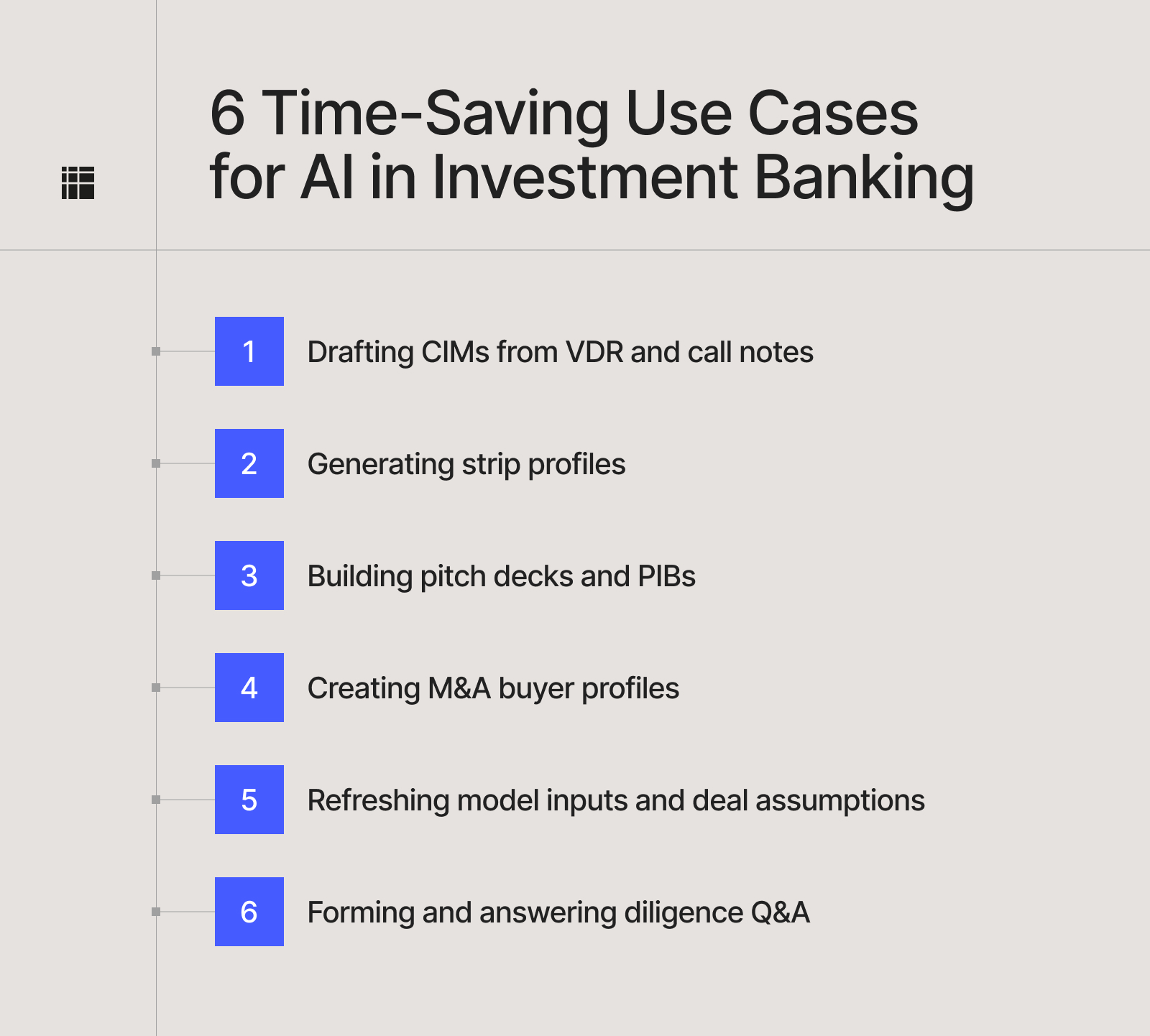
Drafting Confidential Information Memorandums (CIMs)
A CIM is a comprehensive document prepared by a company or its advisors to provide potential buyers or investors with detailed information about the business during a transaction process. AI can transform dispersed VDR folders, call notes, and diligence memos into first-draft CIM sections within hours by extracting:
- Business overviews
- Market landscape analyses
- Financial highlights
AI also helps identify risk factors from filings, KPIs from vendor reports, and growth metrics from internal models. Agentic processes emulate the typical investment banking analyst workflow by reading documents, extracting key sections, normalizing terminology, drafting prose, inserting citations, and conducting quality assurance checks.
Each claim is linked to a verifiable source to stand up to internal reviews. This approach shortens first-draft CIM cycles and enhances consistency across sections.
With Hebbia, you can export analysis to fully formatted slide decks and reports in MS PowerPoint, MS Word, or PDF , so you can spend less time building deliverables from scratch.
Generating Strip Profiles
A strip profile is a summary that presents key operational, financial, and strategic data for a company or asset, commonly used in investment and deal analysis. Building them often requires dozens of hours of copying data from filings, broker reports, and internal databases into standardized slides. AI automates this process by reading source documents and populating profile templates with consistent formatting, extracting:
- Revenue by geography from 10-Ks
- Comparable deals from press releases
- Strategic fit commentary from business model analyses
Every data point links back to the source for validation. When markets shift, AI helps teams refresh all profiles instantly.
Building Public Information Books (PIBs)
While PIBs and pitch decks differ in purpose and tone—PIBs offer objective, comprehensive overviews for transaction initiation, while pitch decks are crafted to persuade and win business—the process of gathering, formatting, and presenting information is surprisingly similar for both.
Both require market maps, company profiles, strategic rationale, and valuation tables. Traditionally, associates spend days gathering data from reports, databases, and past deal materials.
AI can compress that cycle by generating first-draft slide decks . It can:
- Create market maps from industry reports
- Build valuation ranges from comparable company information
- Draft rationale slides based on buyer criteria
Charts, footnotes, and sources can populate automatically. This frees up teams to refine strategy instead of building slides from scratch.
Creating Mergers & Acquisitions (M&A) Buyer Profiles
Screening potential buyers is a time-consuming step early in the M&A deal process. Teams typically review earnings call transcripts, analyze balance sheets, and research portfolios to build profiles that assess product fit, geographic presence, and deal history.
AI can automate much of this screening and profiling by:
- Reading earnings call transcripts to identify companies that have expressed interest in M&A
- Calculating each buyer’s debt capacity from financial statements
- Mapping overlaps in private equity portfolios to identify relevant sector experience
- Scoring and ranking buyers based on how well their strategic priorities, financial capacity, and past deal activity align with the target company
This approach enables broader and more targeted buyer coverage, increasing competition and the potential for higher valuations—without extending deal timelines.
Automating and Refreshing Financial Models
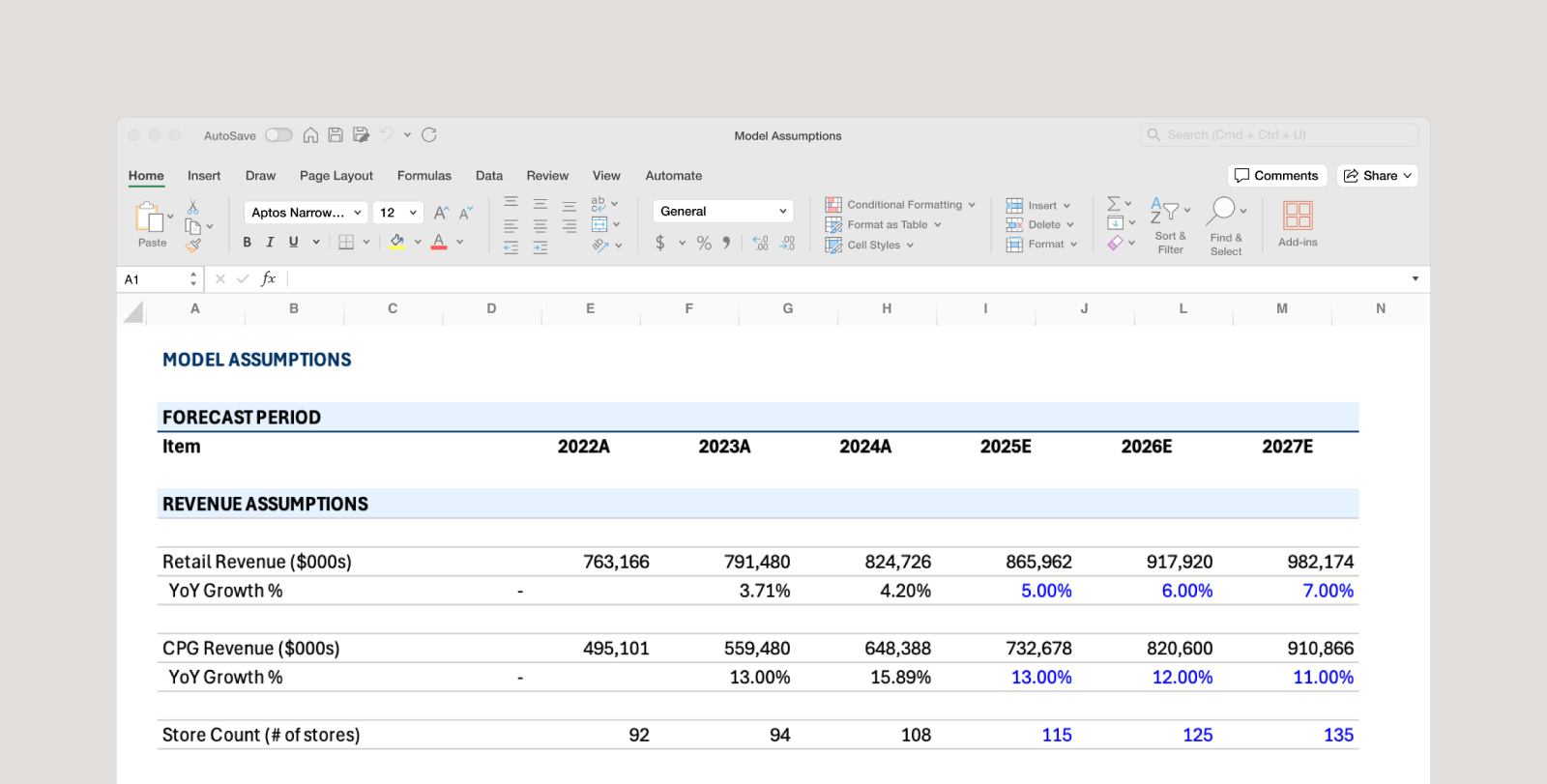
Building and maintaining financial models is an integral part of everyday workflows. Teams must constantly update assumptions and inputs as companies report earnings and market conditions change, which traditionally means poring over filings, earnings call transcripts, and data feeds, then carefully updating Excel templates while preserving formulas and links. This manual process is not only time-consuming but also prone to errors, broken formulas, and version control issues.
AI can transform financial modeling by both generating models from scratch and automating ongoing updates. By connecting to trusted data feeds and parsing new filings and transcripts, AI can:
- Update financial models, comps, and assumptions directly from source documents
- Extract revised multiples, KPIs, and management guidance
- Normalize historical data and forecast drivers across time periods
- Populate Excel templates with accurate formatting, cell logic, and citations
- Flag and annotate material changes—such as management turnover or credit events
- Refresh inputs and identify discrepancies automatically
Instead of spending hours on manual data entry and error-checking, teams can devote time to strategic thinking and deeper analysis, confident that their models are accurate and up-to-date for client presentations and reviews.
Forming and Answering Due Diligence Questionnaires (DDQs)
DDQs are sent by prospective buyers seeking detailed information about a target’s financials, contracts, customers, and operations. Sell-side teams must find supporting evidence across thousands of files and track every open item. Manual searches slow response time and create risk of missed documents, inconsistent answers, and a weak audit trail.
AI can support this workflow across the entire deal room with the functionality to:
- Read contracts, financials, customer data, and prior memos to efficiently locate answers
- Draft responses with precise citations which buyers can reference
- Identify missing information or documents and create action lists for management to address outstanding requests
With automation, teams can maintain a centralized DDQ log that tracks status, ownership, and timing, ensuring every answer is defensible and delivered on time.
Benefits of AI for Investment Bankers
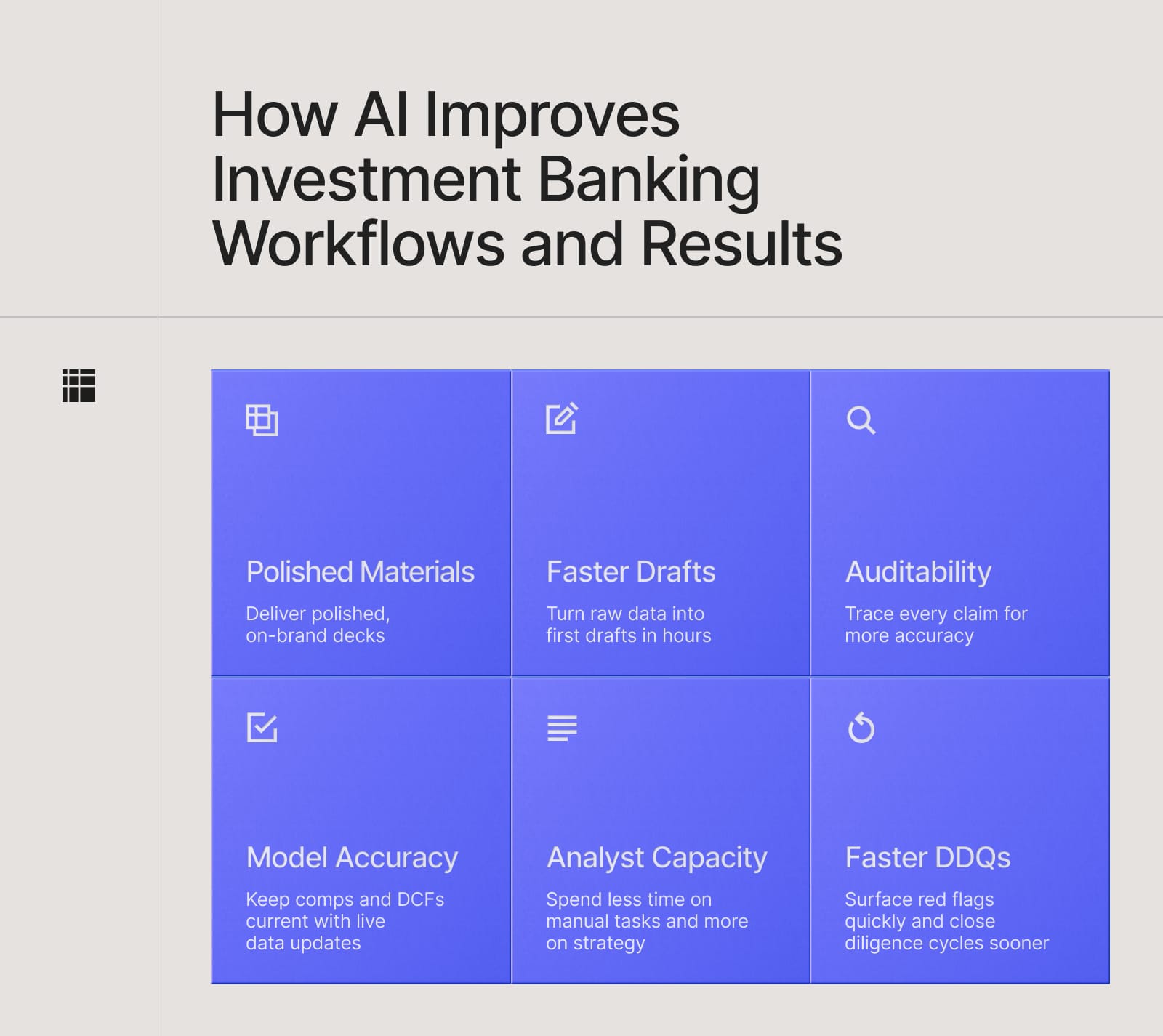
AI-driven automation is fundamentally transforming investment banking, delivering measurable advantages across deal execution, client service, and analyst productivity. Banks leveraging AI at scale report the following benefits:
- Empowering junior bankers to focus on high-impact work: Junior bankers can automate much of the manual analysis and deliverable generation in their workflows—such as compiling data, building decks, updating models. This frees up time for them to focus on crafting compelling narratives and developing critical insights that give their teams an edge in competitive deals.
- Enabling senior bankers to generate novel insights and strategies: Senior deal makers can use AI to surface new patterns, identify unique angles for pitches, and think through innovative deal strategies.
- Auditability that withstands client and regulator scrutiny: Every claim and model input should tie back to original sources.. Compliance and client teams can verify assumptions instantly.
- Always-up-to-date models and research discipline: Keep comps, transaction multiples, and model drivers updated in real-time. This helps teams avoid version drift or calculation errors and enhances research rigor.
- Faster diligence and quality review: Structured prompts can surface red flags and produce source-backed answers that move counterparties and counsel faster. Deal teams close diligence phases sooner while maintaining full audit quality.
Considerations for Using AI in Investment Banking
AI can introduce operational and compliance risks in investment banking that firms must address through governance and controls. The list below covers primary concerns that require due diligence and mitigation strategies.
- Over-reliance on automation: Teams may skip critical review steps or lose deal intuition when delegating too much to AI. Human judgment is still crucial for critical assumptions, strategic decisions, and client-facing narratives.
- Data privacy and security: Investment banks handle sensitive client data that requires enterprise-grade protection. Platforms must provide isolated environments, encryption, and strict access controls. Vendors should prevent data retention, block model training on client materials, and meet financial security standards.
- Model bias and accuracy: AI trained on limited data can repeat historical patterns or generate incorrect claims. Banks need tools to audit model logic, validate outputs against independent sources, and maintain human oversight with strict fact-checking standards before client delivery.
- Regulatory and ethical concerns: SEC, FINRA, and international regulators scrutinize AI use in material disclosures and fairness opinions. Document AI involvement in deal processes and maintain human accountability for final outputs.
What To Look for in an AI Solution
Selecting the right platform requires matching capabilities to institutional requirements. Banks need systems that handle document volume, are accurate, and integrate with existing workflows without compromising security.
Transparency, Auditability, and Source Traceability
Every claim in a deck, memo, or model input should have a verifiable source with a page number or timestamp. Citations and lineage must carry through exports so clients can validate and reproduce results. Strong auditability ensures every output can be reviewed, traced, and verified during compliance checks.
Questions to ask:
- Are citations embedded in slides and docs?
- Do Excel cells keep assumption lineage?
- Is there a version history for compliance?
Ability To Handle Large Document Sets
The tool should comfortably ingest and reason over thousands of pages at once, like full VDRs, diligence binders, and long PIBs, without chunking artifacts—such as broken sentences, missing context between sections, or repetitive answers caused by splitting documents into small pieces. Processing capacity determines whether AI can handle real mandates or just demo scenarios.
Questions to ask:
- How much text can the tool handle in a single question or upload?
- How many files or pages can I include in one run?
- Are there any hard limits on file size or number of words?
- When the tool quotes from documents, does it keep page numbers or other location references?
Produce High-Fidelity Deliverables
Prioritize solutions that can generate not just individual slides or pages, but complete deliberables that align with your firm’s branded templates—including layouts, fonts, colors, and chart styles. The ability to fully customize outputs to your firm’s standards ensures that presentations require minimal manual reformatting.
Questions to ask:
- Can the tool generate entire decks, not just single slides?
- Does it respect slide masters and your firm’s branding guidelines?
- Are charts, tables, and quantitative visuals included and formatted correctly?
- Can it export to PowerPoint with all formatting, charts, and footnotes intact?
Deep Data Integrations
Prioritize tools with direct integrations to trusted finance data sources that you use every day.
Questions to ask:
- Which data sources are supported?
- Does the integration have all or just some of the data I need?
- Are private company and transaction datasets included?
Data Security and Compliance
Secure data management practices are critical when using AI to analyze sensitive data. Banks need isolated environments for each engagement, role-based access permissions, and strict data retention policies. Any security failure risks exposing confidential deal information and triggering regulatory action.
Questions to ask:
- Does the vendor have a zero-data-retention policy with large language model (LLM)providers?
- If they have their own LLM, how will they use data for training models?
- How will they store and manage any historical analysis or data?
- Are access logs and export controls available for audits?
Why Leading Investment Banks Trust Hebbia
Hebbia sets the standard for accuracy at scale, processing massive volumes of data to deliver precise, traceable insights. You can create polished, client-ready deliverables while seamlessly integrating with leading financial data sources and your own document repositories—giving you a single, intelligent platform for every step of the deal process.
Request a demo to see how Hebbia accelerates deal execution and elevates deliverable quality across banking workflows.


