
Finance is Outgrowing the Email Attachment
Customers are replacing models and memos with custom apps built on Hebbia.
Banks and investment firms have spent billions on systems for managing information, executing transactions, and monitoring risk. The work still happens in Excel, PowerPoint, and email. Teams spend weeks on an opportunity, put the results in a deck, and circulate it for comments. The deck is revised half a dozen times before it reaches the client. Then the client asks questions, the model changes, and the deck is revised again.
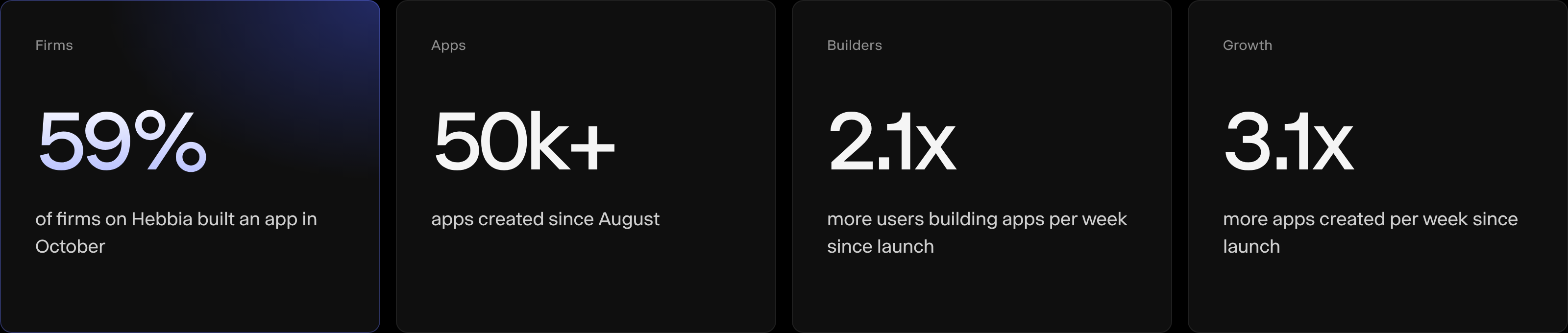
To solve this problem, customers have started building their own applications in Hebbia. In October, 59% of firms on Hebbia built one. Since Max launched a couple of months ago, twice as many people build apps each week, and they create 3.1x as many. One leading private equity investor shares portfolio company updates for board prep in an app that refreshes as new information on each company comes in. Because it stays connected to the firm’s data, no one sends another attachment.
Finance professionals have always used charts and dashboards to explain their data. In Hebbia, they build the apps themselves, for their own work and for their teams. We think applications are how work increasingly gets done from here.
Follow the usage data
Until recently, a team that wanted an app asked the internal technology team to build one. That meant a queue, a business case, and a long wait, and the market had often moved by the time it shipped. AI now lets a professional produce a useful app in minutes. Running it in a permissioned, access-controlled environment is much harder, and a prototype on someone’s laptop is not an enterprise app.
Practitioners know how they want to gather, analyze, and present information. The institution needs permissions, consistency, and control over the systems where its records live. Apps can do both.
Unlike decks and documents that circulate as attachments, they stay connected to the firm’s data and access controls. Customers share them internally at 10x the rate of traditional decks and documents, and they now make up roughly half of all artifacts published to teams. Customers also keep revising them, downloading the results, and reshaping the output for their own needs.
Why is the work evolving
Consider a coverage team preparing for its weekly pipeline meeting. Client activity sits in the CRM, recent conversations in meeting notes, and potential transactions in deal folders. Someone consolidates it all into a spreadsheet, and the team updates it every week while the underlying information keeps changing. An application built on Hebbia pulls these sources into a live pipeline view, so the team tracks developments, updates next steps, and works from current information.
Portfolio monitoring is a similar problem. Investment teams track financial results, research, and management commentary against the original thesis, and that information lives in different systems. An application brings it together. The team sees what changed, revisits assumptions, and records decisions alongside the numbers.
These applications stay connected to their underlying sources and follow the institution’s existing access controls. Comments, decisions, and updates persist. Everyone returns to the same work instead of creating another version of it.
The biggest change comes when the work reaches the client. Financial advice still tends to arrive as a deck, spreadsheet, or PDF. The client gets a snapshot, then clarifies calls and revised attachments. An application lets the client explore the analysis through a controlled view, ask questions, and return as the information changes.
Where we go from here
Attachments will still persist where a fixed record matters. But for work that keeps moving, a file is out of date the moment it is sent. The deck that took weeks to build and half a dozen revisions to approve is a snapshot of an analysis that has already changed.
Customers building applications on Hebbia are replacing that snapshot with the analysis itself. It stays connected to the firm’s data and access controls, so everyone who opens it sees the current numbers. More than half of active firms built an app in October, within months of Max launching. We think this is how finance work gets done from here.
Start with the workflow your team rebuilds every week and build it as an application. To see what that looks like on your own workflows, reach out to our team.


