
AI Financial Modeling: Key Uses, Benefits, and Future Impact
Across finance roles, teams spend hours each week on data collection and validation, resulting in significant lost time to manual work. This leaves less capacity for the strategic work that drives investment decisions.
AI changes this dynamic by automating repetitive tasks like data gathering, assumptions, and even building fully-formatted spreadsheets. This enables teams to focus on higher-level model analysis and improves their odds of winning deals and making successful investments.
In this post, we explain how AI financial modeling tools work, where they add the most value, how they give finance teams an edge, and what the shift to AI means for the future of financial analysis.
What Is AI Financial Modeling?
AI financial modeling leverages machine learning (ML) and natural language processing (NLP) to automate and enhance every stage of the financial modeling process. Instead of relying on manual data collection and spreadsheet work, AI systems can automatically gather and synthesize data from a wide range of sources, analyze and interpret complex financial information, and even reason through assumptions on future projections.
These advanced tools can generate fully formatted, dynamic financial models that are ready to use in collaborative spreadsheet platforms like Microsoft Excel, streamlining workflows and enabling teams to work more efficiently and accurately.
How Does AI Financial Modeling Work?
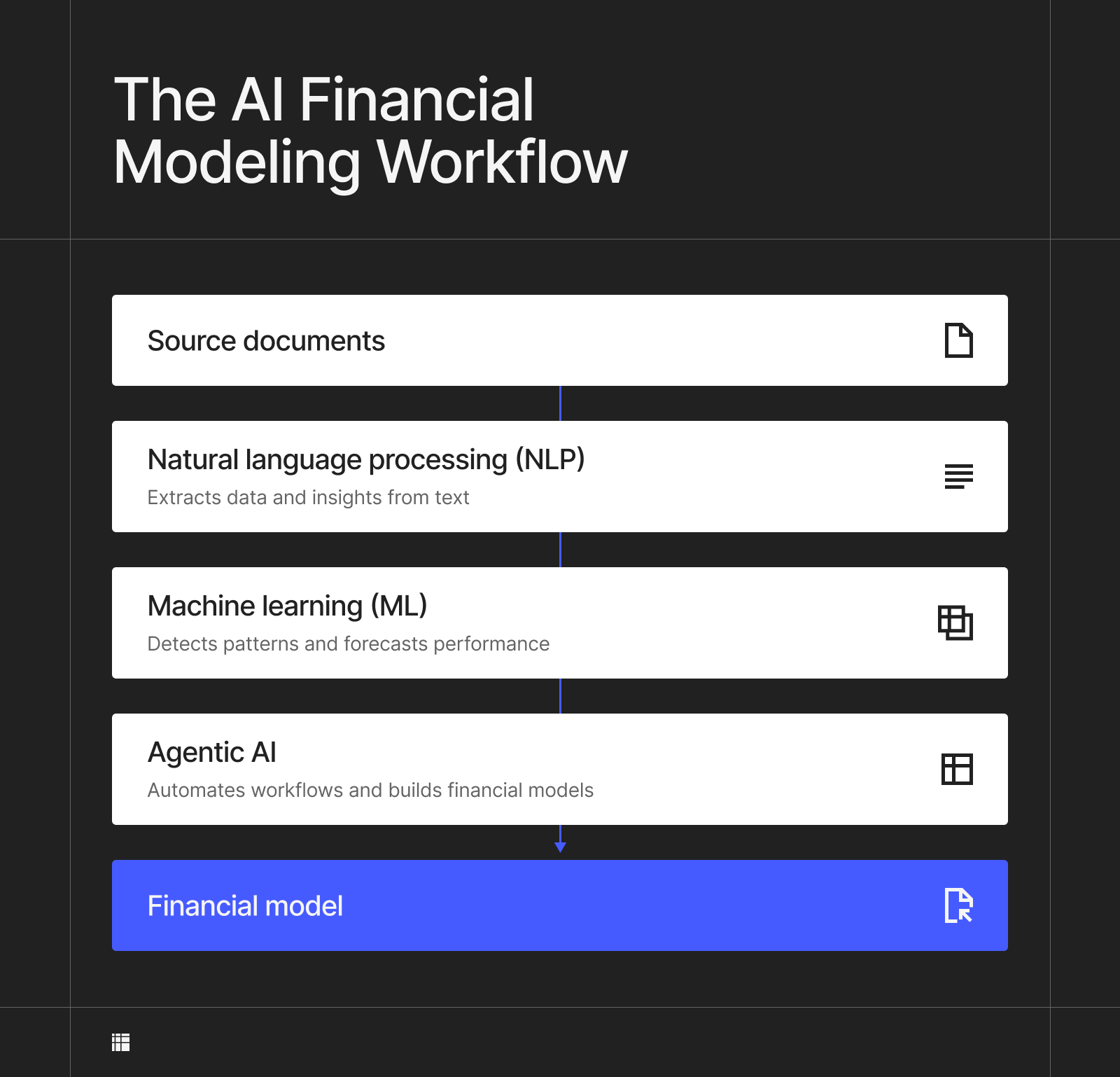
AI financial modeling combines three technical approaches to transform document-heavy workflows into automated processes. Each component addresses a specific challenge in building and maintaining financial projections at scale.
- Natural language processing: Text analysis engines extract numerical data and qualitative insights from unstructured documents like earnings calls, credit memos, and management discussions. NLP then converts narrative text into structured data that populates relevant model fields automatically.
- Machine learning: Pattern recognition algorithms learn from historical financial statements to identify trends, detect anomalies, and project future performance. ML models train on thousands of company filings to understand sector-specific metrics and typical growth trajectories.
- Agentic AI: Autonomous systems execute multi-step workflows by breaking down complex modeling tasks into discrete actions. Agentic AI decides which documents to prioritize, what data to extract, and how to structure outputs based on the model type and use case.
These technologies work together to ingest source documents, validate data accuracy, populate model templates, and flag assumptions that require review. Work that required days or weeks of manual effort can now be completed in a single day, delivering investment-grade accuracy.
How Has AI Improved Traditional Financial Modeling?
While most finance teams already have their own financial model templates, AI dramatically reduces the manual effort involved in updating historical data and maintaining complex financial models.
By automating data imports and formula updates, AI minimizes the risk of “fat finger” errors and accidental formula mistakes—common pain points in traditional modeling workflows. This allows finance professionals to start from a more accurate and up-to-date baseline, freeing them to focus on fine-tuning key assumptions and accounting treatments, rather than repetitive data entry.
The result is not only substantial time savings but also greater confidence and precision in the final model.
Streamlined Data Ingestion

Manual data gathering for financial modeling is notoriously tedious—teams often spend countless hours copying figures from financial statements, credit agreements, and disclosure documents into spreadsheets. AI-powered data ingestion automates these steps, extracting and structuring years of historical data from thousands of pages in just minutes.
By instantly compiling, normalizing, and organizing data for immediate use in model templates, AI for financial modeling eliminates one of the most labor-intensive bottlenecks in the investing and deal-making process.
Reduced Risk of Human Error
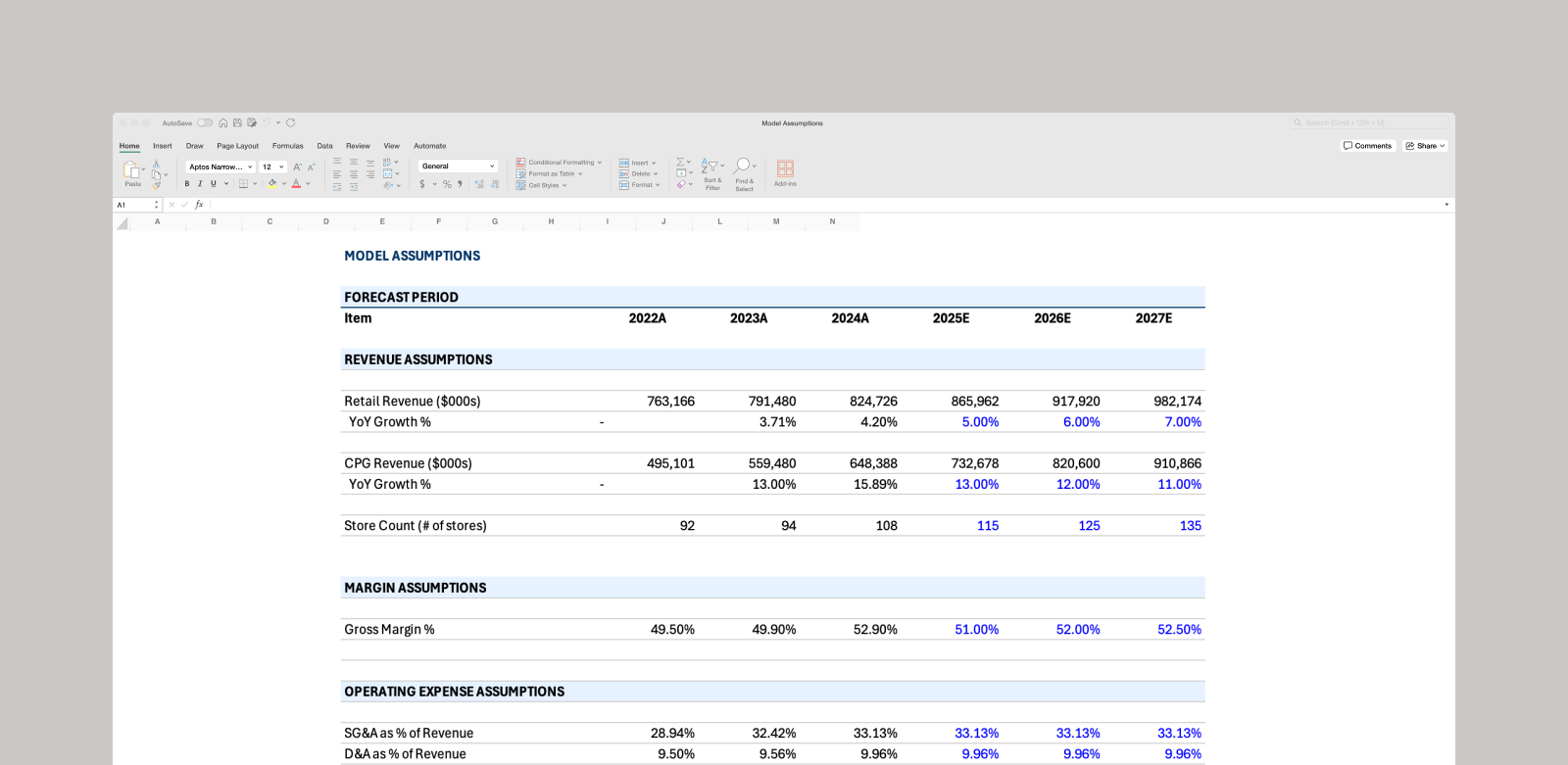
Manual data entry introduces errors that can cascade through linked financial statements. For example, a misplaced decimal in revenue growth can distort valuations by millions. The best AI tools for financial modeling prevent these mistakes by blocking incorrect numbers before they enter the model or flagging potential discrepancies that require human judgment.
The technology also cross-references data with original sources, creating an easily auditable path to validate results.
How AI Enhances the Four Core Financial Models
AI enhances the four model types that drive most institutional finance decisions. The technology adapts to each model's specific structure and analytical requirements while maintaining the flexibility professionals need for custom assumptions and adjustments.
AI Use Cases | Tasks |
|---|---|
Discounted cash flows (DCFs) | - Extracts financial and growth data from filings and presentations - Projects future cash flows using benchmarks and company guidance - Runs automated sensitivity tests on weighted average cost of capital (WACC) and terminal growth |
Leveraged buyouts (LBOs) | - Builds debt schedules directly from credit agreements - Calculates returns across exit scenarios and holding periods - Tests covenant compliance under multiple assumptions |
Three-statement models | - Links income, balance sheet, and cash flow statements automatically - Updates all statements as inputs change - Flags circular references and formula errors in real time |
Comparables | - Pulls valuation multiples and key metrics for peers - Normalizes data for accounting differences - Ranks companies and highlights outliers |
1. DCFs
DCF models estimate a company’s intrinsic value based on projected cash flows. Traditionally, analysts spend hours gathering revenue, margin, and capital expenditure (capex) data and linking formulas across multiple sheets.
AI streamlines this process by pulling data directly from filings and applying management guidance or industry benchmarks. The system builds linked models with sensitivity tables that adjust automatically, allowing teams to test assumptions and focus on interpretation rather than manual setup.
2. LBOs
Leveraged buyout models analyze potential returns when acquiring a company with debt financing. These builds require careful attention to debt terms, repayment schedules, and exit scenarios, which can take days to structure and validate manually.
AI reads debt terms from credit agreements, calculates interest and repayment schedules, and runs multiple exit and operating scenarios in seconds. Finance teams gain a complete view of returns and capital structure without repetitive formula updates.
3. Three-statement models
Three-statement models connect the income statement, balance sheet, and cash flow statement to reflect a company’s full financial picture. Maintaining these links manually is time-intensive and prone to formula errors.
AI connects the statements into a dynamic system that updates instantly when assumptions change. It flags circular references, maintains data consistency, and handles the mechanical work of linking statements so teams can concentrate on the story the numbers tell.
4. Comps
Comparable company analysis benchmarks valuation and performance metrics across peer firms. It requires pulling and normalizing data from multiple filings and databases to create accurate comparison tables.
AI accelerates this process by gathering valuation multiples and metrics from filings, normalizing accounting differences, and assembling clean comparison tables. What once took hours of spreadsheet work now happens in minutes, giving teams more time to analyze patterns and outliers across peer groups.
Challenges of Implementing AI Financial Modeling
Two primary obstacles can prevent finance teams from realizing the full benefits of AI-powered workflows. These obstacles require thoughtful planning and vendor selection aligned with the security, accuracy, and compliance demands of institutional finance.
1. Data quality problems: Financial models generally need clean, structured inputs. Inconsistent formatting, poor scans, or mixed table and text layouts reduce extraction accuracy.
Solution: Use AI tools trained on large volumes of unstructured data like documents and images. Choose platforms with clear citations and audit trails so every figure links back to its source. Validate outputs regularly to confirm accuracy across document types.
2. Strict data compliance requirements: Finance teams cannot work with vendors that store or reuse sensitive deal data. Retaining inputs for model training creates confidentiality and compliance risks.
Solution: Select platforms with zero data retention (ZDR) policies and contractual guarantees that delete data immediately after processing.
Learn how secure, ZDR-compliant AI keeps your financial data fully confidential.
What's Next? The Future of AI Financial Modeling
The future of AI in financial modeling isn’t just about speed—it’s about building systems capable of deeper analysis, greater accuracy, and more confident decision-making.
While AI has advanced the mechanics of financial modeling, it still lacks true human-like nuance. Tasks such as identifying subtle accounting discrepancies across years, interpreting ambiguous disclosures, or making informed judgment calls remain the domain of experienced finance professionals.
The next wave of AI will focus on learning expert logic and contextual reasoning. As these models are exposed to more real-world scenarios and accumulate broader context, their sophistication will dramatically increase.
In the future, AI-driven systems will be able to automatically adapt to evolving accounting policies, shifting reporting standards, and other subtle changes that impact financial analysis—but human oversight will always be an essential check.
Leverage Hebbia for AI Financial Modeling
Hebbia is the AI platform built specifically for finance, empowering teams at every stage of investing and deal-making. Hebbia connects your expertise with your firm’s documents—the most critical data source for finance teams—and real-time market information to uncover insights others miss.
Hebbia’s AI platform can process large volumes of complex documents at scale, deliver Excel-ready financial models, generate presentations, and more. That’s why the world’s leading investment banks and asset managers trust Hebbia to accelerate decisions and deliver consistently higher-quality results.
Explore our AI tools for finance to see how leading firms use them to move faster without sacrificing accuracy.


