
Skills: Expertise at Institutional Scale
Two people at the same firm, in the same role, doing the same task, using the same AI model will get meaningfully different outputs.
Even as LLMs have become more intelligent, getting them to generate financial outputs at consistent quality continues to place the burden on individuals to become prompt engineers. LLMs need instructions on how to approach the task, make judgment calls, use domain conventions and syntax, the output format, and sometimes incorporate esoteric knowledge of "here's how my team does this". None of that lives inside the model. It lives inside people’s heads.
And achieving that consistency institution-wide is a taller order. As George put it in his recent essay, AI has made individuals 10x more productive, but that productivity hasn’t scaled to the institution. The firm’s expertise and way of working transfers from seniors to juniors and tenured members to new joiners slowly, expensively, and inconsistently.
We built Skills in Hebbia to bridge that gap between individual and institutional AI.
Introducing Hebbia Skills
A Skill is a structured set of instructions that tells the AI exactly how to perform a specific task, distilling methodologies and domain expertise that would otherwise take years to absorb into packets of information that LLMs can consume when relevant.
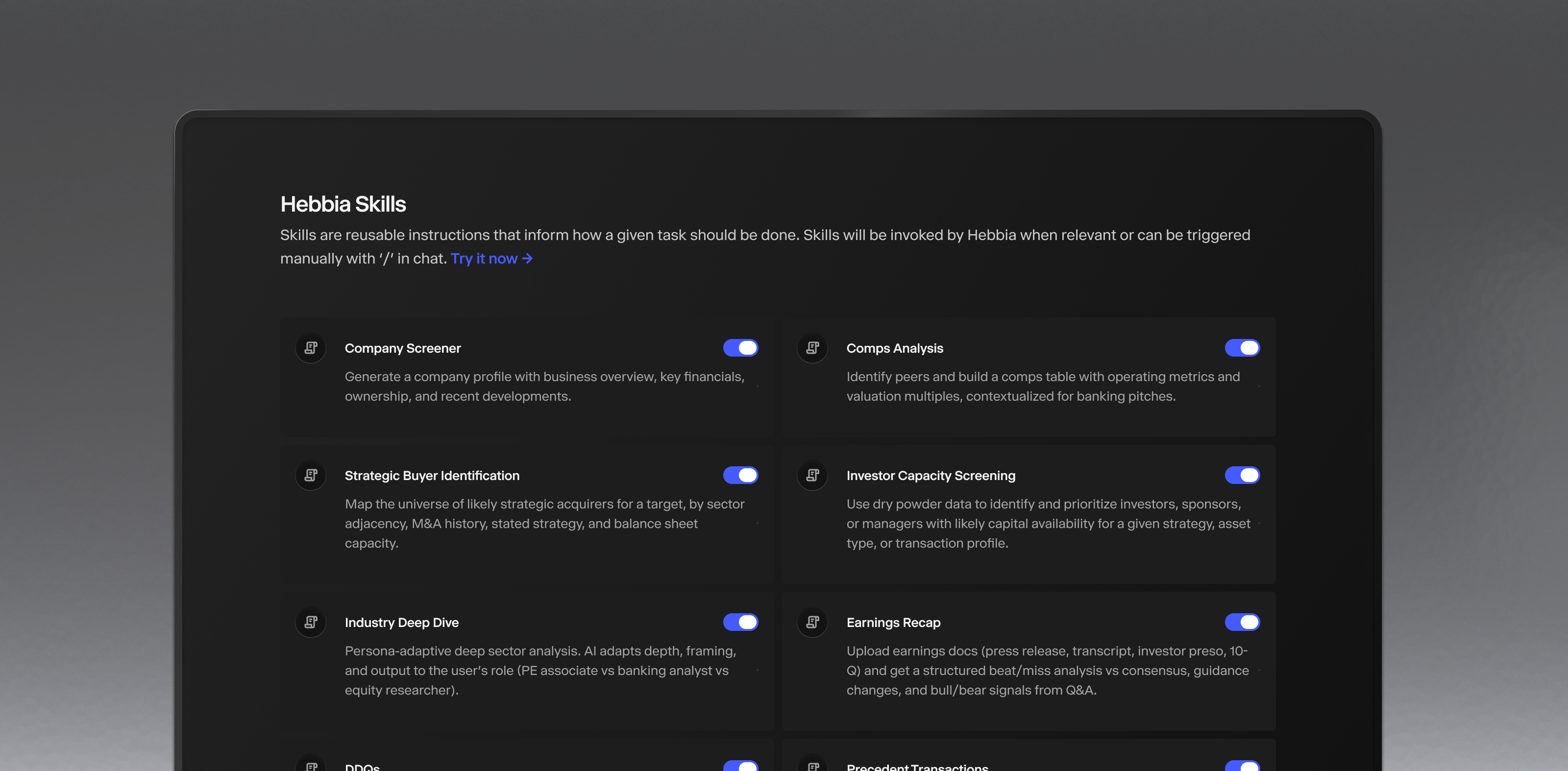
Once built, a Skill gets reused every time the LLM performs that task, approaching it the same way each time. Less back and forth. Less "that's not quite what I meant." Less stochasticity in the model's behavior.
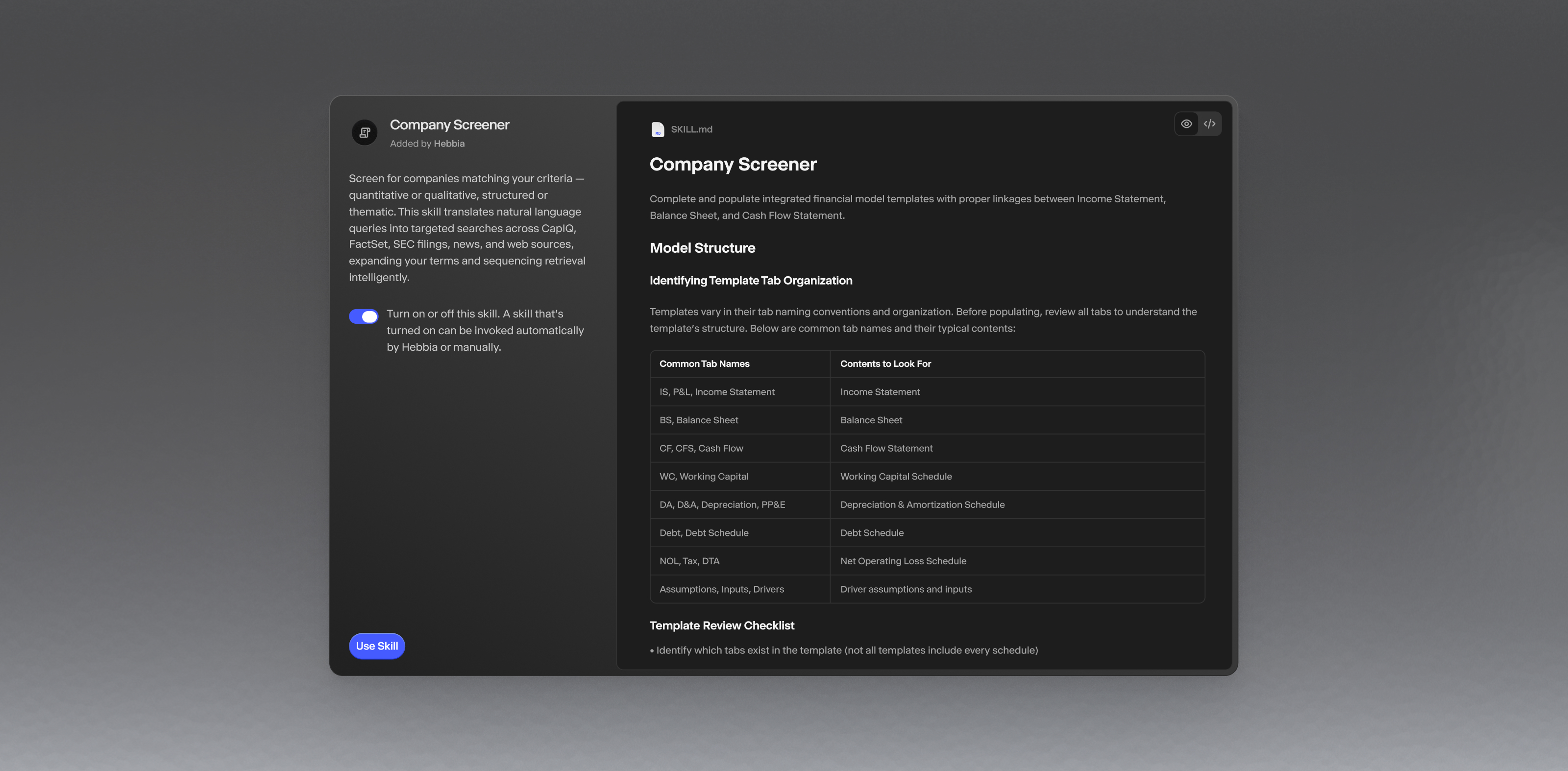
Under the hood, each Skill is a lightweight folder containing at least one markdown file (called SKILL.md) containing steps that tells the AI exactly how to perform a specific task. The folder can optionally include additional reference materials such as instructions on how to handle edge cases, exemplar output standards and formatting, or scenario-specific details.
Hebbia has integrations with a number of leading financial data providers, like PitchBook and Preqin for private market investors, and all of that data can be used in Skills.
Skills Built by Experts, Firms, and You
We designed Skills around a question: how does expertise actually move inside an organization? The answer, in almost every firm we’ve seen, is three ways: from the industry, from the firm, and from individuals. So we built three corresponding Skill types.
Hebbia Skills are written by our team, specifically by domain experts who came from the industries we serve. Former PE associates, credit analysts, investment bankers, and attorneys who now encode the methodologies they used to execute by hand into structured instructions that any Hebbia user can invoke.
The Precedent Transactions Hebbia Skill, for example, is built by someone who spent years running deal comps at Evercore and encodes decisions that aren’t inherent in current LLMs: which data fields matter, how to handle missing comps, when to normalize for deal structure. Hebbia’s Strategy Buyer Identification Skill brings the same depth to sourcing workflows for M&A Bankers and PE Investors across our user base.
We're launching Skills for investment banking, private markets, public markets, and law with the library expanding continuously based on what our customers identify as highest-impact use cases.
Organizational Skills are where AI gets specific to your institution.
Every firm has people who are exceptionally good at a given task. The associate who structures credit memos in a way that consistently clears IC. The partner who screens deals with a methodology the rest of the team tries to reverse-engineer from their output. Organizational Skills let those individuals encode their approach into a Skill that every team member can use and get the same quality of output when leveraging AI.
Organizational Skills are like putting the AI through your firm's training program: each Skill distills the team’s methodology, judgment calls, formatting guidelines, and historical context. When someone uses that Skill, the AI’s output comes out the way your best people do.
This Skill type comes with enterprise-grade governance: editing permissions, sharing controls, visibility settings. As more of our customers stand up central AI teams to manage Skills across the organization, these controls become essential. Governance here is about protecting the quality of what your best people built so it stays reliable as more of the firm adopts the Skill.
This is where AI adoption starts to reap benefits at institutional scale. When Skills have clear ownership, visibility controls, and permissioning baked in, firms can manage AI the way they manage any critical system, with accountability and a clear picture of what's deployed and why.
Personal Skills work the way you'd expect from consumer AI tools. You encode your own preferences, your own shortcuts, your own way of doing things into a Skill that the agent reuses. Want your weekly pipeline summary formatted a specific way? Want your research memos to always follow a particular structure? A Personal Skill makes the output consistent every time, without re-explaining your preferences in every conversation.
Why this Matters Now
Skills transform how firms operate by scaling their most valuable asset: their collective expertise. This goes beyond AI being simply for time-savings; it becomes about codifying and scaling your firm’s best judgment. When your team invokes a Skill, they aren’t just "using AI”, they are executing a proven approach built by your top experts. The result isn't just faster output; it's your highest institutional standard, applied consistently and with precision at scale.
Hebbia Skills are available now. Contact our team to get started.


