
Introducing Projects
Collaborative, secure environments to connect financial workflows, agents, documents, and deliverables.
AI has made individual analysts dramatically more productive – able to analyze hundreds of documents in the time it once took to review a handful. As the volume of AI-assisted work scales, so does the challenge of managing it. Without a system to organize and coordinate work, these individual productivity gains are only partially realized by the organization.
Financial work is collaborative by nature – analysts hand off to associates, deal teams share diligence findings, credit committees review what underwriters have surfaced. These multi-player workflows demand a persistent workspace – one where context accumulates, where a new team member can walk in and see what has been done, and where agents have context of all work to help build the knowledge base.
Hebbia Projects give teams a persistent, permissioned workspace where documents, analyses, and generated work can live together – visible to the right people, with context intact for both human collaborators and agents to act on.
Projects provide a single environment to manage financial work at the volume and velocity that AI enables. Rather than sharing a static VDR, individual files, or disparate chat threads, Projects offer a living knowledge base that grows as deal work progresses.
Manage Financial Workflows with Projects
AI should feel like one coherent and coordinated platform, not a collection of disconnected tools. Here’s how we’ve been approaching Projects within Hebbia:
Organize work with shared context, not just shared folders. Source material and downstream analysis live together. Projects hold uploaded documents, integrated file systems, published Chats and Matrices, and generated artifacts – all searchable in a single index.
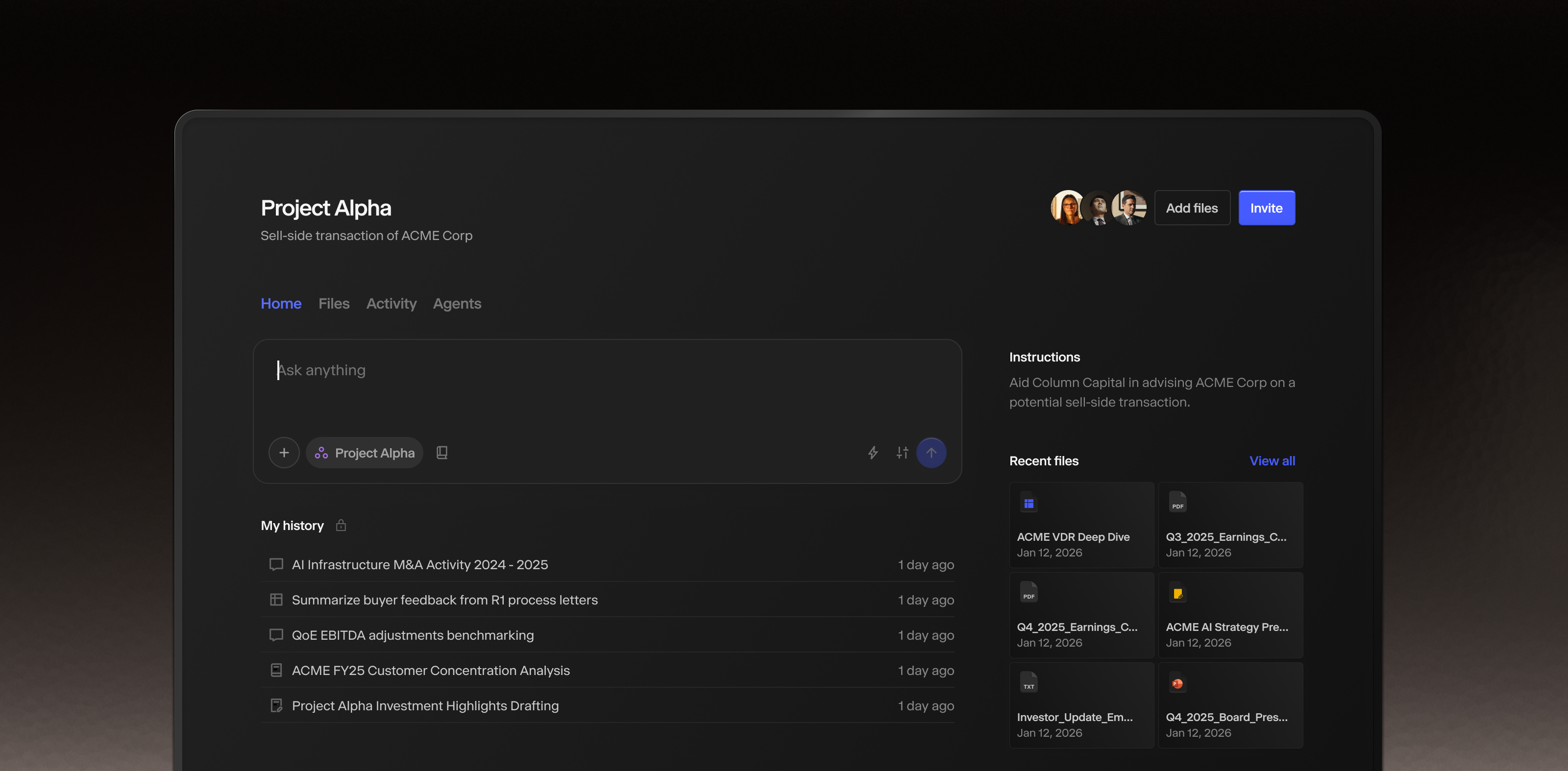
Govern projects with instructions. Define your Project’s scope, terminology, default integrations, and thesis into instructions that govern the rest of your workflow. Instructions inject context into every Chat automatically, so the analysis starts from the project’s baseline, not from a blank prompt.
Work in single-player and multi-player. Iterate and pressure-test analyses in your own workspace before sharing to a Project. Work moves from individual to team with granular control.
Build collaboratively on your team's work. Work within a Project is cumulative. Open a colleague's published Chat and continue the conversation. Build upon an existing Matrix and extend the analysis. Each analysis adds to the Project's knowledge base rather than disappearing into an individual's history.
Track what changed and when. A real-time activity feed captures everything published, uploaded, and changed across the Project. Anyone joining mid-deal starts with full context.
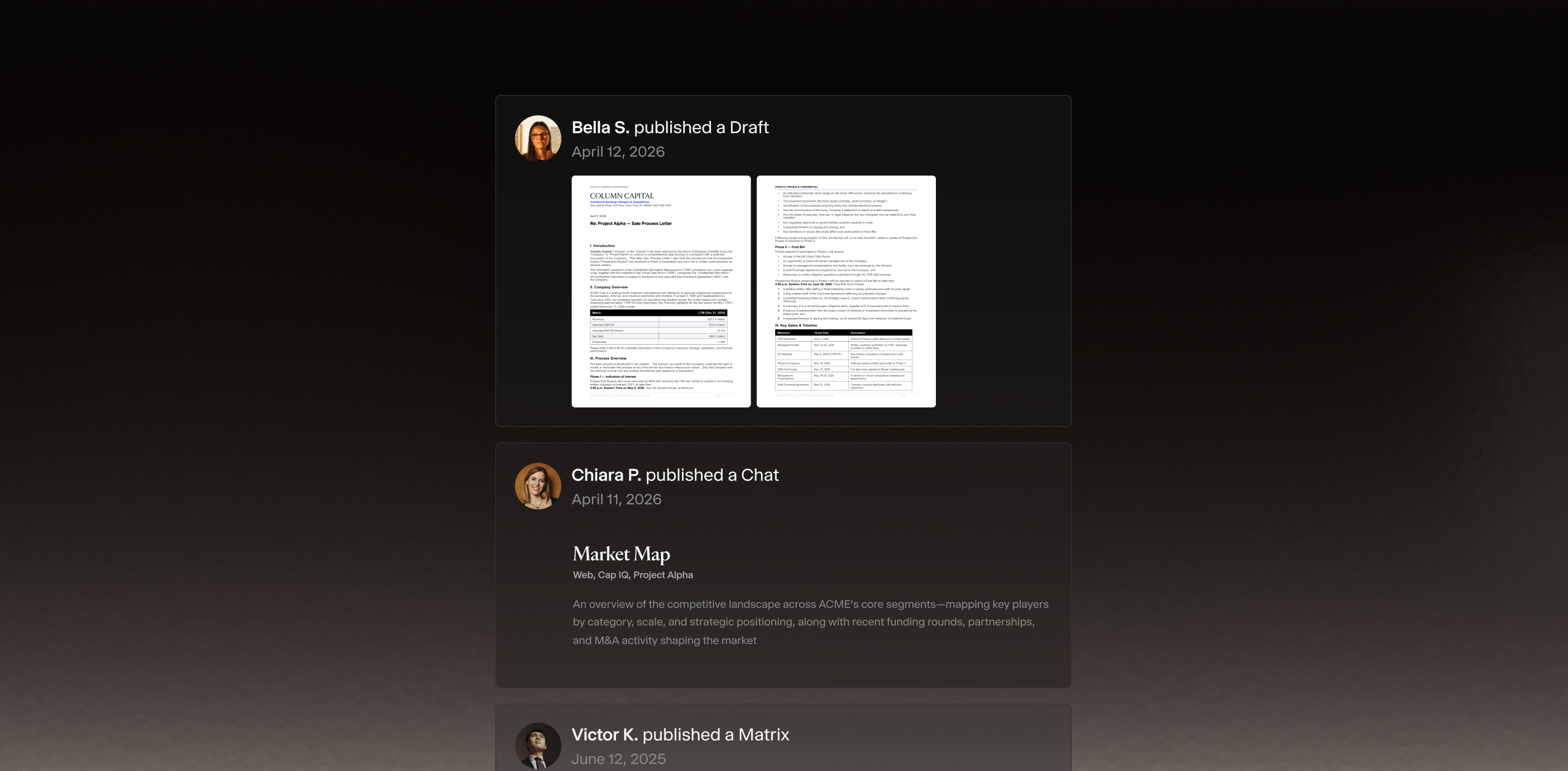
Deliver client-ready documents in your format. Generate PowerPoint presentations, memos, teasers, and committee-ready documents that draw the accumulated information in a Project and match your firm's templates.
Align permissions with how you work. Manage access and permissions at the Project level. Invite individuals or groups synced from your internal directory. Permissioned editors and viewers stay in sync without per-document sharing or multiple overlapping access controls.
Introducing Always-On Agents [Beta]
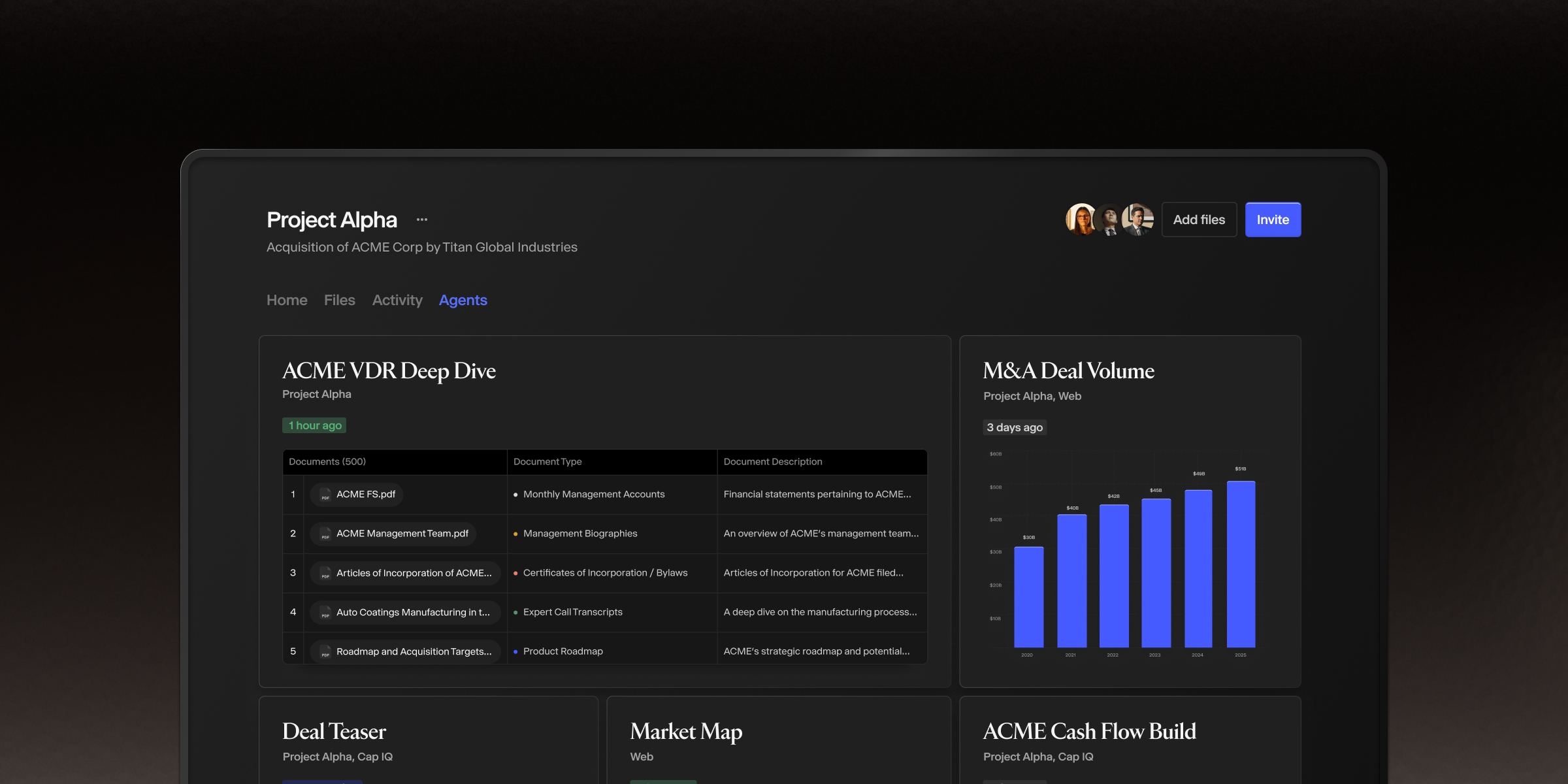
Within Projects, we’ve also introduced always-on background agents as a beta feature – unprompted workflows that run autonomously within the context of a Project. Agents watch the Project workspace for new documents, track public sources, monitor market signals, and update analysis based on new information. They’re designed to proactively do discovery, become experts on your project, and things you weren’t even looking for – all within a controlled environment.
The result is continuous, always-on intelligence grounded in the same documents and instructions the rest of the team uses. Background agents operate while the deal team focuses on higher-order work.
Projects for M&A diligence: Move faster from first screen to investment recommendation
In a typical diligence process, analytical work is scattered across individual workflows and reconstructed manually at each stage. Projects consolidate the full lifecycle into one workspace where each analysis feeds the next.
Set up a Project with VDR documents and deal-specific instructions covering the thesis, target criteria, and key diligence areas. Analysts work through exploratory questions in Chat and publish finished analyses to the Project when ready. Other team members open published work to validate specific findings and publish refined outputs without re-reading source documents or re-explaining deal context. Additional workstreams run in parallel within the same Project, each with visibility into what the others have surfaced.
As documents arrive, the Project's activity feed tracks what has been published, what changed, and what is new, giving any team member joining mid-deal full visibility from day one.
The result is a continuous analytical record that moves from initial screen through competitive benchmarking, peer analysis, and diligence synthesis to a data-backed IC memo. Each stage is informed by and traceable to the last, and the final deliverable draws from the full body of work the team has accumulated in the Project.
Projects for CIM creation: Faster, more defensible documents from accumulated analysis
Producing a CIM requires synthesizing management data, financial models, market research, and competitive positioning into a single polished document. Projects bring the full source set and every intermediate analysis into one workspace.
Upload management presentations, historical financials, and market data to a Project. Analysts publish extraction Matrices covering revenue segmentation, growth drivers, and key operating metrics. Other team members build on published work to draft competitive positioning and sector benchmarking. The final CIM is generated directly from the accumulated analysis in the Project.
Projects for credit underwriting: Consistent analysis from deal to deal
Credit teams cycle between evaluating new deals, structuring terms, and monitoring existing borrowers. Each stage generates analytical work that should carry forward to the next, connected through Hebbia Projects.
Use a single workspace to organize different workstreams, screening new opportunities against the firm's underwriting criteria, comparing terms across agreements, and flagging risks from diligence materials. Prior underwriting work and IC memos remain searchable in the Project, so the next deal in the same sector starts from accumulated institutional knowledge.
Building Institutional Intelligence with Projects
Projects reflect another way Hebbia delivers institutional intelligence for leading financial institutions. Projects aggregate context and introduce a coordination layer, permission boundary, and shared analytical record into finance-specific AI workflows. Every analysis the team runs makes the next one faster, and every new deal benefits from the compounding patterns the firm has already established.
Projects are also the foundation for what comes next. With a persistent, context-rich workspace as the primitive, Hebbia can surface recommended agents based on the documents already in a Project, auto-run workflows when new files match known document types, and extend guest permissions so external counsel, co-investors, or portfolio companies can participate.
Projects are available now. Contact our team to see how Hebbia can bring institutional intelligence to your firm.


