
Private Equity Portfolio Management: Strategies for Success
Portfolio management appears seamless in a quarterly review, yet the reality involves tracking dozens of companies with unique covenants, shifting board dynamics, and constant last-minute requests. While core profitability and cash flow metrics sit in spreadsheets, the vital context explaining those figures remains buried in Quality of Earnings reports, credit agreements, and fragmented email threads.
Without a unified view, the process often becomes a stream of scattered updates rather than a focused plan for the next strategic move.
Top-tier firms are closing this gap by using artificial intelligence to transform unstructured data into a competitive advantage. This guide breaks down how these integrated workflows drive sharper investment committee discussions, fewer surprises, and smoother exits.
What Is Portfolio Management in Private Equity?
Private Equity (PE) portfolio management is the essential, hands-on process of driving radical value growth across acquired companies. PE firms commit to transformational change by setting the strategy, fixing operations, optimizing finance, and upgrading talent to ensure superior returns for investors.
Successful PE execution is achieved through these key value drivers:
- Calculated oversight: Setting the clear, data-backed vision and value creation thesis for the company
- Operational improvements: Implementing specific changes to increase margins, optimize pricing, and streamline execution
- Financial restructuring: Optimizing the balance sheet and managing cash flow to protect capital and enable growth
- Talent management: Ensuring the right leaders are in place to execute the ambitious growth plan
- Ongoing monitoring: Continuously tracking performance metrics to deliver instant, verifiable insights into risks and opportunities
- Exit strategy: Planning the sale or IPO from day one, constantly refining the narrative to maximize the final price
The best firms are replacing manual data bottlenecks with purpose-built, intelligent tools. AI-powered platforms automate the extraction of trustworthy insights from complex documents, turning VDR chaos into structured intelligence. This allows general partners, operating partners, and CFOs to execute better deals and focus entirely on high-impact action and value creation.
Want to know how the top teams are scaling their output? Learn more about the five ways leading equity research teams use Hebbia to find the signal before the market does.
What Goes Into Managing a Strong Portfolio?
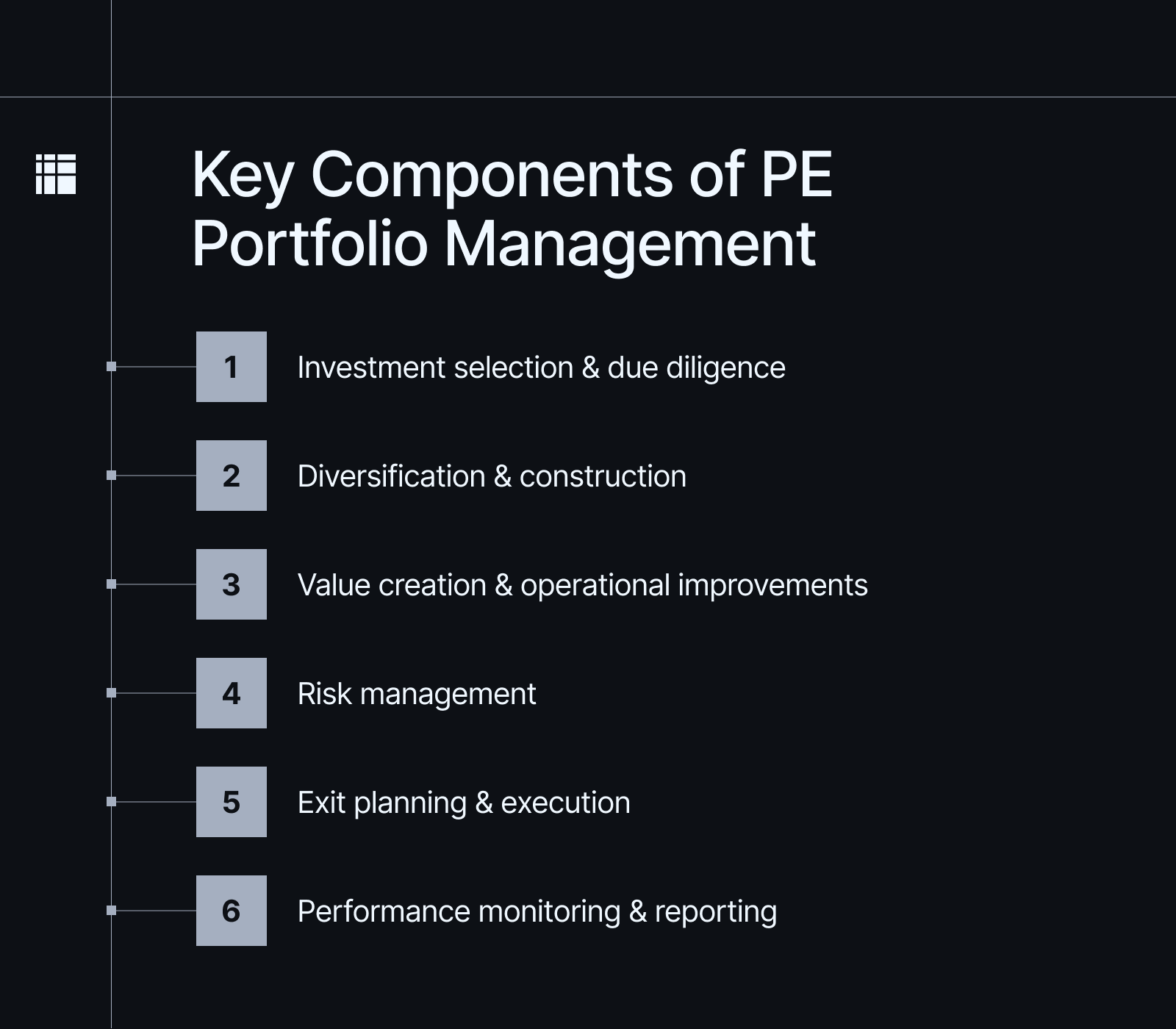
The best firms treat portfolio monitoring as a core operational competency, transforming what were once isolated tasks into continuous, integrated efforts across the entire investment lifecycle.
Effective portfolio management is an active and relentlessly optimized process that establishes a clear roadmap for each asset, drives operational excellence, ensures financial stability, and cultivates the right leadership.
Investment Selection and Due Diligence
Because due diligence directly impacts future outcomes, top firms treat initial investment selection as the most pivotal stage of the portfolio lifecycle.
If the firm identifies a clear strategy, realistic value plans, and documented risks upfront, the company is much easier to manage later on. This means creating and saving essential documentation, such as detailed investment committee (IC) memos and quality of earnings (QoE) reports, that you can quickly reference throughout the entire ownership period.
By leveraging AI platforms that process private documents at scale, associates can build compelling, accurate IC memos that win investment committee confidence—transforming weeks of work into days.
Diversification and Portfolio Construction
Portfolio construction involves deciding how many investments to hold, how concentrated they should be, and the right mix of asset types. Firms actively manage diversification by:
- Setting concentration limits to prevent overexposure to any single investment
- Aligning exposure with the fund’s specific mandate, whether through broad global diversification or a specialized focus on targeted industry sectors and regional geographies.
- Executing a dedicated investment strategy, such as growth capital, buyouts, or distressed debt. While some firms manage multiple strategies, these are typically offered through separate, specialized funds to maintain the distinct risk-return profile expected by investors.
These construction choices are vital because they directly determine the portfolio's overall risk exposure and financial flexibility. A well-constructed portfolio provides the necessary balance to mitigate individual failures. It ensures the fund maintains enough reserved capital and flexibility to either double down on successful companies or stabilize assets when challenges arise.
Value Creation and Operational Improvements
Value creation is a series of repeatable disciplines that, when refined over time, serve as the primary engine for continuous operational improvement. This includes everything from refining pricing models and optimizing supply chains to upgrading core business processes and improving go-to-market execution.
To effectively execute value creation, managers rely on a specific toolkit, which includes:
- Operating partners: Experienced industry executives brought in to work directly with management teams to identify and execute operational improvements, focusing on areas like supply chain optimization, cost reduction, and sales efficiency.
- Specialized consultants: External experts (e.g., in pricing, market strategy, or digital transformation) engaged for targeted projects to solve specific, complex challenges quickly and impart specialized knowledge to the portfolio company.
- Sophisticated software platforms: Technology solutions—including governance, risk, and compliance (GRC) tools, financial modeling suites, and AI-powered document intelligence—used to standardize reporting, track key performance indicators (KPIs) in real-time, and automate data aggregation for faster, more reliable decision-making.
These tools automate performance monitoring and provide granular KPI data. By shifting from manual tracking to intelligent automation, the efficiency gains are massive—63% of professionals save more than six hours per week using AI, and 27% save over 10 hours weekly on research tasks.
Risk Management
Structured risk management is essential for protecting portfolio value. These disciplines move the firm from reactive damage control to proactive stability.
Effective risk management relies on several systematic practices, including:
- Scenario analysis: Teams model various market or company scenarios (e.g., inflation spikes, supply chain disruptions) to assess their impact on revenue, cash flow, and debt covenants, and then proactively plan mitigation responses.
- Diversification strategy: Spreading exposure across different sectors, geographies, and business models reduces the impact of a severe shock in any single area of the market.
- Periodic reviews and audits: Scheduled operational and compliance reviews, along with regular data audits, are used to validate the accuracy of reporting and identify emerging risks before they can escalate into major problems. AI is increasingly used here to continuously monitor portfolios against every credit agreement term, flagging risks and covenant breaches before they impact returns.
By rigorously applying these controls, PE firms transform potential threats into manageable variables, securing the long-term success of the fund.
Exit Planning and Execution
The best PE firms treat exit planning as an intentional discipline that begins the moment the investment is closed. They continuously refine the equity story (the compelling narrative of how and why the company's value has grown) over the entire holding period to ensure the asset is always viewed as a premium target, maximizing buyer interest and final price.
Successful exit execution requires calculated decision-making on the right path to market, whether that be a sale to a strategic buyer, a secondary sale to another PE firm, or an initial public offering (IPO).
This process relies heavily on data quality, clean reporting, and documented wins throughout the firm's ownership. A clean, verifiable financial and operational history removes buyer uncertainty, shortens the due diligence process, and delivers a smoother, more profitable transaction.
Don't let poor data quality compromise your next exit. Discover how Hebbia's deeper research agent processes documents while maintaining perfect citations, ensuring your financial and operational history is clean, verifiable, and ready for due diligence.
Performance Monitoring and Reporting
Consistent, high-quality performance reporting keeps each portfolio company fully aligned with fund goals and empowers teams to spot both underperformance and upside opportunities early. This pillar turns data into actionable intelligence, enabling the firm to make fast course corrections to maintain momentum toward its value creation targets.
Effective monitoring relies on documented workflows and advanced data tools:
- Portfolio dashboards: Real-time dashboards provide a single, unified view of key metrics across all companies, enabling teams to quickly identify critical trends or performance variances.
- Recurring reporting cadence: Monthly or quarterly reporting packs summarize financials, operational performance, and progress on key initiatives, ensuring that sponsors, management teams, and lenders remain aligned on progress.
- Peer benchmarking: Comparing a company's results against sector benchmarks or similar portfolio companies helps gauge its competitiveness and highlight precisely where performance lags or excels.
Benefits of Effective Private Equity Portfolio Management
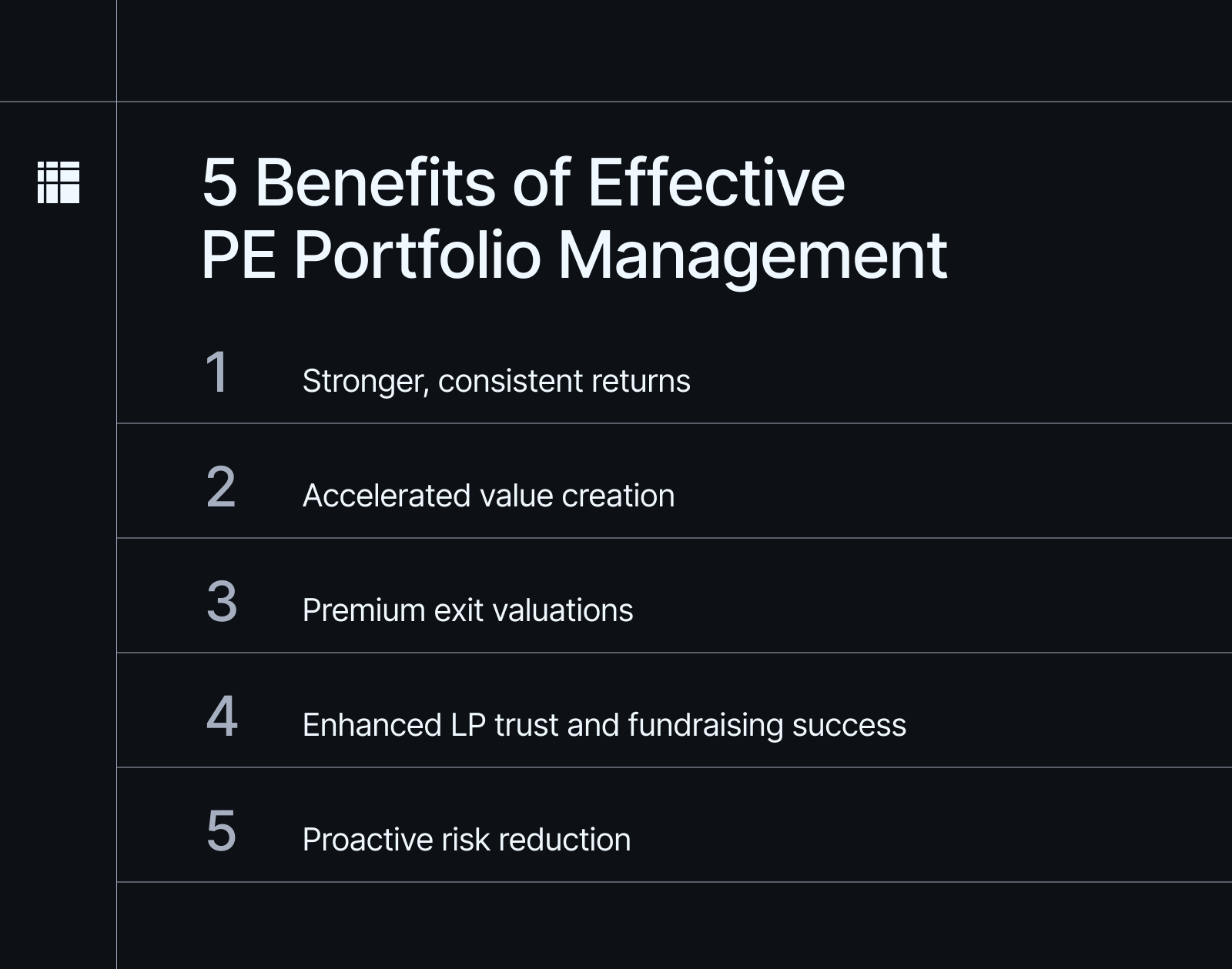
Portfolio management generates value at every stage of the holding period, resulting in enhanced cash flow margins, reduced operational friction, and a more compelling equity story at the point of exit. These benefits are the direct result of proactive engagement and data-driven strategies:
- Stronger, more consistent returns: Combining disciplined value creation, active risk management, and well-timed exits lifts the Internal Rate of Return (IRR) and Multiple on Invested Capital (MOIC) across the fund, making performance more repeatable.
- Accelerated value creation: The ability to track concrete operational levers (like pricing, margins, and sales efficiency) allows firms to rapidly identify what works, build scalable playbooks, and roll out high-impact initiatives across the portfolio.
- Premium exit valuations: Organized data, clear performance tracking, and consistent documentation streamline due diligence and boost buyer confidence. This translates into stronger valuations and smoother sales.
- Proactive risk reduction: Continuous monitoring and structured risk reviews allow teams to anticipate threats, significantly reducing covenant breaches, minimizing customer losses, and eliminating negative surprises across the portfolio.
- Enhanced LP trust and fundraise success: Consistent, transparent KPI tracking provides investment teams with a clear, objective view of portfolio health. This accountability leads to better-targeted decisions and builds essential trust with limited partners (LPs) for successful future fundraises.
Best Practices for Portfolio Management
Top private equity firms rely on a combination of structured governance, disciplined risk oversight, and modern technology to create a unified operating model. This powerful blend allows them to make portfolio management consistent, repeatable, and scalable.
- Governance and accountability: Clear roles, disciplined review cycles, and strong documentation support effective decision-making, ensure regulatory compliance, and support audit readiness across the portfolio.
- Integrated risk management: Teams embed systematic risk reviews into regular portfolio updates, actively track leading risk indicators, and maintain unified visibility into both company-specific and fund-level exposures.
- Technology and analytics adoption: Specialized AI and document intelligence platforms, such as Hebbia, are becoming essential for consolidating tools and linking core source systems to dramatically improve the speed, accuracy, and deep context insight generation required for top-tier portfolio analysis.
Common Portfolio Management Challenges
While the goal is consistency and scale, leading private equity firms constantly grapple with three core challenges: risk visibility, manual data processes, and poor technology adoption and integration. These hurdles prevent a unified view of the portfolio and slow down value creation efforts.
- Risk visibility: Inconsistent information and lagging metrics make it impossible to track fund-wide risk. Better reporting standards and the use of forward-looking, early warning KPIs are necessary to improve visibility.
- Manual data processes: Scattered data inputs and manual compilation dramatically slow down analysis, which can negatively impact reporting quality. Standard templates, clear ownership, and automation are critical to fixing data flow. This is where AI orchestration steps in, eliminating tedious work without sacrificing accuracy.
- Technology adoption and integration: Tool sprawl and poor adoption limit impact and waste resources. Firms should connect their core data systems and start with targeted AI tools, such as document intelligence, to get fast and clear results with zero-effort adoption.
How Hebbia Expedites Portfolio Management
Effective private equity portfolio management constantly demands instant access to crucial information buried in documents like credit agreements, QoE reports, and IC memos. However, sifting through all that unstructured data across different systems slows down value creation and increases risk.
Hebbia's proprietary AI rapidly screens, benchmarks, and automates analysis across vast document sets. It quickly answers complex questions, such as summarizing all risks or identifying all debt covenants across a portfolio, and returns structured, verifiable results with inline citations. This is the fastest way to get deep context insights and transition directly from document review to market-beating returns.
Book a demo to see Hebbia in action on your own portfolio documents and questions.


