
The 9 Best Deal Sourcing Software Tools for PE, IB & M&A Teams
Most deal teams can find targets. The harder problem is evaluating them fast enough to act. Traditional due diligence workflows, spread across databases, documents, and disconnected systems, consistently slow that process down.
The right deal sourcing software can change that—but not every platform works the same way. Some are built to help you find targets. Others manage your pipeline, map your network, or analyze the documents behind a deal. The best stack for your team depends on where the bottleneck actually is.
This list covers 9 of the best deal sourcing platforms across the four categories that drive institutional deal flow: customer relationship management systems (CRMs), private company databases, AI research layers, and deal networks. Use it to find the right fit for where your team needs the edge.
Top Deal Sourcing Software at a Glance
The tools below cover the full sourcing stack, from target discovery to document analysis, so you can find the right fit for where your team's deal sourcing workflow actually breaks down.
Platform | Type | Best for | Key features |
|---|---|---|---|
Hebbia | AI research layer | Analyzing deal documents and building institutional research intelligence at scale | - Iterative Source Decomposition (ISD) for full-context document analysis - Natural language queries across thousands of documents in a single workflow - Firm-wide institutional memory indexed across queries and outputs - Clickable in-line citations traceable to exact source sentences |
Grata | Private company database | Finding and screening private company acquisition targets | - AI-powered search across millions of private company profiles - Live deal tracking and pipeline management - Buyer list building and conference prospecting |
Affinity | Relationship intelligence CRM | Surfacing warm introductions and tracking relationship history | - Automatic relationship capture from email and calendar - Network mapping to surface warm intro paths across the firm - AI relationship scoring and deal recommendations |
DealCloud (Intapp) | Relationship intelligence CRM | Managing deal pipelines with integrated relationship tracking | - AI-powered deal origination with relationship intelligence - Centralized deal pipeline with customizable workflows - Intapp compliance and conflicts integration |
PitchBook | Private company database | Pulling private market data, deal comparables, and fund intelligence | - Advanced company screening by size, industry, stage, ownership, and location - Comparable transaction analysis and financial spreading - Excel add-in for direct data push into financial models |
Inven | AI research layer | AI-native global target discovery | - AI-powered discovery across 28M+ global private companies - Agentic workflows for multi-step M&A research - Market and competitor analysis |
4Degrees | Relationship intelligence CRM | Auto-capturing relationship history and mapping deal networks | - Automatic relationship capture from email and calendar - Network mapping and warm intro identification - Deal pipeline and portfolio company tracking |
Axial | Deal network | Accessing proprietary middle market deal flow | - Curated deal matching based on buy-side acquisition criteria - Access to 3,500+ M&A advisors and their deal mandates - Built-in pipeline CRM for buy-side deal tracking |
Cyndx | AI research layer | Using machine learning (ML) to identify acquisition targets | - ML-powered acquisition target identification - Capital raise matching connecting acquirers with sellers - M&A market comps and deal universe mapping |
1. Hebbia

Type: AI research layer
Best for: Analyzing deal documents and building institutional research intelligence at scale
Hebbia leads this list because no other platform on it handles what comes after you find a target. Reading hundreds of pages of confidential information memorandums (CIMs), virtual data room (VDR) contents, credit agreements, and prior deal documents to build a defensible investment view still falls on your team with most deal sourcing software. Hebbia processes those documents simultaneously and at scale, preserving context across long files, with every output linked to its source.
For deal teams, Hebbia allows analysts' time to be spent on judgment rather than assembly. It can run natural language queries across an entire VDR, extract covenant terms from credit agreements, and surface comparable deal structures from prior work—all with sentence-level citations the investment committee can audit.
Key features:
- Iterative Source Decomposition (ISD) for full-context document analysis: Hebbia's ISD processes each document in full rather than breaking it into chunks, preserving context when a detail in one section of a filing affects the interpretation of another.
- Natural language queries across thousands of documents in a single workflow: Users can query an entire document set in a single workflow using plain language. Hebbia handles the scale so analysts aren't toggling between systems or manually cross-referencing sources.
- Firm-wide institutional memory indexed across queries and outputs: Every query and output is indexed into a shared knowledge base, making prior deal work, diligence findings, and research outputs searchable across the firm rather than siloed in individual drives.
- Clickable in-line citations traceable to exact source sentences: Every output links to the exact sentence, cell, or clause it came from, so analysts can verify information before anything goes into a deliverable, and the committee can trace every output back to its source.
2. Grata
Type: Private company database
Best for: Finding and screening private company acquisition targets
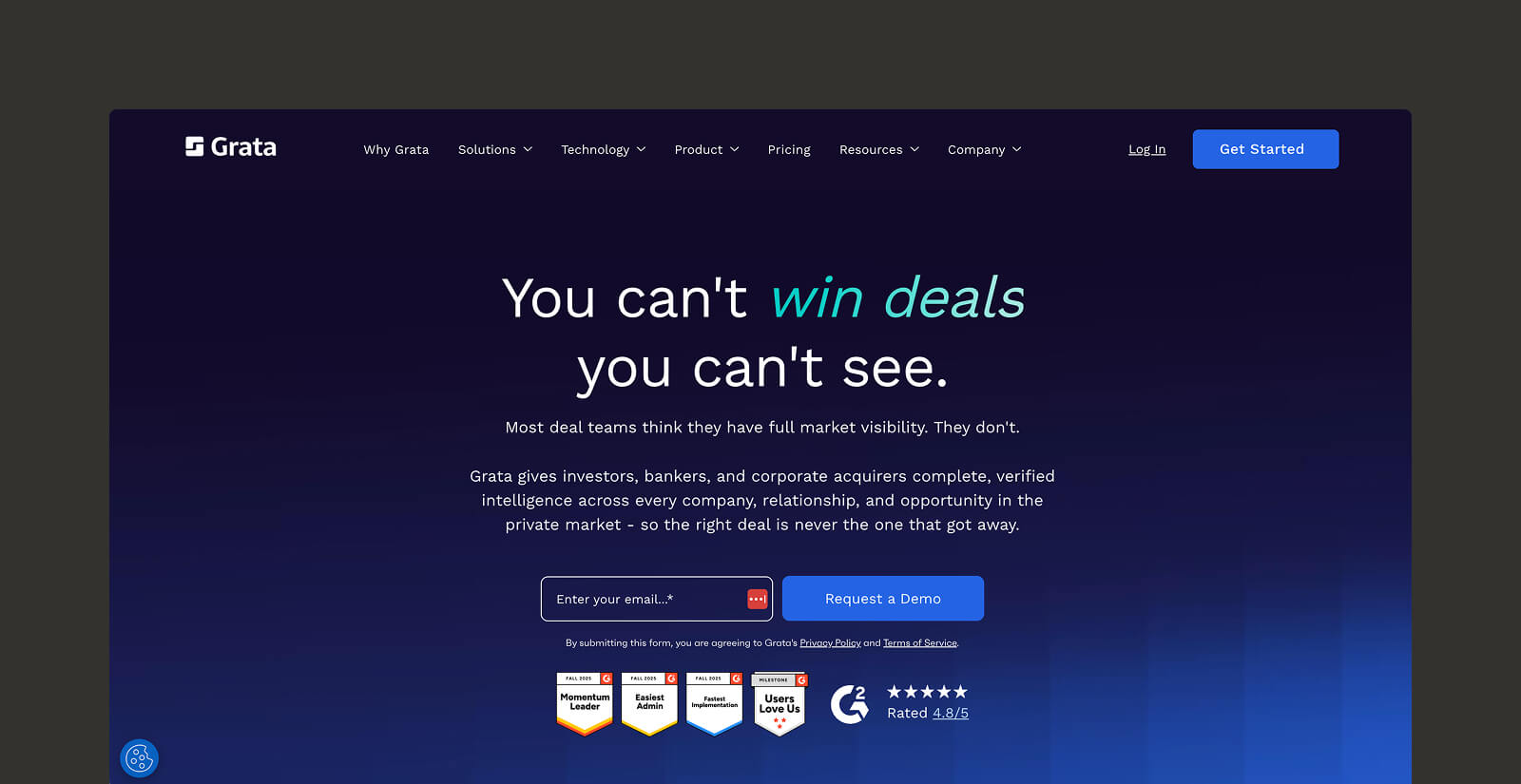
Grata is built for target identification in the private markets, specifically the lower- and middle-market, where companies don't show up in traditional databases. Its AI-powered search tool scans company websites to surface businesses by business model, ownership structure, industry, and growth signals—a strong starting point for building target lists and mapping markets.
The platform covers the full pre-outreach workflow: pipeline tracking, buyer list building, and conference prospecting, with customer relationship management (CRM) integrations for Salesforce, DealCloud, and HubSpot. However, because it’s not built to read the CIMs and VDR materials behind a deal, Grata is more limited in document analysis.
Teams that need both tend to pair it with a dedicated document intelligence layer, but for pure sourcing and origination, it covers a lot of ground in one place.
Key features:
- AI-powered search across millions of private company profiles: Grata's agentic search interprets intent rather than matching keywords, surfacing relevant companies based on business model, industry, revenue, ownership, and growth signals.
- Live deal tracking and pipeline management: Teams can track targets through the sourcing funnel, add notes and labels, and monitor deal status—with sell-side advisor deal flow surfaced directly through the Grata Deal Network.
- Buyer list building and conference prospecting: Grata generates buyer lists for M&A mandates and lets teams identify and prioritize attendees at relevant industry events before they arrive.
3. Affinity
Type: Relationship intelligence CRM
Best for: Surfacing warm introductions and tracking relationship history
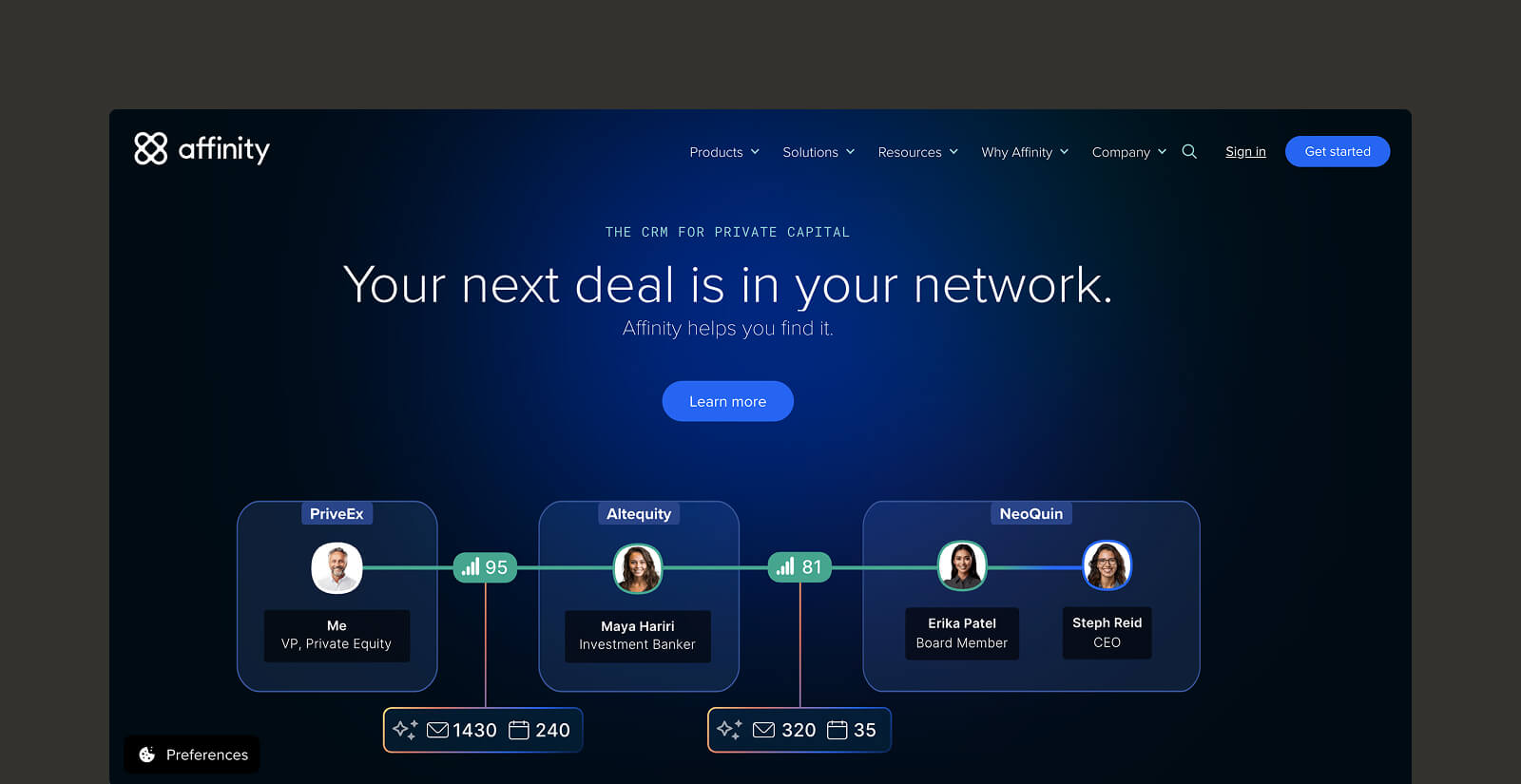
Affinity is designed around the premise that the strongest deal flow comes from relationships, not cold outreach. It automatically captures emails, meetings, and interactions across the firm, building a running relationship history without manual data entry. Connection paths to target companies are surfaced based on actual interaction strength, not just shared contacts.
Where Affinity is more limited is on the company data side. It's a relationship layer, not a private company database, so teams still need a tool like Grata or PitchBook for target discovery and market mapping.
For firms where warm introductions and relationship coordination are the primary sourcing constraint, though, it's one of the more purpose-built tools on this list.
Key features:
- Automatic relationship capture from email and calendar: Affinity logs every interaction across the firm automatically, eliminating manual CRM entry and ensuring no touchpoint falls through the cracks.
- Network mapping to surface warm intro paths: The platform maps connection strength across the entire firm's collective network, identifying the highest-quality introduction path to any target based on actual communication history.
- AI relationship scoring and deal recommendations: Affinity scores relationships and surfaces recommended deals based on fit and relationship strength, helping teams prioritize outreach before opportunities move.
4. DealCloud (Intapp)
Type: Relationship intelligence CRM
Best for: Managing deal pipelines with integrated relationship tracking
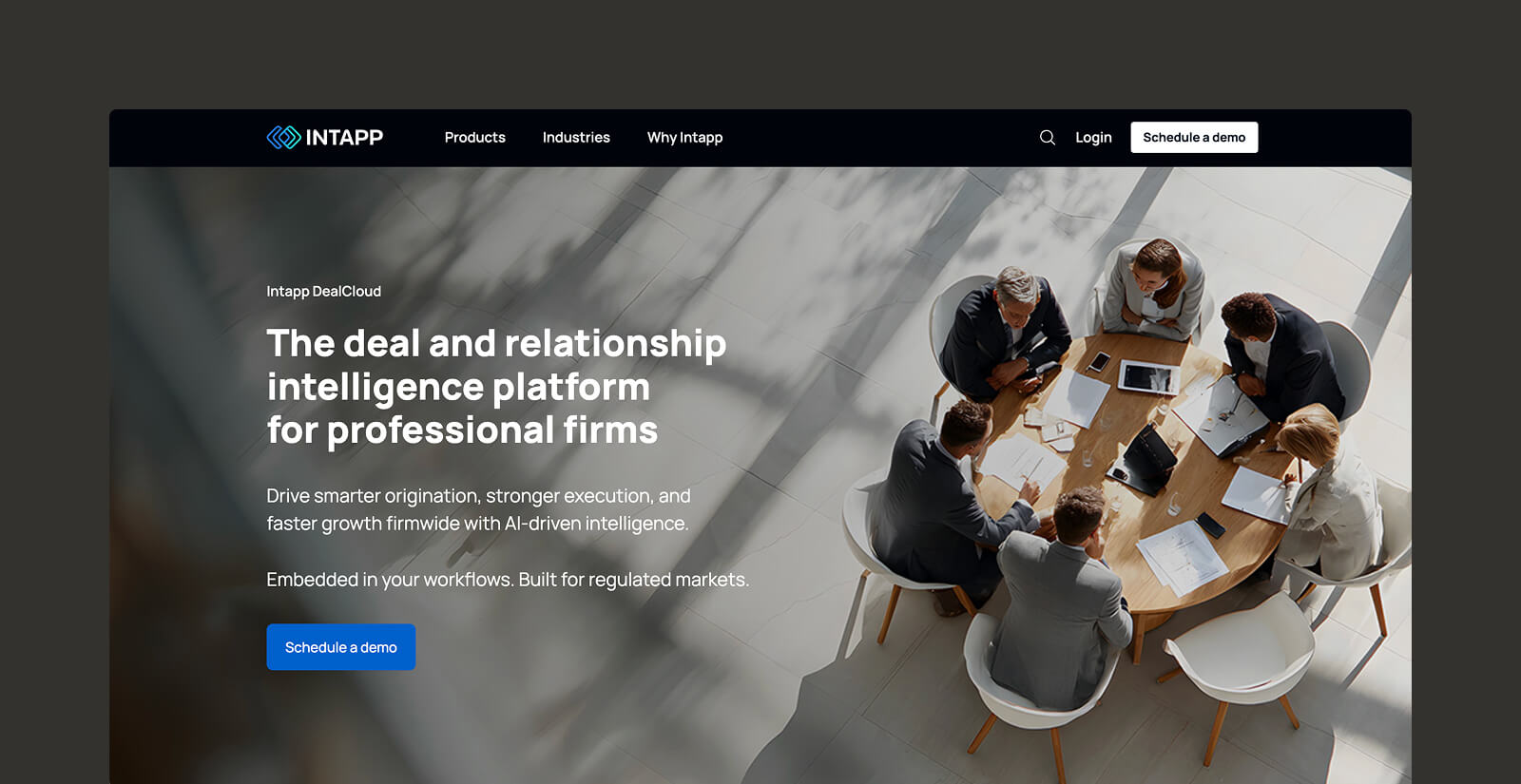
DealCloud leans more toward pipeline structure and deal execution than relationship capture. That makes it a common choice for larger IB and PE teams that need configurable workflow management across multiple deal stages. Its integration with Intapp's compliance and conflicts tools is a real differentiator for firms where governance requirements are non-negotiable.
The tradeoff is complexity. DealCloud is a more enterprise-grade implementation than most CRMs on this list, and getting it configured to a firm's specific workflows typically requires meaningful setup time.
For firms that need the depth of customization and compliance infrastructure, it's well-suited. However, the overhead may outweigh the benefits for smaller teams looking for faster deployment.
Key features:
- AI-powered deal origination with relationship intelligence: DealCloud surfaces deal opportunities and flags relevant relationships across the firm based on prior interactions and deal history, helping teams identify warm paths to targets earlier in the process.
- Centralized deal pipeline with customizable workflows: Teams can configure pipeline stages, deal tracking fields, and approval workflows to match how the firm actually operates, with visibility across the full deal lifecycle.
- Intapp compliance and conflicts integration: DealCloud connects directly to Intapp's compliance and conflicts management tools. Firms get a single system for tracking deal activity and satisfying regulatory and internal governance requirements.
5. PitchBook
Type: Private company database
Best for: Pulling private market data, deal comparables, and fund intelligence
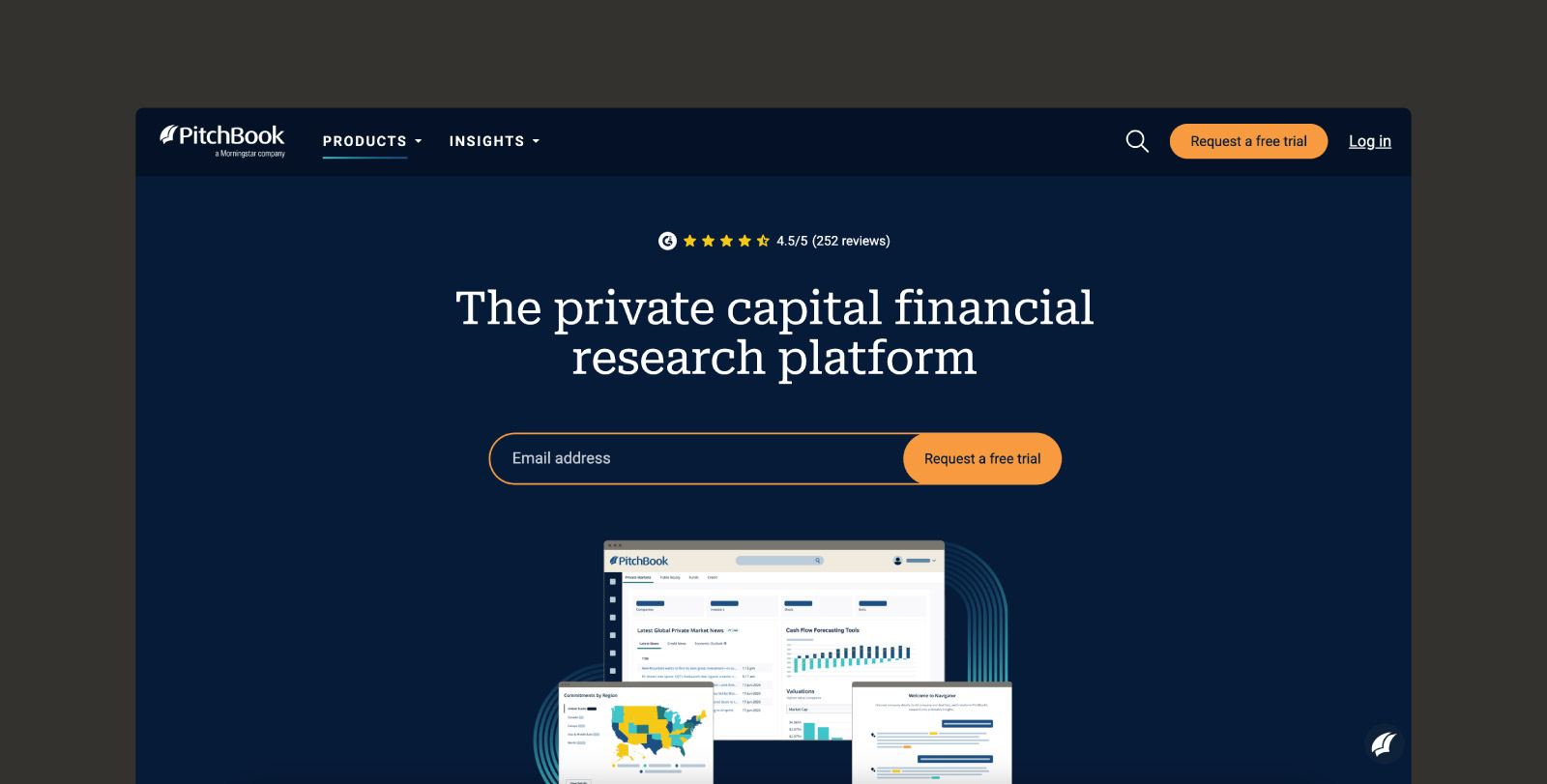
For most institutional finance teams, PitchBook is the default starting point for market data. Its coverage includes deals, companies, funds, investors, and LP activity across PE, VC, credit, and public markets. Its deal database spans more than 2.8 million transactions, making it one of the deepest sources of private market intelligence.
The main limitation is coverage depth in the lower-middle market, where private companies are less likely to provide meaningful financial detail—Grata tends to have a stronger signal there.
PitchBook's strength is breadth: For teams that need reliable comps, investor intelligence, and fund benchmarks across asset classes, it covers more ground in one place than most alternatives.
Key features:
- Advanced company screening by size, industry, stage, ownership, and location: PitchBook's screeners let teams filter across a large universe of private and public companies, with saved searches and custom alerts for ongoing deal monitoring.
- Comparable transaction analysis and financial spreading: Teams can pull precedent deal data, filter by sector and deal structure, and benchmark valuations against historical transactions across PE, VC, and M&A.
- Excel add-in for direct data push into financial models: PitchBook data pulls directly into Excel, letting analysts build and update models without toggling between platforms or copying data manually.
6. Inven

Type: AI research layer
Best for: AI-native global target discovery
Inven is an AI-native deal sourcing platform built for target discovery and market mapping at a global scale. Founded by former McKinsey and BCG analysts, it indexes over 28 million private companies across 160+ markets.
The platform specializes in surfacing off-market targets that don't appear in traditional databases, with coverage spanning all major sectors and geographies.
Teams use Inven to build target lists at scale, automate repeatable financial research workflows, and generate company materials like strip profiles and market maps directly from the platform.
Inven is more limited on the document intelligence side. Once a target is in the pipeline and the real diligence work begins, teams typically need a dedicated platform to read and synthesize the underlying deal documents.
For the sourcing and origination phase, though, it covers significant ground across global markets.
Key features:
- AI-powered discovery across 28M+ global private companies: Inven indexes private companies across 160+ markets, including off-market businesses that don't surface in traditional databases, with coverage spanning all major sectors and geographies.
- Agentic workflows for multi-step M&A research: Teams can automate repeatable research tasks, like target list building, market mapping, and buyer identification, and let Inven run them end-to-end rather than manually re-running the same queries.
- Market and competitor analysis: Inven maps full competitive landscapes, identifies adjacencies, and sizes market segments, producing structured outputs teams can take directly into client conversations or IC prep.
7. 4Degrees
Type: Relationship intelligence CRM
Best for: Auto-capturing relationship history and mapping deal networks
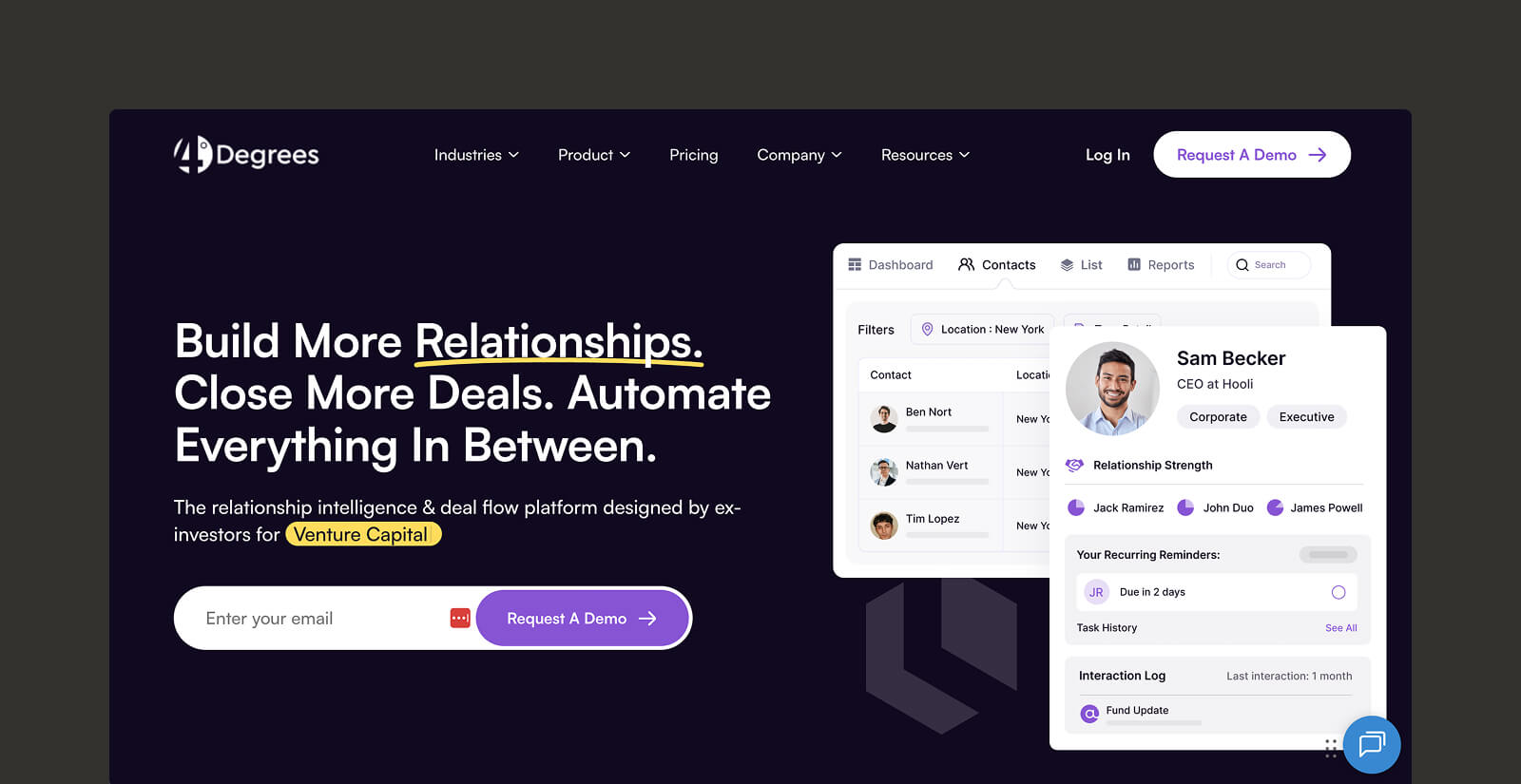
Designed by ex-investors, 4Degrees takes a similar approach to Affinity but with a stronger emphasis on PE and VC workflows out of the box. It automatically syncs email, calendar, and third-party sources to populate deal and contact records, and surfaces warm intro paths across the firm's network based on actual interaction history rather than just shared connections.
Deal pipeline and portfolio tracking are built into the same platform, making it a practical single tool for smaller teams. Firms that need deeper compliance infrastructure or more configurable enterprise workflows may find it less suited to those requirements than platforms like DealCloud.
But for teams where relationship management is the primary bottleneck in sourcing, it covers the core workflow well.
Key features:
- Automatic relationship capture from email and calendar: 4Degrees syncs interactions across email, calendar, LinkedIn, and third-party data sources to keep contact and deal records current without manual entry.
- Network mapping and warm intro identification: Relationship strength scoring identifies the highest-quality introduction path to any target or investor across the firm's full network, based on actual communication frequency and recency.
- Deal pipeline and portfolio company tracking: Teams can track deals from sourcing through close and monitor portfolio company activity in the same platform, with reporting across business development, sourcing, and portfolio KPIs (key performance indicators).
8. Axial
Type: Deal network
Best for: Accessing proprietary middle market deal flow
Axial operates differently from every other platform on this list. Rather than helping you find and research targets, it delivers deal flow directly to you. Buy-side members define their acquisition criteria once, and sell-side advisors send matching opportunities as they come to market, privately and confidentially, from a network of 3,500+ boutique M&A firms.
The platform is built specifically for North American lower-middle-market transactions ($2.5M–$250M in revenue), so it's less useful for teams sourcing larger deals or international markets.
For firms where that segment is a strategic priority, it surfaces opportunities that wouldn't reach a firm's network through traditional outreach. Once a deal lands, a document intelligence layer like Hebbia handles the CIMs and due diligence materials behind it.
Key features:
- Curated deal matching based on buy-side acquisition criteria: Members define their deal criteria—geography, size, sector, transaction type—and receive matched opportunities from sell-side advisors as they come to market, without public listings or manual searching.
- Access to 3,500+ M&A advisors and their deal mandates: Axial connects buy-side members with boutique advisory firms representing lower-middle-market companies, covering deal flow that rarely reaches larger databases or networks.
- Built-in pipeline CRM for buy-side deal tracking: Teams can manage deal status, execute NDAs, share documents, and coordinate internally on active opportunities directly within the platform.
9. Cyndx
Type: AI research layer
Best for: Using machine learning (ML) to identify acquisition targets
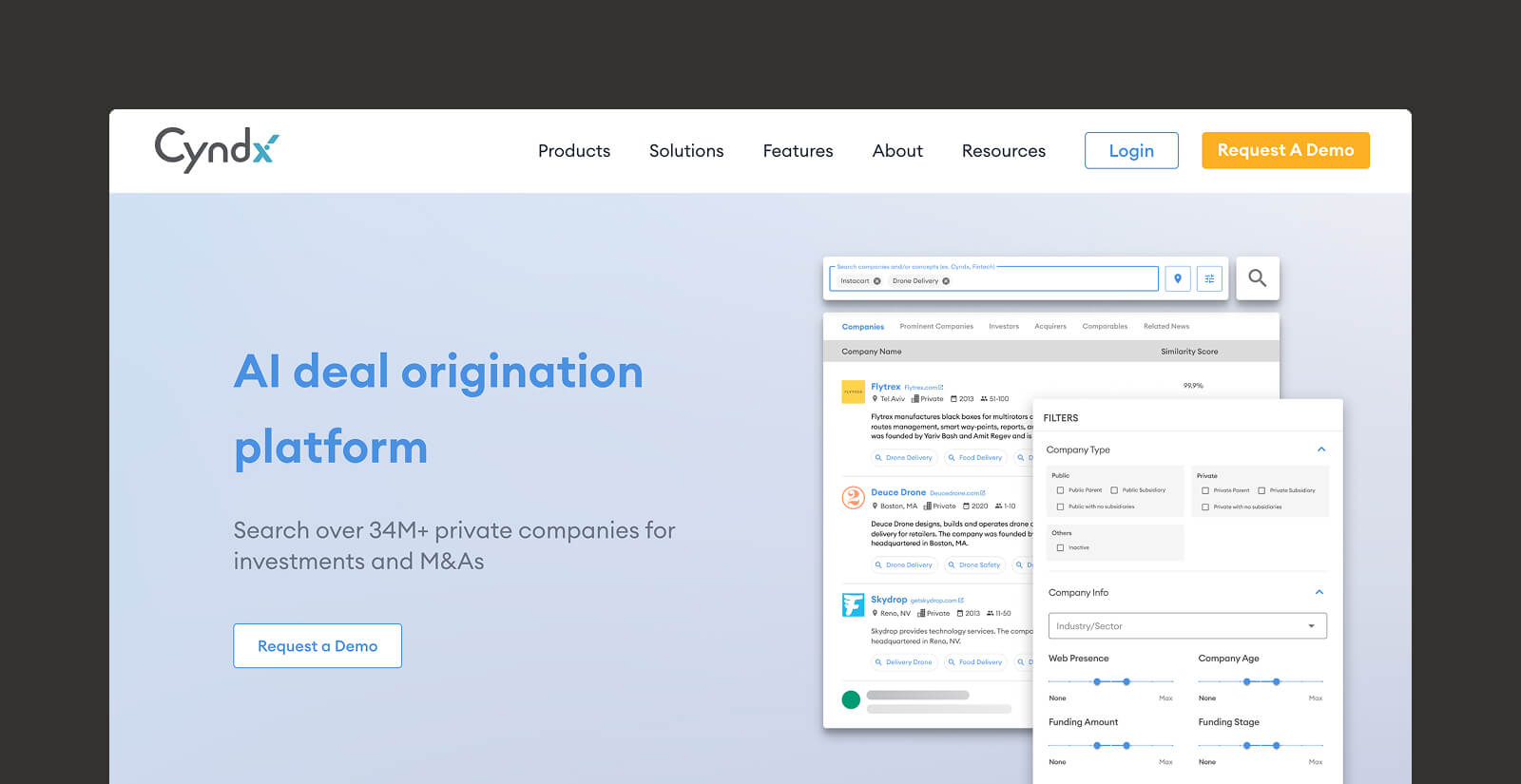
Cyndx covers more of the deal workflow in one platform than most tools on this list, with four distinct products: Finder for target discovery, Scholar for AI-generated research reports, Valer for business valuations, and Raiser for investor identification. Finder searches across 33M+ global companies using natural language queries, surfacing acquisition targets and mapping markets without requiring structured filters or Boolean search logic.
The tradeoff is depth. Cyndx generates research outputs quickly from its database, but it's not built to ingest and analyze a firm's proprietary deal documents.
Teams that need that functionality can pair it with a platform like Hebbia. But for early-stage target identification, quick valuations, and investor matching, Cyndex covers significant ground without requiring multiple subscriptions.
Key features:
- ML-powered acquisition target identification: Cyndx Finder uses AI and natural language processing (NLP) to search across 33M+ global companies in plain language, mapping niche markets and surfacing targets based on sector, growth metrics, funding history, and deal fit.
- Capital raise matching connecting acquirers with investors: Cyndx Raiser analyzes billions of data points to identify the most relevant financial and strategic investors for a deal, filtered by sector, deal size, stage, and investment preferences.
- M&A market comps and deal universe mapping: Cyndx Valer produces AI-powered valuation reports with public comparables and precedent transactions, giving deal teams a fast starting point for comp analysis without manual data pulls.
How To Choose the Best Deal Sourcing Platform for Your Team
No single platform covers every stage of the deal sourcing workflow. The right choice depends on where your team loses the most time.
Most institutional teams run two or three of these tools in combination, so the more useful question isn't which platform is best, but which gap in your current stack is costing you the most.
Private Equity
PE deal teams face two separate problems: finding targets and analyzing them. A private company database solves the first, but raw data access doesn't tell you whether a target is worth pursuing. That judgment comes from the documents, and reading hundreds of pages of CIMs, VDRs, and historical deal files still falls on your team.
The strongest private equity deal sourcing stacks pair a data platform with a document intelligence layer. Consider using Grata or PitchBook to handle discovery and market mapping, while Hebbia simultaneously processes the deal documents behind each target. Together, they cover the full workflow, from identifying a target to building a defensible investment view.
The ideal PE deal sourcing stack:
- For target discovery and market mapping: Grata (lower middle market focus) or PitchBook (broader private market coverage)
- For document analysis and diligence: Hebbia for processing VDRs, CIMs, and prior deal documents with sentence-level citations
- For relationship management: Affinity or 4Degrees
Investment Banking
In investment banking, the bottleneck is usually turning data into client-ready work products on a timeline that doesn't allow for multiple review cycles. Coverage management and relationship tracking can help manage workflows, but an execution layer is needed for quick turnarounds.
Tools like DealCloud or Affinity keep deal pipelines organized and relationship history current, while Hebbia acts as the execution layer. It synthesizes comparable deal data, verifies company details, and produces first-draft strip profiles, CIM sections, and pitch inputs—work the team can then refine rather than build it from scratch.
Every output is traceable to its source, which matters when senior MDs need to verify a figure before it goes to a client.
The ideal investment banking deal sourcing stack:
- For coverage management and relationship tracking: DealCloud or Affinity
- For execution and first-draft deliverables: Hebbia for synthesizing comps, verifying details, and producing source-cited work product that the team refines
Learn more about how leading investment banks use Hebbia to produce client-ready work faster.
Credit and Leveraged Finance
Credit success is defined by what you catch. Covenant nuances, lien restrictions, change-of-control provisions—the risks that matter are buried deep in dense financing documents, not surfaced by a Bloomberg terminal. PitchBook and Preqin handle the market data and comp research. What they don't do is read the actual credit agreements.
Hebbia is the fine print layer. It extracts and compares covenant terms across hundreds of agreements, flagging unrestricted subsidiary structures, subordination risks, and liquidity constraints that standard search tools miss entirely.
When it's time to build the credit committee memo, Hebbia has already synthesized the risk mitigants, covenant terms, and liquidity assessments directly from raw filings, with each output cited back to its source.
The analyst doesn't have to reconstruct the argument from scratch—they just have to defend it.
The ideal credit and leveraged finance deal sourcing stack:
- For market data and comp research: PitchBook or Preqin
- For document analysis and covenant extraction: Hebbia for processing credit agreements, indentures, and raw filings with sentence-level citations
- For coverage management and lender relationships: DealCloud or Salesforce Financial Services Cloud
Why Leading Finance Teams Build on Hebbia
Every other platform on this list helps you find and manage targets. What they don't do is document-level analysis—reading the VDRs, CIMs, and credit agreements behind a deal and turning them into source-cited work products. With these other tools, it still falls on your team to extract the details that actually drive conviction from hundreds of pages of deal documents.
Hebbia sits on top of your existing sourcing stack as an intelligence layer. It processes the documents behind a deal simultaneously and at scale, with source-linked outputs your team can trace and verify. The institutional memory it builds compounds across every deal your firm completes.
Leading investment banks and more than 40% of the largest asset managers by AUM rely on Hebbia for their most critical work. Book a demo to see how it fits into your workflow.


