
Top 10 Rogo Competitors
AI is reshaping how finance professionals conduct research, and how competitive a firm will be as its rivals tap their own platforms. As firms move from pilots to firm-wide deployments, they're finding that different use cases demand different capabilities—some need deeper integration with proprietary databases, others require more flexible workflows, while still others seek different pricing models. This variability has created an opening for specialized alternatives, each targeting distinct segments of the AI finance market.
This guide evaluates the top 10 Rogo competitors across three essential categories:
- Agentic operating systems: AI-reasoning layer for firms to accelerate workflows with verifiable information at scale.
- Data repository for context: Leverage data moats – either proprietary or partnership – to power their AI-driven insights.
- Precision vertical specialists: Prioritize deep accuracy in specific domains such as real-time event intelligence or financial modeling.
By understanding these three categories, firms can determine whether they need a generalist agent for workflow automation, a data-rich search engine for market intelligence, or a specialist tool for high-accuracy quantitative tasks.
What Is Rogo?
Former investment bankers founded Rogo in 2021 with a clear mandate: Automate the repetitive, time-intensive tasks that consume the hours of junior analysts. The platform performs as a workflow orchestrator built on top of large language models, or LLMs, and is designed to streamline outputs such as company profiles, deal memos, and benchmarking analyses.
Rogo’s roots in investment banking are both its greatest strength and a key constraint—Rogo was designed for IB workflows, and that specificity shapes everything from its feature set to the types of firms it serves best.
At its core, Rogo is built around three pillars:
- External data partnerships (LSEG, FactSet, S&P Global) power its research outputs, making it well-suited for structured, standardized tasks but less flexible for teams working across large unstructured document sets.
- Excel automation, added through the acquisition of Subset, extends the platform into high-volume modeling workflows, although bespoke or complex financial models remain outside its core strength.
- Single-tenant deployment and a dedicated security board make it a credible choice for global banks with strict compliance requirements.
For large institutions running standardized processes, that infrastructure carries real weight. But for investors—PE firms, credit teams, hedge funds—whose analytical needs extend well beyond traditional IB workflows, Rogo's design boundaries can feel like limitations.
Rogo Pros
For investment banks and advisory firms running high-volume, standardized workflows, Rogo delivers real efficiency gains out of the box. It quickly onboards clients, maps outputs directly to familiar IB deliverables, and requires minimal configuration to add value.
- Investment banking-specific workflows: Unlike general-purpose LLMs, Rogo’s user interface is built around standard banking tasks such as peer comps, drafting confidential information memoranda (CIMs), and public company profiling, making it easier for junior staff to adopt.
- Deep institutional partnerships: Rogo offers direct, real-time access to "gold standard" data from LSEG (Workspace), FactSet, and S&P Global, allowing users to query premium datasets without leaving the platform.
- Strong spreadsheet integration: With its 2025 acquisition of Subset, Rogo excels at "rolling forward" 40-tab Excel models and auditing formula errors—a high-value utility for pure investment banking work.
- Reliable enterprise security: Features single-tenant deployment and a high-profile Security Advisory Board, which has helped it gain standardized status at global firms such as Lazard, Nomura, and Jefferies.
Rogo Cons
Rogo's strengths in standardized IB workflows come with meaningful trade-offs. For firms with complex, high-volume, or investor-grade analytical needs, several limitations become apparent at scale.
- Document scale: Rogo operates as a user interface application built on top of existing LLMs. Yet it can't reliably scale analysis over thousands of documents, including a firm's past deals, because LLMs still have limited “context windows.”
- Citation granularity: Rogo provides auditable, response-level citations, but lacks true sentence-level sourcing. For teams that demand high accuracy and need to trace every claim back to a specific passage, this distinction matters.
- Limited collaboration: Rogo enables individual bankers to perform tasks more efficiently, but it currently lacks a strong collaboration framework within teams and companies to unlock greater productivity within the platform.
- Lack of native content moats: Rogo doesn't own its data; it's an aggregator. This makes it subject to the licensing terms of its partners (LSEG, etc.).
- Rigid workflow structure: Rogo is optimized for standard investment banking tasks. For investors who are conducting complex due diligence that may not follow a template, the platform can feel less flexible than an advanced reasoning engine like Hebbia.
- High operating costs: With reported minimum contracts reaching into the seven-figure range for enterprise licenses, it is often seen as a top-down corporate mandate rather than a tool chosen by professionals for its technical superiority.
Rogo Competitors at a Glance
No two platforms on this list support the same use case—and that's the point. The appropriate Rogo alternative depends on whether a team needs to interrogate data rooms, monitor earnings calls, automate audit workflows, or plan next quarter's budget. Use the table below as a starting point to identify which platforms align with your workflow before going deeper.
Software | Category | Best for | Top features |
|---|---|---|---|
Hebbia | Agentic operating system | High-stakes due diligence and complex data interrogation | - Cross-firm collaboration with Projects - Reasoning at scale with Iterative Source Decomposition (ISD) technology - Finance-specific integrations - Finance-tailored LLMs - Generative financial modeling - Generative customizable slide decks |
Vena Copilot | Agentic operating system | Large-scale strategic planning and corporate budgeting | - Vena CubeFLEX engine - Native Microsoft 365/Teams integration - ‘What-if’ scenario planning agents |
AlphaSense | Data-rich search engine | Market intelligence and comprehensive thematic research | - Generative Grid for scaling prompts across docs - Smart Synonyms for search intent- - 10,000+ premium data sources |
S&P Capital IQ Pro | Data-rich search engine | Institutional-grade company analysis and screening | - 450M+ data points on public and private companies - Excel plug-in for live data feeds - Comp table generation and peer analysis - M&A precedent transaction database |
FactSet | Data-rich search engine | Institutional portfolio management and quantitative research | - Integrated market data with 1.5M+ securities - FactSet Workstation for multi-asset analytics - Portfolio attribution and risk modeling - Custom API access for quant strategies |
Bloomberg Terminal | Data-rich search engine | Real-time trading floor intelligence and risk assessment | - Financial-native 50B parameter model - Natural language to BQL (Bloomberg Query Language) translation - Tick-by-tick sentiment analysis |
Model ML | Precision vertical specialist | Credit modeling and loan underwriting automation | - Automated financial spreading from bank statements - Cash flow and covenant analysis - Credit risk scoring with probability of default models - Integration with loan origination systems |
Datarails | Precision vertical specialist | Small-to-mid market FP&A and Excel automation | - "FP&A Genius" chat interface - Automated data consolidation from multiple silos - Storyboard creator for executive narratives |
Aiera | Precision vertical specialist | Earnings call monitoring and live event intelligence | - Live streaming transcription with <1s latency - Tonal sentiment analysis - Cross-company management commentary tracking |
DataSnipper | Precision vertical specialist | External audit, forensic accounting, and reconciliation | - Document matching for ledger-to-PDF verification - "Snip" technology for traceable audit trails - Excel-native verification agents |
1. Hebbia
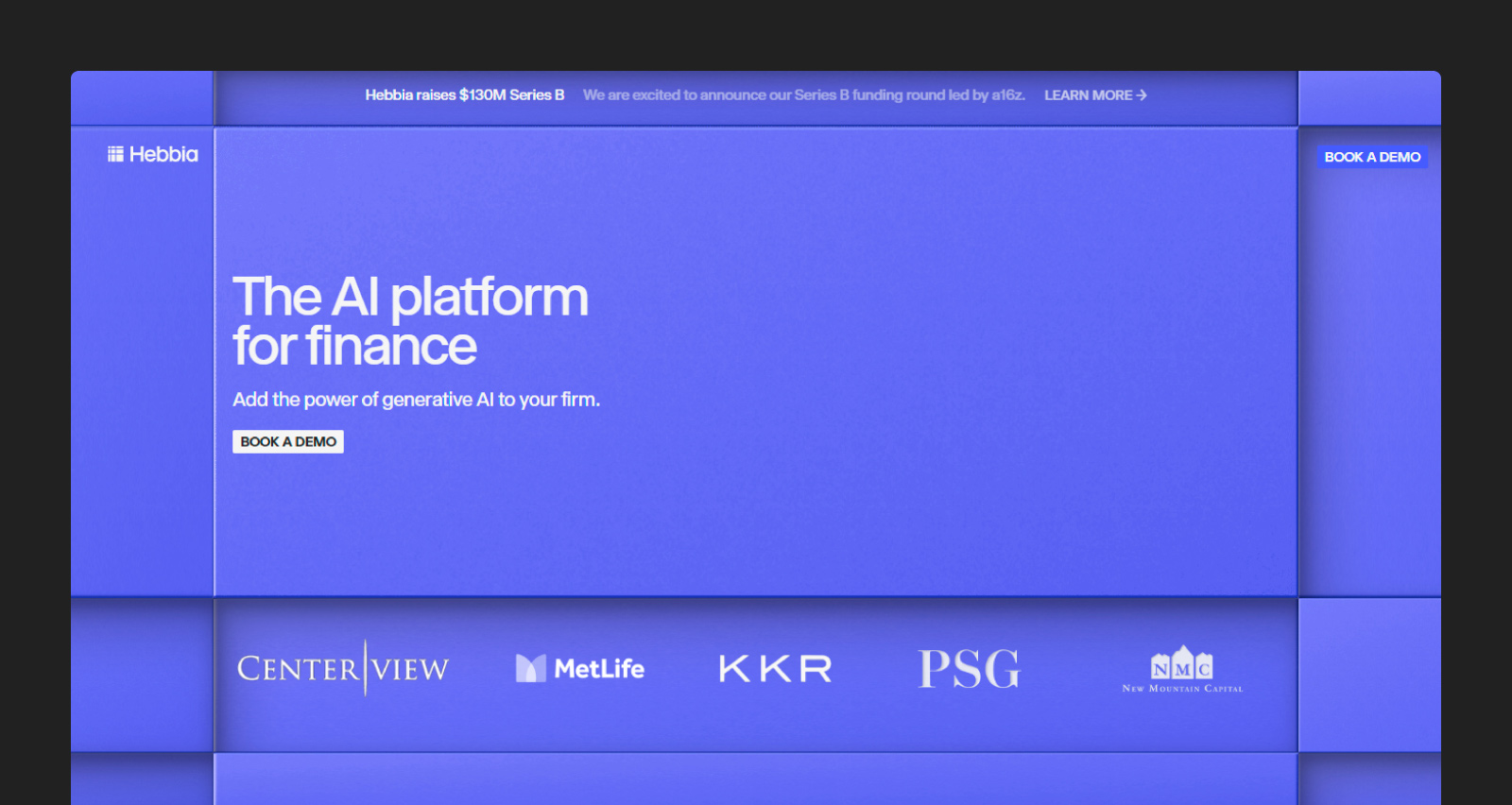
Best for: High-stakes due diligence and complex data interrogation
Hebbia is the AI platform of choice for firms where the stakes of getting it wrong are highest. Trusted by leading investment banks and more than 40% of the largest asset managers by AUM, Hebbia is built for the full spectrum of financial workflows—from IB deal execution to credit analysis, private equity due diligence, and public equity research.
Unlike platforms optimized for standardized outputs, Hebbia is designed to unearth the insights buried deep in your firm's proprietary data, and across volumes of documents that would be virtually impossible to review manually.
Where Hebbia most clearly separates itself is at the intersection of scale and precision. Its ability to process large, complex, and unstructured document sets while maintaining sentence-level traceability makes it the platform senior professionals reach for when the work can't follow a template.
Key features:
- Cross-firm collaboration: Projects is a shared workspace for the full deal team. Analysts, associates, MDs, compliance, legal, and IR all build on the same documents, prompts, and AI workflows in one place. Coverage gaps close faster, teams stay aligned, and institutional knowledge doesn't get lost across inboxes and drives.
- Reasoning at scale with Iterative Source Decomposition (ISD) technology: Hebbia's proprietary ISD technology goes beyond standard RAG-based retrieval by breaking down complex queries across entire document sets and returning answers with sentence-level citations. This makes it possible to interrogate thousands of documents simultaneously—data rooms, past deals, internal research—with full auditability at every step.
- Financial-specific integrations: Hebbia connects to a broad ecosystem of financial data sources, including real-time market data, company filings, document cloud storage, and CRMs. Every source is fully indexed, so teams can search across both external data and their firm's proprietary knowledge base instantly without switching platforms or manually locating files.
- Finance-tailored LLMs: Hebbia's chat interface is fine-tuned to respond using the structure, language, and tone expected by finance professionals. This means outputs are calibrated to your firm's standards from the start, enabling deeper and more accurate diligence insights tailored to real financial workflows.
- Generative financial modeling: Hebbia automates the extraction and synthesis of financial data across large document sets, enabling analysts to build and pressure-test models faster without sacrificing the depth or accuracy required for complex investment decisions.
- Generative customizable slide decks: Through its acquisition of FlashDocs, Hebbia can generate complete, fully branded pitch decks and client materials—not just individual slides. This gives finance teams unmatched flexibility for producing client-ready outputs that meet the visual and editorial standards of top-tier financial institutions.
Rogo vs. Hebbia
Rogo | Hebbia | |
|---|---|---|
Collaboration | No collaboration features. Focus is on individual productivity | Projects gives the full deal team a shared workspace so they can build on the same documents, prompts, and AI workflows in one place |
Scale | Constrained by LLM context window limits, reducing accuracy and scalability | Significantly larger context window—delivering more accurate, reliable, and context-aware outputs, even across complex documents |
Reliability | Only some answers are traceable to the sentence-level, creating risk in high-stakes workflows | Sentence-level citations for every prompt |
Financial data access | Limited to manual uploads of individual private documents | Connects to a wide range of data sources—including public and private data—so you always have access to the information you need |
Workflow customization | Limited AI agent capabilities | Customizable agents that let you chain full workflows, including pulling data, running analysis, and creating full models and presentations in your firm's brand style |
Slide generation | Single slide outputs, limited template customization | Multiple pages and charts |
Excel modeling | Editable within the Rogo UI | Build models with AI and export to Excel to edit |
2. Vena Copilot
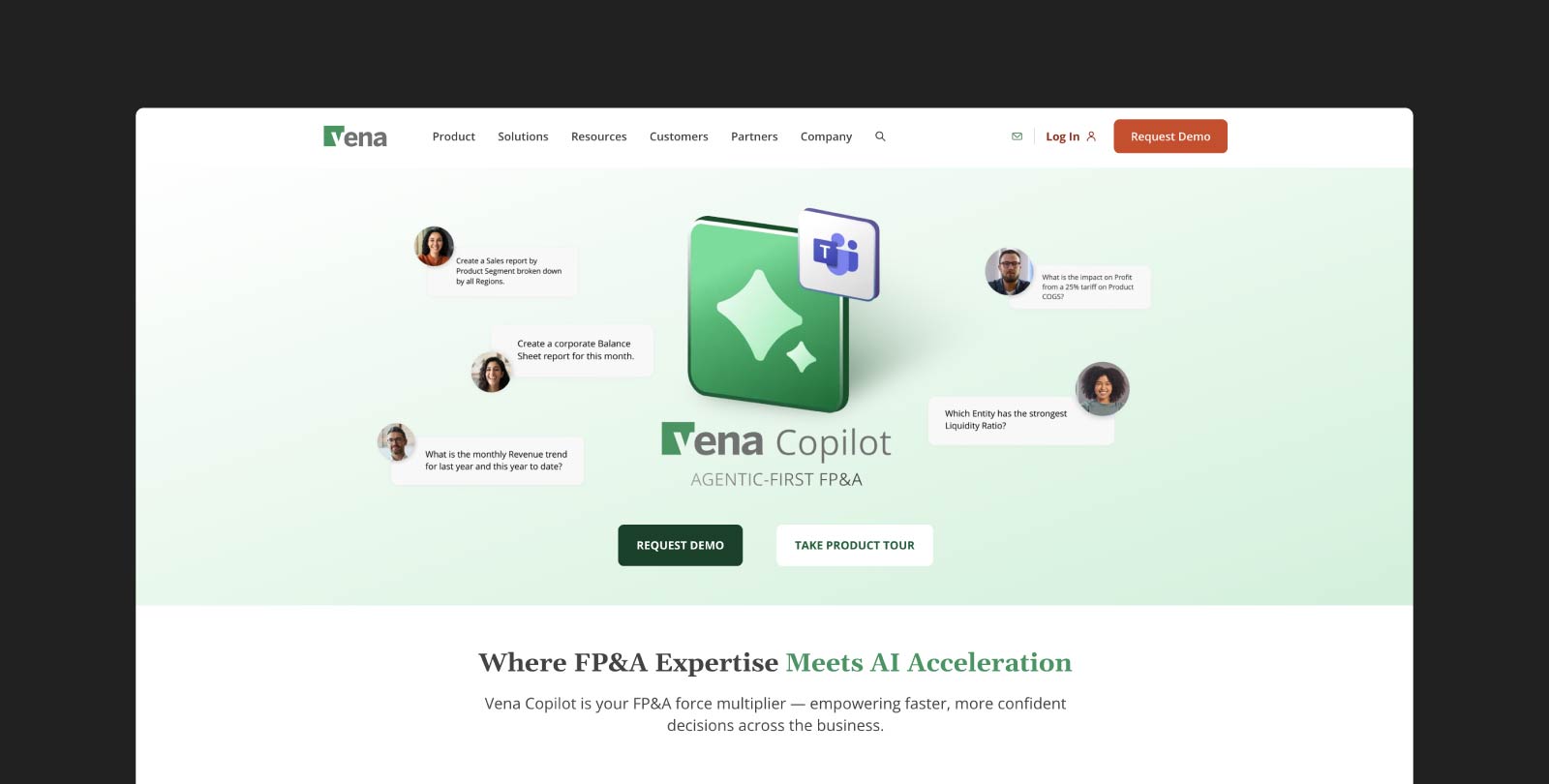
Best for: Large-scale strategic planning and corporate budgeting
Vena Copilot is an AI planning assistant built for financial planning and analysis (FP&A) teams, powered by Microsoft Azure OpenAI and layered on top of Vena's Excel-native Complete Planning platform. Its core strength lies in its internal planning cycles—budgeting, forecasting, variance analysis, and scenario modeling—making it a natural fit for corporate finance teams already embedded in the Microsoft ecosystem.
Compared to Rogo, Vena operates in a fundamentally different lane: where Rogo automates IB deliverables, Vena is oriented around planning infrastructure for mid-market to enterprise organizations. Users consistently praise its Excel integration and ease of use, though implementation can take several months, delay time to value, and tie up internal resources.
Key features:
- Vena CubeFLEX engine: CubeFLEX is Vena Copilot's proprietary analytical data model, which sits at its core and connects directly to a firm's financial and operational data. It inherits existing security protocols and permission structures, meaning governance and access controls stay intact as AI gets layered into planning workflows.
- Native Microsoft 365/Teams integration: Users can access FP&A intelligence and run analyses directly within Teams meetings, chats, and channels without switching platforms or interrupting their existing workflow. The integration also enables real-time collaborative reporting in Excel Live, allowing finance teams and business stakeholders to work from the same data simultaneously.
- "What-if" scenario planning agents: The analytics agent runs complex variance and trend analyses, powers scenario simulations, and delivers real-time insights based on shifting assumptions. Finance teams can model multiple outcomes—best case, worst case, and most likely—across key business drivers without rebuilding their models from scratch.
Rogo vs. Vena Copilot
Rogo | Vena Copilot | |
|---|---|---|
Collaboration | No collaboration features | Excel Live and Teams Integration allows finance teams to work from the same live data and run analyses directly within chat channels |
Scale | Less equipped for the structured, multi-entity planning data that enterprise FP&A workflows require | Scales well for enterprise planning workflows, but is designed for structured internal data rather than large unstructured document sets |
Reliability | Less suited for the iterative, version-controlled planning cycles where Vena's audit trails add the most value | Auditable AI interactions via Admin View, though citation granularity is tied to internal planning data rather than external documents |
Financial data access | Not designed to connect to the ERP, CRM, and internal planning systems that FP&A teams depend on | Draws on internal financial and operational data via CubeFLEX, but is less suited for external market research or deal-driven data needs |
Workflow customization | Not built for the budgeting, forecasting, and variance workflows that Vena's agents are purpose-designed around | Purpose-built agents for budgeting, forecasting, and variance analysis, with strong customization within FP&A workflows but limited outside of planning use cases |
Slide generation | Generates client-facing deal materials like pitch decks and CIMs, but outputs are designed for external audiences rather than internal planning presentations | Outputs are planning-oriented rather than client-facing deal materials |
Excel modeling | Less integrated with the live, permission-controlled Excel environment that Vena's planning workflows are built around | Native Excel integration is a core strength, with models built and edited directly within Excel via the CubeFLEX framework |
3. AlphaSense
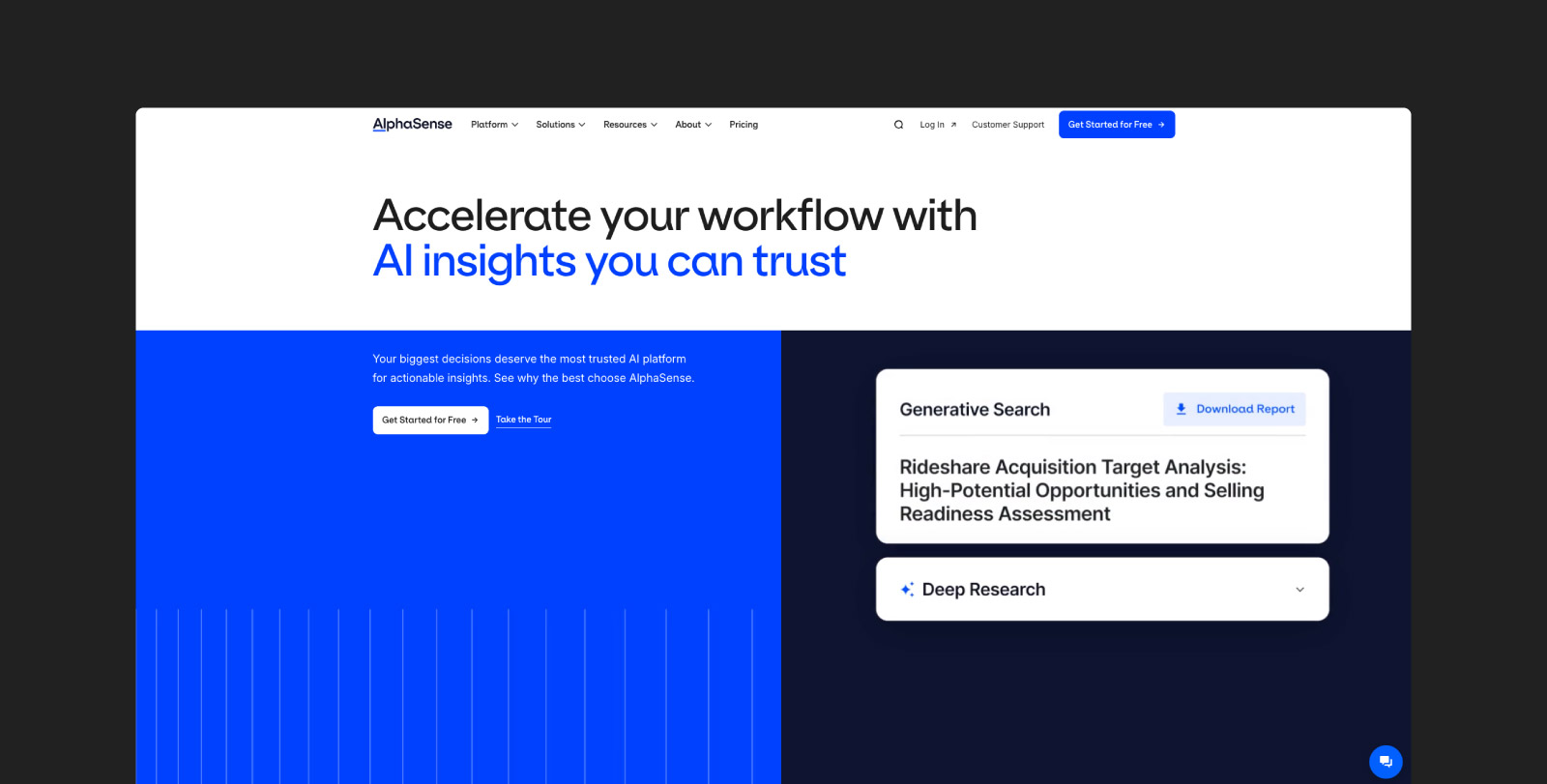
Best for: Market intelligence and comprehensive thematic research
AlphaSense is a market intelligence search platform built around the breadth and quality of its content library—over 10,000 private, public, premium, and proprietary data sources, including Wall Street equity research, expert call transcripts, Securities and Exchange Commission (SEC) filings, earnings calls, and news. The platform is fundamentally built around search, helping analysts get smarter on a company, sector, or theme faster by surfacing relevant information across hundreds of millions of documents.
AlphaSense and Rogo are designed to produce different products. Rogo is optimized for generating IB deliverables—memos, benchmarking outputs, pitch prep—while AlphaSense is largely focused on summarizing what's already in its content library. It excels at telling you what a research document says but struggles to automate the next steps, such as drafting a multi-page IC memo, building a formatted covenant-tracking table, or generating a client-ready pitch deck.
Key features:
- Generative Grid for scaling prompts across docs: AlphaSense's Generative Grid applies multiple AI prompts to many documents simultaneously to provide organized answers to research questions at scale, in an easy-to-read table format.
- Smart Synonyms for search intent: Smart Synonyms understands both the keyword and search intent behind any query, factoring in variations in business language—so a search for "TAM" also surfaces results on "addressable market" and "market size."This makes the search experience more intuitive and less dependent on exact terminology.
- 10,000+ premium data sources: AlphaSense's content library includes broker research, expert call transcripts, SEC and global filings, earnings calls, news, and proprietary internal content—all accessible in a single platform.
Rogo vs. AlphaSense
Rogo | AlphaSense | |
|---|---|---|
Collaboration | No collaboration features | Notebooks and shared annotations allow teams to share research folders and tag teammates in document annotations |
Scale | Lacks AlphaSense's breadth of external content coverage, but applies AI reasoning across uploaded documents rather than just searching across a content library | Search-first architecture scales well across large content libraries, but struggles with deep cross-contextual reasoning across entire VDRs or private document sets |
Reliability | Less robust than AlphaSense for verifying claims across large external content sets | Sentence-level citations on standard queries, but the audit trail becomes strained at high document volumes |
Financial data access | Narrower external content library than AlphaSense, but better suited for firms that want to work across their own proprietary documents rather than a third-party content universe | 10,000+ premium proprietary sources, including broker research, expert calls, and SEC filings, but limited to its own library for private document analysis |
Workflow customization | Goes further than AlphaSense in generating structured outputs—memos, benchmarking reports, and pitch prep—rather than stopping at search summarization | Generative Grid automates repeatable research tasks, but has limited ability to generate structured workflow outputs like IC memos or pitch decks |
Slide generation | Generates single slides with limited template customization | No native slide generation capability |
Excel modeling | Supports standardized modeling within the UI | No native Excel modeling capability |
4. S&P Capital IQ Pro
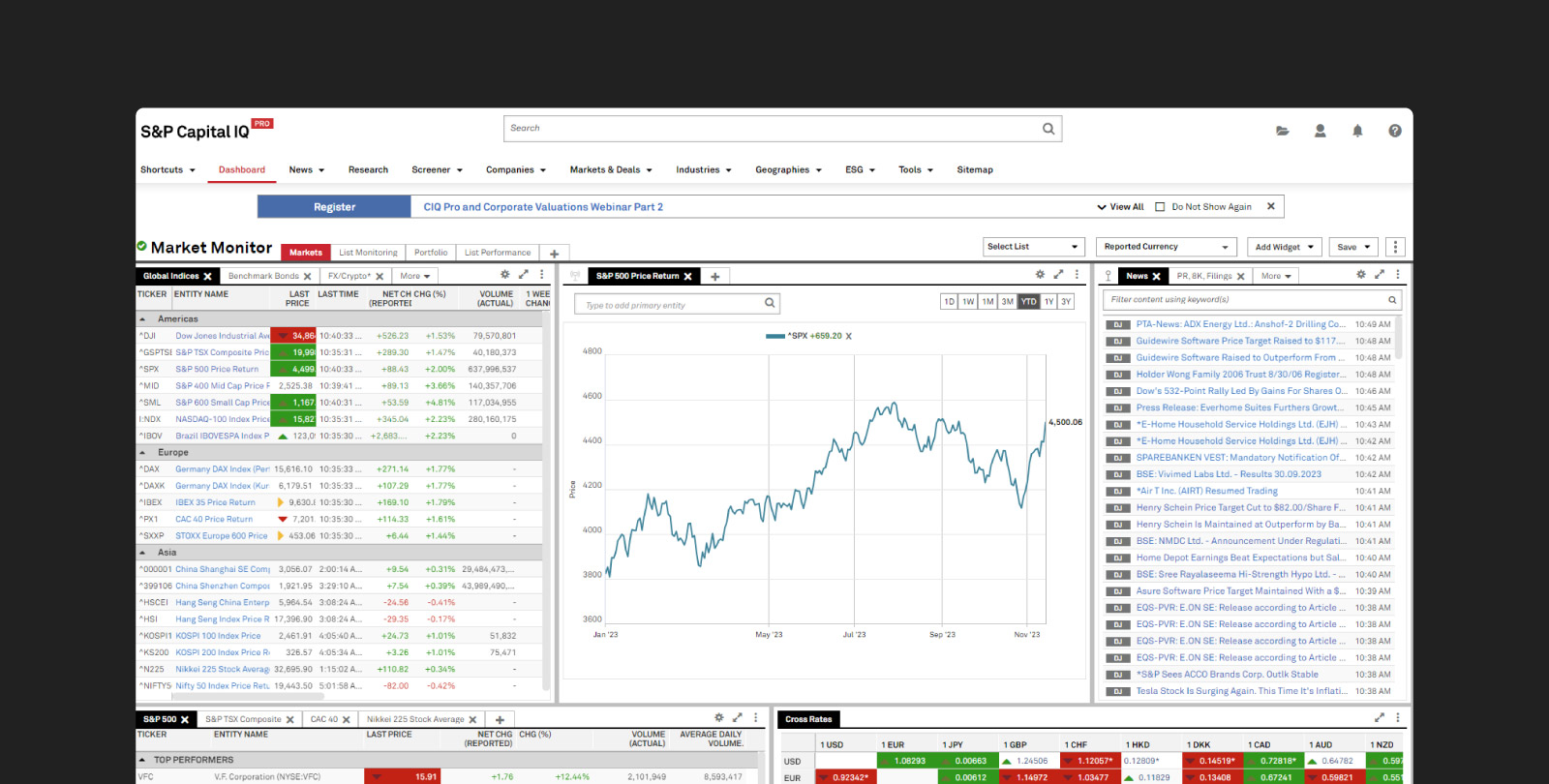
Best for: Institutional-grade company analysis and screening
S&P Capital IQ Pro has been a fixture in institutional finance for decades, functioning primarily as a structured data platform for financial screening, benchmarking, and company research. The platform unites company financials, industry metrics, credit ratings, and macroeconomic indicators, making it the default starting point for comp builds, target screening, and deal research.
That said, Capital IQ Pro is fundamentally a data platform, not an AI workflow tool. Users on G2 note that the interface can feel outdated and hard to navigate. And while recent AI enhancements like Document Intelligence 2.0 have improved its document analysis capabilities, the platform still relies on users to turn structured data into finished work products.
Key features:
- 450M+ data points on public and private companies: The platform covers 109,000+ public companies and 60M+ private companies, including 16M+ with recent financials, giving analysts a starting point for virtually any screening or benchmarking exercise.
- Excel plug-in for live data feeds: The Excel integration allows analysts to pull live, formula-driven financial data directly into models, eliminating the need to manually update figures and reducing the risk of presenting stale data in deliverables.
- Comp table generation and peer analysis: Capital IQ Pro's screening and benchmarking tools are purpose-built for quickly building trading and transaction comps, with filtering across hundreds of financial metrics and customizable output formats.
- M&A precedent transaction database: The platform's transaction data includes detailed deal metrics, valuation multiples, and buyer/seller profiles, making it a go-to resource for precedent transaction analysis in M&A advisory and fairness opinion work.
Rogo vs. S&P Capital IQ Pro
Rogo | S&P Capital IQ Pro | |
|---|---|---|
Collaboration | No collaboration features | Shared lists and portfolio sync allows teams to share screened company lists across the institutional dashboard |
Scale | Constrained by LLM context window limits, reducing accuracy across large document sets | Scales well across structured financial data on 450M+ data points, but is less equipped for reasoning across large unstructured document sets |
Reliability | More AI-native but with less established data accuracy benchmarks than Capital IQ's structured data | Highly accurate structured financial data with a decades-long track record |
Financial data access | Aggregates external data from partnerships, including LSEG, FactSet, and S&P—without owning the underlying data infrastructure | 450M+ proprietary structured data points on public and private companies |
Workflow customization | Purpose-built workflow automation for IB deliverables like memos and benchmarking, but with less depth of underlying structured data than Capital IQ | Strong data retrieval and screening tools, but limited ability to automate multi-step analytical workflows or generate finished work products |
Slide generation | Single slide outputs with limited template customization | No native slide generation capability |
Excel modeling | Less integrated than Capital IQ's native Excel infrastructure | Industry-standard Excel plug-in with live, formula-driven financial data feeds |
5. FactSet
Best for: Institutional portfolio management and quantitative research
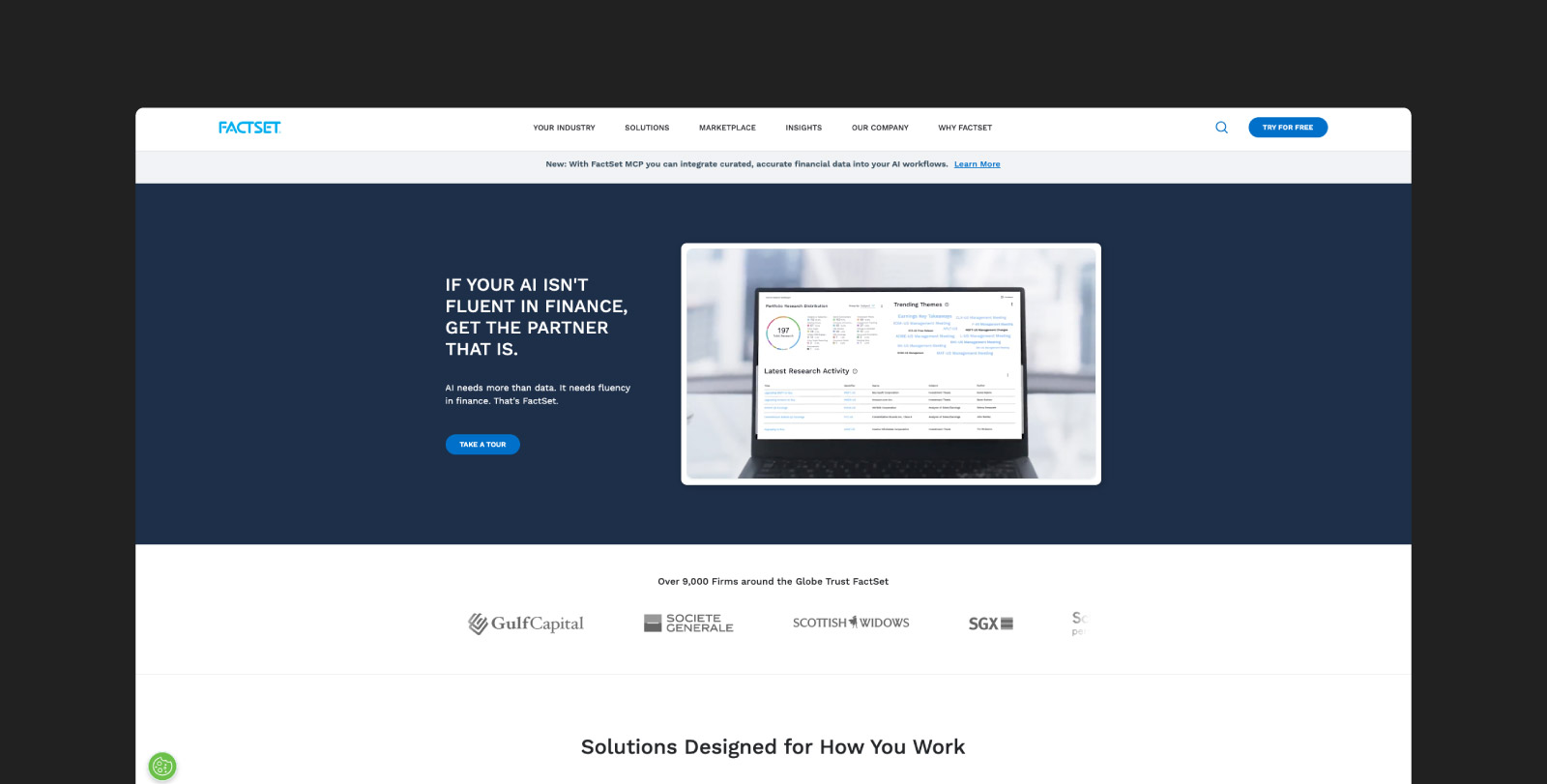
FactSet is a data and analytics platform primarily built around the buy-side, integrating over 800 data sources across asset classes and markets to support portfolio construction, risk modeling, and multi-asset research. It sits closer to a structured data environment than an AI workflow tool, serving investment professionals who need real-time market data, portfolio attribution, and quantitative analytics across a broad universe of securities.
Where FactSet diverges from Rogo is in what it's optimized to produce. The platform has been building generative AI capabilities through its Mercury conversational engine and Pitch Creator for Bankers, but these are newer additions layered on top of a fundamentally data infrastructure tool. Users note that FactSet can be challenging to navigate given its extensive tools, and flag that AI could play a greater role given the volume of data the platform holds.
Key features:
- Integrated market data with 1.5M+ securities: FactSet consolidates real-time and historical pricing, fundamentals, estimates, and alternative data across equities, fixed income, and private markets—giving investment teams a single environment for multi-asset research and portfolio monitoring.
- FactSet Workstation for multi-asset analytics: The Workstation is a dynamic platform that empowers financial professionals with seamless data access, advanced analytics, and intuitive technology, with customizable panels that can be configured around specific investment workflows and asset class coverage.
- Portfolio attribution and risk modeling: FactSet's portfolio analytics tools allow buy-side teams to break down performance attribution, run factor-based risk models, and stress-test portfolios against macroeconomic scenarios—capabilities that go well beyond what deal-focused platforms like Rogo offer.
- Custom API access for quant strategies: FactSet's open API framework allows quantitative teams to pull structured data directly into proprietary models and internal systems, making it a popular infrastructure layer for systematic and quant-driven investment strategies.
Rogo vs. FactSet
Rogo | Factset | |
|---|---|---|
Collaboration | No collaboration features | Workstation sharing allows users to share custom panels, workspaces, and portfolio models across the team |
Scale | Better suited for document-driven workflows than multi-asset quantitative analysis | Scales across 800+ data sources and 1.5M+ securities for portfolio-level analysis, but is less equipped for reasoning across large unstructured document sets |
Reliability | More AI-native, but with less established structured data accuracy | Highly reliable structured market data with deep historical coverage, but AI workflow features are newer and less proven at scale |
Financial data access | Aggregates external data from third-party partners, with no proprietary data infrastructure of its own | Proprietary multi-asset data infrastructure spanning equities, fixed income, private markets, and alternative data |
Workflow customization | Limited quantitative or portfolio-level analytical capabilities | Strong quantitative and portfolio analytics, but generative AI workflow tools like Pitch Creator are still maturing |
Slide generation | Single slide outputs with limited template customization | Pitch Creator for Bankers automates elements of pitch book creation |
Excel modeling | Less integrated with live data infrastructure | Excel plug-in with live data feeds widely used across buy-side firms for model-building and portfolio analysis |
6. Bloomberg Terminal
Best for: Real-time trading floor intelligence and risk assessment
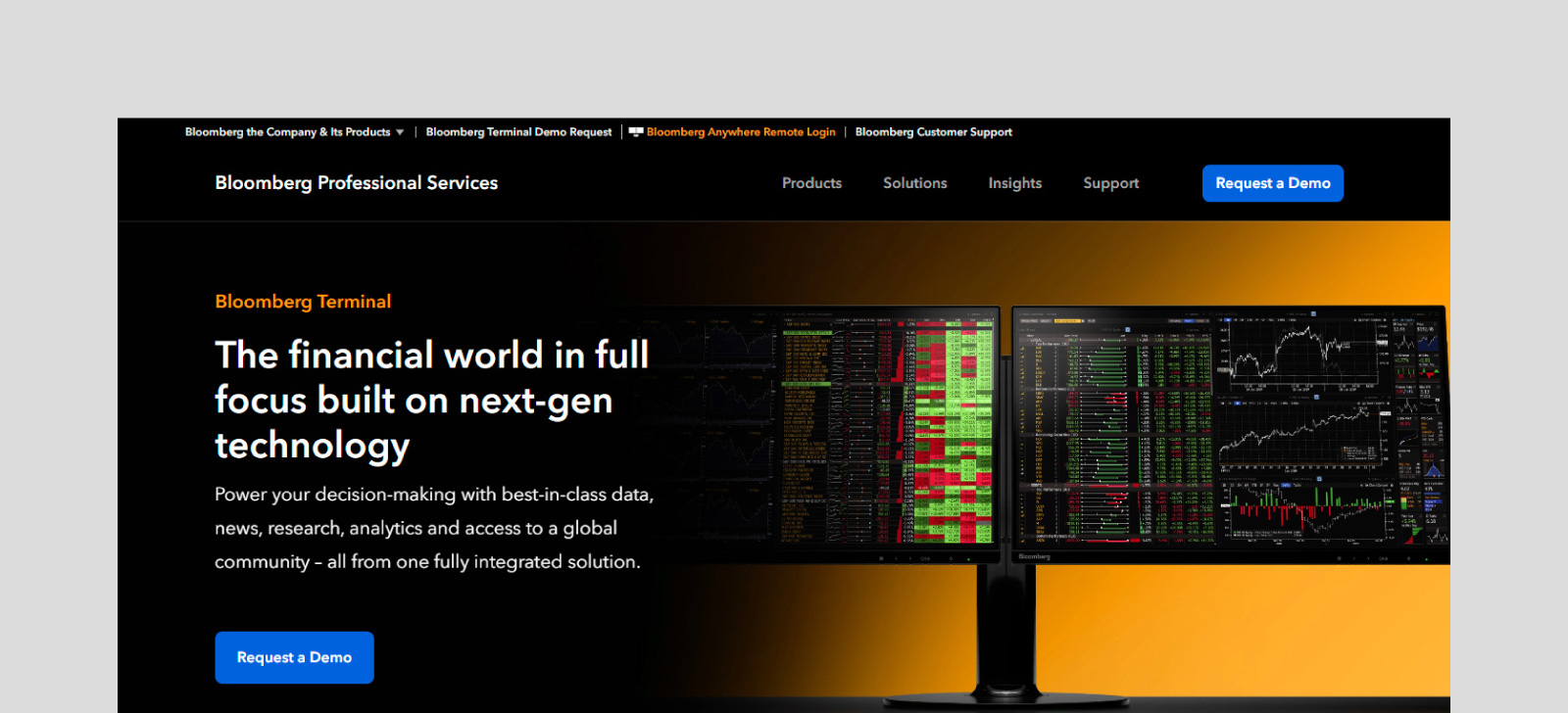
For more than four decades, the Bloomberg Terminal has fed a constant stream of real-time financial data to Wall Street traders and others—and over the past two years, Bloomberg has invested meaningfully in integrating generative AI and large language models into that infrastructure. The AI layer, powered in part by BloombergGPT, is built to operate on top of the Terminal's proprietary data universe, making it powerful for professionals already embedded in the Bloomberg ecosystem who need faster access to real-time intelligence, not a new platform to learn.
Where Rogo is built for the deal room, the Terminal is built for the trading floor—optimized for speed-to-insight across real-time market data rather than automating document-heavy workflows. That strength comes with a meaningful constraint: The platform is tightly coupled to the Terminal subscription, and when benchmarked against GPT-4, BloombergGPT lagged on financial question-answering tasks despite its domain-specific training, suggesting that domain specialization alone doesn't always translate to superior AI performance in practice.
Key features:
- Financial-native 50B parameter model: BloombergGPT was trained on a 700 billion-token dataset drawn from Bloomberg's four decades of curated financial documents, giving it deep fluency in financial terminology, market events, and entity recognition that general-purpose models lack out of the box.
- Natural language to BQL (Bloomberg Query Language) translation: The Terminal allows users to obtain search results similar to what they would find using Bloomberg Query Language, but without having to use the coding language. Instead, users can type requests in plain English. This lowers the barrier to accessing Bloomberg's structured data universe.
- Tick-by-tick sentiment analysis: The Terminal powers real-time sentiment scoring across news, filings, and market events as they happen—giving trading desks and risk teams a continuous signal layer that can be incorporated into intraday decision-making.
Rogo vs. Bloomberg Terminal
Rogo | Bloomberg Terminal | |
|---|---|---|
Collaboration | No collaboration features | IB chat and MSG is the industry standard for real-time data sharing and trading communication |
Scale | Better suited for document-driven IB workflows than real-time multi-asset data environments | Less suited for reasoning across large private document sets or internal firm knowledge |
Reliability | More AI-native, but benchmarks lag Bloomberg's structured data accuracy | Grounded in Bloomberg's trusted proprietary data, but benchmarked against general-purpose models like GPT-5 showed gaps on financial question-answering tasks |
Financial data access | Aggregates external data from third-party partnerships | Decades of proprietary Bloomberg data across all asset classes, but it's tightly coupled to a Terminal subscription |
Workflow customization | Purpose-built agents for IB deliverables like memos, benchmarking, and pitch prep | ASKB Workflows speed up repetitive tasks like pre-earnings prep and post-earnings analysis, but it's less suited for generating finished deal documents or client-ready materials |
Slide generation | Single slide outputs with limited template customization | No native slide generation capability |
Excel modeling | Standardized modeling support within the UI | Provides underlying BQL code so users can extend analysis directly in Excel or BQuant |
7. Model ML
Best for: Credit modeling and loan underwriting automation
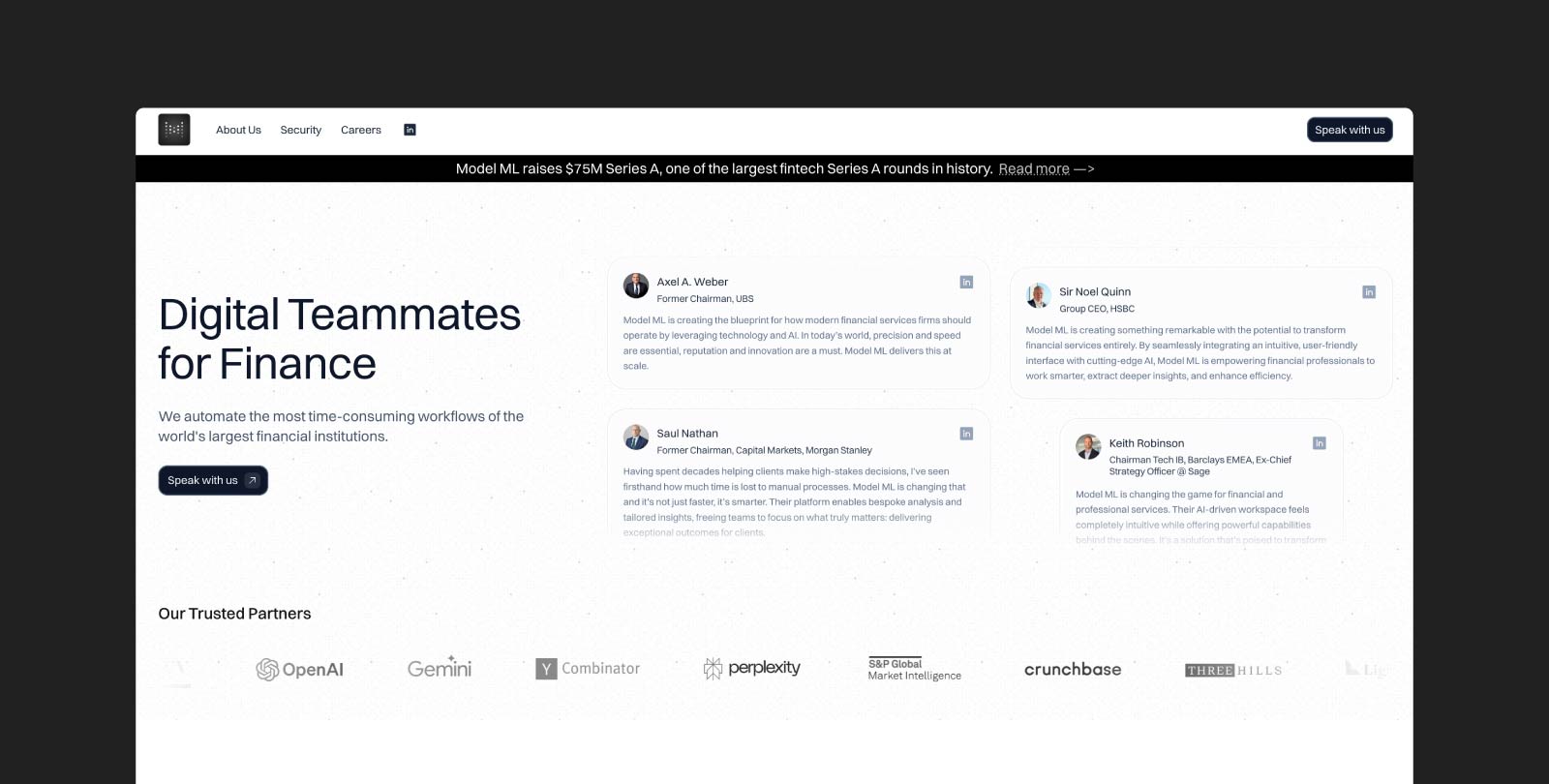
Model ML is an AI-powered workflow automation platform built for financial services firms that produces client-ready documents directly from trusted data sources, with built-in verification. Its core focus is automating the document-heavy, repetitive workflows that slow down credit and lending teams—extracting financial data, analyzing cash flows, and generating structured credit outputs. This makes the platform a natural fit for commercial lenders and credit investors who need to move faster without sacrificing rigor.
The platform performs similarly to Rogo in terms of workflow automation, but targets a different buyer. Where Rogo is optimized for investment banking deliverables like memos and pitch prep, Model ML is purpose-built for credit workflows. That specialization is its strength and its constraint: teams operating across both deal and credit workflows may find it narrower than a more horizontally capable platform.
Key features:
- Automated financial spreading from bank statements: Model ML extracts and standardizes financial data from bank statements and borrower documents automatically, eliminating manual data entry and reducing the time credit analysts spend preparing financials for review.
- Cash flow and covenant analysis: The platform automates cash flow analysis and covenant tracking across borrower portfolios, flagging breaches and trends without requiring analysts to manually parse through loan agreements and financial statements.
- Credit risk scoring with probability-of-default models: Model ML integrates probability-of-default modeling into its underwriting workflows, providing credit teams with a quantitative risk signal alongside qualitative analysis from borrower documents.
- Integration with loan origination systems: The platform connects directly to existing loan origination systems, enabling credit outputs to flow into downstream systems without manual handoffs or reformatting.
Rogo vs. Model ML
Rogo | Model ML | |
|---|---|---|
Collaboration | No collaboration features | Audit-ready review flow allows teams to collaborate on risk scoring with a shared verification trail |
Scale | Better suited for IB document workflows than high-volume loan portfolio analysis | Built to process high volumes of borrower documents and financial statements across loan portfolios |
Reliability | Response-level citations, but limited traceability for credit decision audit trails | Outputs include built-in verification tied to source documents, designed with credit audit requirements in mind |
Financial data access | Relies on external data partnerships (LSEG, FactSet, S&P) for market data | Draws primarily on borrower-supplied documents and integrated loan origination data rather than third-party market data |
Workflow customization | Purpose-built agents for IB deliverables like memos and benchmarking, with limited credit-specific workflow depth | Built for credit workflows, including spreading, covenant analysis, and underwriting; limited IB workflow capability |
Slide generation | Single slide outputs with limited template customization | Client-ready document generation with exact formatting replication, but is less focused on presentation-style outputs |
Excel modeling | Standardized modeling support within the UI | Outputs structured financial data designed to integrate with existing credit models and loan origination systems |
8. Datarails
Best for: Small-to-mid market FP&A and Excel automation
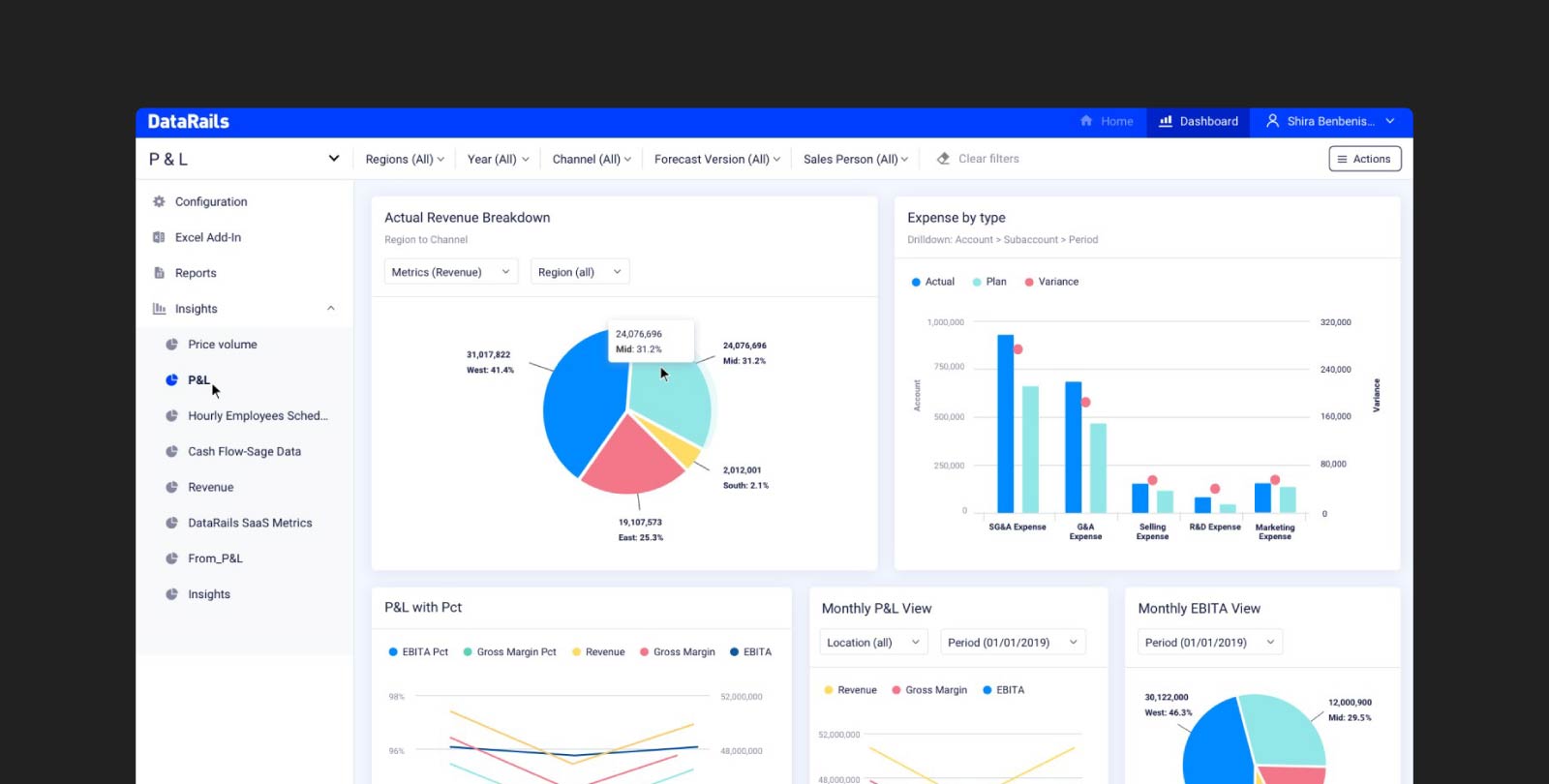
Datarails is an Excel-native FP&A platform built for SMB and mid-market finance teams that need automation and structure without abandoning their existing spreadsheet workflows. The platform integrates data from ERPs, CRMs, HR systems, and banks into a single source of truth, automating the most time-consuming parts of FP&A—consolidation, reporting, and forecasting—while keeping Excel at the center of the workflow.
The overlap with Rogo is limited—Datarails serves corporate finance teams running internal planning cycles, not deal teams or investors. Its AI layer, FP&A Genius, adds chat, insights, and storyboards, but the platform's payoff depends on clean models, reliable integrations, and sound governance.For lean finance teams that live in Excel and need faster month-end close and board-ready reporting, Datarails is a strong fit. For investment-side workflows requiring deal research, document analysis, or external market data, it's not designed for that use case.
Key features:
- "FP&A Genius" chat interface: Datarails AI actively analyzes performance, explores scenarios, and produces usable financial outputs that support decision-making, going beyond a basic chatbot to surface variance drivers and forward-looking insights directly from a firm's own financial data.
- Automated data consolidation from multiple silos: Datarails integrates with 200+ accounting software, ERP, CRM, bank, and HRIS systems, automatically pulling data into a centralized model so finance teams spend less time chasing inputs and more time on analysis.
- Storyboard creator for executive narratives: Storyboards use generative AI to spot trends, offer insights, and turn financial data into compelling narratives for management teams and boards, bridging the gap between raw numbers and presentation-ready outputs.
Rogo vs. Datarails
Rogo | Datarails | |
|---|---|---|
Collaboration | No collaboration features | Centralized data bub tracks version history and comments on consolidated reports |
Scale | Built for external document-driven IB workflows | Scales well across internal financial data from multiple ERP and accounting systems, but is not designed for large unstructured document sets |
Reliability | Response-level citations and AI outputs tied to external data partnerships | AI outputs are grounded in a firm's own validated financial data, but reliability depends on clean underlying models and integrations |
Financial data access | Aggregates external market data from third-party partnerships (LSEG, FactSet, S&P) | Draws exclusively on internal financial and operational data |
Workflow customization | Purpose-built agents for IB deliverables like memos and benchmarking | Purpose-built agents for FP&A workflows, including budgeting, forecasting, and variance analysis; no deal-side workflow capability |
Slide generation | Single slide outputs with limited template customization | Storyboard creator generates board-ready narrative presentations from internal financial data |
Excel modeling | Standardized modeling support within the UI | Core Excel-native infrastructure; models are built, edited, and live-updated directly within Excel |
9. Aiera
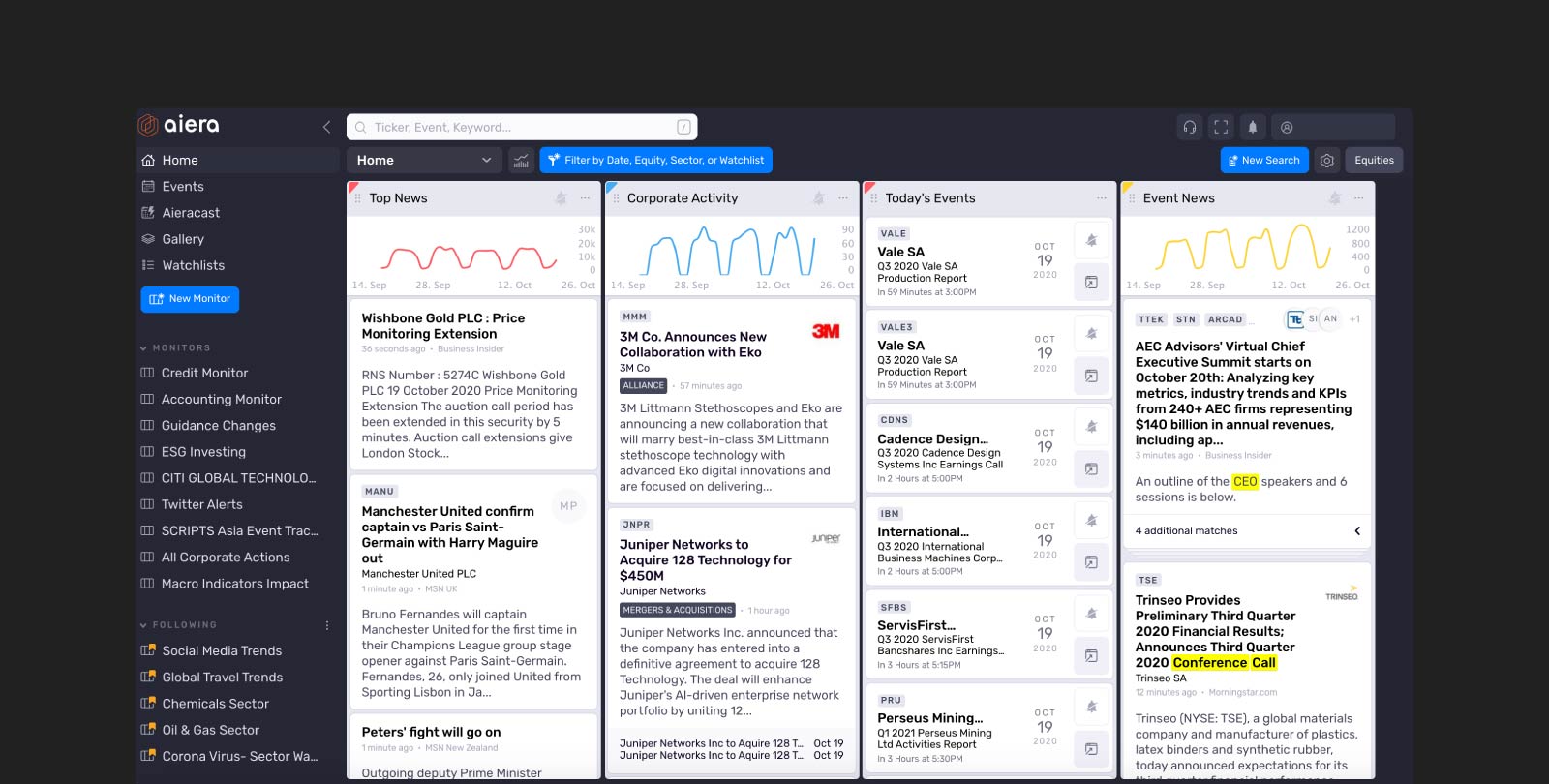
Best for: Earnings call monitoring and live event intelligence
Where most alternatives on this list compete on document synthesis or workflow automation, Aiera occupies a different lane entirely: real-time event intelligence. The platform covers more than 60,000 investor conferences and earnings events each year across 13,000+ companies worldwide, providing live transcription, one-click audio, and sentiment analysis through a desktop and mobile app as well as direct API access. For equity analysts and portfolio managers who need to be in the room without actually being there, Aiera is built for that workflow.
The platform's limitations come into focus when the workflow moves beyond monitoring. Aiera's AI capabilities span transcription, entity and topic extraction, sentiment analysis, SWOT analysis, and event summarization, but it doesn't generate the downstream deliverables that follow from those insights. Teams that need to act on what management says during an earnings call will still need a separate platform to do so.
Key features:
- Live streaming transcription with <1s latency: Aiera is the only live event monitoring and search platform covering all available Wall Street events, delivering real-time transcription fast enough to track breaking commentary and guidance revisions as they happen.
- Tonal sentiment analysis: Aiera's intelligence layer includes tonal sentiment analysis alongside topic relevance rankings and Q&A overviews, surfacing not just what management said but how they said it.
- Cross-company management commentary tracking: Aiera delivers source intelligence across corporate earnings, government announcements, and industry conferences, enabling analysts to track thematic shifts in management commentary—pricing language, capex guidance, demand signals—consistently across a coverage universe.
Rogo vs. Aiera
Rogo | Aiera | |
|---|---|---|
Collaboration | No collaboration features | Team watchlists and smart alerts allows teams to share monitored events and alert settings |
Scale | Built for deal-driven research workflows | Built for breadth of event coverage, not deep document analysis |
Reliability | Response-level citations tied to external data partnerships | Human-reviewed transcripts with auditable sourcing, with reliability anchored in live event capture rather than synthesized research |
Financial data access | Aggregates external market data via third-party partnerships (LSEG, FactSet, S&P) | No structured financial data or market data outside of earnings and conference content |
Workflow customization | Purpose-built agents for IB deliverables: memos, benchmarking, screening | Monitoring, alerting, and transcript search workflows, but no downstream deliverable generation (memos, models, presentations) |
Slide generation | Single slide outputs within the platform UI | Platform surfaces intelligence but does not generate formatted outputs |
Excel modeling | Standardized modeling support within the UI | Not available—event data accessible via API for teams building their own integrations |
10. DataSnipper
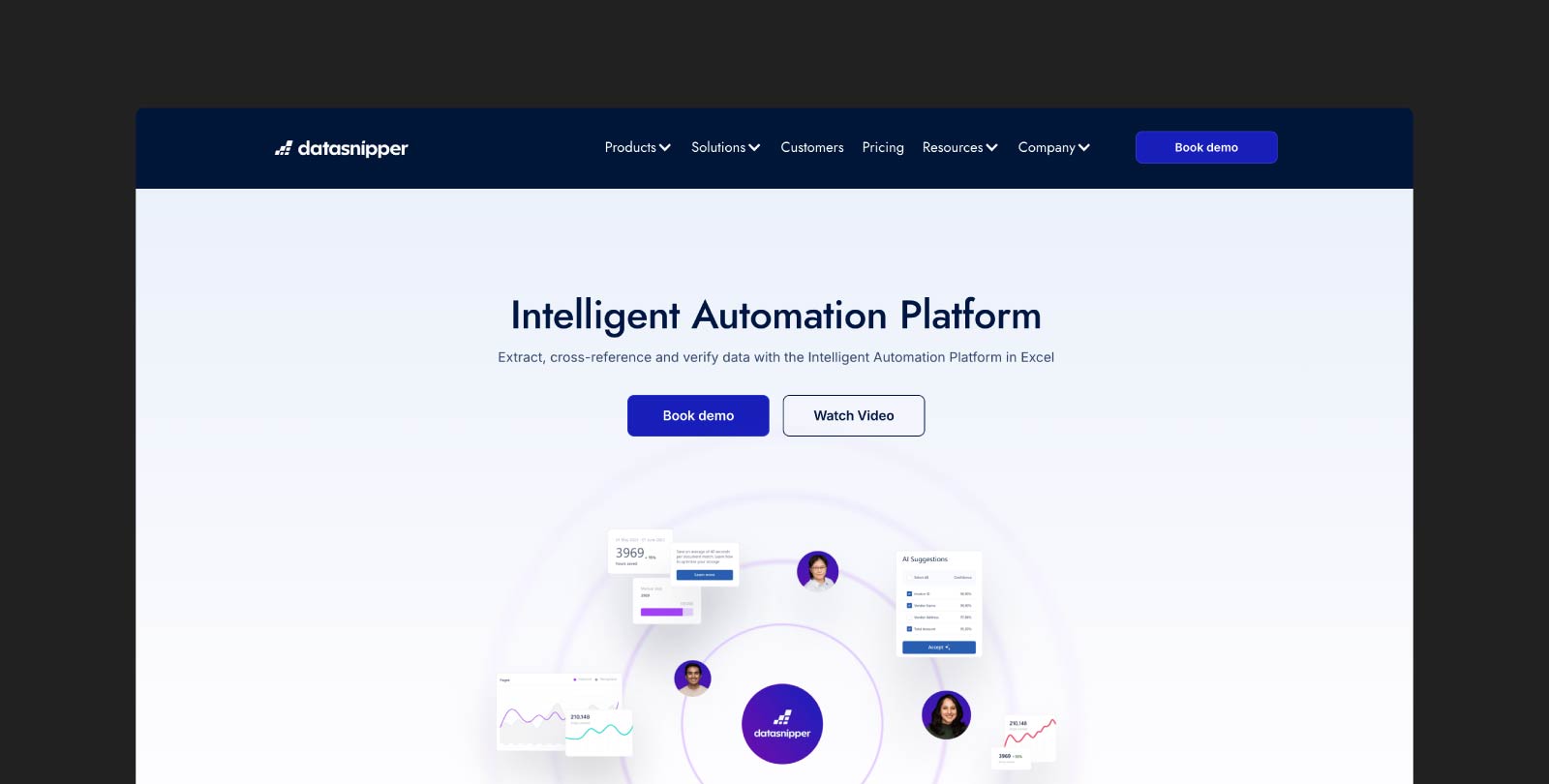
Best for: External audit, forensic accounting, and reconciliation
DataSnipper is an Excel-native intelligent automation platform built specifically for audit and finance teams. The platform allows users to extract data from source documents, link it directly into Excel, and create a fully traceable audit trail—all without leaving the spreadsheet. It has also expanded steadily into internal audit, SOX compliance, and forensic workflows across banking, insurance, and manufacturing.
DataSnipper excels at matching a number in an Excel cell back to its source document with a traceable reference, but it doesn't synthesize market data, generate IC memos, or support deal-side analysis. For audit teams managing high volumes of evidence across complex engagements, it's a well-regarded tool; for investment banking or diligence workflows, it's simply not designed for that use case.
Key features:
- Document matching for ledger-to-PDF verification: DataSnipper's Document Matching automatically matches Excel data with supporting documents such as invoices, bank statements, and contracts, locating the correct text, date, or number in the source file and creating a direct reference back to the sample.
- "Snip" technology for traceable audit trails: The AI understands financial documents and provides answers always linked back to the original source, so users can verify everything with full transparency.
- Excel-native verification agents: AI agents powered by Microsoft Azure that embed directly into audit workflows to drive productivity, eliminate repetition, and accelerate reviews, enabling auditors to query evidence-collection requirements, extract relevant documentation, and flag high-risk items without leaving the Excel environment.
Rogo vs. DataSnipper
Rogo | DataSnipper | |
|---|---|---|
Collaboration | No collaboration features | Review and annotation features allows managers to review "snips" directly in a shared Excel workbook |
Scale | Built for deal-driven research workflows | Built for evidence verification breadth, not synthesis across unstructured research |
Reliability | Response-level citations tied to external data partnerships | Snip-based references linked directly to source documents in the workbook; every claim is traceable to its original evidence file |
Financial data access | Aggregates external market data via third-party partnerships (LSEG, FactSet, S&P) | Works exclusively with documents provided by the engagement team, with no external market data, company research, or financial database access |
Workflow customization | Purpose-built agents for IB deliverables: memos, benchmarking, screening | Purpose-built agents for audit procedures: SOX testing, test of controls, walkthroughs, contract review, with no deal-side or research workflow capability |
Slide generation | Single slide outputs within the platform UI | Outputs are structured workpapers and traceable audit documentation, not presentation-ready formats |
Excel modeling | Standardized modeling support within the UI | All verification, extraction, and matching workflows run directly inside Excel workbooks |
How To Choose the Right Rogo Alternative
The right platform depends less on feature lists and more on how your team actually works. A few factors worth considering before you commit:
- Consider whether your team works alone or together: Some platforms are built for individual productivity — a single analyst running queries on their own documents. If your workflows involve multiple departments sharing context across a deal, look for platforms with true collaboration infrastructure. Hebbia's Projects gives the full deal team a shared workspace, so they can instantly build on the same institutional knowledge, documents, and workflows.
- Match the tool to your primary use case: If you're running complex due diligence on thousands of documents, prioritize platforms with advanced document interrogation, such as Hebbia's Iterative Source Decomposition technology. For market intelligence gathering, focus on the breadth of data sources, such as Hebbia or S&P Capital IQ Pro.
- Evaluate integration requirements: Determine whether the platform can integrate with your existing tech stack. Hebbia's end-to-end workflows can replace multiple point solutions, while tools like Vena Copilot are built specifically for Microsoft 365 environments, and FactSet offers robust API access for custom integrations.
- Assess your document volume and complexity: Platforms handle scale differently. If you regularly analyze entire data rooms with 1,000+ documents, Hebbia's infinite context window allows simultaneous analysis across all files. Smaller, focused research projects may not require this level of processing power.
- Consider team size and deployment scope: Some platforms price per seat and work best for smaller teams, while others are designed for firm-wide rollouts. Determine whether you need a specialized tool for a single department or an agile operating system like Hebbia that can coordinate work across multiple teams and projects.
- Test accuracy and source transparency: Request demos with your own documents and verify how each platform handles nuanced questions. Hebbia's direct-source linking and page-level verification ensure you can trace every insight back to its source—critical for high-stakes financial decisions where audit trails matter.
Stop Prompting and Start Building with Hebbia
Looking across Rogo competitors, you'll find tools built for different strengths, like quick answers, market research, or narrow use cases. Some handle multi-document analysis, but most aren’t fit for the complex workflows that define institutional finance.
Chat-based workflows and simple document Q&A only scratch the surface of what Hebbia does. While Rogo and its competitors excel at conversational knowledge retrieval, Hebbia's collaboration, scale, integrations, and output quality make it great for diligence of any kind. The world's leading financial institutions use Hebbia because it transforms weeks of manual synthesis into hours of verified, structured output—the kind of work product that determines whether or not you win deals.
Request a demo to see Hebbia handle your actual workflows to see what institutional-grade AI can do for your business.


