
Finance Teams Spend Hours Each Week Searching For Data Buried in Documents
The job of a finance professional runs through documents. But as document volumes have grown, so has the time it takes just to find the right information—and that search burden is quietly shaping the quality of the work that follows.
We surveyed more than 500 U.S.-based finance professionals to understand how document retrieval challenges affect their day-to-day work. The findings show that time lost to search is only part of the story. The harder it is to find information, the harder it is to trust the conclusions drawn from it.
Three in four respondents say document volume is affecting the accuracy or depth of their analysis. For many, that means operating under real uncertainty about whether the full picture was captured before a recommendation was made.
That search burden is carrying consequences for the quality and completeness of the work that follows. The sections below trace where that pressure is being felt, and where financial analysis AI is beginning to redefine how finance teams preserve and act on institutional knowledge.
Key Takeaways
- 50% of finance professionals spend 6 or more hours per week searching for information in documents before analysis can begin.
- 39% say their team repeats searches at least monthly because prior work is hard to locate.
- 40% say important insights or risks get overlooked at least once a month due to time pressure.
- 76% say document volume affects the accuracy or depth of their analysis at least occasionally, with 39% saying this happens frequently or almost always.
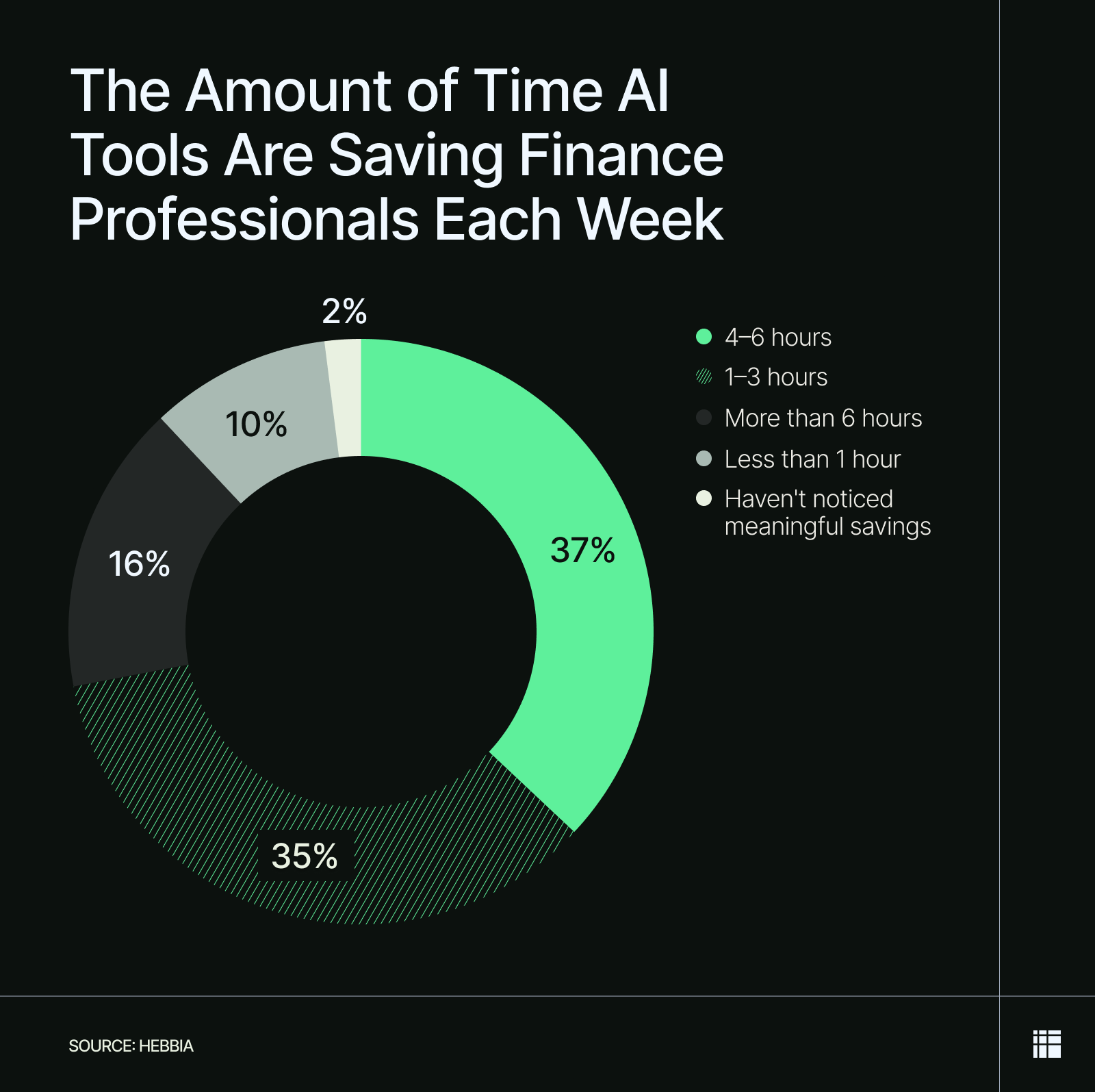
- Among finance professionals using AI tools for document work, 53% estimate saving 4 or more hours per week.
Documents Occupy a Big Part of the Finance Workweek
Searching for information is not the same as analyzing it, but for many finance professionals, the two have become difficult to separate. Half of our survey respondents say they spend six or more hours per week searching across financial documents just to locate specific information, and 13% spend more than 10 hours doing so. That is time spent before a single line of analysis has been written.
The volume of documents driving that search load is substantial. 70% of respondents typically review 51 or more documents in a single financial analysis or evaluation, with 27% reviewing more than 100. At that scale, search becomes an ongoing part of the work rather than a quick preliminary step.
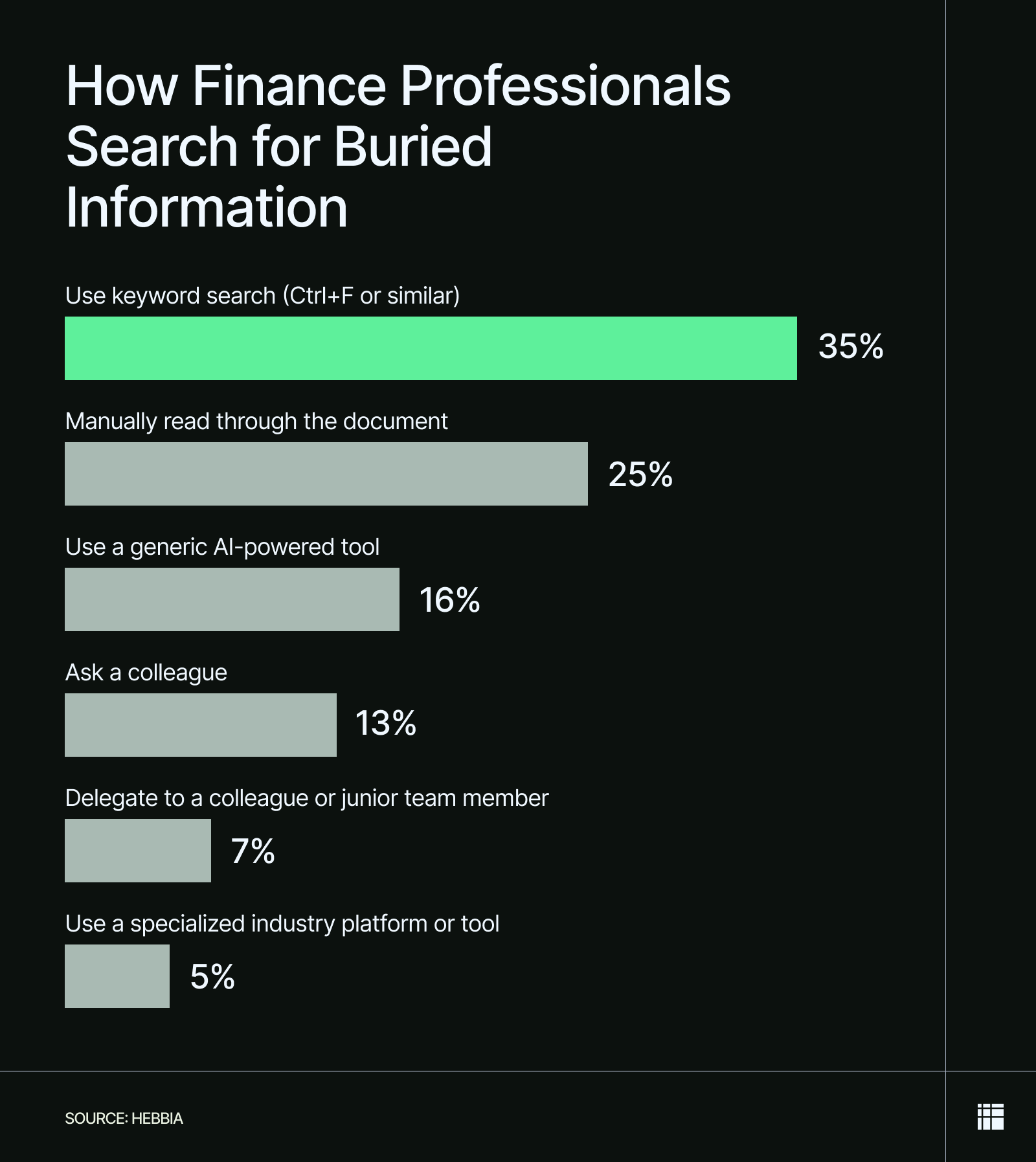
When professionals need to locate a specific data point buried in a document, most still rely on basic methods. More than a third say their first move is an old-school keyword search, while a quarter manually read through the document. Only 5% turn to specialized financial research platforms that are built for this kind of retrieval.
As a result, six in 10 finance professionals are defaulting to time-intensive retrieval approaches—creating a meaningful drag in workflows where speed and accuracy both matter. For firms still relying on Ctrl+F and manual reads as their primary retrieval methods, Hebbia's Matrix represents one of the more immediate and measurable upgrades available to finance teams today.
Having Too Many Documents to Examine Is Hurting the Accuracy and Depth of Financial Analysis
The hours spent searching for information carry a cost beyond lost time. More than three-quarters of respondents say the volume of documents they need to review affects the accuracy or depth of their analysis at least occasionally. And for two out of five professionals, that happens frequently or almost always.
At that frequency, document volume regularly shapes the conclusions they reach. That influence becomes more pointed when looking at how professionals assess their own work, with 37% saying they are at most somewhat confident they captured all relevant information before making a recommendation or decision.
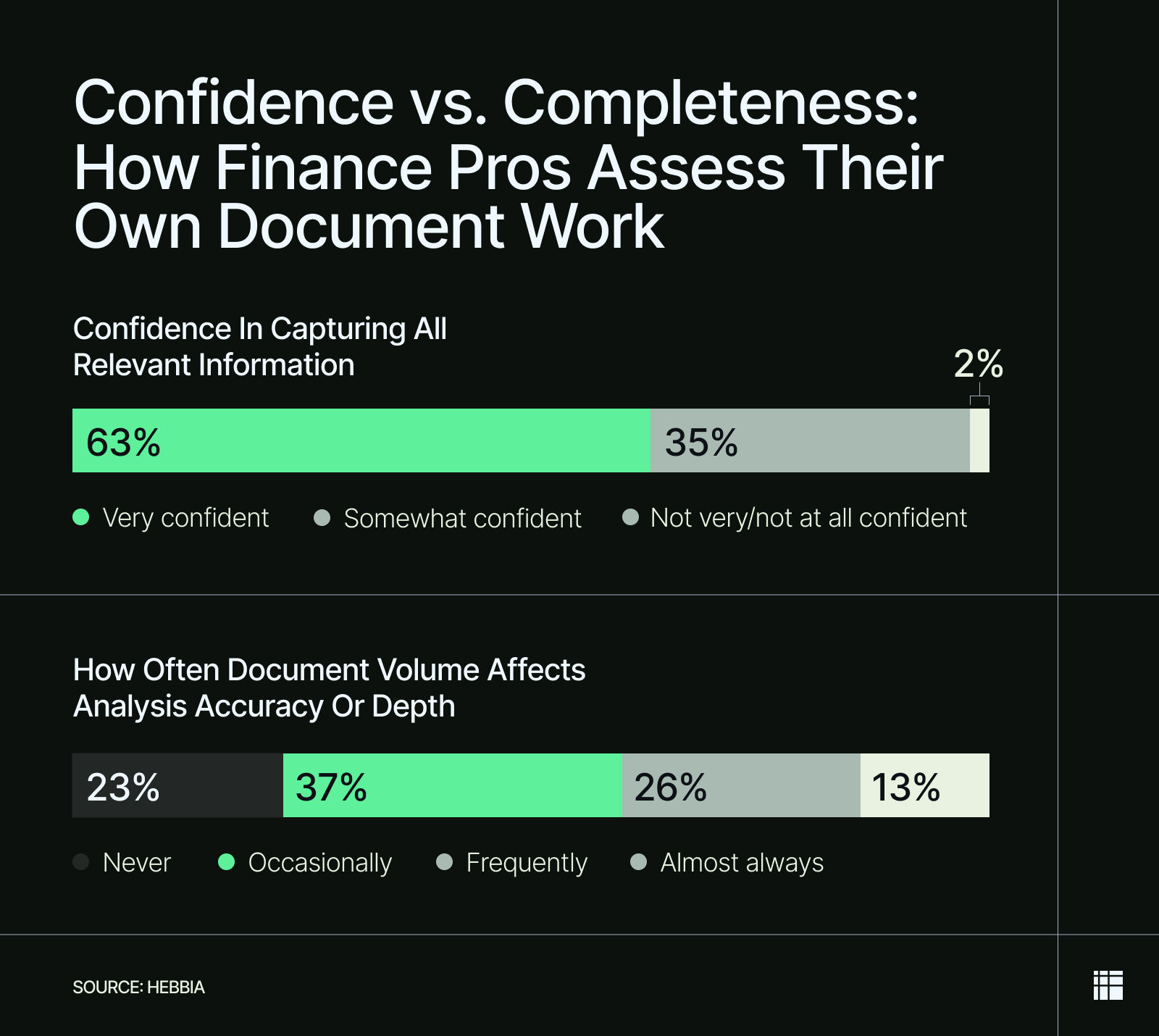
In many fields, some degree of uncertainty is manageable. In finance, where recommendations carry capital consequences, even a moderate level of doubt about completeness has material implications.
Because fragmented document workflows make it genuinely difficult to know what wasn't seen before a decision was made, a firm-wide AI platform that surfaces relevant information automatically doesn't just save time. It restores the confidence that thorough analysis was actually done.
Missed Insights and Repeated Work Are Regular Costs of Fragmented Documentation
When there isn't enough time to review every document thoroughly, something gets missed. Two out of five finance pros say important insights or risks get overlooked at least monthly for exactly that reason, and 13% say it happens weekly or more.
That means missing important information is a regular occurrence for a meaningful share of professionals working under real-time pressure.
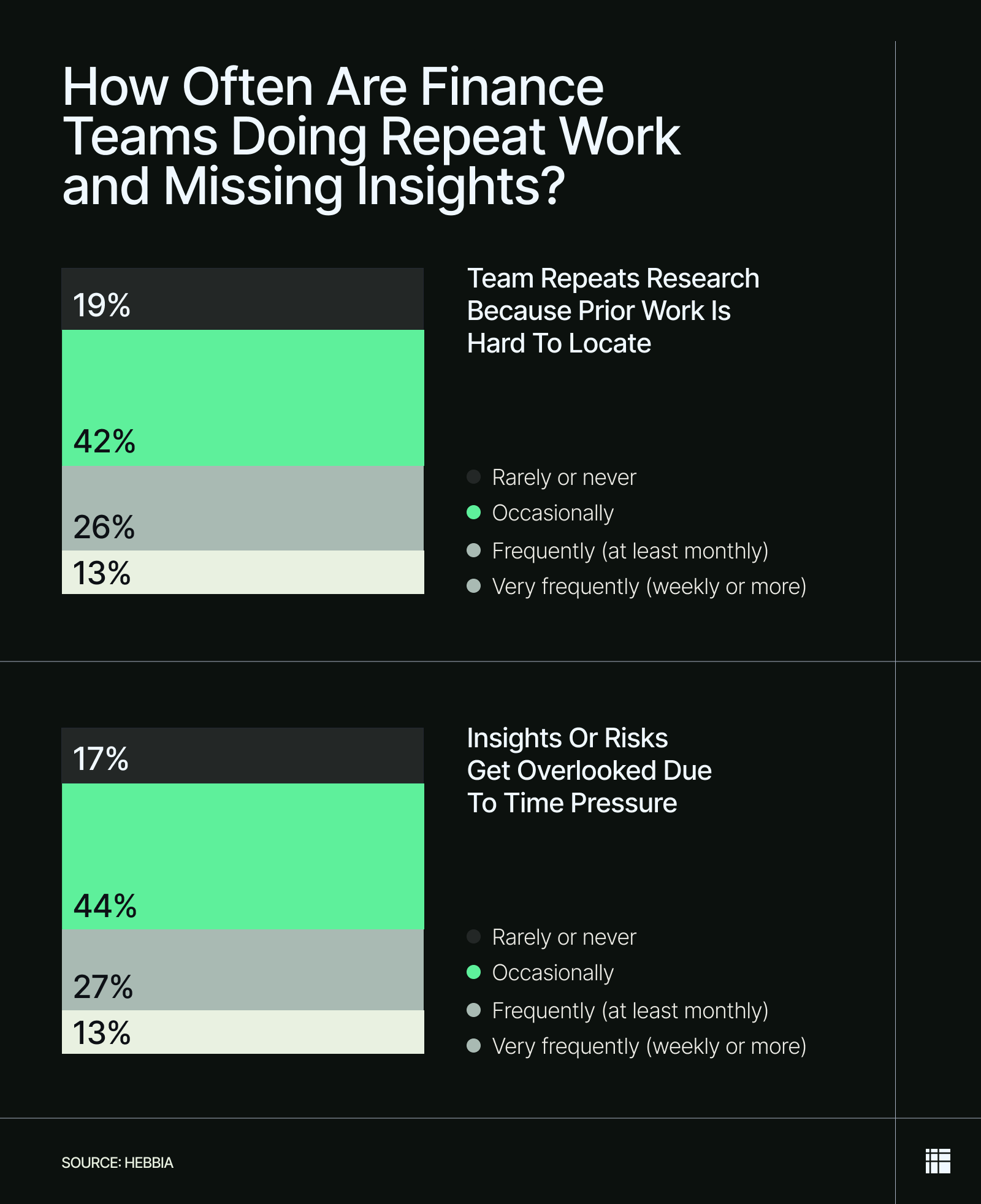
Fragmented documentation creates an additional cost on top of missed insights. 39% say their teams repeat research or analysis at least monthly because prior work is simply too difficult to locate or access, with 13% reporting this happens weekly or more.
Every hour spent redoing work that already exists somewhere else could have gone toward moving a deal or decision forward. As AI due diligence tools become more widely adopted, the ability to surface and retain prior work automatically is emerging as one of the more practical ways to reduce duplication.
Even if the hands-on work of document retrieval tends to fall to more junior staff, the consequences of fragmented documentation don't stay at the junior level.
When senior leaders are making recommendations based on searches they know were incomplete, it erodes the conviction behind their decisions and increases the firm's exposure to institutional risk. Preserving that conviction—and the institutional knowledge behind it—is as strong a case for AI as saving analyst hours.
AI Is Already Saving Finance Teams Real Time
AI adoption for document work is already well underway across the industry, though how deeply it has taken hold varies considerably. Among survey respondents, 43% say their firm regularly uses investment research software or other AI tools for document search, synthesis, or analysis, while another 26% say adoption has been limited or inconsistent.
The remaining 31% are either still evaluating options or haven't explored AI for document work at all, meaning a significant share of finance teams are still absorbing the full cost of manual document workflows every week.
For those using AI tools regularly, the time savings are tangible, with 53% of AI users estimating that they save four or more hours per week. When held up against the six or more hours that many professionals report spending on document search alone, those savings represent a meaningful shift in how workweek hours get allocated.
Most finance professionals expect that shift to accelerate, consistent with broader AI trends in finance. More than three quarters expect AI to bring major or significant changes to how financial professionals work with documents over the next three years.
The firms best positioned to lead that shift are treating AI not as a point solution for search, but as a layer of institutional memory, thus ensuring that analysis completed on one deal or credit review doesn't disappear into a folder no one can find six months later. The teams still absorbing the costs documented by our survey are the ones with the most to gain.
What Document Overload Really Costs
Across a variety of finance teams, the same pattern shows up repeatedly. Time is lost to search before analysis begins. Document volume then constrains the depth of that analysis. Insights get missed under time pressure. And when prior work can't be found, the effort gets repeated. Each of these costs adds up to a significant drag on the speed and quality of finance work.
AI can read and synthesize documents faster than any human, driving productivity on individual tasks. But the firms getting the most out of AI are the ones that have put their documents on a common platform, so every search, analysis, and decision draws from the full picture of their proprietary data. Hebbia is built to be that platform, giving your firm's AI the context it needs to move from first search to final recommendation.
Methodology
The survey was conducted by Centiment for Hebbia. The survey was fielded between March 31 and April 4 of 2026. The results are based on 525 completed surveys among U.S.-based finance professionals across investment banking, private equity, private credit, corporate finance, and related roles. Respondents were screened to confirm active work in finance. Data is unweighted, and the margin of error is approximately +/-3% for the overall sample with a 95% confidence level.


