
10 Best Investment Research Software Platforms
Investment research software has been driving industry-wide changes for decades now. Thanks to the industry’s leading platforms, modern institutional investors are practically drowning in data, from deep company financials and private company intelligence to public market and stock price data.
The sheer volume of information available across platforms has enabled firms to build stronger strategies at a much larger scale. But that scale comes off the backs of hard-working professionals who get in the weeds and synthesize actionable insights from thousands of documents and reports, often with fragmented workflows and hours of manual drudgery.
The emergence of AI in finance is helping these professionals reason over data more quickly and generate outperformance in a market where data is effectively democratized. With 89% of the finance industry expecting to collaborate with AI on the main aspects of their jobs in the future, this analysis is no longer a nice-to-have feature.
The Best Investment Research Software At a Glance
Below is a snapshot of the best investment research software.
Investment research software | Best for | Notable features |
|---|---|---|
Hebbia | End-to-end, institutional investment research | - Max for finance-native chat and first-pass deliverables |
Bloomberg Terminal | Real-time market data and news | - Sell-side and independent research from 1,200+ sources - Comprehensive global market news - Portfolio analytics |
FactSet | Portfolio analytics and risk metrics | - FactSet Workstation for comprehensive data access - AI-powered investment banking workflows - Advanced attribution and performance analysis |
PitchBook | Private market intelligence | - Global fund performance and investor activity data - In-depth intelligence on private companies - Deal history visibility |
S&P Capital IQ Pro | Deep company-level financial data | - Granular quantitative and qualitative data - Extensive plug-ins and analysis tools - Company and market monitoring solutions |
Morningstar Direct | Unified public and private market data | - Comprehensive public and private market data access - Customizable data feeds - Presentation Studio for deck building |
Koyfin | Data visualization and customizability | - Portfolio modeling and analysis tools - Custom watchlists for asset and market monitoring - Company Snapshots for security-level insights |
AlphaSense | Proprietary insights and research augmentation | - Proprietary expert-led insights - Generative Grid for document comparison - Excel integration |
VerityRMS | Extensive third-party integrations | - In-app collaboration tools - Generative AI solutions - Various third-party integrations |
CalibreRMS | Financial modeling | - ESG data centralization platform - Financial modeling tools - Extensive third-party data aggregation |
1. Hebbia

Best for: End-to-end, institutional investment research
Institutional investors use Hebbia to give AI the context a decision needs.
That context is scattered. Filings, transcripts, credit agreements, VDRs, and years of internal memos sit in different systems. Third-party data sits in others. An AI model working from one of them sees part of the picture.
Matrix, Hebbia's proprietary engine, reads thousands of these documents at once and keeps the analysis in one workflow. Native connections to databases like S&P Capital IQ add third-party data to the same view. The model works from everything your firm has, not one source at a time. Teams stop reconciling conflicting answers across platforms.
Agents and Skills then run your firm's processes on that context, such as screening companies, pulling precedent transactions, and drafting a first pass. Every output cites its exact source in-line, so it stands up in front of an investment committee (IC) or portfolio manager.
Firms managing $30 trillion in assets under management (AUM) use Hebbia, including leading private equity firms and credit funds.
Key features:
- Max for first-pass deliverables: Max, Hebbia’s AI agent for institutional finance, turns finished analysis into the chart, dashboard, or deck a team needs next, and every figure traces back to the source behind it. Max never recalculates or invents a value, so a first pass arrives ready to review.
- Matrix for high-volume, multi-step document analysis: Matrix runs structured analysis across thousands of documents at once, with each column handling a step in the workflow. Teams pull from private files, connected data feeds, and the web in the same grid, then feed one Matrix into another to build a repeatable pass.
- Autonomous Agents and Skills for screening, precedents, and diligence: Firms build investment research processes that Agents and Skills execute autonomously and repeatedly, so they can focus on surfacing critical signals. Every research workflow follows the same standards regardless of who runs it, with sharing and permissioning controls adding guardrails.
- Iterative source decomposition (ISD) technology: Hebbia’s reasoning engine outperforms retrieval augmented generation (RAG) with a multi-agent architecture that links every takeaway or statement of fact to inline citations that highlight the precise source they came from. This granular traceability helps researchers attribute information in reports and decks and leaves a clear audit trail for decision-makers to follow as they conduct their final assessments.
- API and MCP server for connecting Hebbia to your own stack: Hebbia's API and MCP server let firms pull Hebbia's context into the models and internal tools they already run. Filings, VDRs, internal memos, and third-party data come together in one place, so a firm's own AI works from the full picture instead of one source at a time.
- Enterprise-grade security: With encryption for data in transit and at rest and full compliance with data security standards and regulations such as GDPR, SOC2 Type I, and SOC 2 Type II, Hebbia provides a secure environment for finance firms.
2. Bloomberg Terminal
Best for: Real-time market data and news
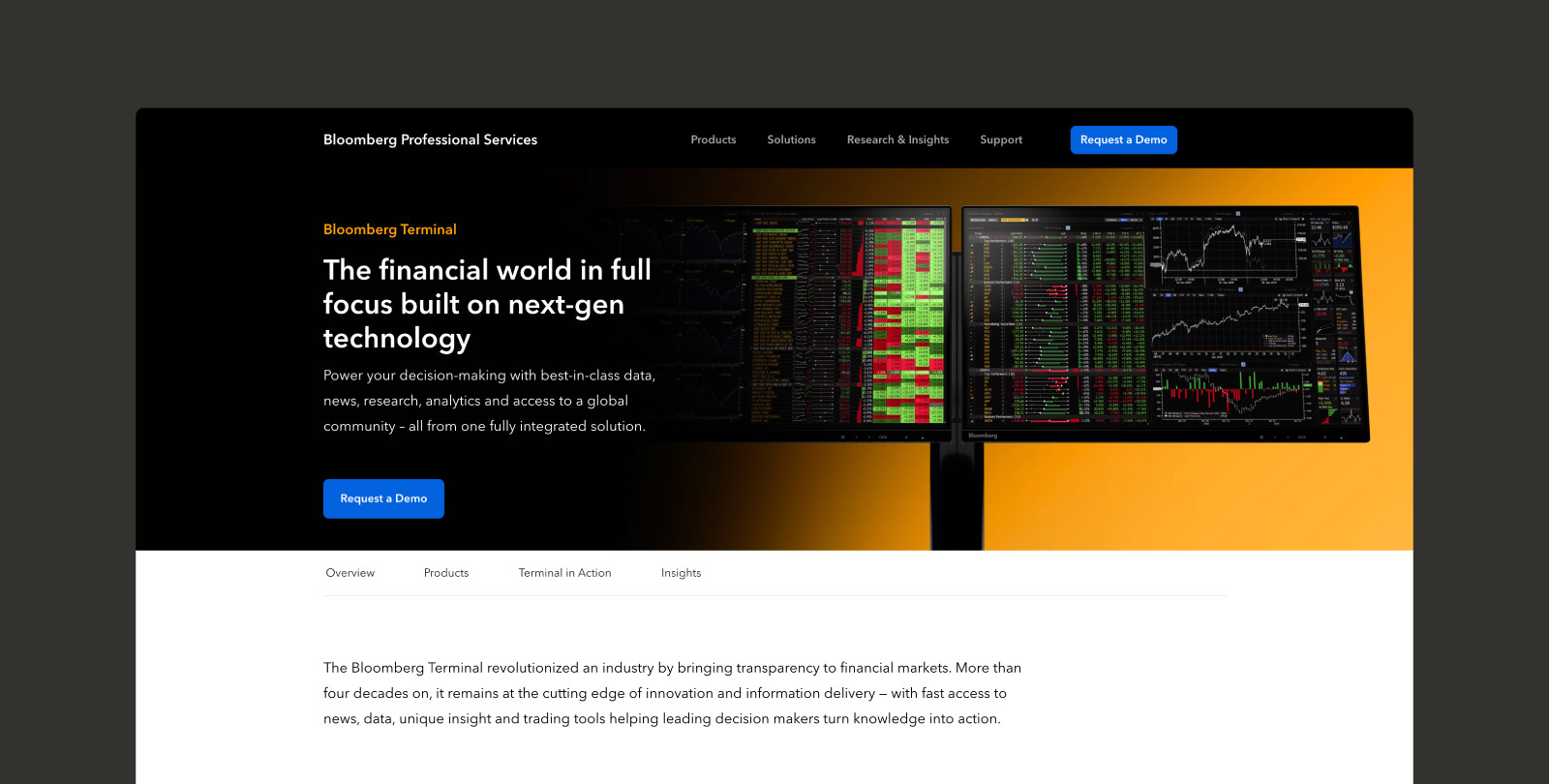
The Bloomberg Terminal provides an industry-standard information ecosystem for fundamental and quantitative investment research. Professionals rely on the Bloomberg Terminal to access everything from news headlines and macroeconomic trends to company fundamentals and stock insights.
For analysts and portfolio managers, it acts as a central repository for granular financial and credit history, consensus estimates, and deep market intelligence across asset classes. This investment research software provides tools for customizable daily reports, AI-powered analysis, financial modeling, backtesting, signal generation, and much more.
Key features:
- Sell-side and independent research from 1,200+ sources: This investment research platform aggregates research reports from investment banks, expert analysts, and specialized research firms into a centralized repository. Professionals can search across this content to gather multiple perspectives on investment opportunities, and even message individual analysts directly.
- Comprehensive global market news: Known for its speed, Bloomberg Terminal's news operation delivers real-time coverage of market-moving events, corporate developments, and regulatory changes across global markets from over 1,000 news agencies. The news function integrates directly with pricing data and analytics, allowing users to correlate events with market reactions and sentiment.
- Portfolio analytics: Bloomberg Terminal provides access to customizable analytics tools for risk modeling across asset classes, performance attribution, and multi-portfolio visualization, alongside client reporting features that generate thousands of customized outputs at once.
3. FactSet
Best for: Portfolio analytics and risk metrics
FactSet is an investment research software tool that provides institutional investors with integrated financial data and analytics across public and private markets. Professionals can use the platform to aggregate current and historical industry, market, and company-level data from hundreds of sources. FactSet also provides access to real-time news reports, alternative data, and financial modeling solutions.
This investment analytics software platform augments research workflows with a comprehensive research management system (RMS) that lets teams organize their records in a searchable database. FactSet is regarded as one of the best investment analysis tools, providing deep data access and the capabilities (including stress testing and scenario analysis tools) necessary to manage portfolios, track theses over time, and build market-beating strategies.
Teams already licensed for FactSet can also bring that data into Hebbia through an integration.
Key features:
- FactSet Workstation for comprehensive data access: FactSet Workstation integrates data from over 800 sources, providing visibility into everything from fundamentals and estimates to supply chain and geographic revenue exposure insights.
- AI-powered investment banking workflows: FactSet AI for banking automates the research-to-mandate cycle with agents that perform signal-driven research and generate deliverables.
- Advanced attribution and performance analysis: The platform offers an in-depth, unified portfolio analytics solution that simplifies attribution analysis and enables quick responses to market changes.
4. PitchBook
Best for: Private market intelligence
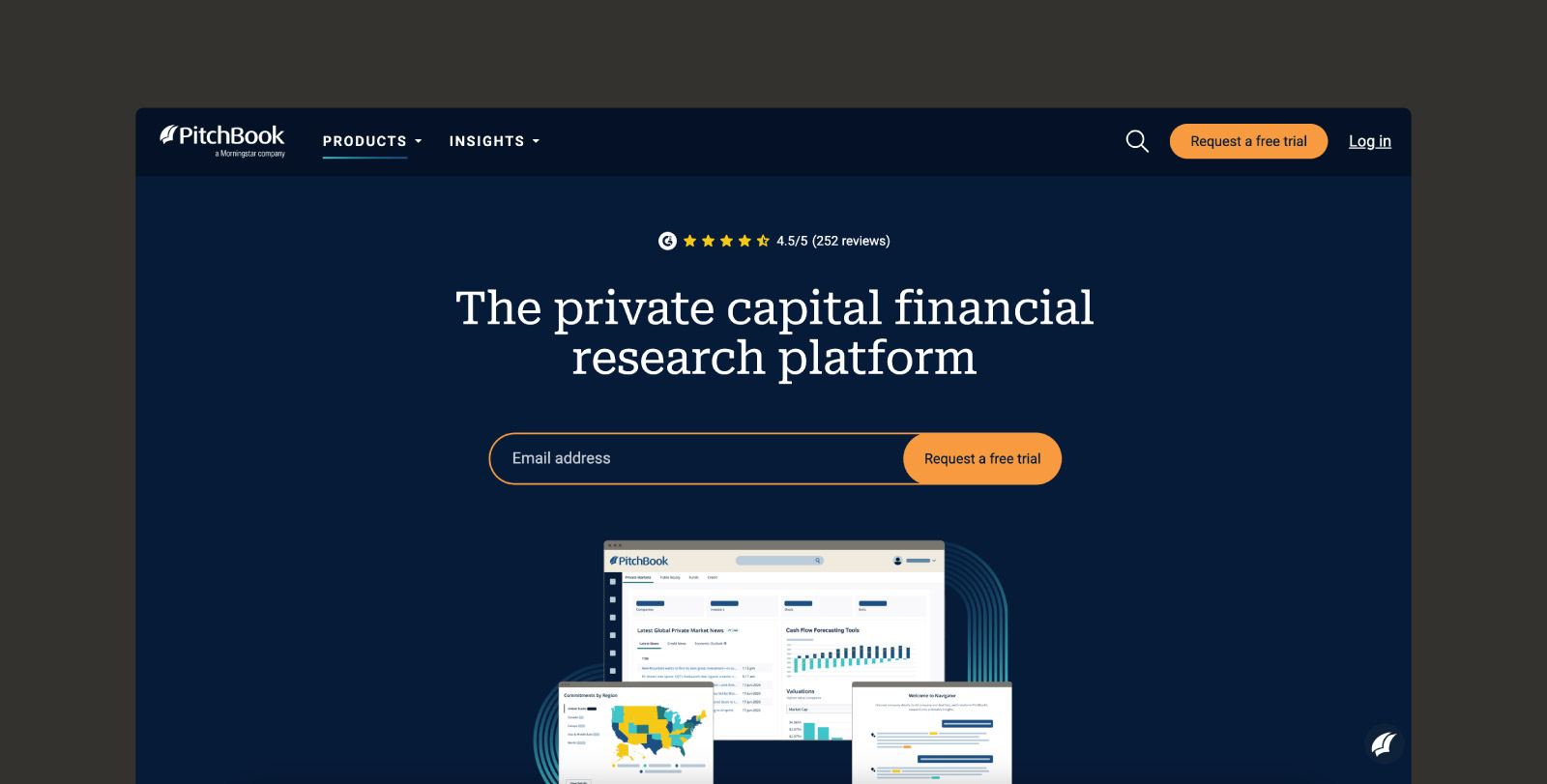
PitchBook delivers market-leading intelligence on private capital markets, serving private equity firms and investment banks that need visibility into deal activity, company financials, and private market trends. Teams can use the platform to source potential investment opportunities, access private market deal history, gain granular insight into emerging companies, and more.
The platform provides formatted market maps, historical valuations and multiples, and other points of competitive intelligence that inform strategic decisions and due diligence. Its database coverage is comprehensive, providing researchers with detailed information on both public and private companies, including those operating in nascent or emerging markets.
Hebbia users with a PitchBook license can also access this data within Matrix.
Key features:
- Global fund performance and investor activity data: Teams can use PitchBook to research detailed profiles of funds and investors, benchmark performance against them based on a variety of criteria, and track capital flows to follow investment and fundraising trends.
- In-depth intelligence on private companies: The platform contains detailed profiles for over 13 million businesses in total, including financials, historical valuations, leadership and investors, and operating metrics. Professionals can also access real-time coverage on companies within emerging spaces (before they break into public markets), so novel opportunities don’t fly under the radar.
- Deal history visibility: PitchBook’s database captures transaction details for nearly 3 million deals across private equity, venture capital, strategic M&A, and more. This capability lets researchers analyze precedent deals to inform decisions on pricing and deal terms.
5. S&P Capital IQ Pro
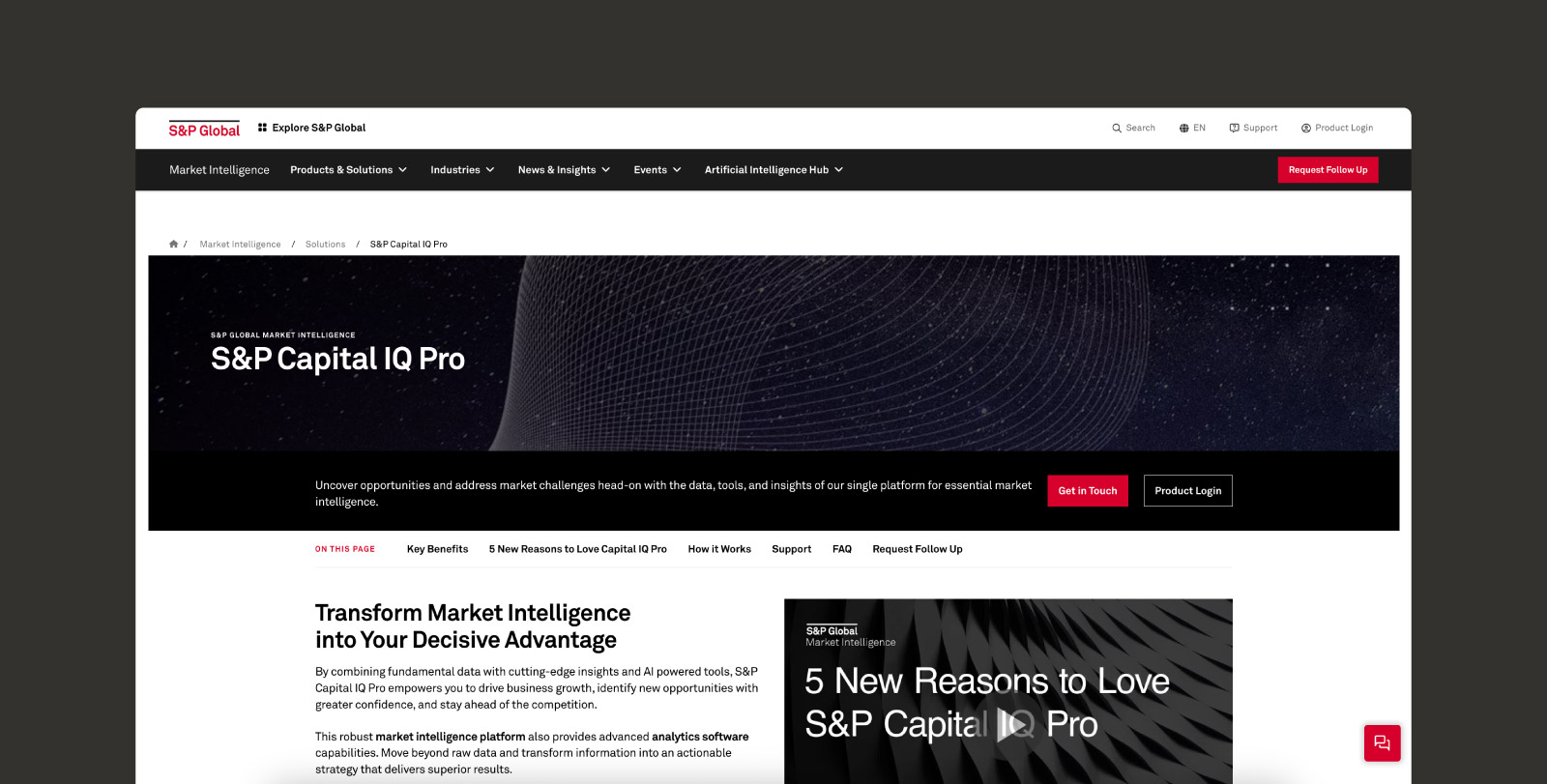
S&P Capital IQ Pro functions as a data and analytics platform for fundamental research across a massive range of public and private companies, markets, and individuals. It powers in-depth company and industry-level research, lets users build and track custom screening universes in real-time, and provides the tools necessary to translate those insights into action (including portfolio management solutions and source-linked financial modeling tools with click-through capacity).
This investment research software gives professionals access to one of the most all-encompassing information sources available today, with coverage ranging from macroeconomic trends and news headlines all the way down to company financials and credit ratings. Its comprehensive mix of in-house tools and third-party integrations make it ideal for production and analysis work. Over the past year, S&P has extended the platform beyond data access into document analysis, putting generative AI tools directly into the research workflow.
Key features:
- Granular quantitative and qualitative data: S&P Capital IQ Pro delivers an interface to a deep dataset covering tens of thousands of public companies and millions of private companies. It blends structured data, such as standardized financials, capital structure, and in-depth estimates, with soft intelligence, such as third-party research reports and transcripts.
- Extensive plug-ins and analysis tools: The platform features various investment analysis tools, including charting solutions to pick out trends, a peer-relative credit assessment tool, and an Excel plug-in with hundreds of customizable model and report templates.
- Automated document analysis: Document intelligence pulls insights from filings, transcripts, investment committee meeting packs, and limited partner filings, with natural language processing-based sentiment analysis surfacing themes and tone across earnings calls.
6. Morningstar Direct
Best for: Unified public and private market data
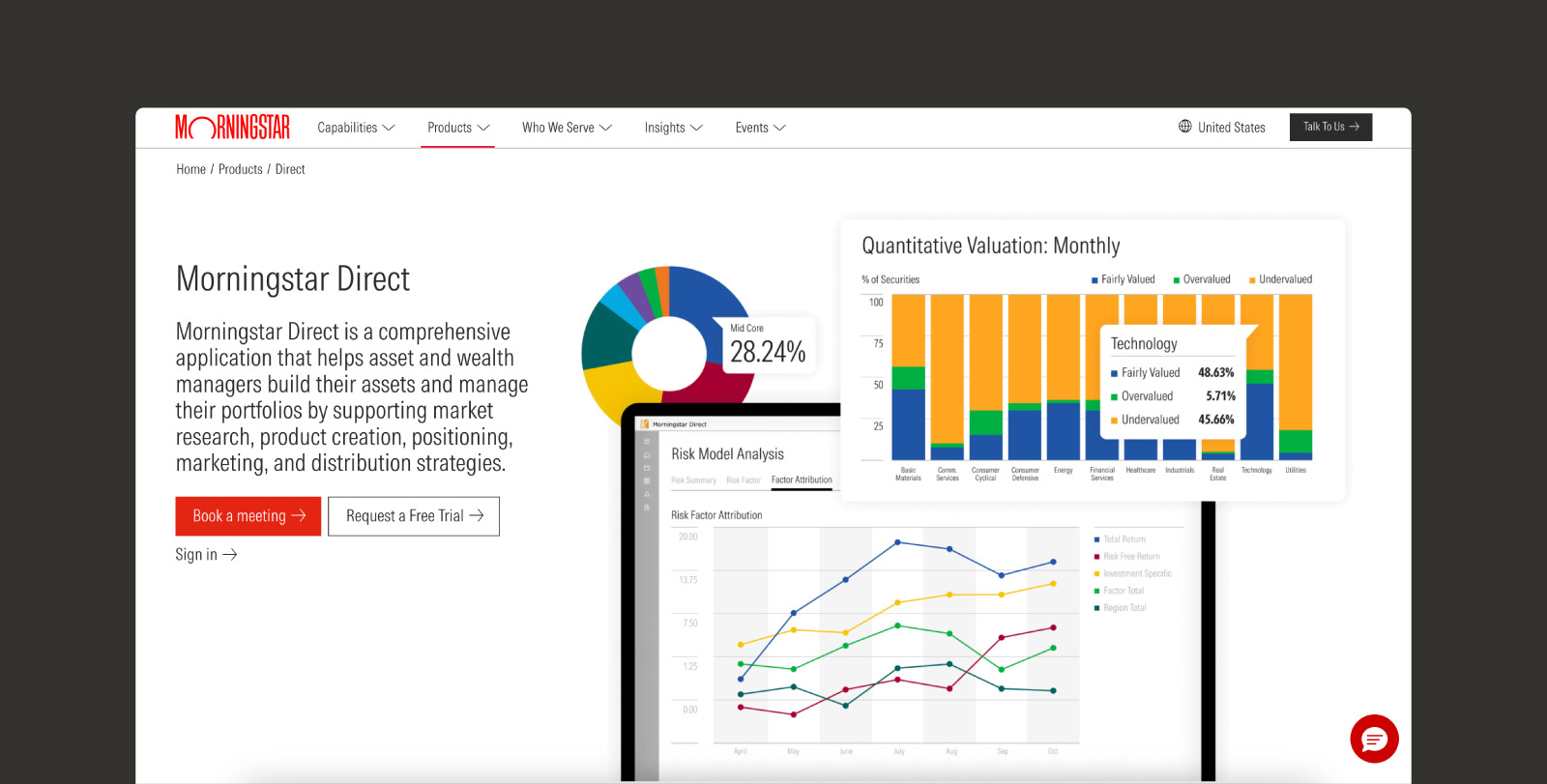
Morningstar Direct is an investment research software tool that provides an interface to both public security data and private market intelligence (with PitchBook data integrated directly into the platform). It enables teams to rigorously test active strategies against custom benchmarks and peer groups and supports due diligence with nuanced attribution insights and analyst ratings.
Morningstar Direct also bridges the gap between raw analytics and narrative storytelling with Presentation Studio, which lets you create custom data visualizations from Morningstar data and embed them in decks, reports, and more.
Key features
- Comprehensive public and private market data access: Morningstar’s database covers over 54,000 publicly traded companies and millions of privately held companies through PitchBook. Professionals can track market moves and stock prices, access exclusive quantitative and qualitative analyst ratings/assessments for securities, and surface opportunities quickly with a custom screening tool.
- Customizable data feeds: Morningstar Direct provides professionals with a fully customizable interface to Morningstar’s database. Users can choose their own sources, parameters, format, and delivery method to receive analysis-relevant data exactly how they want it.
- Presentation Studio for deck building: Presentation Studio simplifies deliverable creation, letting professionals use customized templates (for charts, graphs, tables, and more) integrated directly with Morningstar data to break down complex information into branded slide decks and reports.
7. Koyfin
Best for: Data visualization and customizability
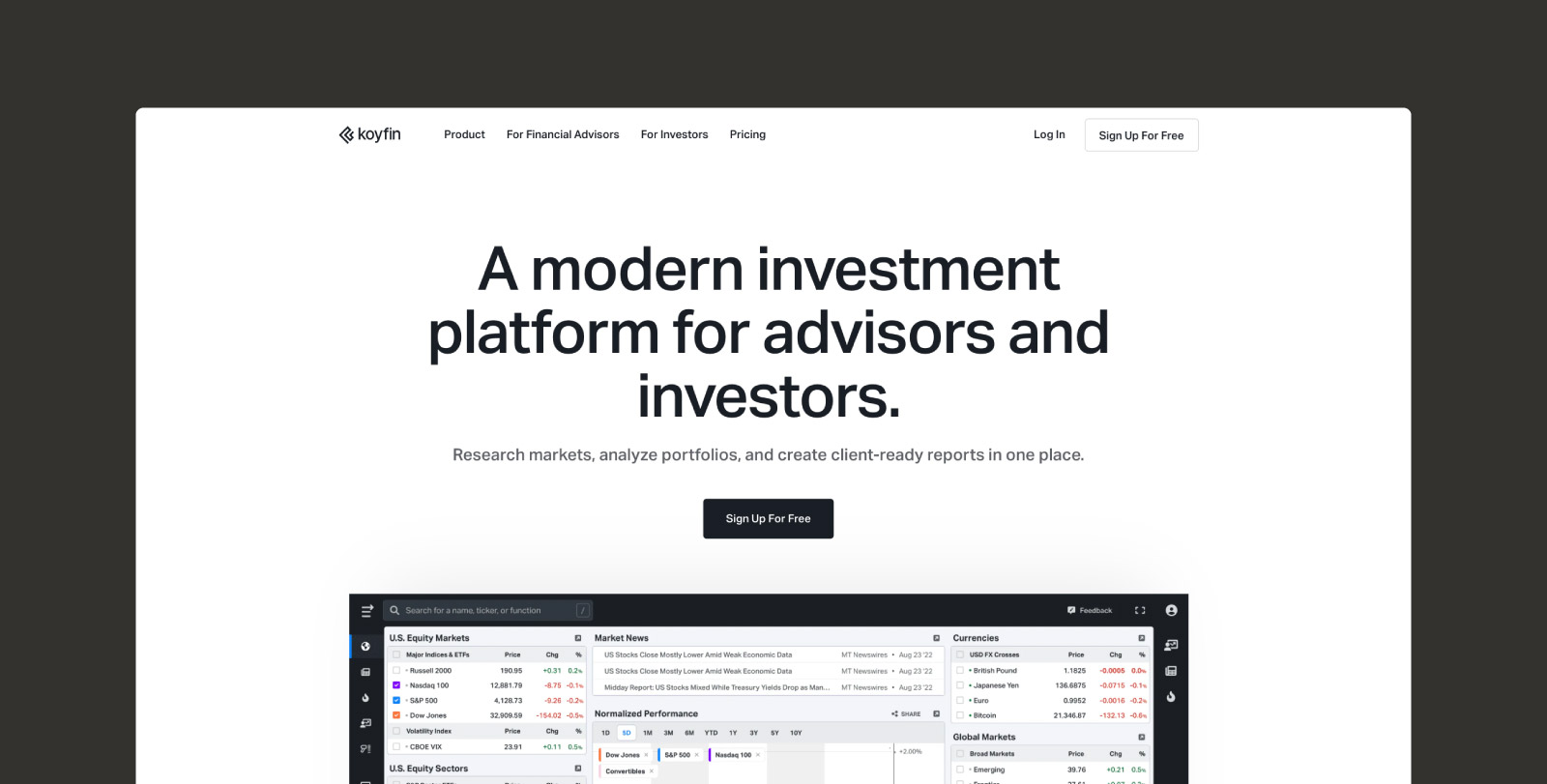
Koyfin is an investment analysis platform built with an emphasis on customization, workflow simplification, and flexibility to accommodate individual and firm-specific preferences. It delivers real-time and historical information access from a variety of third-party sources, including everything from fundamentals to consensus estimates.
Professionals can build, track, and share custom watchlists and newsfeeds that update in real time and deliver alerts for changes. Beyond visibility, Koyfin provides tools for deep financial analysis, including portfolio modeling solutions, stock performance assessment tools, and advanced charting capabilities.
Key features:
- Portfolio modeling and analysis tools: Koyfin enables investors to create and manage model portfolios with granular controls for rebalancing frequency, asset allocation, and more. Professionals can then conduct in-depth analysis of the model portfolio’s performance, including risk assessments, benchmark comparisons, and allocation drift monitoring.
- Custom watchlists for asset and market monitoring: The platform lets professionals create custom security watchlists and set alerts for events such as price target hits, valuation changes, and earnings releases.
- Company Snapshots for security-level insights: Koyfin packages fundamentals, analyst insights (such as price targets and earnings estimates), stock data, and historical and projected earnings into one convenient view for each company in its database.
8. AlphaSense
Best for: Proprietary insights and research augmentation
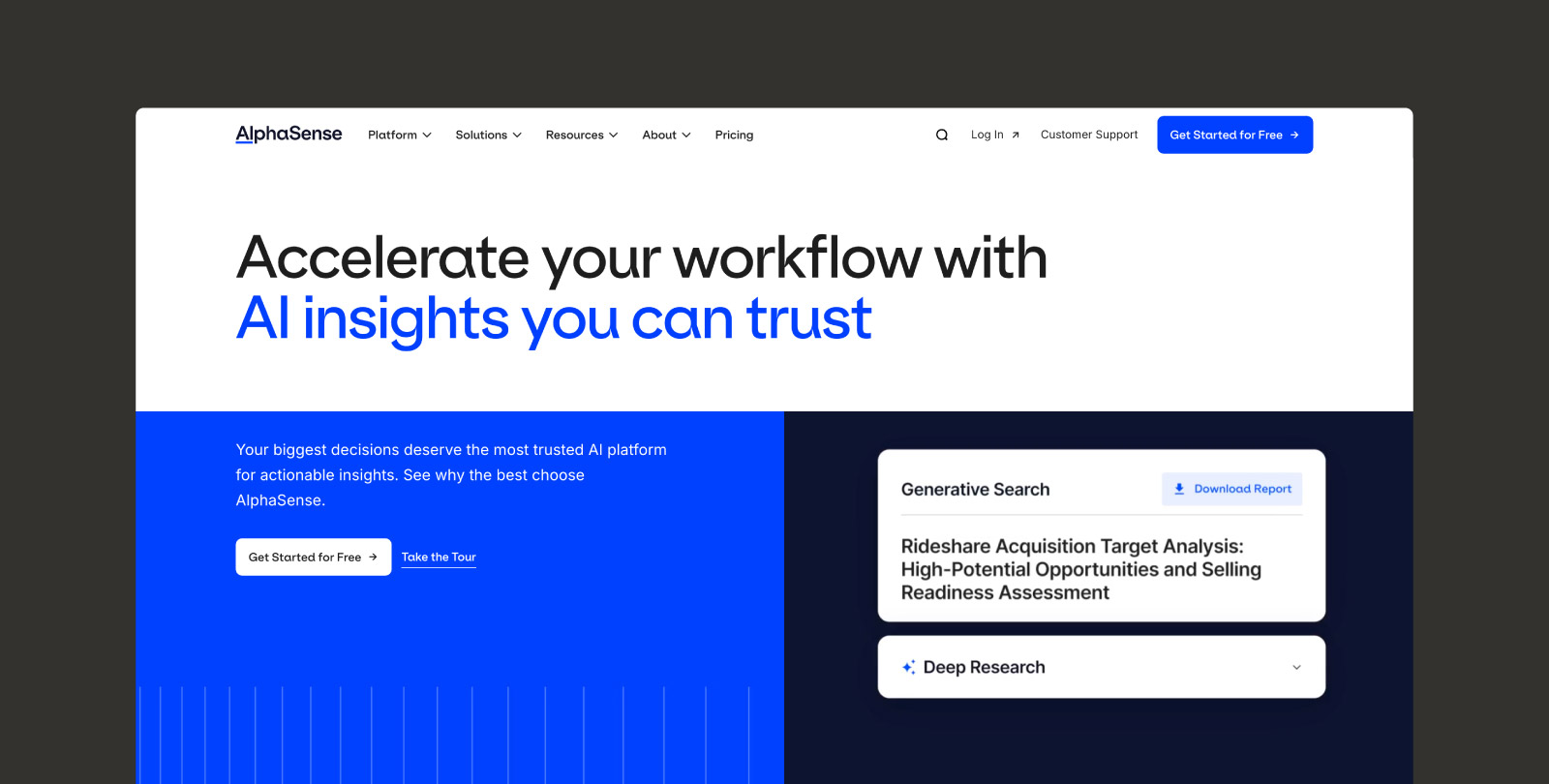
AlphaSense is a market intelligence platform designed for corporate and financial users. The platform lets professionals aggregate data (such as expert call transcripts, broker research reports, news stories, and SEC filings) into an intuitive interface, with accurate document summarization and RAG-based output generation. It offers a range of capabilities for investment researchers, including market mapping, earnings analysis, and portfolio monitoring.
AlphaSense’s automation and indexing capabilities are valuable for investment research teams that want a convenient platform to execute standard analysis tasks and access to a differentiated proprietary data library. Those researching AlphaSense competitors may find that the platform is effective for search but insufficient for structured grid analysis of large data sets due to a 400-document limit. Teams should also be aware that the platform’s third-party data coverage is narrow.
Key features:
- Proprietary expert-led insights: The platform provides access to broker research and interviews with former executives, industry specialists, and consultants who offer differentiated perspectives on competitive positioning and market dynamics. Professionals can search across transcribed expert calls or written reports to find commentary on specific companies and industry developments.
- Generative Grid for document comparison: AlphaSense lets users upload their own documents and data hosted on the platform into a customizable grid interface that allows professionals to ask natural-language queries to surface insights across up to 400 documents at once.
- Excel integration: AlphaSense provides an Excel add-in that lets professionals integrate the platform’s data into financial models with pre-built templates.
9. VerityRMS
Best for: Extensive third-party integrations
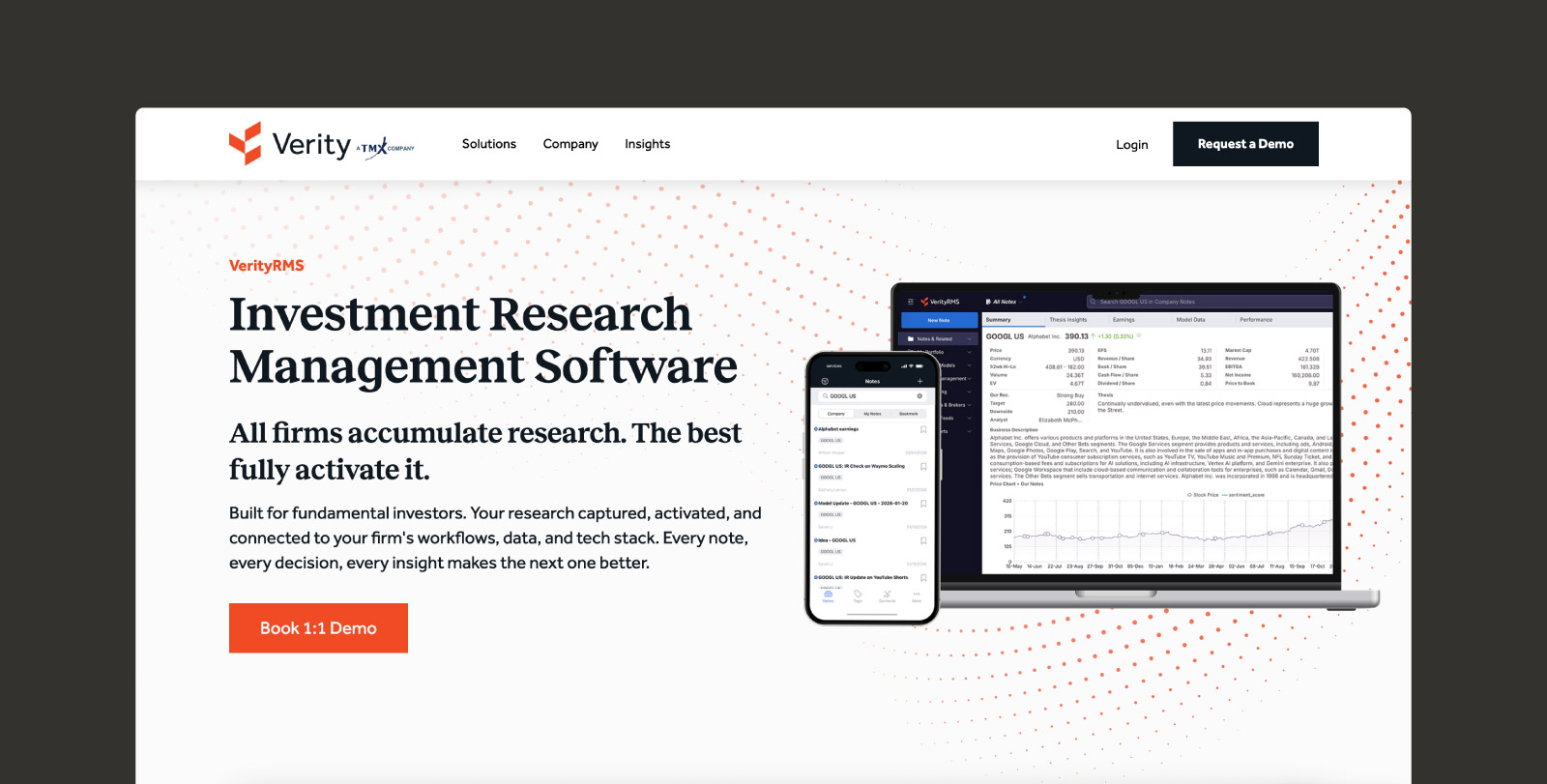
VerityRMS is an investment research management system specialized for fundamental investment teams and asset managers. It consolidates disparate research activities into a single platform, from coverage updates and financial modeling to watchlist creation and automated reporting. VerityRMS also features a few generative AI solutions and an MCP that can help speed up manual workflows; however, these aren’t likely to match the capabilities of a dedicated AI-powered analysis platform when deployed at scale.
The platform offers native mobile apps for both iOS and Android and features a vast library of third-party integrations, including, but not limited to, the Microsoft Office ecosystem, market data platforms (such as Bloomberg and S&P), and portfolio management tools (such as Aladdin and Enfusion).
Key features:
- In-app collaboration tools: VerityRMS comes equipped with built-in tools, including shared calendars, a chat/commenting tool, and live document editing with version control.
- Generative AI solutions: Professionals can use generative AI tools within VerityRMS to execute basic tasks, such as retrieving information from institutional research and market data, templating and organizing research notes, and summarizing documents.
- Various third-party integrations: VerityRMS integrates with market data and portfolio management solutions, cloud storage platforms, collaborative tools, CRMs, and business intelligence tools, including the Microsoft Office Suite, enabling firms to bring workflows across all levels of the investment research process into a centralized view.
10. CalibreRMS
Best for: Financial modeling
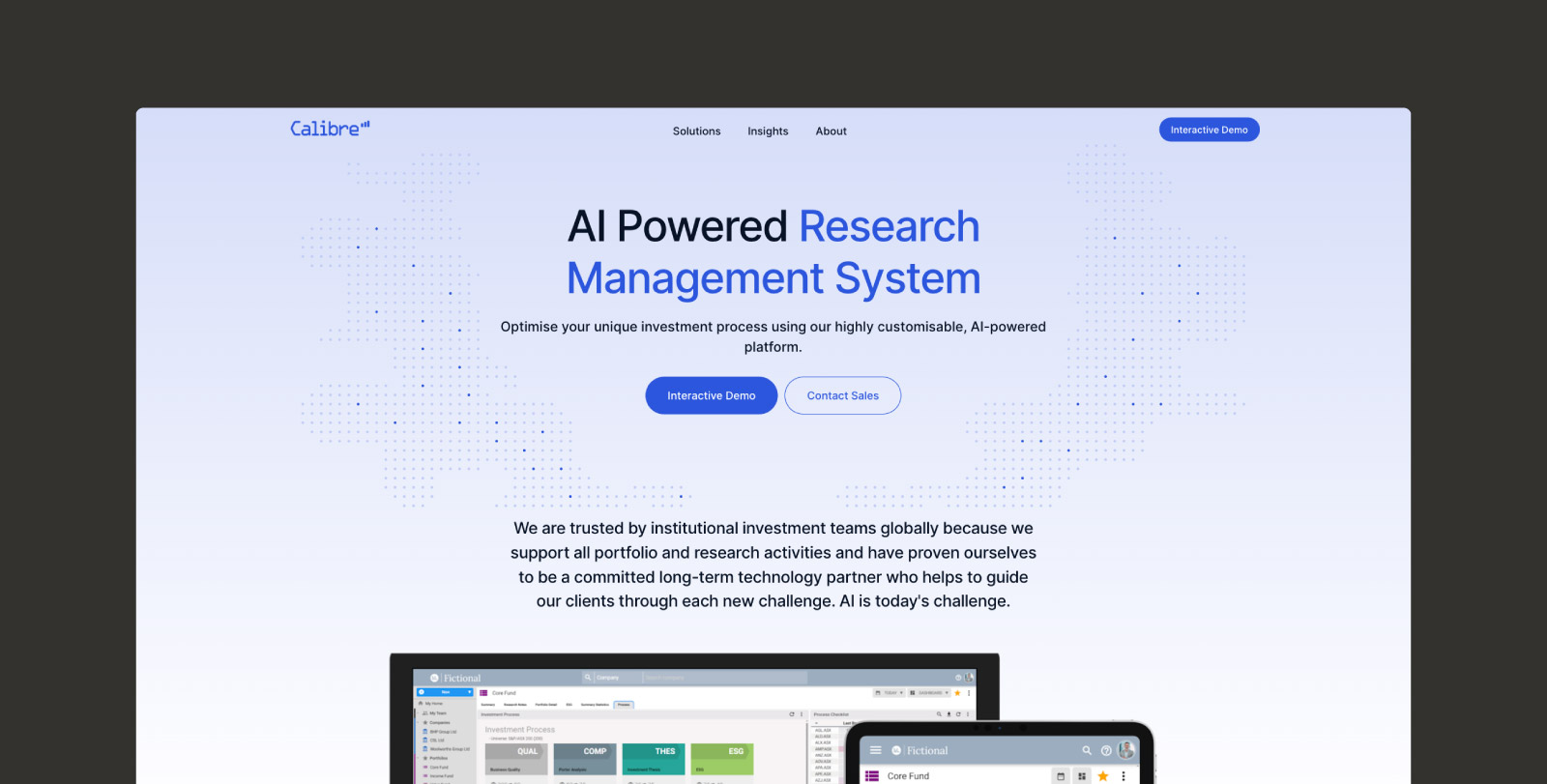
CalibreRMS provides a research management system that centralizes data on a single platform, powered by generative AI, to speed up basic research workflows, such as transcribing and analyzing audio files, building and updating company snapshots, and organizing notes.
CalibreRMS integrates with third-party data providers such as Visible Alpha, Sustainalytics, Bloomberg, and more, allowing firms to bring massive amounts of disparate data into a single source of truth. Calibre’s extensive integration with data providers makes the platform a solid choice for firms across the industry, with researchers able to cross-reference institutional knowledge with reputable third-party information for virtually any purpose.
Key features:
- ESG data centralization platform: Unifies first- and third-party ESG data through customizable data feeds, analysis tools, and reporting solutions, enabling researchers to make ESG research a core part of their workflow.
- Financial modeling tools: Researchers can integrate data from CalibreRMS directly into Excel models with full version control, distribution control, and automated tracking of iterations and assumption changes.
- Extensive third-party data aggregation: CalibreRMS natively integrates third-party data, from market analytics and deep company fundamentals to consensus estimates and sustainability insights, through its library of third-party integrations.
Features to Look For in Investment Research Management Software
As you build your shortlist of platforms to use, you’ll come across a wide variety of options, from data and analytics solutions to investment research management systems and AI investment research software.
Despite the variance, there are several features you’ll want to keep an eye out for to ensure you’re equipping your teams with the cream of the crop.
AI Analysis at Scale
Surfacing weak signals from third-party data, reasoning over institutional knowledge, and synthesizing the two together for strategic insights is often one of the most time-consuming parts of investment research. Choose a platform that enables trustworthy, auditable analysis at scale, with AI agents that automate end-to-end workflows so researchers can reclaim their time and focus on strategy.
Customizability
Your platform of choice should offer extensive customization options. This allows firms to translate their methodologies and templates into the system, while letting individuals use it in a way that suits their preferences and needs. Look for platforms with dashboards, reporting and modeling templates, and analytics tools that you can change as you see fit.
Data Governance and Quality Controls
Most top-tier investment research tools provide access to vetted, trustworthy information relevant to your diligence. Seek out platforms that provide or integrate industry-standard, high-quality, up-to-date data and analysis sources so that no opportunity is lost due to bad or outdated information.
Document Indexing
Look for platforms that allow you to upload a flexible amount of private documents into a single searchable database that also interfaces with third-party information. This allows firms to centralize institutional knowledge and makes it easy for researchers to synthesize it with public data for complete diligence.
Proactive Alerts and Notifications
Your platform should enable customizable, real-time alerts to track developments at the company, industry, and market level. This allows researchers to track signals and changes before the wider market reacts and funnel up recommendations to capitalize on opportunities or hedge against risk exposure.
Why Leading Firms Choose Hebbia to Automate Investment Research
Investment research rewards the team that reaches a defensible view first. That means turning thousands of documents into something a committee can act on. Most platforms in this list handle one part of that, and the analysis still has to be assembled somewhere else.
Hebbia handles the whole process. Max, Hebbia's finance-native chat, answers quick questions as your team works, while Matrix takes the deep research questions and analyzes large document sets at scale. The API and MCP server plug into your own stack and pull disparate data into one place, so your firm already runs AI workflows from full context.
Book a demo to see Matrix, Max, and Hebbia's API and MCP server run on an investment research workflow.


