
10 Best AI Pitch Deck Generators in 2026
In business, the ability to clearly communicate your insights in a compelling narrative is just as important as conducting thorough analyses to develop those insights. Whether you’re submitting your findings for internal review or presenting them to clients, building high-quality pitch decks has traditionally been a time-consuming task for knowledge professionals.
AI is empowering teams to expedite the process, generating sophisticated presentations from scratch that include structured content, on-brand designs, and data visualizations, such as charts, tables, and graphs. For finance teams, especially, that efficiency adds up fast: 63% of professionals save more than six hours per week using AI.
In this comprehensive guide, we’ll explore the top AI pitch deck generators available today. We’ll highlight their key features, ideal use cases, and how each platform can help you optimize your pitch deck creation workflow, whether you’re a finance professional seeking a competitive edge or a startup founder looking to save time.
The Best AI Pitch Deck Generators at a Glance
Below is a snapshot of the best AI pitch deck generators.
AI pitch deck generator | Best for | Notable features |
|---|---|---|
Hebbia | Enterprise-ready pitch deck creation for finance professionals | - Multi-slide presentations - Customizable themes and templates - Automated table and chart generation - Generates outputs for PowerPoint - Proprietary Iterative Source Decomposition (ISD) for in-line citations |
Beautiful.ai | Design guardrails and brand consistency | - Smart Slides for automatic formatting - AI text editing and image generation - In-depth viewer analytics |
Slidebean | Startup fundraising support | - Professional pitch deck design services - Startup-focused financial services - Pitch deck templates based on successful examples |
Pitch | Collaborative deck creation | - Real-time and asynchronous collaboration tools - Integrations for embedding - Access to free media assets |
PlusAI | Native PowerPoint and Google Slides workflows | - Native integration with Microsoft PowerPoint and Google Slides - Various pitch deck generation options - Advanced AI-based editing capabilities |
Storydoc | Interactive, personalized pitch decks | - Uses prompts, webpages, or documents to generate pitch decks - Customer relationship management (CRM) integrations to personalize decks for each investor - Detailed analytics panel |
Canva | Brand-forward pitch decks with flexible design control | - AI image generation in multiple styles - AI data analysis and graphic generation - Virtual whiteboard feature |
Decktopus | Guided pitch creation | - Document ingestion for context-informed pitch decks - AI-guided editing - Target audience selection |
Gamma | Fast pitch deck creation | - Outline generation - AI-powered editing features - Spotlight feature |
PitchBob | Founder coaching and investor outreach | - AI pitch deck improvement tool - AI investor matching - Pitch deck consultancy |
1. Hebbia
Best for: Enterprise-ready pitch deck creation for finance professionals
Hebbia is an AI platform designed to give your team a competitive edge at every stage of investing and deal-making. By automating routine work and connecting your team’s expertise with your firm’s proprietary documents and real-time market data, Hebbia helps you uncover net-new insights overlooked by competitors, seize better opportunities, move faster, and consistently make higher-quality decisions across your entire organization.
After acquiring FlashDocs, Hebbia became one of the only solutions that unifies AI for both deep analysis and complete deliverable generation into a single platform, allowing finance professionals to automate tedious tasks throughout their workflows. Investment bankers, public/private equity professionals, and private credit teams use Hebbia to fully automate complex financial analysis and due diligence tasks and synthesize takeaways into fully formatted, accurately branded slide decks.
Hebbia can create full pitch decks complete with source-linked information, automatically generated charts and tables to visualize complex quantitative data, and nuanced text that aligns strategic positioning with the client’s self-perception. Outputs conform to your firm's templates—professionals can upload any deck as a template, and Hebbia can match its formatting with no technical knowledge or manual design required.
As a result, finance teams can produce high-quality pitch decks on a far greater scale, spending significantly less time bogged down in minutiae and more time refining their pitches. Here are some of the key features that make Hebbia the best AI pitch deck generator in finance:
Key features:
- Multi-slide presentations: Automatically generates full slide decks, allowing professionals to create a complete first-pass deck in one click with a Matrix agent rather than manually generating each slide one-by-one.
- Customizable themes and templates: Professionals can create a customizable template by uploading a document containing the desired formatting and structure for their deck. Matrix seamlessly integrates new information while intelligently modifying design, branding, and logos.
- Automated table and chart generation: Generates accurate, source-linked tables and charts to visualize quantitative data from financial models, such as valuation football fields, strip profiles, and market maps.
- Generates outputs for PowerPoint: Outputs slide decks in .pptx format, allowing professionals to generate expert-level PowerPoint decks without ever having to learn or train on the platform’s nuances.
- Automates analysis workflows: Uses proprietary iterative source decomposition (ISD) technology (which has proven to be vastly superior to retrieval augmented generation for complex finance tasks) to reason across massive datasets to surface valuable insights for your pitch deck, complete with in-line citations that link claims and data to the exact line or cell they came from.
2. Beautiful.ai
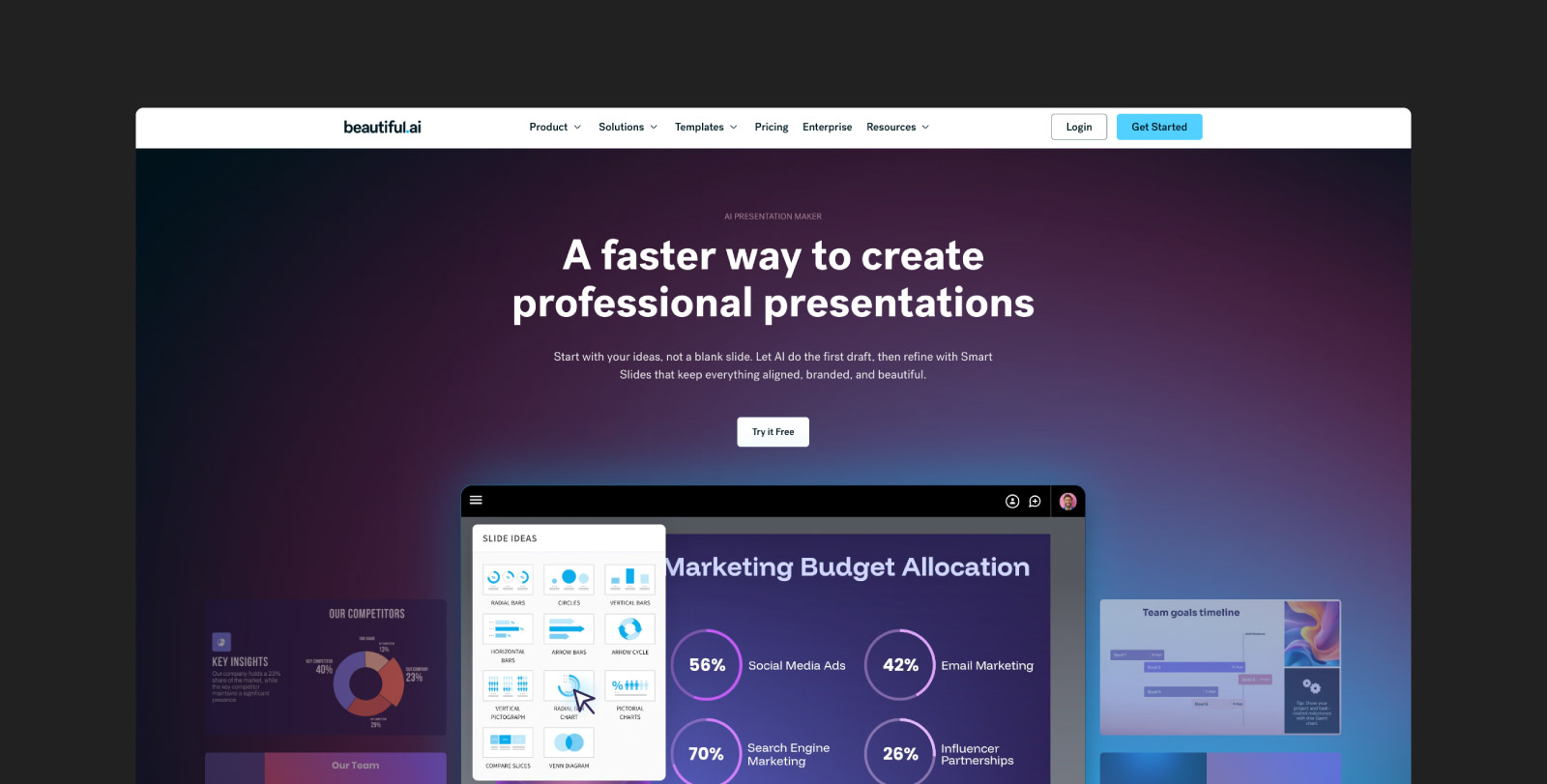
Best for: Design guardrails and brand consistency
Beautiful.ai is a presentation builder that startups and small businesses can use to create professional, visually stunning pitch decks at scale without needing to hire a design team. It offers dozens of templates that automatically adjust during editing, AI text and image generation, intelligent application of brand standards (including fonts, logos, and color palettes), and built-in collaboration features.
Users highlight how it automates tasks that are normally tedious, such as image creation, text editing, and maintaining formatting consistency. With that said, many note that options for user-driven layout customization (such as adding extra content, tweaking image placement, or other manual adjustments) are limited because the tool has strict rules for maintaining visual fidelity.
Key features:
- Smart Slides: Pre-built slide templates that dynamically adjust formatting and organization for optimal audience engagement and visual impact.
- AI text and image generation: Enables prompt-based AI text editing to help build a strong investment case, as well as image generation to create professional-grade, on-brand visuals in seconds.
- In-depth viewer analytics: Provides detailed statistics, including total views, views per day, unique views, average view time, total view time, completion rate, and date of last view for Pro plan subscribers and up.
3. Slidebean

Best for: Startup fundraising support
Slidebean combines slide deck creation and financial services to help startup founders build and deploy refined pitches. Users can choose from over 100 pre-built, customizable templates or create a deck from scratch with AI. Slidebean’s financial services help founders build a budget, understand their path to growth, forecast future revenue, and ultimately, learn how much they’ll need to raise from investors so they can tune their pitches accordingly.
Reviewers confirm that the platform expedites pitch deck creation, particularly thanks to its AI-powered drag-and-drop editing features. Slidebean may be best suited to those seeking templates with an intuitive editing suite rather than those wanting to generate full, original decks from scratch.
Key features:
- Professional pitch deck design services: Lets startups completely outsource the pitch deck creation workflow to a team of experienced professionals who draft, write, and design decks on their behalf.
- Startup-focused financial services: Helps startups organize and understand their financial data to refine pitches and support holistic success.
- Pitch deck templates based on successful examples: Features over 100 investor-vetted pitch deck templates to help founders and teams expedite design.
4. Pitch

Best for: Collaborative deck creation
Pitch is a collaborative slide deck creation platform that lets startups and business teams create a variety of different presentations, including pitch decks. It’s used to generate fully branded decks with basic prompts, collaborate in real-time, and implement edits with a comprehensive, intuitive suite of tools.
Users note Pitch’s ease of use and appreciate its collaboration features, but point to issues generating outputs in PowerPoint and customization limitations (such as restrictive video embedding, photo editing, and font options).
Key features:
- Real-time and asynchronous collaboration tools: Pitch offers a suite of collaboration and task management features. Users can assign tasks, track project status, leave comments for review, or even host live video meetings.
- Integrations for embedding: Users can leverage various integrations to embed data and media directly into their pitch decks, including tables, charts, CRM data, sales data, interactive forms and calendars, and more.
- Access to free media assets: Pitch lets users access a variety of free photos, videos, and other media content.
5. PlusAI
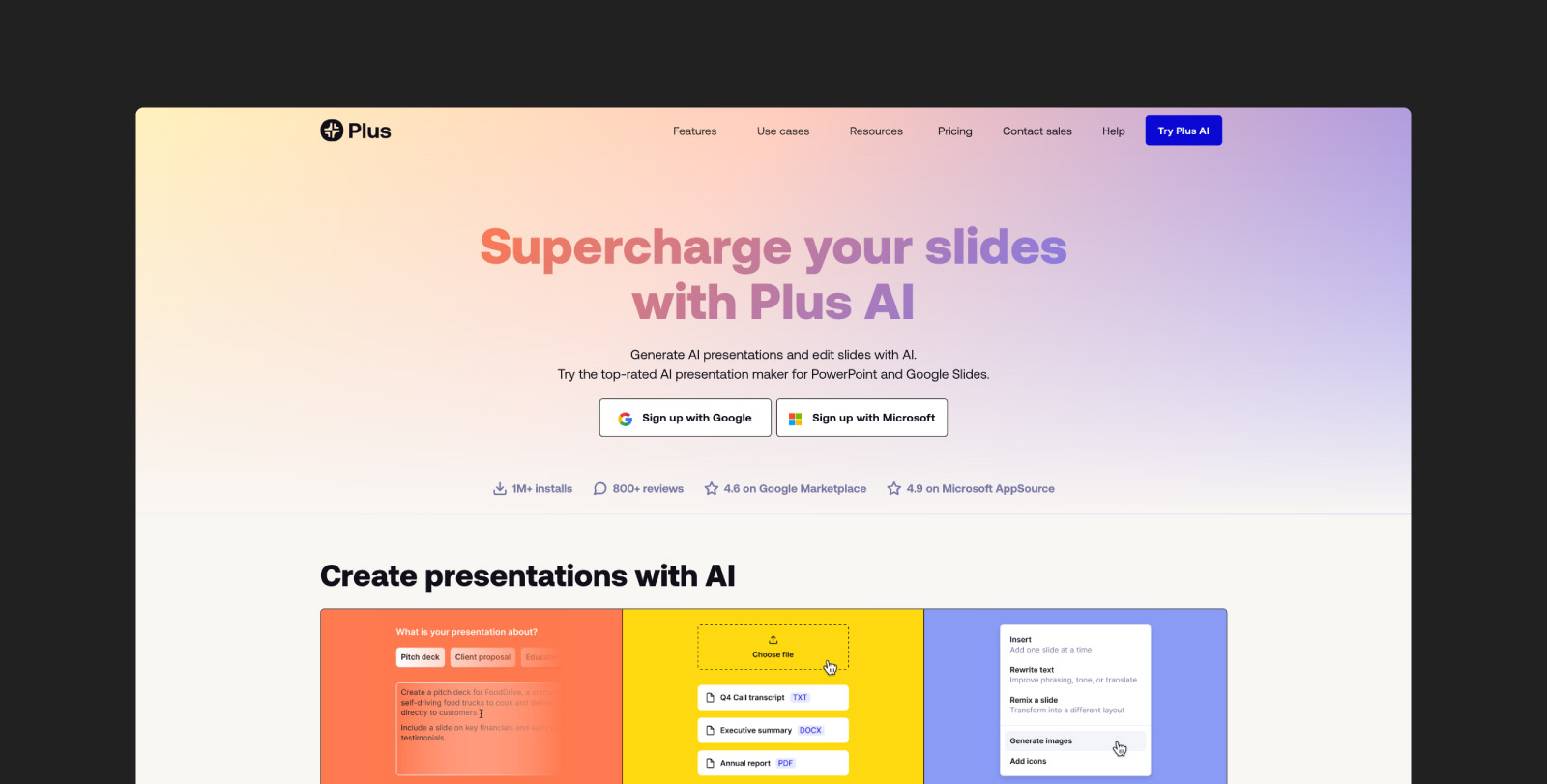
Best for: Native PowerPoint and Google Slides workflows
Unlike most other standalone AI pitch deck generators, PlusAI integrates directly within Microsoft PowerPoint and Google Slides. PlusAI enables startups and business teams to automatically generate comprehensive presentations, including pitch decks, with professional-grade design using detailed prompts of up to 100,000 characters. Once generated, users can insert video recordings, animations, structured data screenshots that update in real-time, and other manual additions.
Reviewers find that PlusAI saves a lot of time in the slide deck creation process and appreciate its convenience. However, they point to difficulties maintaining prompt adherence and weak customer support.
Key features:
- Native integration with Microsoft PowerPoint and Google Slides: Operates as a third-party extension directly within PowerPoint and Google Slides, letting users leverage AI features without leaving their preferred platform.
- Various pitch deck generation options: Users can generate full pitch decks by writing a prompt or uploading a document, which PlusAI will then convert into a deck. Users can also generate individual slides one by one.
- Advanced AI-based editing capabilities: Gives users the option to edit their pitch decks with three core features: Insert, Remix, and Rewrite. These features let users automatically add, reformat, and copy-edit slides through prompting.
6. Storydoc
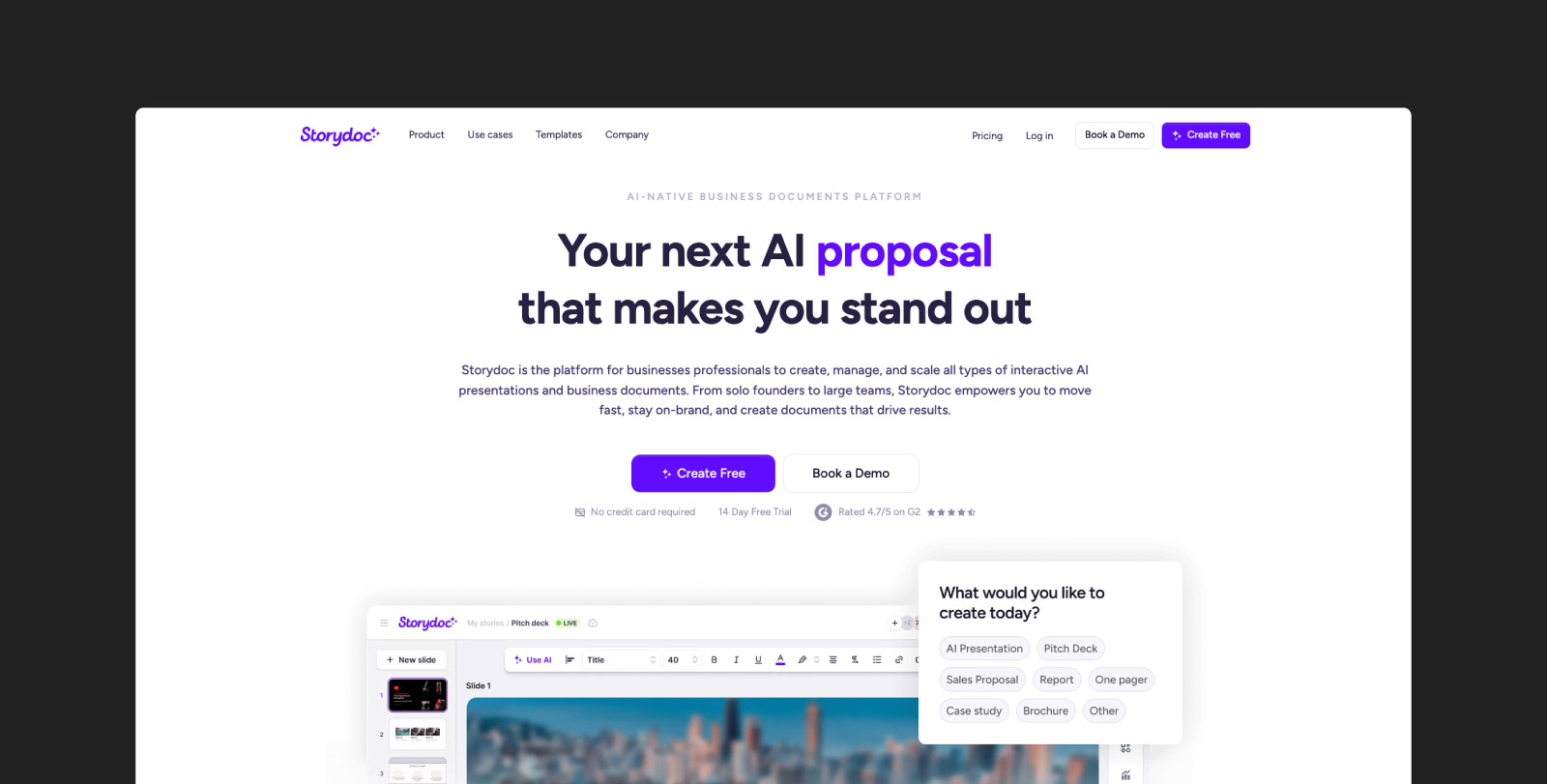
Best for: Interactive, personalized pitch decks
Storydoc is an AI deck creator for business professionals. Users can prompt AI or link their company website to generate interactive, personalized pitch decks complete with text content, animations, media, and accurate branding.
Teams can then edit AI outputs collaboratively, save branding and formatting templates to deploy on future decks, and access in-depth analytics to understand how each investor interacts with the pitch deck for fine-tuning and optimization.
Reviewers appreciate the platform’s user friendliness as well as its responsive and helpful customer support. However, others point out that Storydoc is relatively cost-prohibitive and lacks in-depth customization features.
Key features:
- Uses prompts, webpages, or documents to generate pitch decks: Generates full pitch decks based on user prompts, uploaded PDF documents, or a company webpage.
- CRM integrations to personalize decks for each investor: Allows users to personalize their pitch decks to individual investors at scale using dynamic variables for text and media. It can change basic information (such as the name and firm) and in-depth details (including investment focus) based on information from integrated CRMs.
- Detailed analytics panel: Provides in-depth engagement analytics, including views, reading activity, and click-through rates.
7. Canva
Best for: Brand-forward pitch decks with flexible design control
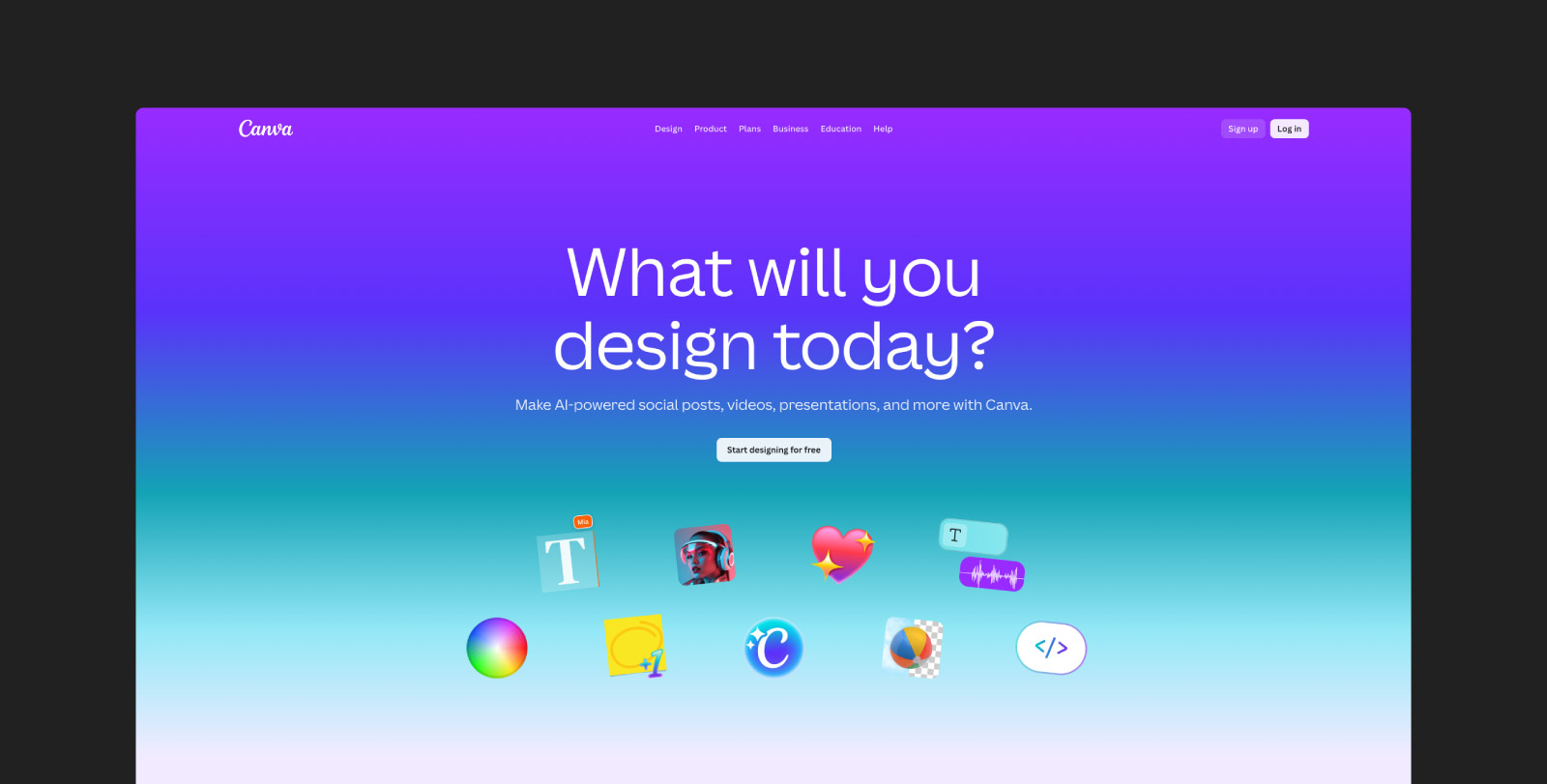
Canva is a dedicated visual design platform that can be used to create pitch decks. It features thousands of professional-grade templates and an AI presentation creator, with a number of proprietary AI tools that automate formatting, brand-aligned design, writing, and more.
Users can also leverage AI features to generate images in various styles, program interactive elements into slides, and even conduct data analysis to surface pitch-relevant insights and convert them into tables and charts.
Reviewers attest that Canva is great at simplifying professional-grade design for those with little to no design experience, but note some issues, such as occasional formatting breaks when importing files and slow customer support. In addition, while Canva’s data analysis capabilities may work for startups and small businesses, they lack the scale, depth, and complexity necessary for finance workflows.
Key features:
- AI image generation in multiple styles: Lets users generate high-quality, prompt-adherent, animatable AI imagery in multiple styles to align with their specific brand and design requirements.
- AI data analysis and graphic generation: Conducts basic analysis over imported spreadsheets to help uncover pitch-relevant insights and place them into branded, interactive tables, charts, and graphs.
- Virtual whiteboard feature: Provides a collaborative virtual whiteboard space to help teams brainstorm and visualize ideas for pitch decks.
8. Decktopus
Best for: Guided pitch creation
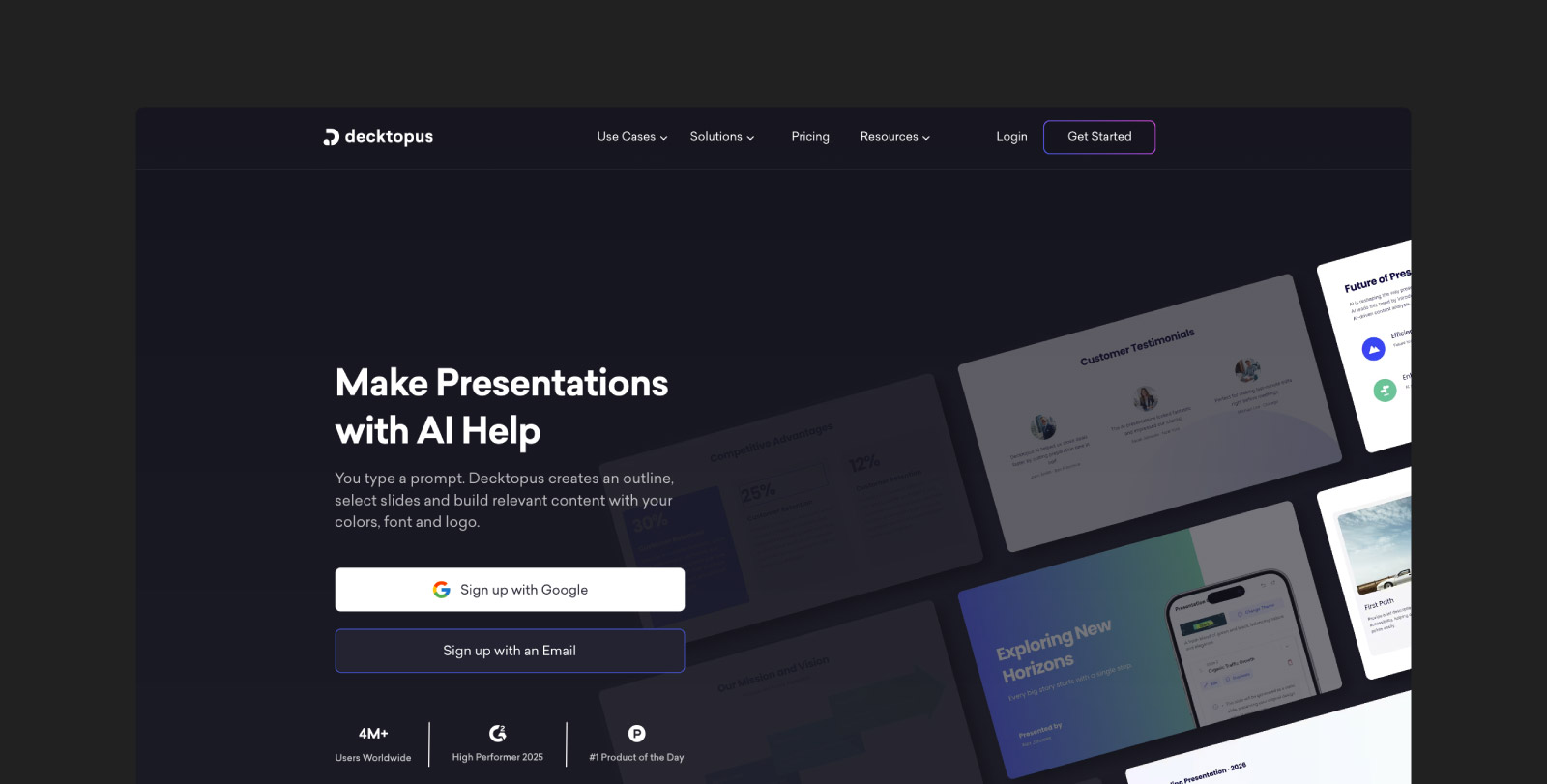
Decktopus turns slide deck generation into an intuitive, guided, and thorough process. Creators start by writing a prompt, uploading documents for context, and selecting a visual theme (paying subscribers can upload brand assets to create a theme deployable across all decks).
Decktopus then creates an editable deck outline, where users can manually change the text and layout to be applied to each slide, or request changes through further AI prompting. From there, the platform generates a fully written, designed, and formatted deck in one click, which users can refine with a block-based, AI-powered editing suite.
While reviewers appreciate how quickly they can create slides with Decktopus using simple prompts, many point to various feature limitations, such as the inability to upload presentations as templates or edit exported .pptx files.
Key features:
- Document ingestion for context-informed pitch decks: Lets users upload documents as part of prompts for greater contextual understanding.
- AI-guided editing: Provides AI-based editing tools, including individual slide generation, image generation, text translation, and smart tips to advise users through the deck creation/editing process.
- Target audience selection: Lets users specify the target audience of their presentation (for example, a private equity investor) to tune generated content accordingly.
9. Gamma
Best for: Fast pitch deck creation
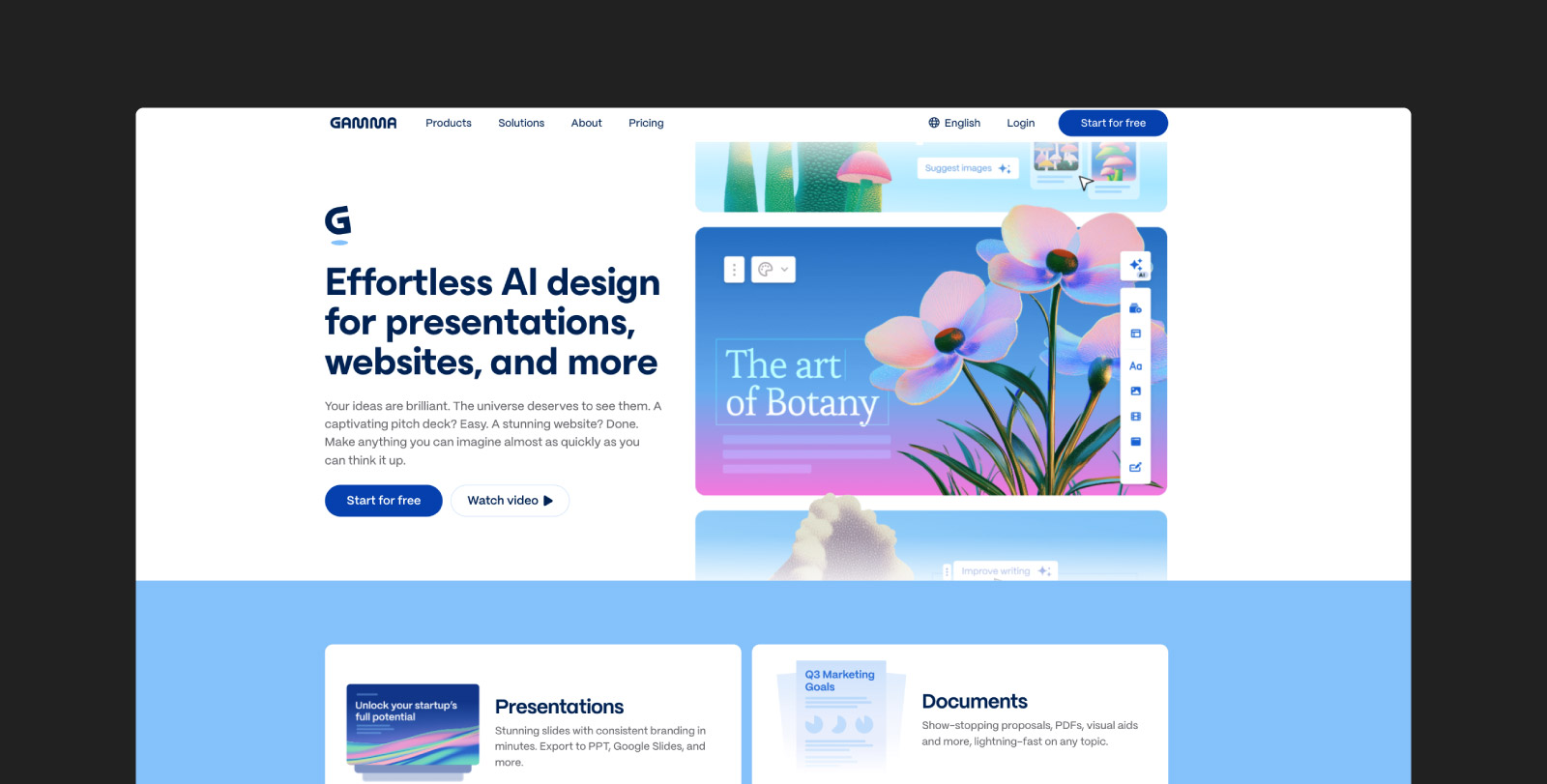
Gamma is an AI design platform that prioritizes speed and convenience for business teams and educators. Its slide deck creation tool lets users import files, paste in notes, or use an AI prompt to build a complete, modifiable pitch deck outline with a pre-built theme or imported brand assets. With design, formatting, and initial text generation handled for you, all that’s left is to edit the AI-generated content, which can be done manually or with AI-powered smart suggestions.
User reviews attest to the quickness and visual fidelity of the outputs, but also point to several issues, including formatting errors in final outputs, trouble exporting designs, and a lack of features for visualizing complex data, such as charts.
Key features:
- Outline generation: Creates an outline from an initial prompt that lets users apply granular, slide-level modifications before generating the final output.
- AI-powered editing features: One-click buttons that allow users to expedite the editing process with AI, including but not limited to layout modification, writing, and translation.
- Spotlight feature: Lets users present their Gamma deck by gradually unraveling information on each slide rather than revealing all of the information at once.
10. PitchBob
Best for: Founder coaching and investor outreach
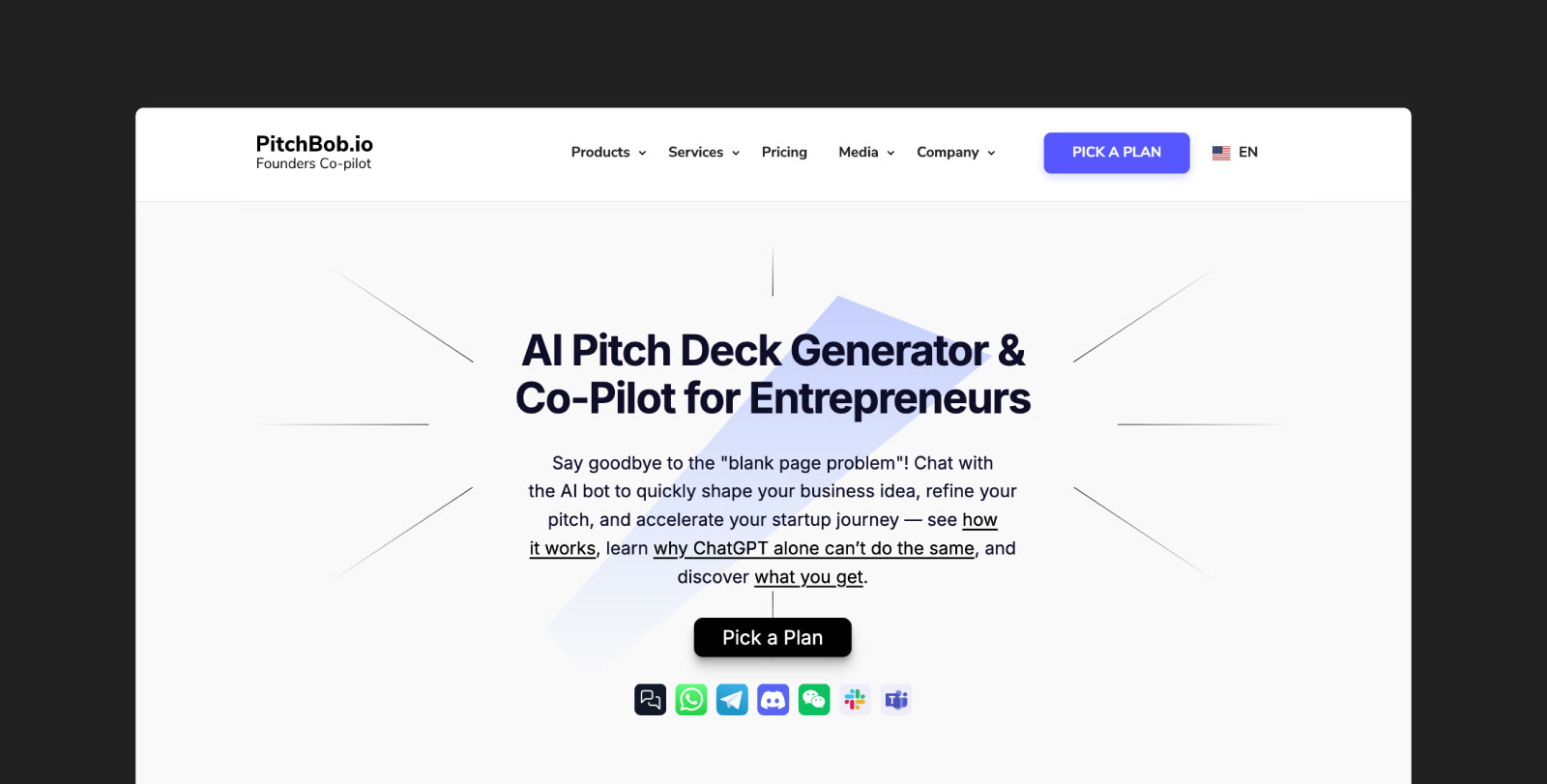
PitchBob is an AI pitch deck generator offering holistic support for startups and entrepreneurs building and refining their pitches. The platform's AI deck creator guides users through the prompting process to craft a compelling story, automates design, and provides in-depth feedback to help users refine their outputs into investor-ready content.
Beyond deck creation, PitchBob offers a comprehensive range of support services tailored to entrepreneurs, including pitch deck consultancy, in-house or AI-based investor outreach assistance, and various AI tools (such as a business plan generator, financial model creator, and market research tool). Reviewers appreciate the convenience and conceptual guidance PitchBob offers, but note consistent formatting, design, and textual errors within final outputs.
Key features:
- AI pitch deck improvement tool: Lets users upload existing pitch decks or concept ideas for improvement. AI converts it into a PitchBob deck template, applying structural, narrative, and design improvements throughout.
- AI investor matching: Lets users upload their pitch deck to identify a shortlist of relevant funding opportunities from a database of over 150,000 investors, accelerators, and VCs, generating personalized outreach e-mails for each.
- Pitch deck consultancy: Connects entrepreneurs with a network of experienced consultants who deliver live feedback on your pitch deck.
How to Choose an AI Pitch Deck Generator
Below are some recommendations to help you select an AI pitch deck generator that fits your needs.
1. Consider Your Specific Use Case
AI pitch deck generators come with their own unique sets of features and capabilities, so it's important to evaluate each platform based on how well it aligns with your needs. All in all, your platform of choice should automate the most time-consuming manual work so you can focus on the substance of your pitch.
For startup founders and entrepreneurs, you’ll likely be seeking a platform that automates repetitive design, formatting, and writing tasks. Many platforms offer these features, so your choice may come down to a matter of preference, compatibility with your specific workflow, or budget fit.
If you’re a finance professional facing rigid, flawless quality standards, you’ll need a platform with those capabilities and much more, including:
- Automatic data visualization for complex quantitative data such as financial models, performance metrics, and forecasts
- Ability to host user-provided templates and brand standards so you can generate pitch decks that conform to your firm’s structure and intelligently adjust branding on a case-by-case basis
- Capacity to link text and data with verifiable sources to minimize the risk of hallucinations or errors that can impact deals and damage credibility
2. Consider the Scale You Need
Evaluate AI pitch deck generators based on the scale of automation they offer. Generally speaking, the more the platform can automate, the better, especially for those planning to create dozens or even hundreds of pitch decks per year.
Seek out solutions that can generate complete decks from scratch with only minimal editing required for nuanced refinements. Platforms that can only create individual slides or produce outputs that still require fundamental changes may not yield substantial time savings at scale.
Pro tip: Take advantage of product demos or free trials, and track and compare how long it takes to build a satisfactory first-pass pitch deck within each platform.
3. Evaluate Customizability
When presenting pitch decks in any context, adhering to brand and template guidelines is essential. That touch of personalization and professionalism is key to setting yourself apart, whether you’re a startup making your case to investors or a banker setting the tone for a multi-million-dollar deal.
Select a platform that lets you upload your own custom templates and brand assets (such as logos, icons, color palettes, and fonts) that can be automatically and tastefully implemented throughout your decks at scale. That way, you can spend less time on repetitive formatting and more time on substance.
Hebbia lets users upload a pre-existing pitch deck and build an AI agent that re-creates its structure for future decks, intelligently adjusting all information and branding where appropriate. Generating full, high-quality decks becomes as simple as one click, giving professionals more time to refine the pitch and perfect the final deliverable.
4. Assess Source Traceability
Prioritize platforms that don’t just generate content, but also link content directly to the source from which it was pulled. This helps streamline internal reviews ahead of presentation and ensures that any data, analysis, or wording in the deck is trustworthy.
For any information presented as a fact or credible estimate, immediate verifiability is crucial for maintaining accountability and trustworthiness. This is especially important for finance professionals, who have their firm’s reputation on the line with every externally facing deliverable, including pitch decks.
5. Verify Chart and Table Generation Capabilities
The best AI pitch deck generators can automatically create accurate data visualizations based on the documents you upload. Manually building tables, charts, and graphs can consume a significant amount of valuable time, so the ability to generate them on demand is often a massive time-saver.
Data visualizations are important to communicate quantitative data for pitch decks in any context. For example, a finance professional may need to generate a table to quickly visualize an EBITDA forecast or summarize comparable data. Meanwhile, a startup founder may want to implement a line graph that demonstrates their product’s market performance over time.
6. Review Security and Compliance Fit
To generate a solid first-pass pitch deck with AI, you’re likely going to need to feed it some sensitive data. For example, startup founders may need to embed their own financial information that they’ll have an interest in protecting. Meanwhile, finance professionals will have to upload proprietary documents, financial performance data, and other confidential information. Leaks may result in serious reputational damages, lost business, and compliance risks.
Carefully evaluate AI pitch deck generators based on the security and compliance features they offer. Prioritize those that have:
- Compliance with data security regulations (like GDPR, CCPA) and standards (like SOC 2)
- Audit logs that show user activity in detail
- Single sign-on options, multi-factor authentication, and role-based access controls
- Zero data retention (ZDR) policies, ensuring that large language models (LLMs) aren’t being trained on your data
Build Complete, Client-Ready Pitch Decks in Minutes with Hebbia
Hebbia stands out as the best AI pitch deck generator for finance workflows. As the only platform that can automate the pitch deck creation workflow completely (from analysis to deliverable generation), it offers unmatched flexibility and fidelity for client-ready materials.
Hebbia leads the market in scale, customizability, and data visualization capacity for pitch decks, empowering finance teams to automate repetitive formatting and content creation tasks so they can focus on what really matters: the substance, accuracy, and narrative of their pitches.
Ready to see how it fits into your workflow? Book a demo today to see its capabilities live.
AI Pitch Deck Generator FAQ
What is an AI pitch deck generator?
An AI pitch deck generator is a platform that turns prompts, documents, websites, or structured notes into a presentation draft. Depending on the product, that can include outlining, slide writing, design automation, chart creation, personalization, collaboration, or export into PowerPoint and Google Slides.
What's the difference between a pitch deck and a pitch book?
A pitch deck is usually shorter and more narrative-driven. A pitch book is broader, denser, and often used in investment banking or other client-service workflows. If you need source-linked data, house templates, complex charts, and document-heavy analysis, you are usually closer to pitch book automation than startup deck generation.
Are free AI pitch deck generators enough?
Free tools are fine for experimentationor rough first drafts. They are usually less suitable for teams that need deep customization, secure data handling, reliable exports, or source-linked factual claims.
Which AI pitch deck generator is best for finance professionals?
Hebbia is the best fit for finance professionals on this list because it combines document analysis, research, source citation, deliverable generation in one workflow. It is built for pitch decks that need client-ready polish, quantitative slides, and defensible source traceability—not just attractive layouts.


