
Top 10 AlphaSense Competitors for Financial Research and Intelligence
AlphaSense remains a strong platform for external research, but the buyer question has changed. Teams are no longer just evaluating who has the deepest content library. They’re evaluating which platform can connect premium research, internal files, structured market data, and AI workflows into one defensible research stack.
This guide compares the top AlphaSense alternatives across AI-native research platforms, market-data terminals, and expert networks so investment teams can see which tools are best for discovery, which are best for structured analysis, and which can actually turn signal into work product.
What Is AlphaSense?
AlphaSense is a market-intelligence platform built for financial and corporate research. It's designed to help financial and corporate users quickly retrieve and sift through a massive data library to uncover relevant insights.
AlphaSense Pros
AlphaSense has built a strong position in financial research by making market research more accessible. For teams that primarily need to search across public market intelligence, they offer genuine value in several areas:
- Extensive document library: AlphaSense aggregates millions of documents, including broker research, expert call transcripts (through their acquisition of Tegus), SEC filings, news, and trade publications. This breadth of external content is valuable for teams conducting public market research who want a single search interface across multiple content types.
- Established brand: They serve over 6,000 enterprise clients, with strong adoption across major financial institutions. This market position means familiarity and trust within the industry.
- Intuitive interface: Their platform offers a user-friendly search experience with smart synonym recognition and filtering capabilities, helping users navigate their content library effectively, even when using varied terminology.
- Content partnerships: AlphaSense has built integrations with key data providers and virtual data room (VDR) platforms like Datasite, expanding access to public and some private content sources through a single interface.
AlphaSense Cons
While AlphaSense remains a powerful discovery tool, its architecture reveals structural bottlenecks when teams transition from gathering information to executing high-stakes workflows:
- Limited data source coverage: While it supports document uploads, it lacks the ability to provide content beyond their own proprietary library. This means users must still manually source and cross-reference materials from external databases, reducing the platform's value as a single point of research.
- Diminished information exclusivity: Research providers are increasingly partnering directly with individual companies and AI-native platforms. As these partnerships expand, AlphaSense's once-differentiated content advantage continues to erode, making it harder to justify on the basis of exclusive access alone.
- Synthesis vs. summarization: While AlphaSense has introduced generative AI features, its capabilities are largely focused on summarizing search results. It excels at telling you what is in a research document. Still, it struggles to automate what comes next, such as drafting a multi-page investment committee (IC) memo, building a formatted covenant tracking table, or generating a client-ready pitch deck.
- Limited scale: While AlphaSense has moved to provide some sentence-level citations, high-stakes financial decisions require reliable line-by-line verification across massive datasets. When moving beyond simple queries to analyzing entire VDRs or multi-thousand-document portfolios, AlphaSense’s search-first architecture can struggle with the deep, cross-contextual reasoning required to maintain a perfect audit trail.
AlphaSense Competitors at a Glance
The market for financial research and intelligence spans multiple categories, from AI-native platforms that automate workflows to traditional data terminals and expert networks. The table below compares the leading platforms across categories, use cases, and core features to help you quickly find the right fit for your workflows.
Software | Category | Best for | Top Features |
|---|---|---|---|
Hebbia | Direct competitor | AI-powered financial diligence and end-to-end workflow automation | - End-to-end AI workflows - Breadth of financial data sources - Accuracy at scale with its proprietary - Iterative Source Decomposition (ISD) technology - White-glove onboarding |
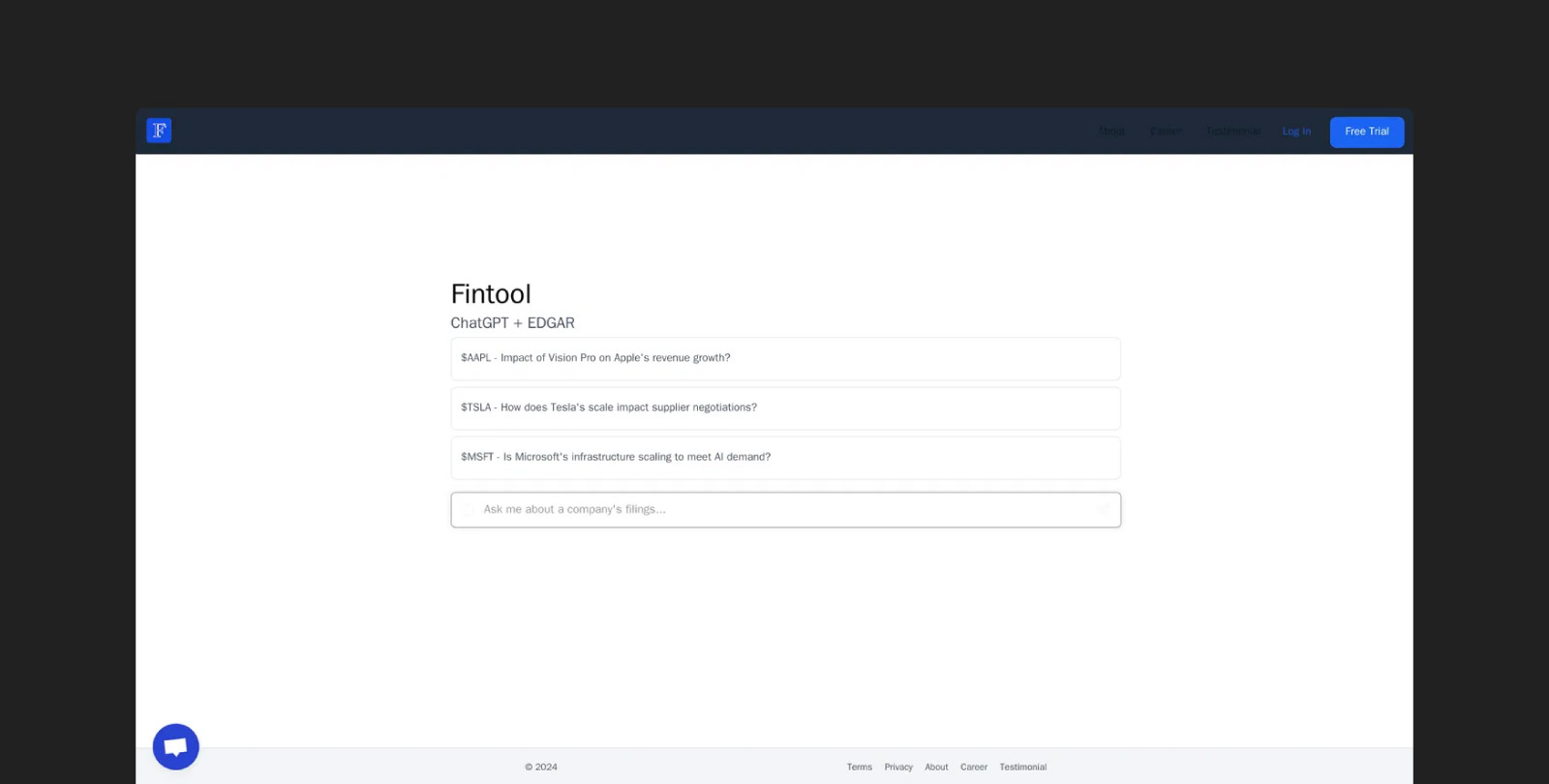
Fintool | Direct competitor | Public equity analysts seeking quick answers from SEC filings | - XBRL-to-table mapping - Footnote disclosure tracking - GAAP consistency engine |
ChatGPT | Direct competitor | General research and ideation across industries | - Generalist creative writing - Code interpreter (advanced data analysis) - Massive plug-in ecosystem |
Bloomberg Terminal | Financial data terminal | Traders and analysts requiring real-time market data | - Real-time execution and trading - The terminal community - Fixed income analytics |
S&P Capital IQ Pro | Financial data terminal | Investment banking and credit teams needing detailed financials and comparables | - Excel plug-in (modeling) - S&P Global ratings integration - Mapping and spatial data |
PitchBook | Financial data terminal | Private equity and VC professionals tracking private markets | - Private market valuations - LP and fund performance data - Deal sourcing filters |
Harmonic | Financial data terminal | VCs and growth equity teams sourcing early-stage startup deals | - Founder pedigree tracking - Predictive growth signals - Network-integrated sourcing |
Third Bridge | Expert network and qualitative research | Investors and corporates who prioritize analyst-curated insights and reusable transcript libraries | - Analyst-moderated transcripts - Human-in-the-loop surveys - Forum platform for ongoing expert access |
GLG (Gerson Lehrman Group) | Expert network and qualitative research | Large institutions needing global expert coverage across diverse industries and geographies | - Bespoke expert consultations - Compliance framework - Executive councils |
AlphaSights | Expert network and qualitative research | PE and consulting teams that need rapid C-suite access with white-glove project management | - Global expert sourcing - Compliance-led transcripts - Custom B2B surveys |
1. Hebbia

Best for: AI-powered financial diligence and end-to-end workflow automation
While AlphaSense is a content aggregation platform that has added AI features to help teams search broker research and expert calls faster, Hebbia is AI-native curating everything from data extraction and analysis to financial modeling and presentation creation. Where AlphaSense is optimized for retrieving insights from specific search results, Hebbia’s agentic architecture allows it to analyze thousands of documents simultaneously with sentence-level proof, effectively automating up to 90% of the manual document synthesis required in diligence workflows.
Key features:
- End-to-end AI workflows: Hebbia automates complete diligence processes in one platform, from VDR analysis to IC memo creation to pitch deck generation. The platform does the actual work—building investment memos, generating client materials, and monitoring covenants across portfolios. Teams move from raw documents to finished deliverables without needing to switch tools or manually synthesize findings.
- Unmatched breadth of financial data sources: Hebbia integrates with S&P CapIQ, FactSet, PitchBook, Preqin, Third Bridge, SharePoint, Box, Snowflake, DealCloud, Salesforce, and more. This allows for a unified intelligence layer across all the data sources teams actually use for comprehensive diligence.
- Iterative source decomposition (ISD) technology: Hebbia's advanced reasoning engine analyzes thousands of documents simultaneously using a multi-agent architecture, providing sentence-level citations for every fact and quote. This granular traceability makes outputs defensible in board presentations and when making high-stakes decisions, enabling the complete audit trails that finance workflows require.
- Human-first onboarding and engagement: Hebbia provides white-glove implementation led individuals who previously worked in asset management, banking, and advisory. The approach is fully customized to your specific processes, whether that's PE due diligence, covenant monitoring, or client material generation, ensuring enterprise customers get the hands-on support needed to realize value quickly.
Hebbia vs. AlphaSense
Hebbia | AlphaSense | |
|---|---|---|
Data coverage | Multiple first party and third party data sources | Limited to first-party documents and proprietary content |
Scale of analysis | Built for parallel reasoning across thousands of files simultaneously | Optimized for smaller a smaller set of, curated batches of documents |
Accuracy and auditability | Sentence-level citations for every extracted fact, number, and quote, ensuring accuracy and full traceability at scale | Provides document-level citations with only some at the sentence-level |
Flexibility | Fully customizable, agentic workflows—from data sources and analysis to financial modeling and presentation outputs | Offers pre-built AI tools (generative search, sentiment analysis) that are standardized across the platform, while also allowing users to build custom agents for research |
Enterprise deployment | White-glove implementation led by AI strategists with deep industry expertise, focused on embedding AI into real operating workflows | Professional, high-volume onboarding designed to get teams up and running on a fixed set of features quickly |
2. Fintool
Best for: Public equity analysts seeking quick answers from SEC filings
Fintool is an AI copilot built specifically for analyzing public company financials and SEC filings. The platform excels at extracting structured data from 10-Ks, 10-Qs, and earnings transcripts—tasks that would take analysts hours of manual work.
Fintool operates in a narrower lane than AlphaSense. Where AlphaSense provides broad market intelligence across broker research, expert calls, and news, Fintool focuses exclusively on public filings and earnings data. It's faster and more accurate for pulling specific metrics from SEC documents, but it can't access the breadth of content, such as expert networks, proprietary research, and alternative data, that AlphaSense offers.
Key features:
- XBRL-to-table mapping: Fintool automatically extracts financial line items into clean, Excel-ready tables, identifying and reconciling period-over-period mapping changes that traditional scrapers miss.
- Footnote disclosure tracking: The platform uses semantic comparison to flag subtle changes in legal language or financial disclosures within the fine print, surfacing risks that often go unnoticed in high-level summaries.
- GAAP consistency engine: Maps divergent GAAP reporting styles into a unified framework, allowing for accurate peer-to-peer benchmarking and apples-to-apples margin analysis across entire sectors.
Fintool vs. AlphaSense
Fintool | AlphaSense | |
|---|---|---|
Data coverage | - Purpose-built for US equity research, specializing in deep analysis of SEC filings (10-Ks, 10-Qs, 8-Ks), proxy statements, and earnings transcripts - No broker research, expert calls, or alternative data sources | Aggregated secondary research (broker reports, news, filings) + Tegus expert calls |
Scale of analysis | - Optimized for deep analysis of individual company filings and multi-period comparisons - Not designed for portfolio-wide or cross-sector synthesis at scale | - Search-optimized for millions of documents - Excellent at broad market sentiment and keyword tracking |
Accuracy and auditability | - Utilizes a three-agent verification system to ensure zero hallucinations - Provides ubiquitous, audit-ready citations for every data point | - Snippet-level citations for search - Verification of massive data synthesis can require manual oversight |
Flexibility | - Purpose-built for public equity fundamental analysis (financial statement comparison, disclosure tracking, metrics extraction) - Limited customization outside this narrow use case | - More versatile across research types (qualitative and quantitative) - Self-service platform with new custom workflow agents for recurring search and monitoring |
Enterprise deployment | - Self-service platform with standard onboarding - Lower price point, but minimal hands-on implementation support or workflow design | - Predictable annual SaaS licensing - Designed for rapid, organization-wide adoption |
3. ChatGPT
Best for: General research and ideation across industries
ChatGPT is the most widely used general-purpose AI platform, with millions of finance professionals relying on it daily for productivity tasks like drafting emails, summarizing meetings, generating first-draft investment memos, brainstorming deal themes, and explaining complex concepts.
ChatGPT operates in an entirely different category than AlphaSense. AlphaSense is a finance-specific platform with curated content libraries, proprietary broker research, and expert call transcripts, designed for professional market intelligence workflows. ChatGPT is general-purpose with no access to proprietary financial data, real-time market information, or your firm's internal documents without manual uploads. Where AlphaSense provides searchable, finance-specific content, ChatGPT offers broad conversational capabilities across any domain.
Key features:
- Generalist creative writing: ChatGPT handles diverse writing tasks from drafting investment memos and executive summaries to editing research reports and translating documents. However, it has deficiencies in logical thinking and common-sense reasoning, which are especially noticeable in financial research where high degrees of causal and analogical reasoning are required.
- Code interpreter (advanced data analysis): The platform can analyze uploaded datasets, create visualizations, perform statistical analysis, and generate Python code for financial modeling. However, all analysis requires manual data uploads each session as there is no persistent access to firm data.
- Massive plug-in ecosystem: ChatGPT connects to hundreds of third-party tools and data sources via plugins, enabling expanded functionality from web search to specialized calculators, though integration depth and data security vary significantly across plugins compared to those of enterprise-grade financial platforms.
ChatGPT vs. AlphaSense
ChatGPT | AlphaSense | |
|---|---|---|
Data coverage | - General knowledge trained on broad internet data with a knowledge cutoff - No proprietary financial data or firm-specific documents unless manually uploaded each session | Finance-specific curated library including broker research, expert calls from the Tegus acquisition, company filings, and news |
Scale of analysis | - Handles individual documents or small batches per conversation - No capability to index or persistently analyze large document repositories across sessions | - Optimized for searching and reasoning across its entire multi-million document library - Generative Grid allows you to run prompts across hundreds of filings or reports simultaneously |
Accuracy and auditability | - Cannot trace claims back to specific sources or verify information without web search enabled - Not suitable for high-stakes financial decisions | - Better verification than ChatGPT for researched content - Every generative summary links directly to the source text, ensuring a verifiable audit trail for high-stakes compliance |
Flexibility | - Extremely versatile across any domain—writing, coding, analysis, brainstorming - General-purpose tool not optimized for any specific professional workflow | Purpose-built for financial research workflows |
Enterprise deployment | - Consumer tool with business tier available - No workflow integration, compliance infrastructure, or specialized onboarding for financial services firms | Enterprise sales model with a financial services focus |
4. Bloomberg Terminal
Best for: Traders and analysts requiring real-time market data
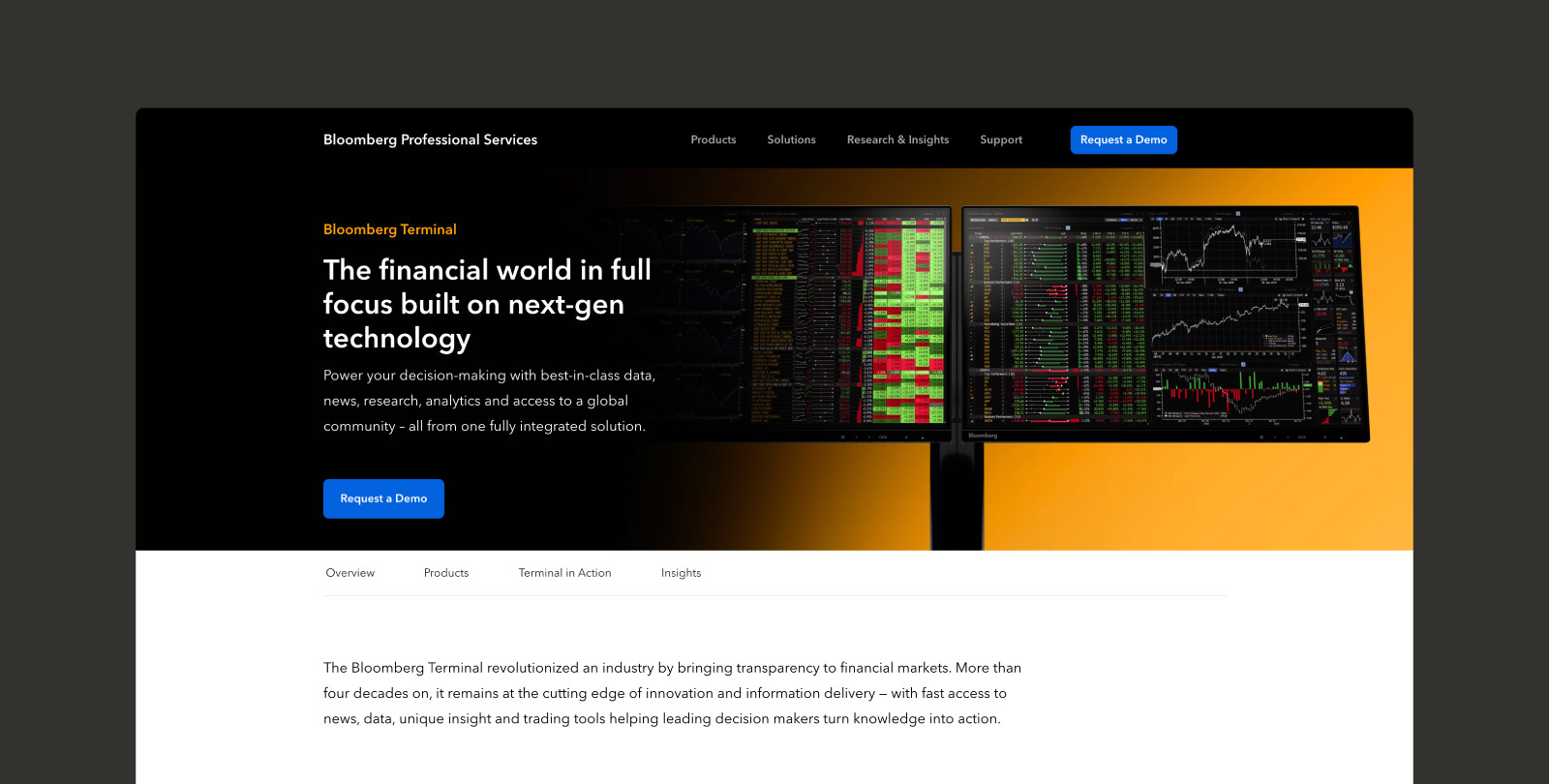
Bloomberg Terminal is widely considered the financial operating system for the global investment community. It provides unparalleled real-time pricing across all asset classes, proprietary news coverage through Bloomberg News, and a built-in professional network via Instant Bloomberg (IB).
While AlphaSense serves as a high-velocity search engine for broker research and filings, Bloomberg serves as the primary ecosystem for live market participation. Most firms rely on Bloomberg for its quantitative depth and real-time pricing, while turning to AlphaSense to solve the specific qualitative bottlenecks, such as searching through thousands of analyst reports, that the Terminal’s broader toolset isn't natively designed to automate.
Key features:
- Real-time execution and trading: Bloomberg provides direct market access to equities, fixed income, FX, commodities, and derivatives, with live pricing feeds and order management. The platform is designed for active traders who need millisecond-level data accuracy and immediate execution capabilities across global markets.
- The terminal community: Instant Bloomberg connects over 350,000 finance professionals globally, serving as the industry’s primary network for relationship building and real-time deal flow.
- Fixed income analytics: The platform offers comprehensive bond analytics, including yield curves, spread analysis, scenario modeling, and credit research. Users consistently note that these fixed-income tools remain essential for their workflows, with functionality that competitors struggle to replicate.
Bloomberg Terminal vs. AlphaSense
Bloomberg Terminal | AlphaSense | |
|---|---|---|
Data coverage | - Real-time market data across all asset classes, plus Bloomberg News and proprietary research - Entirely external live data with no internal document integration | - Curated library of broker research, expert calls, company filings, and news - Secondary research content without real-time market data or pricing feeds |
Scale of analysis | - Not designed for document analysis or synthesis - Optimized for real-time market queries and historical data analysis, not reasoning across unstructured documents | Optimized for keyword search and thematic discovery across an unstructured 100M+ document library |
Accuracy and auditability | - Highly accurate for market data with rigorous quality controls on pricing and financials - Not applicable for document analysis or AI-powered synthesis workflows | - Provides snippet-level citations - Relies on 3rd-party sources, requiring manual verification for high-stakes modeling |
Flexibility | - Comprehensive platform spanning trading, analytics, news, and messaging - Not optimized for AI document workflows, and users note a steep learning curve | Offers custom agents for research and monitoring, but is primarily restricted to its own internal data silos |
Enterprise deployment | - Premium service with dedicated support and extensive training resources - Known for responsive customer service, but requires significant investment in both cost and user training | Lower cost of entry with a faster, browser-based onboarding experience |
5. S&P Capital IQ Pro
Best for: Investment banking and credit teams needing detailed financials and comparables
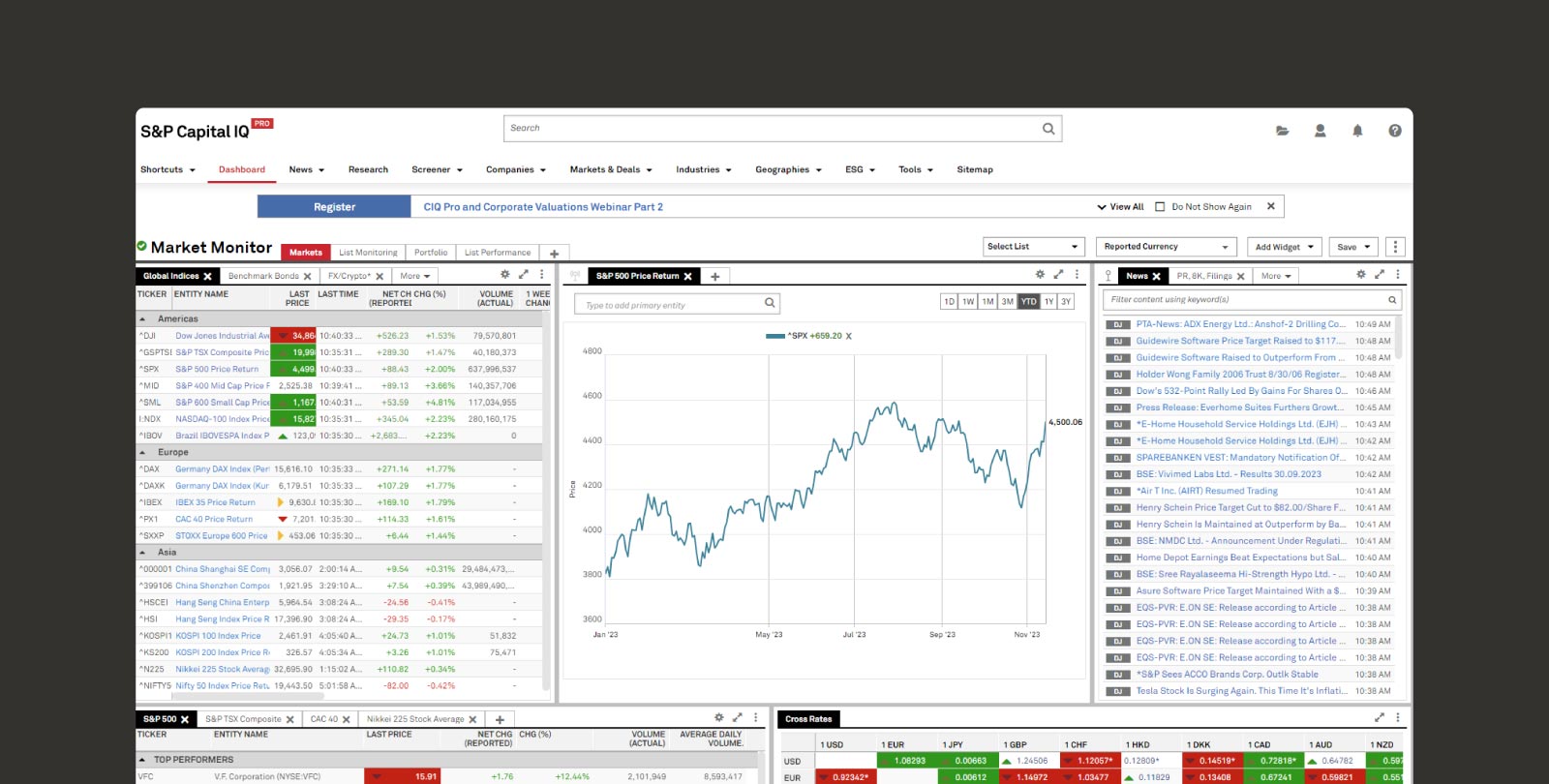
S&P Capital IQ Pro specializes in structured financial databases and quantitative modeling. The platform provides data on 250M+ private companies and 58M+ million companies total, with extensive coverage of mergers and acquisitions (M&A), ownership structures, and credit metrics.
While AlphaSense has introduced a financial data suite (powered by Canalyst) to bridge the gap between qualitative research and quantitative screening, S&P Capital IQ Pro remains the definitive choice for professionals who spend their time in financial models. The platform is optimized for building complex comp sets and screening large company universes based on granular financial line items. However, most firms view the two as complementary: Capital IQ provides the structured foundation for the numbers, while AlphaSense offers the speed for document-based discovery.
Key features:
- Excel plug-in (modeling): The direct Excel integration allows users to pull live financial data, build models, and keep analyses updated without leaving spreadsheets. Reviewers note that the integration also helps reduce the time requirement for analysis with greater accuracy, making it essential for teams that live in Excel.
- S&P Global ratings integration: Native integration with S&P's credit ratings, research, and analytics provides comprehensive credit intelligence, including detailed covenant information and debt structure data. This integration is particularly valuable for credit teams analyzing issuer risk and fixed income investments.
- Mapping and spatial data: The platform includes geographic mapping tools and spatial analytics for industries, such as real estate, energy, and infrastructure, allowing users to visualize asset locations, regional exposure, and geographic concentration risk when managing portfolios.
S&P Capital IQ Pro vs. AlphaSense
S&P Capital Pro | AlphaSense | |
|---|---|---|
Data coverage | - Structured financial data on 60M+ companies, including detailed financials, M&A transactions, credit metrics, and ownership structures - No qualitative research content like expert calls or broker analysis | - Strong qualitative library, but its quantitative data is a secondary layer - Lacks the registry-level depth for complex corporate linkages and private credit |
Scale of analysis | - Optimized for screening large company universes and building comp sets - Powerful filtering across financial metrics, but not designed for document analysis or synthesis across unstructured files | - Optimized for top-down research - Not built for building 3-statement models from scratch or conducting granular peer-group reconciliation |
Accuracy and auditability | - High accuracy for structured financial data with rigorous verification of company financials and transaction details - Not applicable for document analysis or unstructured content synthesis | - Uses AI to extract and map data - While accurate for quick comps, it lacks the human-verified accounting rigor required for high-stakes investment banking models |
6. PitchBook
Best for: Private equity and VC professionals tracking private markets
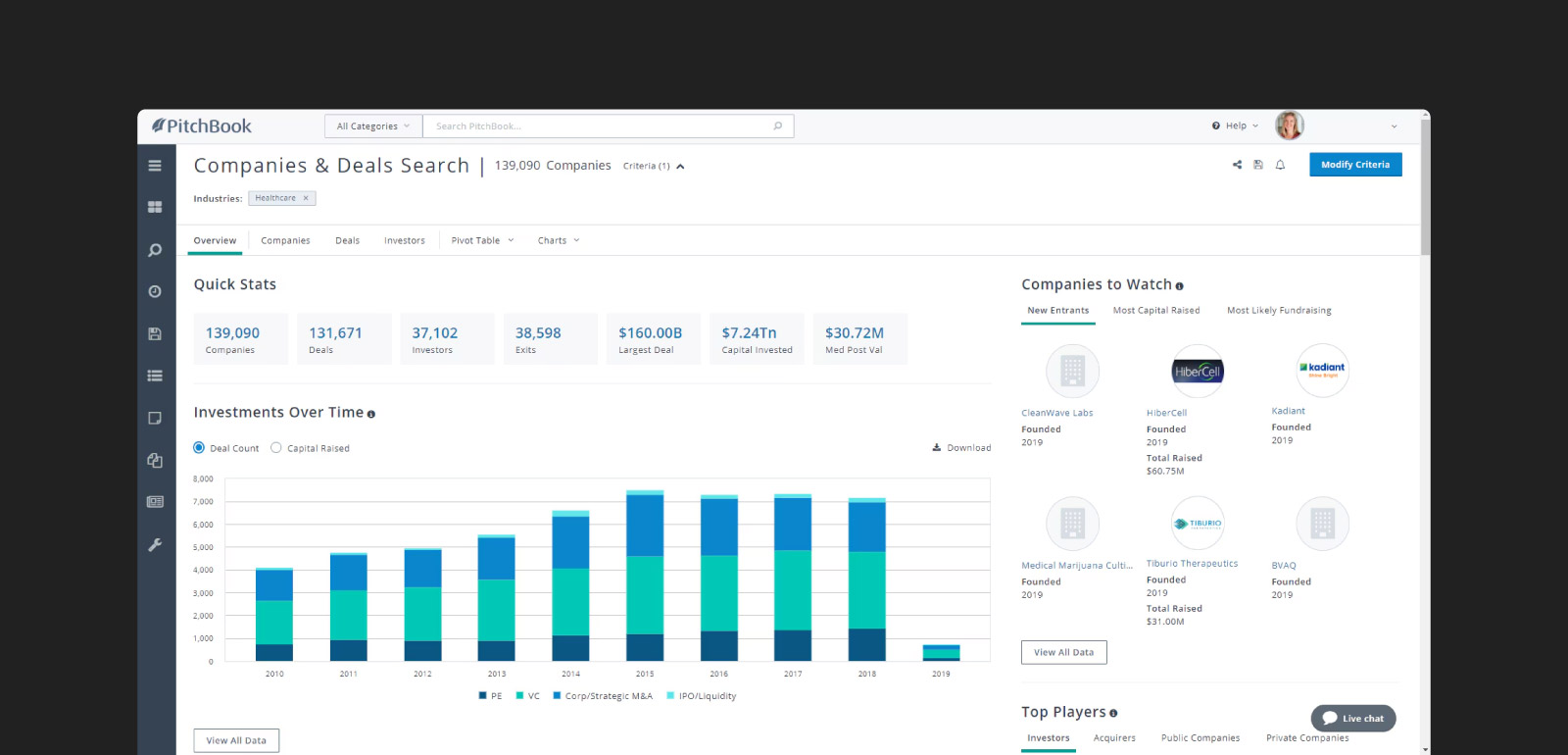
PitchBook specializes in private market intelligence with comprehensive data on venture capital, private equity, and M&A activity. The platform tracks data on companies, investors, deals, and funds across the private capital markets, serving over 100,000 professionals worldwide.
Where PitchBook excels at tracking private market transactions—valuations, funding rounds, limited/general partner relationships, deal terms—AlphaSense provides qualitative intelligence through broker research and expert calls. The use cases rarely overlap: PitchBook answers "Who's raising capital and at what valuation?" while AlphaSense addresses "What are analysts saying about this industry?" PE and VC firms frequently maintain subscriptions to both, using PitchBook for deal flow and AlphaSense for market intelligence.
Key features:
- Private market valuations: PitchBook provides detailed valuation data on private companies, including funding round terms, pre- and post-money valuations, and comparable transaction multiples. This data is essential for PE and VC professionals to benchmark deals and understand market pricing trends across sectors and stages.
- LP and fund performance data: The platform tracks LP/GP relationships, fund returns, vintage year analysis, and fundraising intelligence, enabling limited partners to assess manager performance and general partners to benchmark their funds against competitors.
- Deal sourcing filters: Advanced screening tools allow users to identify investment opportunities based on sector, geography, funding stage, revenue metrics, and growth characteristics.
PitchBook vs. AlphaSense
PitchBook | AlphaSense | |
|---|---|---|
Data coverage | - Private market data exclusively—VC deals, PE transactions, private company financials, fund performance, and LP/GP relationships - Limited public company coverage compared to specialized terminals | Covers both public and private markets, but without PitchBook's transactional deal data depth |
Scale of analysis | - Optimized for screening private companies and tracking deal flow - Not designed for document analysis or synthesis across unstructured files like VDRs or investment memos | Better for qualitative research than private market deal and transaction tracking |
Accuracy and auditability | - Data accuracy depends on insider contacts and voluntary disclosures - Some users note that funding data sometimes seems to be out of date, and incomplete fields limit comprehensiveness | Different accuracy profile—focused on published research verification rather than private transaction data validation |
Flexibility | - Purpose-built for private market research, deal sourcing, and fundraising intelligence - Excel/PowerPoint integration, but limited AI capabilities, and no workflow automation for diligence or materials generation | - Designed for market intelligence and research content discovery - More versatile across public and private content |
Enterprise deployment | High-cost enterprise model with team-based licensing | Lower cost than PitchBook with standardized onboarding |
7. Harmonic
Best for: VCs and growth equity teams sourcing early-stage startup deals
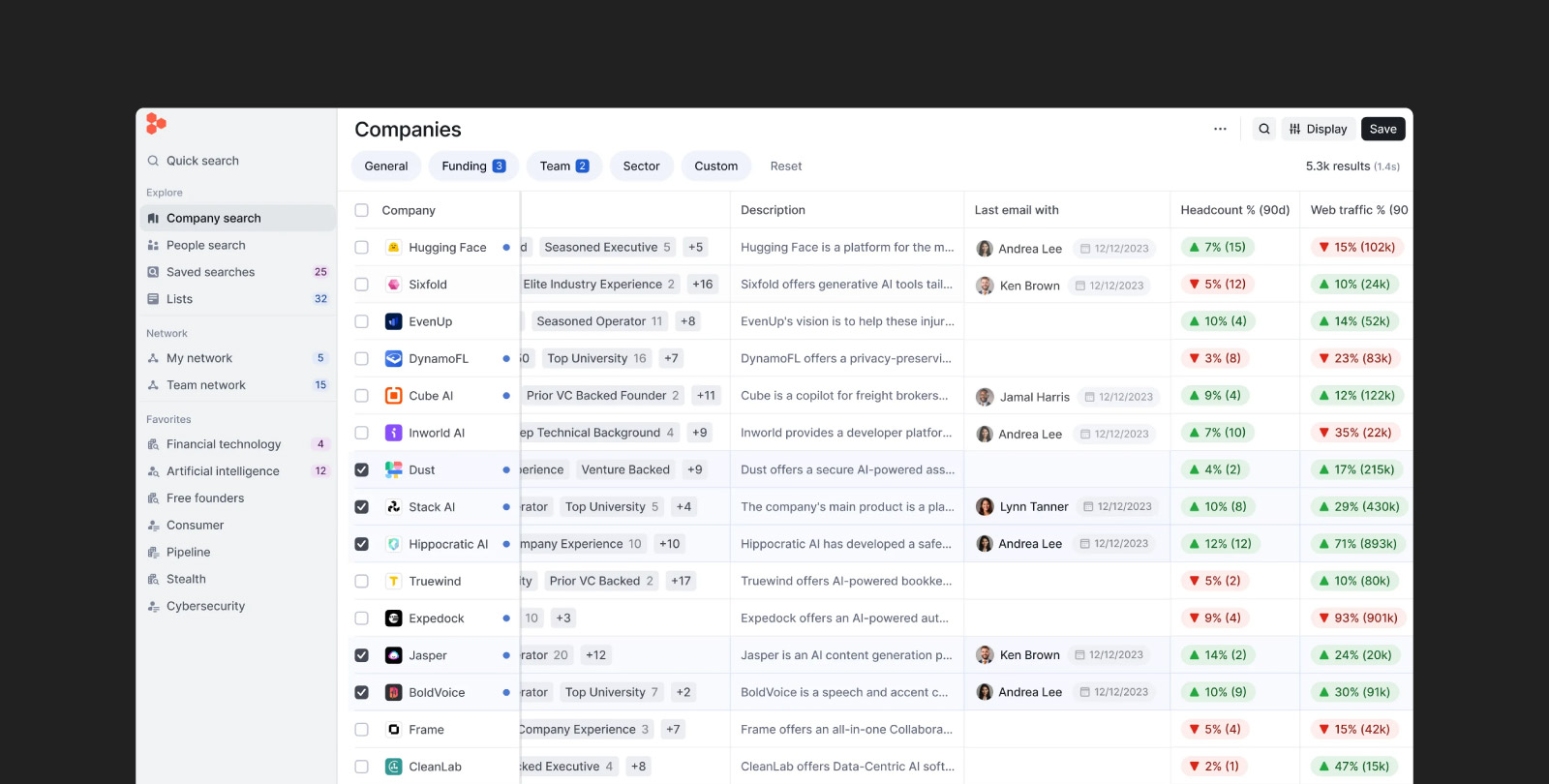
Harmonic is a startup discovery platform built specifically for venture capital deal sourcing. The platform indexes over 30 million companies and provides real-time updates, helping VCs identify promising startups before they reach the broader market. Its AI Scout agent answers natural-language queries like "Find vertical SaaS companies in construction tech with 10-50 employees that have recent funding," enabling data-driven sourcing that extends beyond traditional network-based deal flow.
The platform functions as a top-of-funnel engine. Once a company has matured and produced filings or expert interviews, teams then transition to tools like AlphaSense for deep-dive research.
Key features:
- Founder pedigree tracking: Harmonic monitors founder backgrounds, previous ventures, team composition changes, and hiring patterns to identify experienced operators launching new companies. The platform alerts users when portfolio alumni or notable founders start something new, enabling early relationship-building before formal fundraising.
- Predictive growth signals: The platform continuously tracks early indicators of momentum, including stealth domain registrations, hiring velocity, product releases, web traffic patterns, and technology stack changes. These signals help VCs identify breakout companies before they announce funding rounds or become obvious opportunities to competitors.
- Network-integrated sourcing: Harmonic maps LinkedIn connections, email and calendar events, and CRM engagements onto its startup database, surfacing warm introduction paths and companies with existing firm relationships. This blends AI-powered discovery with human network context, showing both opportunities within reach and high-quality targets outside current networks.
Harmonic vs. AlphaSense
Harmonic | AlphaSense | |
|---|---|---|
Data coverage | - 30M+ startup profiles with real-time updates on early-stage companies, founders, funding events, hiring, and growth signals - Focused exclusively on startup discovery and VC deal flow | Broad market intelligence without Harmonic's depth on early-stage startups or founding team data |
Scale of analysis | - Optimized for screening massive startup universes and identifying emerging opportunities - Not designed for document analysis, financial modeling, or synthesis across deal documents | - Better for researching established companies - Not designed for predictive sourcing of unlisted entities |
Accuracy and auditability | - Data continuously updated from public sources, social signals, and legal filings - Accuracy depends on publicly available information; may lack depth on stealth or pre-launch startups | - Citations are linked to published reports and transcripts - Highly dependent on lagging indicators (analyst opinions) rather than leading growth signals |
Flexibility | - Purpose-built for VC deal sourcing with AI Scout for natural language queries, customizable alerts, and CRM integrations - Limited functionality beyond startup discovery workflows | More versatile for established company research but lacks Harmonic's startup-specific discovery tools |
Enterprise deployment | - Tiered subscription model with web platform, Chrome extension, API access, and bulk data options - Focused on VC firms and corporate venture arms seeking systematic deal sourcing | - Standardized enterprise model for financial services - Onboarding is focused on research efficiency rather than deal sourcing or pipeline management |
8. Third Bridge
Best for: Investors and corporates who prioritize analyst-curated insights and reusable transcript libraries
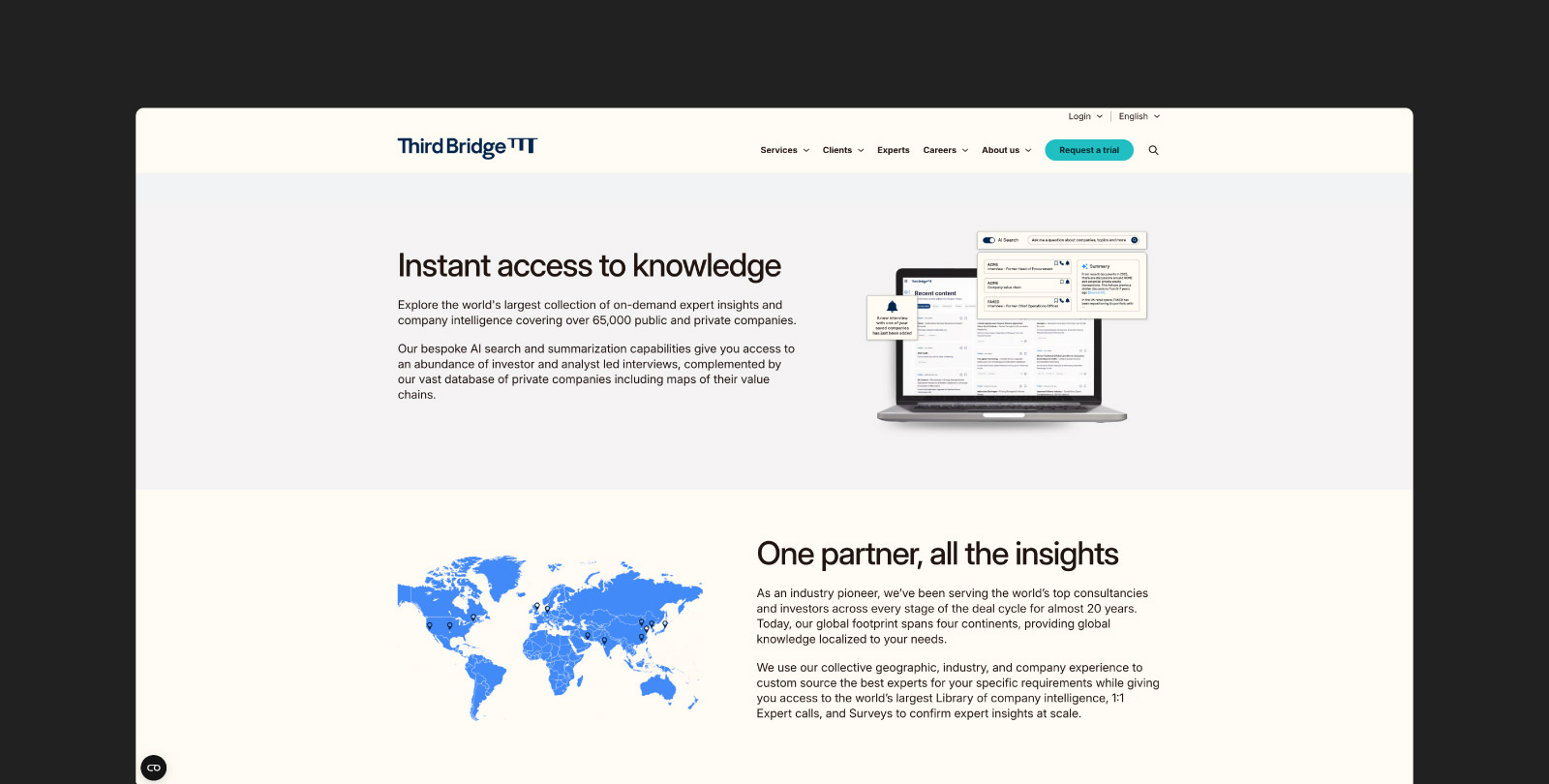
Third Bridge operates as an expert network connecting institutional investors with industry practitioners for one-on-one consultations. Unlike platforms that aggregate published research, Third Bridge facilitates primary research—clients conduct calls with former executives, operators, and specialists to build proprietary insights not available in public reports. The company maintains a library of analyst-moderated interview transcripts covering over 65,000 companies, enabling teams to review existing insights before scheduling new calls.
Third Bridge and AlphaSense complement rather than compete. AlphaSense serves as a high-speed library of information that has already been disclosed in public filings or broker reports. In contrast, Third Bridge is utilized when a team needs to generate an edge by speaking directly to former executives or suppliers to validate a thesis that hasn't yet reached the secondary research market.
Key features:
- Analyst-moderated transcripts: Third Bridge conducts analyst-led expert interviews rather than unmoderated Q&A sessions, providing structured, context-rich transcripts that deliver decision-ready insights. This approach ensures conversations stay focused on investment-relevant topics and produces higher-quality content than self-directed expert calls.
- Human-in-the-loop surveys: Beyond one-on-one calls, Third Bridge designs and executes custom surveys of industry participants to quantify market trends, competitive positioning, or customer sentiment. These surveys combine quantitative rigor with expert network access, providing data points that complement qualitative interview insights.
- Forum platform for ongoing expert access: Third Bridge maintains ongoing relationships with experts through its forum platform, creating a community of practitioners who provide repeated insights over time. This allows firms to track how industries evolve by consulting the same experts at different stages, building deeper intelligence than one-off conversations provide.
Third Bridge vs. AlphaSense
Third Bridge | AlphaSense | |
|---|---|---|
Data coverage | - Primary research through expert consultations and analyst-led interviews - Library of 15,000+ proprietary transcripts covering 65,000+ companies - Custom-sourced experts rather than published content. | Limited ability to custom-source experts for niche primary research |
Scale of analysis | - Designed for conducting and accessing expert consultations - Not built for document analysis, financial modeling, or synthesis across deal documents and internal files | - Optimized for rapid searching across millions of existing files and monitoring market sentiment - Lacks the structured, repeatable interview frameworks found in analyst-led network |
Accuracy and auditability | - Expert insights reflect individual perspectives based on their experience - Each expert provides one viewpoint, so teams typically consult multiple experts to validate findings and build conviction | Reliability is dependent on the quality of third-party analysts and public disclosures |
Flexibility | - Human-driven service model with custom expert sourcing, survey design, and project management - High-touch but requires lead time for expert identification and scheduling | - Offers custom agents for search and sentiment analysis - Operates within a fixed content universe; it cannot generate new expert data on demand |
Enterprise deployment | - Credit-based or subscription pricing ($350-$750+/hour per expert) - Service-intensive model with dedicated account teams managing expert sourcing and compliance workflows | Lower cost than expert consultations but serves a different use case — searching existing content versus conducting primary research |
9. GLG (Gerson Lehrman Group)
Best for: Large institutions needing global expert coverage across diverse industries and geographies
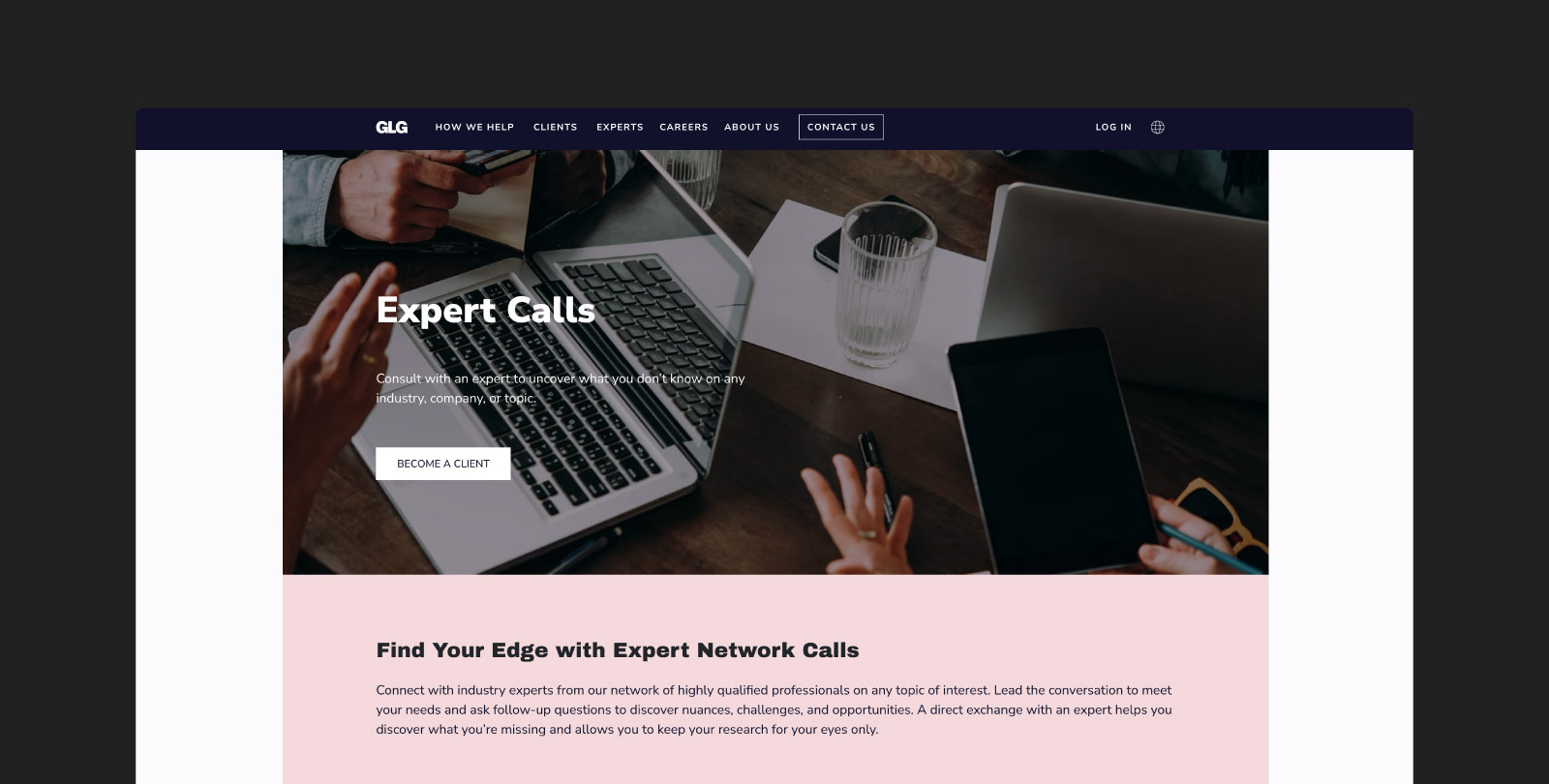
GLG operates the world's largest expert network with over 1.2 million professionals across industries. Founded in 1998, the company pioneered the expert network model connecting institutional investors and consulting firms with subject matter experts through one-on-one calls. The platform also offers surveys, events, library access to past interview transcripts, and longer-term consulting projects beyond standard calls.
Similar to Third Bridge, GLG and AlphaSense serve different use cases, and many institutional investors use both. GLG connects clients directly with experts for custom consultations, enabling firms to ask proprietary questions and probe specific topics with industry insiders, whereas AlphaSense provides access to published secondary research. The key difference is that GLG facilitates new conversations tailored to your specific questions; AlphaSense searches existing published content.
Key features:
- Bespoke expert consultations: GLG custom-sources experts for each client request rather than relying on self-referrals, ensuring relevance and independence. The platform's global reach across 13 countries enables access to specialized expertise in virtually any industry, geography, or functional area with flexible engagement formats from one-hour calls to multi-month projects.
- Compliance framework: GLG maintains rigorous vetting and compliance standards prohibiting experts from sharing non-public information or violating ethical restrictions. This infrastructure, refined over 25+ years, has made GLG trusted by major financial institutions for high-stakes research requiring strict confidentiality and regulatory adherence.
- Executive councils: Beyond individual consultations, GLG facilitates events, roundtables, and ongoing advisory relationships with senior executives through its Executive Councils and GLG Events offerings. These structured group interactions let clients access multiple perspectives simultaneously and build long-term expert relationships for continuous strategic guidance.
GLG vs. AlphaSense
GLG | AlphaSense | |
|---|---|---|
Data coverage | - 1.2M+ expert network spanning all industries and geographies - Facilitates custom consultations and provides a library of past interview transcripts - Primary research through bespoke expert sourcing | Limited ability to custom-recruit new experts for bespoke projects |
Scale of analysis | - Designed for conducting expert consultations and accessing the transcript library - Not built for document analysis, financial modeling, or synthesis across proprietary deal files | - Better for discovering published research - Lacks the human-led project management required for complex, primary data gathering |
Accuracy and auditability | - Expert insights reflect individual viewpoints based on their experience - Rigorous compliance framework prevents non-public information sharing - Teams typically consult multiple experts to build conviction across perspectives | Verifies what analysts have publicly stated, but doesn't provide direct access to experts for custom consultations or proprietary questioning |
Flexibility | - High-touch service model with custom expert sourcing, surveys, events, and project management - Global coverage but premium pricing, and requires lead time for expert identification and scheduling | Faster for finding what's already been written, but restricted to a fixed data library |
Enterprise deployment | - Premium pricing is typically $1,500-$2,000+/hour per expert consultation - Subscription or credit-based models with dedicated account teams - Higher cost reflects global scale and compliance infrastructure | - Platform subscription at lower cost than expert network services - Different use cases; searching aggregated published content versus conducting custom expert consultations |
10. AlphaSights
Best for: PE and consulting teams that need rapid C-suite access with white-glove project management
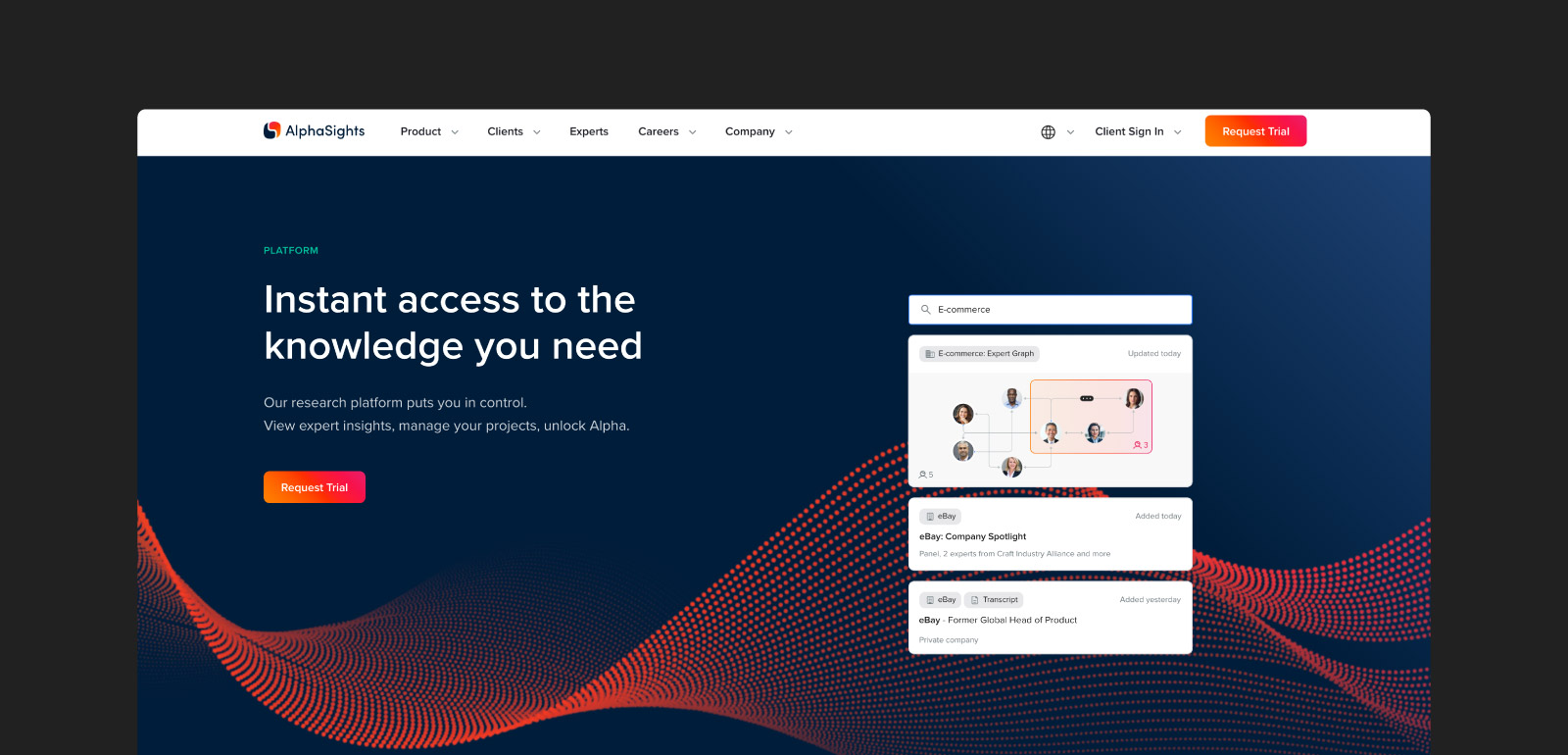
Founded in 2008, AlphaSights has grown into a global expert network known for rapid expert sourcing and premium client service. The company employs over 2,000 professionals across nine offices, providing 24/7 coverage from San Francisco to Shanghai. AlphaSights differentiates through speed and white-glove service, with associates custom-recruiting experts for each project rather than maintaining a static database.
AlphaSights and AlphaSense serve entirely different functions despite the similar names. AlphaSights arranges custom expert consultations, connecting clients with C-suite executives and industry practitioners for proprietary conversations. AlphaSense aggregates published secondary research from broker reports, expert transcripts, and filings without arranging consultations.
Key features:
- Global expert sourcing: AlphaSights custom-recruits experts for each client project using its AlphaGraph knowledge graph that maps over 25 million expert-to-company relationships. This project-specific sourcing model, rather than a pre-registered network, enables precise matching to client requirements with dedicated account teams building a deep understanding of specific research workflows.
- Compliance-led transcripts: The platform provides automatic transcription with comprehensive human quality assurance, delivering perfect call records within hours of consultations. AlphaSights' compliance program includes multi-layered reviews, confidentiality protections, and proprietary financial risk management technology, ensuring both clients and experts operate within strict ethical and regulatory boundaries.
- Custom B2B surveys: Beyond one-on-one consultations, AlphaSights designs and executes custom surveys across targeted professional panels. The platform can rapidly build panels of qualified respondents and deliver high-quality survey output that clients can present immediately to their teams, combining expert network access with quantitative research rigor.
Alphasights vs. AlphaSense
AlphaSights | AlphaSense | |
|---|---|---|
Data coverage | - Expert network facilitating custom consultations with C-suite executives and industry practitioners - AlphaNow library of proprietary expert research insightsPrimary research through bespoke expert recruitment | Published secondary research aggregating broker reports, expert call transcripts from various networks, company filings, and news |
Scale of analysis | - Designed for arranging expert consultations and accessing a proprietary research library - Not built for document analysis, financial modeling, or synthesis across deal files and internal documents | Better for discovering published research than arranging expert consultations or conducting primary research with industry practitioners |
Accuracy and auditability | - Expert insights reflect individual perspectives from custom-sourced practitioners - Rigorous compliance prevents non-public information sharing | Verifies what's been publicly stated but doesn't provide direct expert access for custom consultations or proprietary questioning |
Flexibility | - High-touch concierge model with project-specific expert recruitment, surveys, and dedicated account management - Premium service with 24/7 global coverage, but higher pricing and lead time for sourcing | Faster for finding what's already been written publicly, but cannot arrange expert calls or conduct new primary research with practitioners |
Enterprise deployment | - Premium pricing of $700-$1,800+/hour per expert reflecting C-suite access - Credit-based or retainer models with dedicated teams - Higher cost structure for white-glove service and executive-level expertise | - Platform subscription at a significantly lower cost than expert network services - Different use cases and buyers; research teams searching aggregated content versus arranging bespoke expert consultations |
How To Choose the Right AlphaSense Alternative
Selecting the right platform depends on your firm's specific workflows, data requirements, and whether you need a tool that finds information or one that actually does the work. Consider these factors when evaluating AlphaSense alternatives:
- Identify your primary data bottleneck: Nearly half (46%) of finance professionals struggle to extract information from multiple sources, and 38% struggle searching across disconnected systems. If your team already pays for premium content, the real gap may be synthesis and workflow execution rather than another search layer.
- Evaluate "reasoning" vs. "search": Understand the difference between platforms that help you find information faster versus those that generate insights and work products. Search-focused tools accelerate research; reasoning platforms automate the analysis that comes after, producing IC memos, pitch decks, and investment materials that previously required days of manual work.
- Run a "high-stakes" pilot: Test platforms with real diligence projects, not demo data. For example, upload an actual VDR, process a live credit agreement, or generate client materials under deadline pressure. The best way to evaluate whether a platform delivers genuine value is whether it performs on the workflows that define your success and reputation.
- Avoid the "all-in-one" trap: Don't expect one tool to do everything. Many top firms use Bloomberg for the numbers, Tegus for the transcripts, and Hebbia as the AI associate that synthesizes it all.
- Prioritize enterprise-grade security: Data privacy is essential for high-stakes finance. Ensure your chosen platform offers zero data retention (ZDR), meaning that it doesn't use your proprietary deal documents, internal research, or client materials to train its models. Ask explicitly about data handling policies and whether your firm's information remains isolated.
- Look for deliverable generation: A tool that provides chat answers helps you research faster, but a platform that generates branded pitch decks, formatted Excel tables, or complete IC memos helps turn research into finished work. 63% of finance professionals already save more than six hours per week using AI—the right software should convert that time savings into a real deal-speed advantage
Unlock institutional-grade intelligence with Hebbia
Looking across AlphaSense competitors, you'll find tools built for different jobs: data terminals for market pricing, expert networks for arranging calls, search platforms for finding published content. Some offer basic analysis features, but most stop short of the heavy lifting, like processing entire VDRs, building IC memos, or generating client materials at the scale and speed modern finance demands.
While AlphaSense adds AI tools to help analyze its proprietary content, Hebbia is a completely AI-native platform designed to integrate with the most critical financial data sources. It curates end-to-end agent workflows for diligence and analyzes documents at greater scale with high accuracy — which is what thorough diligence demands.
Over 40% of the largest asset managers use Hebbia because it compresses weeks of diligence into days and automates the work that defines competitive advantage. That's the difference that leads to closing deals while competitors are still reading documents.Request a demo to see Hebbia handle your actual workflows, or explore Matrix to see what AI-native platforms can do for financial research.


