
Hebbia vs. Rogo: Which AI Platform Actually Scales?
Hebbia and Rogo both help institutional finance teams automate research and diligence workflows, but they have fundamentally different goals. One is a chat-based productivity tool for individual analysts; the other is an institutional platform built around the firm's operations.
The decision ultimately comes down to whether your team needs the ability to reason across large volumes of proprietary documents with firm-wide collaboration and full traceability.
This post breaks down where the two platforms differ in document scale, citation precision, collaboration, and use-case fit—the dimensions that tend to drive the final decision.
Hebbia vs. Rogo: Key Differences at a Glance
Hebbia and Rogo both apply AI to financial documents, but they're built for different parts of the workflow.
The table below covers the dimensions that drive the final decision for private equity (PE), credit, and investment banking (IB) teams.
Feature | Hebbia | Rogo |
|---|---|---|
Use case breadth | IB, PE, credit, and public equity | Primarily IB workflows |
Citation granularity | Sentence-level citations for every output | Response-level citations only |
Output consistency | Every step of a Matrix workflow is configured and auditable, so the same question returns the same fields and structure every time | Responses are free-form and not designed for consistency |
Collaboration | Real-time multi-user collaboration with persistent context and material non-public information (MNPI) controls | Deal materials worked on one at a time; persistent context with no MNPI controls |
Workflow automation | Custom and pre-built automations; teams can build, share, and deploy their own Agents and Skills | No custom workflows; pre-built Agents only |
Slide and content generation | Multi-slide generation with branded templates and branded styles | One slide at a time; branded styles only |
Excel | Hebbia Max builds full Excel financial models with cell-level citations | Excel files editable within Rogo UI via Subset |
Security and entitlements | Customized security management and entitlements; access controlled at the role, team, project, and artifact level | Basic provisioning, security management, and single-tenant enterprise deployment |
Application programming interface (API) and Model context protocol (MCP) | Full API + MCP suite for embedding into existing bank tooling and tech stack | No API or MCP framework for custom embedding |
What Is Hebbia?
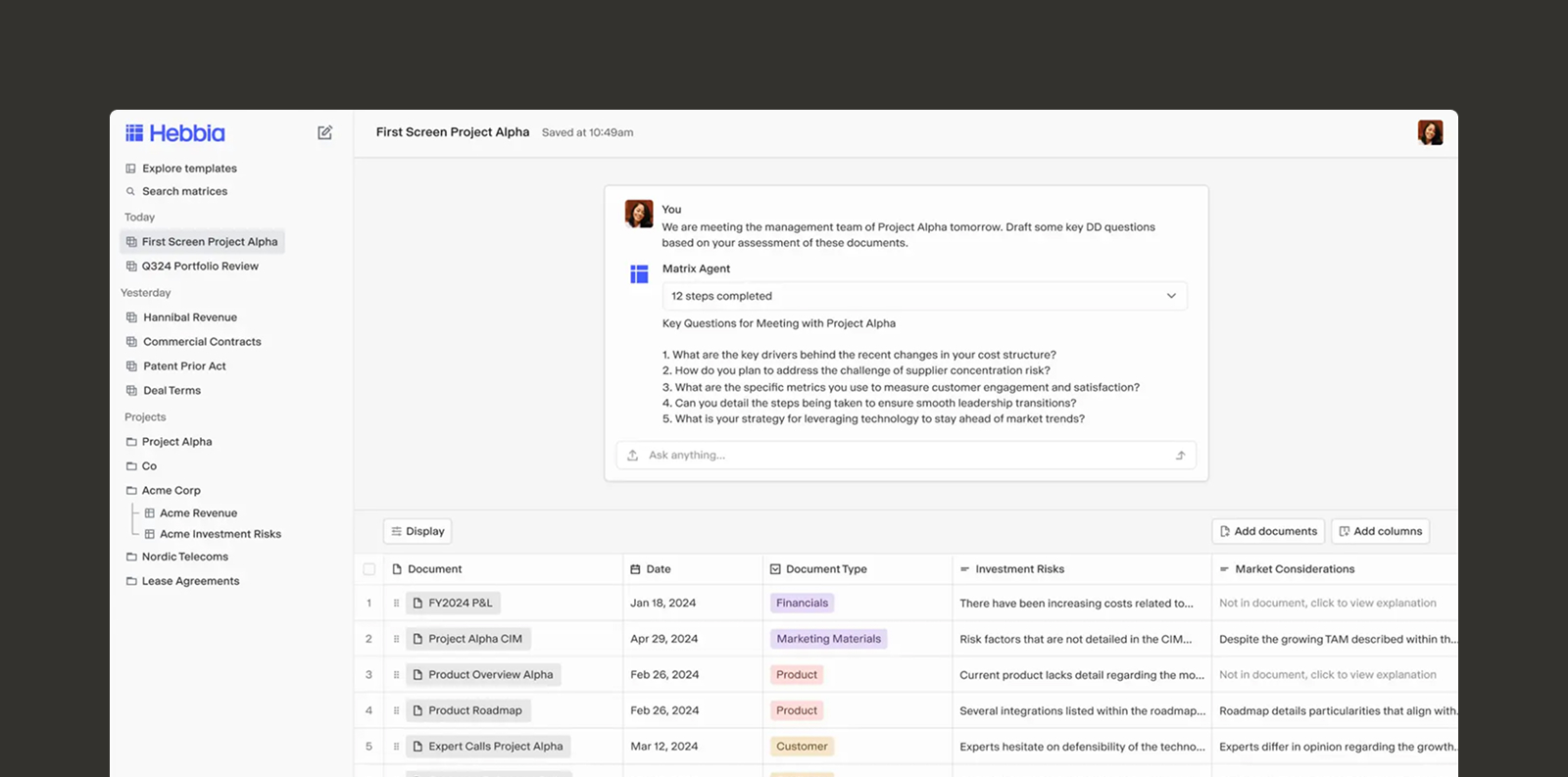
Hebbia is an intelligence platform built for asset managers and investment bankers. One part of it, Hebbia Max, is a chat interface much like Rogo's, built for individual analyst speed. The other part, Matrix, is what sets it apart.
Its core technology, Iterative Source Decomposition (ISD), allows customers to reason across entire document sets without hitting a context window ceiling. For teams working through a 300-page data room, a stack of credit agreements, or years of filings simultaneously, that distinction matters.
Most AI tools return answers from a truncated slice of your documents. Hebbia covers the chat use case through Max, then goes further with Matrix, which processes the full set, returns outputs with sentence-level citations, and keeps that intelligence persistent — so a firm's knowledge compounds across every deal and every team.
That traceability is what makes outputs defensible to an investment committee or a senior MD, for AI due diligence workflows where accuracy isn't negotiable.
Leading investment banks and more than 40% of the largest asset managers by AUM trust Hebbia to run their most critical workflows. It's built to make individual analysts faster and to encode how the firm operates into a platform that the whole deal team works from.
See how Hebbia stacks up against other Rogo alternatives.
Hebbia Pros
Hebbia's advantages compound. Document scale unlocks better analysis, better analysis produces more defensible outputs, and shared workspaces mean the whole deal team benefits from the same intelligence.
Here's where it pulls ahead:
- Iterative Source Decomposition (ISD) processes documents whole, with live syncing across private data: Hebbia reasons across entire document sets, including VDRs, CRMs, and SharePoint, without context window constraints, and keeps private data current across workflows.
- Consistent, structured outputs every time: Hebbia returns the same answer to the same question consistently. For teams that need outputs they can defend to a committee or drop directly into a deliverable, that reliability matters.
- Sentence-level citations for every output: Every finding links back to the exact source clause or passage, giving analysts the traceability they need to defend conclusions to senior reviewers and investment committees.
- Real-time deal team collaboration with MNPI controls: Rather than individual analysts working in silos, Hebbia Projects provides the entire deal team with a shared environment featuring persistent context and built-in MNPI controls.
- Composable Matrix workflows your team can build, share, and deploy: Teams can chain research, modeling, and deliverable generation into a single auditable workflow, save it as a reusable Skill, and extend it into internal systems through Forward Deployed Engineering when needed.
- Multi-format deliverables generated in parallel: With a single prompt, Max can produce a memo, a dashboard, an Excel model, and an audio briefing off the same analysis in one pass, so the deal team isn't rebuilding the same numbers across five different formats.
- Serves IB, PE, credit, and public equity workflows: Hebbia isn't optimized for one use case and stretched to cover others. It's purpose-built for the document-intensive work that defines each of these verticals.
- Institutional context baked into the platform: Hebbia's team of former bankers works desk by desk to encode how your firm operates directly into the platform.
Hebbia Cons
Hebbia is built for institutional complexity, and that focus comes with trade-offs. Here's what to consider before committing:
- Priced for institutional teams: Hebbia is built for enterprise deployment and priced accordingly. It's a fit for firms with a dedicated AI budget, not individual analysts or smaller teams looking for a self-serve option.
- Designed for deep deployment, not quick setup: Getting full value from Hebbia requires upfront configuration and an onboarding period. Teams that invest in that process get workflows built around how their firm actually operates.
- Best suited for document-heavy workflows: Teams whose work centers on structured data feeds and market databases rather than proprietary documents may not get full value from Hebbia's strengths.
Who is Hebbia best for?
Hebbia is best for PE deal teams, credit investors, and IB teams that need to reason across large volumes of proprietary documents, including data rooms, credit agreements, and expert transcripts, with full traceability and firm-wide collaboration.
It's the right fit for firms that want a platform built around how they operate, not just a productivity tool for individual analysts.
What Is Rogo?
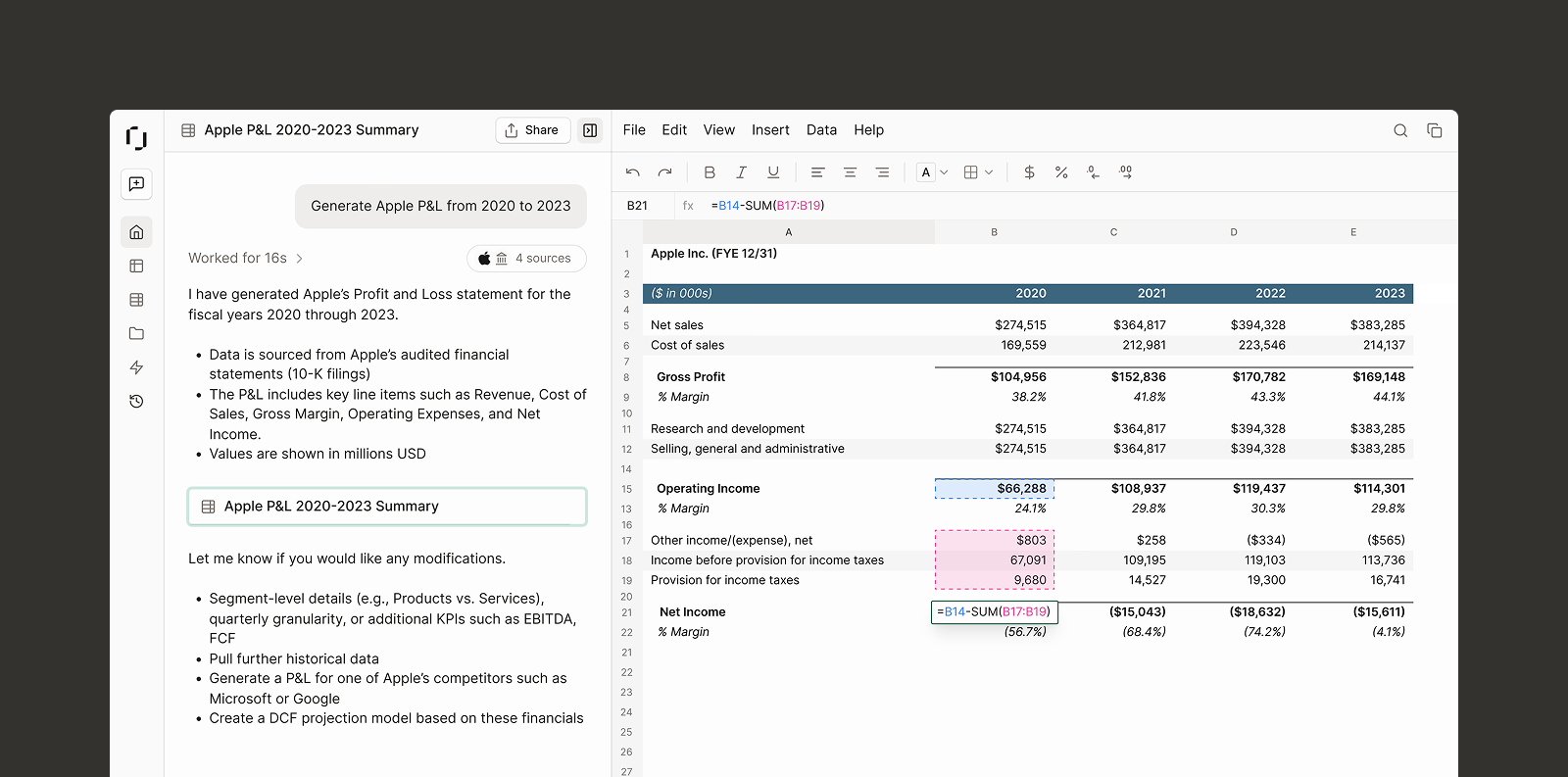
Rogo is an AI finance platform designed primarily for investment banking workflows.
Founded in 2021 by former bankers, it was designed from the ground up for the research and analysis tasks that consume most of a junior banker's day, like pulling data, building comparables, and drafting sections of pitch materials. Results are returned as free-form text through a chat-based interface.
The platform operates across three main pillars:
- Data partnerships with LSEG, FactSet, and S&P Global
- Excel automation capabilities added through its acquisition of Subset
- Single-tenant enterprise deployment that keeps client data fully isolated across firms
Rogo has gained traction at several established global banks, including Lazard, Nomura, and Jefferies. Its focus on investment banking specifically, rather than the broader financial services market, has shaped both its feature set and its go-to-market positioning.
Rogo Pros
Rogo was built by bankers for banking workflows, and that focus shows in its feature set. Teams that need structured IB tooling with direct access to market data and strong enterprise security will find plenty to work with here, including:
- Purpose-built IB workflow templates: Rogo ships with templates designed around common investment banking tasks, reducing the setup time required to get analysts working productively inside the platform.
- Direct real-time access to LSEG, FactSet, and S&P Global via native integrations: Market and financial data from major providers is available directly within the interface, eliminating the need to pull from separate terminals or export into other tools.
- Strong Excel automation through Subset acquisition: The Subset integration enables analysts to run analyses and populate spreadsheets directly in their existing Excel environment, reducing manual data entry and model-building time.
- Established enterprise rollout at global banks with single-tenant deployment: Rogo has completed enterprise deployments at firms including Lazard, Nomura, and Jefferies, with a security architecture that keeps each firm's data fully isolated.
- Guided implementation led by ex-bankers: Rogo's implementation team includes former investment bankers who understand deal workflows firsthand, which can shorten onboarding time and ensure the platform is set up around how deal teams actually work rather than generic templates.
Rogo is purpose-built for investment banking workflows. But so is Hebbia Max from Hebbia. Plus, we have deeper document analysis, firm-wide collaboration, and MNPI controls that Rogo doesn't offer.
Rogo Cons
Rogo's strengths in standardized IB workflows come with trade-offs that become apparent for teams running complex, high-volume, or investor-grade analysis.
Regarding PE diligence, credit work, or any use case that pushes outside traditional banking outputs, the platform has several limitations:
- The LLM context window limits document scale: Rogo is a UI layer built on top of existing large language models (LLMs), so it inherits their context window constraints. Reliably analyzing thousands of documents simultaneously isn't within its current capability. Hebbia's architecture is built specifically to process document sets at that scale.
- Response-level citations and unstructured outputs: Rogo provides auditable citations at the response level but doesn't offer sentence-level sourcing, and returns answers as free-form text rather than in a consistent, structured format. For credit or diligence work where every claim needs to trace back to a specific passage and outputs need to be defensible, both gaps matter.
- No MNPI controls or team collaboration framework: Rogo improves individual analyst efficiency but lacks a shared workspace and has no Material Non-Public Information (MNPI) controls on persistent context—a serious compliance gap for enterprise IB teams handling sensitive deal information.
- No API or MCP framework: Rogo has no API or Model Context Protocol (MCP) support, which limits how deeply banks can embed it into their existing tooling and tech stack.
- Rigid workflow structure for non-IB use cases: Rogo is optimized for standard investment banking outputs. PE firms running deep diligence and credit teams working across dense financing documents will find that the workflow templates don't map cleanly to their analytical needs.
Who is Rogo best for?
Rogo is a strong fit for investment banks and advisory firms running standardized, high-volume workflows, particularly for teams where direct access to LSEG, FactSet, and S&P Global, alongside Excel automation, delivers the most immediate value.
It works best as an individual productivity tool, not a firm-wide intelligence platform.
See Why Hebbia Belongs in Your Tech Stack
Rogo is a capable tool for standardized IB workflows. But the Hebbia vs. Rogo comparison makes one thing clear: The two platforms are not interchangeable if your team needs to process large volumes of proprietary documents with full traceability and firm-wide collaboration.
While Rogo is optimized for speed on familiar, templated deliverables, Hebbia, powered by Max and Matrix, is built for work that requires reasoning across everything your firm knows.
For PE deal teams, credit investors, and IB teams doing work that can't be templated, Hebbia is built for that complexity. Book a demo to see how it handles your actual documents and workflows.
Hebbia vs. Rogo FAQ
The questions below address the most common decision points for finance teams evaluating Hebbia and Rogo side by side.
What Is the Main Difference Between Rogo and Hebbia?
Rogo targets investment banking workflows, with structured templates, real-time market data integrations, and Excel automation built around standard IB outputs — all designed to make individual analysts faster.
Hebbia makes your institution smarter. It processes large, unstructured document sets across VDRs, credit agreements, and confidential information memorandums (CIMs) with sentence-level citations, and layers in firm-wide collaboration, MNPI controls, and workflow customization that encode the firm's operating model into the platform. The core trade-off is individual productivity versus institutional intelligence.
Is Hebbia or Rogo Better for Due Diligence?
Hebbia is the stronger choice for due diligence that requires working across large, unstructured document sets. Its Matrix architecture processes documents at a scale that context-window-bound tools can't match, and sentence-level citations mean every extracted detail traces back to a specific passage.
Rogo handles structured data tasks well, but deep document diligence is outside its core design.
Can Rogo Handle Large Data Rooms?
Rogo cannot handle large data rooms at scale. It is built on top of existing LLMs and inherits their context window limitations, which makes reliable analysis across thousands of documents—a full VDR, for example—a meaningful constraint. By comparison, Hebbia's architecture is designed specifically to handle the volume of large data room work.
Does Hebbia Integrate With FactSet and Bloomberg?
Hebbia does not have native integrations with FactSet or Bloomberg, unlike Rogo. Where Rogo connects directly to those data providers within the platform, Hebbia is built to process the unstructured documents and deal files that sit alongside that data. It's typically paired with a market data provider rather than replacing one.
How Does Rogo's Excel Integration Compare to Hebbia's?
Rogo's Excel integration is a core feature. Built out through its acquisition of Subset, it allows analysts to roll forward models, audit formulas, and populate spreadsheets without leaving their Excel environment.
Hebbia takes a different approach. Its Max agent builds full financial models directly, citing every formula down to the cell, and still exports cleanly to Excel or into Hebbia Chat for live data retrieval and collaborative model building.


