
The 8 Best Financial Forecasting Tools
Static spreadsheets have become a liability in a market defined by data density. High-stakes decisions now demand financial forecasting tools capable of synthesizing disparate data into high-conviction models that move as fast as the tape.
What traditionally takes an analyst three days of manually combing through a virtual data room (VDR) can now be synthesized in minutes. The goal is to implement tools that save teams hundreds of hours per deal cycle and drive firm-wide adoption by automating the heaviest manual lifts.
This guide evaluates the top forecasting software that excels at automated data extraction, complex scenario modeling, and seamless integration across your entire stack.
The Best Financial Forecasting Software at a Glance
The leading financial forecasting solutions prioritize speed and institutional accuracy over manual calculation. This list highlights the top platforms for high-conviction decision-making.
Software | Best for | Notable features |
|---|---|---|
Hebbia | Institutional-grade due diligence and deep document synthesis | - Matrix reasoning analyzes thousands of documents simultaneously -Direct, auditable citations linked back to source data - Automated extraction from unstructured PDFs, SEC filings, and private data rooms - Multi-agent architecture for complex, multi-step research workflows - Enterprise-grade security with zero data retention - Data governance and quality controls for institutional scale |
V7 Go | Visual data extraction and automated diligence triage | - Multi-modal ingestion capable of reading complex tables and handwritten notes - Agentic workflows designed for CIM and data room triage - No-code automation for repetitive document-heavy tasks |
Datarails | Consolidating spreadsheet-based forecasting and reporting | - Native integration with Microsoft Excel to maintain existing workflows - Centralized data lake for automated version control and audit trails - Real-time consolidation of disparate data sources |
Tegus | Linking qualitative primary research to fundamental models | - Integrated Canalyst fundamental models for thousands of public companies - Extensive library of expert call transcripts across multiple industries - Direct data linking from transcripts into active financial models |
Pigment | Real-time modeling for portfolio management and growth companies | - "Business twin" capabilities for instantaneous impact analysis of variables - Highly visual and flexible modeling interface for non-technical stakeholders - Multi-dimensional data architecture suited for private equity teams |
Glean | Internal knowledge discovery and institutional memory | - Unified search layer across Slack, Teams, Drive, and internal databases - Context-aware AI assistant for retrieving internal research and memos - High-security data indexing tailored for enterprise-scale firms |
Anaplan | Global enterprise-level modeling and massive dataset consolidation | - Hyperblock engine for processing massive, multi-dimensional data sets - Connected planning across finance, operations, and HR units - Enterprise-grade scalability for global firms with hundreds of business units |
Visible Alpha | Granular consensus data and line-item forecasting | - Granular consensus data sourced from 1,000+ investment research firms - Line-item detail for segment-level and KPI-specific forecasting - Automated model comparison to identify divergent analyst assumptions |
1. Hebbia

Best for: Institutional-grade due diligence and deep document synthesis
Hebbia functions as a firm-wide platform for institutional intelligence, providing a decisive edge across every stage of the investing and deal-making process. The platform unifies your team’s expertise with the firm’s collective institutional knowledge and real-time market data. This comprehensive integration ensures the entire organization can uncover better opportunities and consistently make higher-quality decisions.
The platform transforms the most grueling manual tasks—like navigating VDR chaos or scouring thousands of SEC filings—into high-conviction insights and finished, client-ready deliverables. Hebbia automates the heavy lifting of data synthesis and content generation through a firm-wide workflow. This shift allows analysts to move past routine data collection and focus on the strategic analysis that actually moves the needle.
Key features:
- Matrix reasoning analyzes thousands of documents simultaneously: Hebbia’s Matrix interface allows users to perform high-level reasoning across millions of pages of data and documents, from internal memos to global regulatory filings, all at once. This "interface to AGI" enables analysts to ask complex, cross-document questions that traditional search tools would take days to process manually.
- Direct, auditable citations linked back to source data: Using proprietary Iterative Source Decomposition (ISD), the platform provides sentence-level citations that map each answer directly to its source in the source document. This level of transparency virtually eliminates the risk of hallucinations and ensures your team has a perfect audit trail for every figure in your forecast.
- Automated extraction from unstructured PDFs, SEC filings, and private data rooms: The platform is built to handle the "messy" data of high finance, effortlessly pulling structured metrics out of dense legal agreements and scanned PDFs. Whether you're interrogating a massive VDR or comparing years of 10-K filings, Hebbia organizes unstructured chaos into clean, usable data for your financial models.
- Multi-agent architecture for complex, multi-step research workflows: Hebbia utilizes autonomous AI agents that can be programmed to execute end-to-end investment processes, from initial screening to drafting investment committee memos. These agents work in parallel to decompose your most difficult research tasks, allowing your firm to scale its expertise without increasing headcount.
- Enterprise-grade security with zero data retention: Hebbia is built for the highest levels of institutional compliance, featuring SOC2 Type II certification and a strict zero-data-retention policy. Your sensitive deal data and proprietary research are never stored, logged, or used to train external models, ensuring complete data sovereignty.
- Data governance and quality controls for institutional scale: The platform allows firms to codify their specific investment methodologies into "Skills" with robust permissioning and sharing controls. These centralized governance tools ensure that your firm’s best practices are applied consistently across every research workflow with full accountability and audit trails.
2. V7 Go
Best for: Visual data extraction and automated diligence triage
V7 Go is an Intelligent Document Processing (IDP) platform primarily used for the initial stages of due diligence and data room organization. It specializes in converting unstructured data from tables and images into structured formats, effectively acting as an automated data-entry layer for deal pipelines.
While technically capable of processing low-quality scans that break traditional optical character recognition (OCR) solutions, V7 Go often involves a steep learning curve and high implementation effort. It is fundamentally an extraction engine rather than a deep analytical platform; consequently, it lacks the native synthesis and deep-research capabilities found in more specialized financial intelligence suites.
Key features:
- Multi-modal ingestion capable of reading complex tables and handwritten notes: V7 Go identifies and extracts data from non-standard document formats, including handwritten annotations and nested tables within legacy PDFs.
- Agentic workflows designed for CIM and data room triage: The platform enables firms to deploy AI agents programmed to follow specific logic paths for deal screening and risk-trigger identification.
- No-code automation for repetitive, document-heavy tasks: Users can build custom automated workflows for tasks like lease abstraction or contract review without extensive coding knowledge using a visual interface.
3. Datarails
Best for: Consolidating spreadsheet-based forecasting and reporting
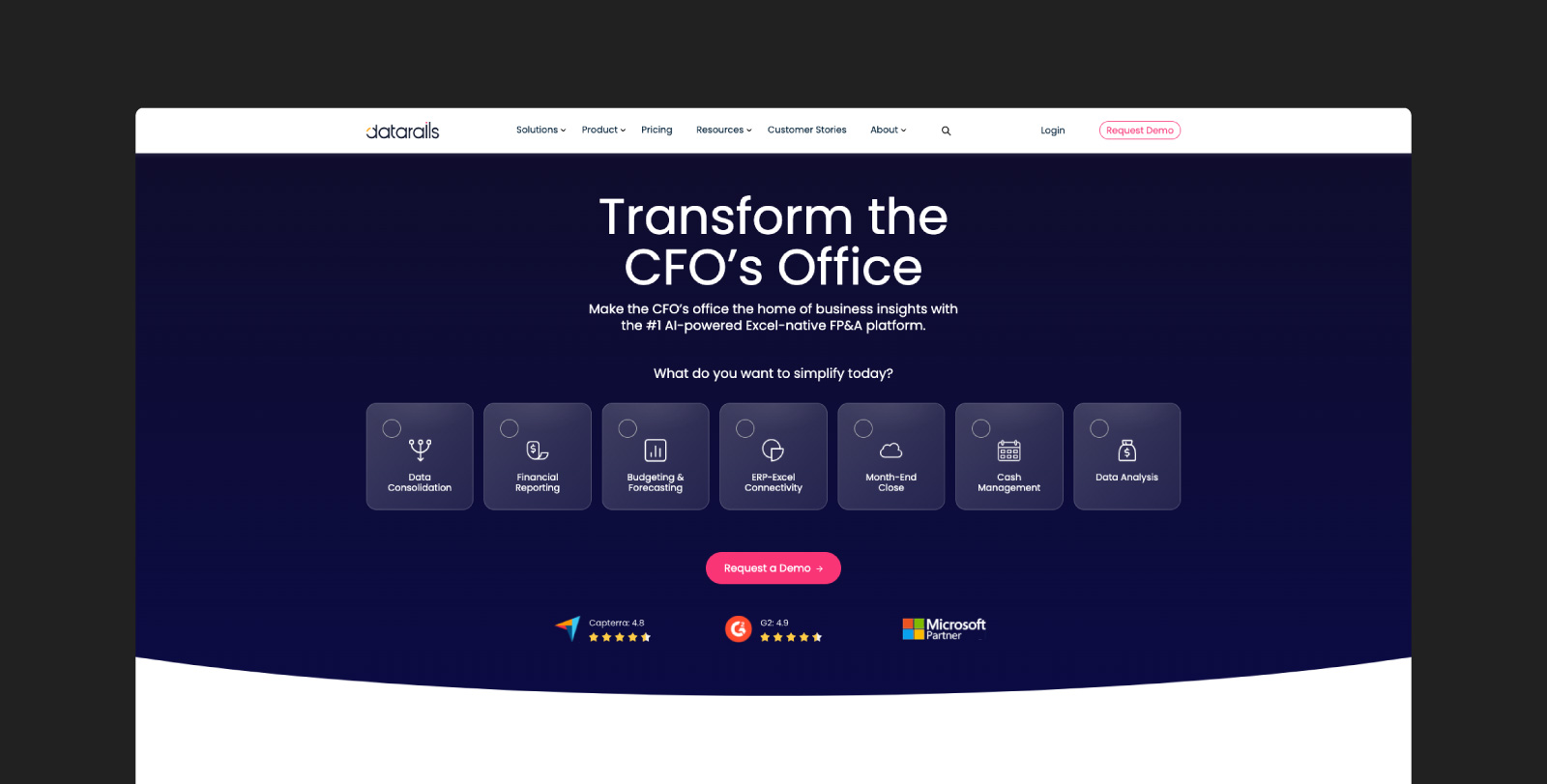
Datarails is designed for finance teams looking to modernize forecasting without abandoning Microsoft Excel. The platform creates a centralized data lake that connects directly to your existing spreadsheets. This integration provides the version control and data integrity of enterprise software while maintaining the flexibility of a local environment.
The platform is highly rated for its "What-If" scenario modeling and its ability to consolidate disparate data sources into a single source of truth.
However, because it's so closely tied to Excel, it doesn't represent a complete departure from legacy modeling risks. Some users find that while it solves for data integrity, it doesn't offer the same "clean sheet" agentic reasoning found in newer, AI-native finance platforms.
Key features:
- Native integration with Microsoft Excel to maintain existing workflows: Datarails functions as a layer over your current spreadsheets, allowing analysts to use familiar formulas and models while the platform handles data consolidation in the background.
- Centralized data lake for automated version control and audit trails: The platform automatically tracks every change made across your firm’s spreadsheets, providing a complete historical record and eliminating the risk of working with outdated data.
- Real-time consolidation of disparate data sources: Datarails pulls data from enterprise resource planning (ERP), customer relationship management (CRM), and human resource information system (HRIS) platforms to create a unified view of company performance, ensuring that forecasts are always based on the most recent actuals.
4. Tegus (AlphaSense)
Best for: Linking qualitative primary research to fundamental models
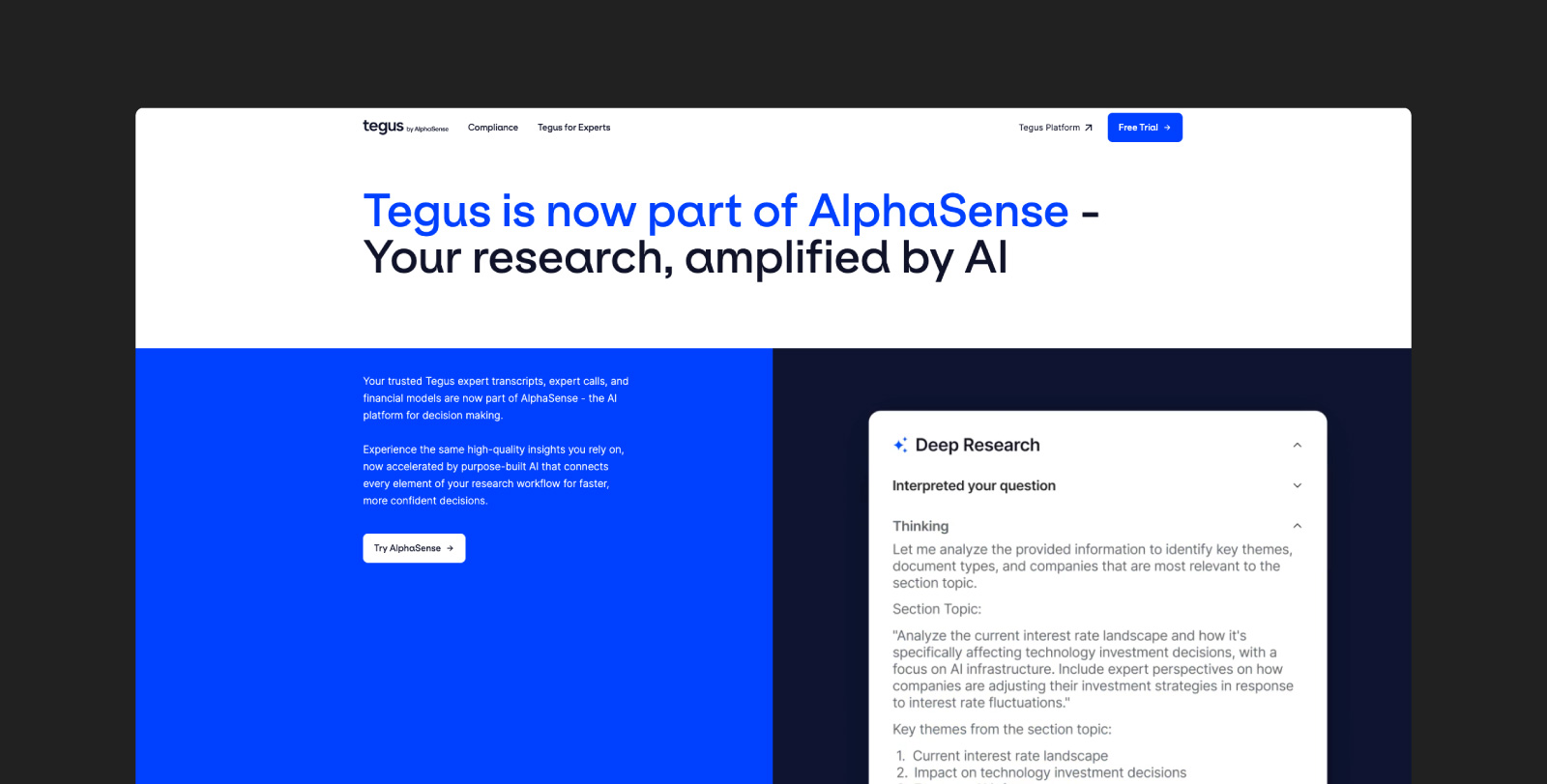
Tegus, recently acquired by AlphaSense, has established itself as a trusted bridge between qualitative insights and quantitative forecasting. By integrating Canalyst’s fundamental models directly with its massive library of expert call transcripts, Tegus enables analysts to populate and stress-test financial models using data from primary interviews.
While highly effective for bottom-up fundamental analysis, Tegus remains specialized at the company level and lacks the broader macro-economic monitoring found in more expansive suites.
The platform is being integrated into the AlphaSense ecosystem following the acquisition, though analysts still have to invest significant time manually synthesizing its deep qualitative data into usable forecasts.
Key features:
- Integrated Canalyst fundamental models for thousands of public companies: Analysts have immediate access to robust, fully-functioning fundamental models that can be customized to fit specific investment theses or sector-specific benchmarks.
- Extensive library of expert call transcripts across multiple industries: The platform hosts a vast searchable database of transcripts from former executives, customers, and competitors, providing the primary research needed to validate forecast assumptions.
- Direct data linking from transcripts into active financial models: Tegus allows users to tag and pull specific data points or "soft" insights from expert transcripts directly into their financial models, streamlining the gap between qualitative research and quantitative output.
5. Pigment
Best for: Real-time modeling for portfolio management and growth companies
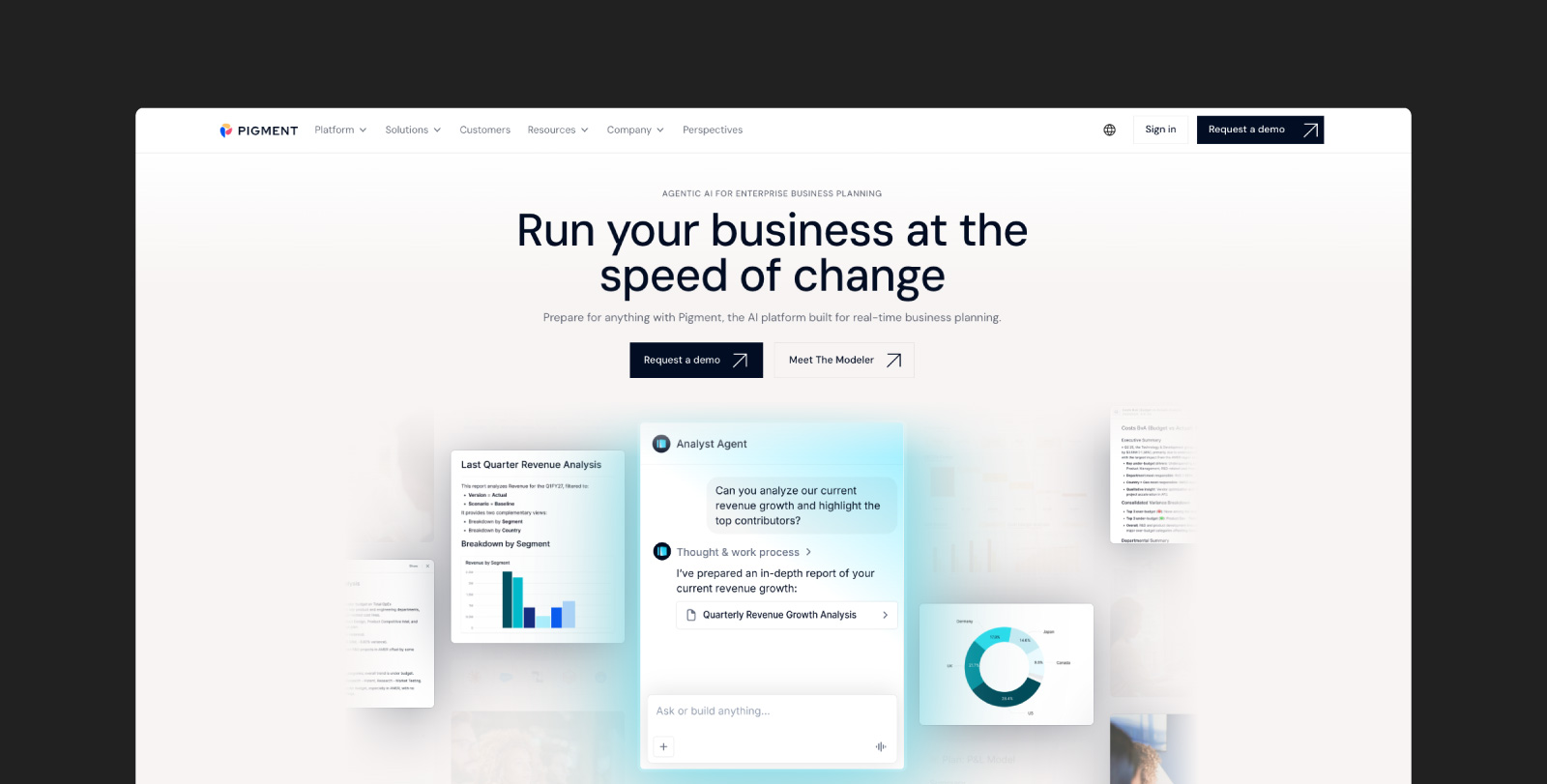
Pigment is a modern alternative to legacy enterprise planning tools, focusing on speed, visual clarity, and collaborative modeling. The platform creates multi-dimensional "business twins" where users toggle variables like headcount or interest rates. These models show the immediate impact of those changes across the entire forecast in real time.
Pigment is widely considered the leader in agentic EPM (Enterprise Performance Management), offering a superior user experience to older systems.
As an operational planning tool, Pigment is excellent for managing portfolio companies. However, it lacks the deep SEC-layer document analysis and market data extraction necessary for the early stages of the investment lifecycle.
Key features:
- "Business twin" capabilities for instantaneous impact analysis of variables: Pigment’s engine enables parallel scenario modeling, allowing teams to compare multiple "what-if" outcomes side-by-side without duplicating models or data.
- Highly visual and flexible modeling interface for non-technical stakeholders: The platform uses a cell-level, transparent calculation engine that allows users to drill down into any formula to understand exactly how a figure was derived.
- Multi-dimensional data architecture suited for private equity teams: Designed to handle the complexity of high-growth portfolio management, Pigment enables the roll-up of data from different subsidiaries into a single, cohesive view of performance.
6. Glean
Best for: Internal knowledge discovery and institutional memory
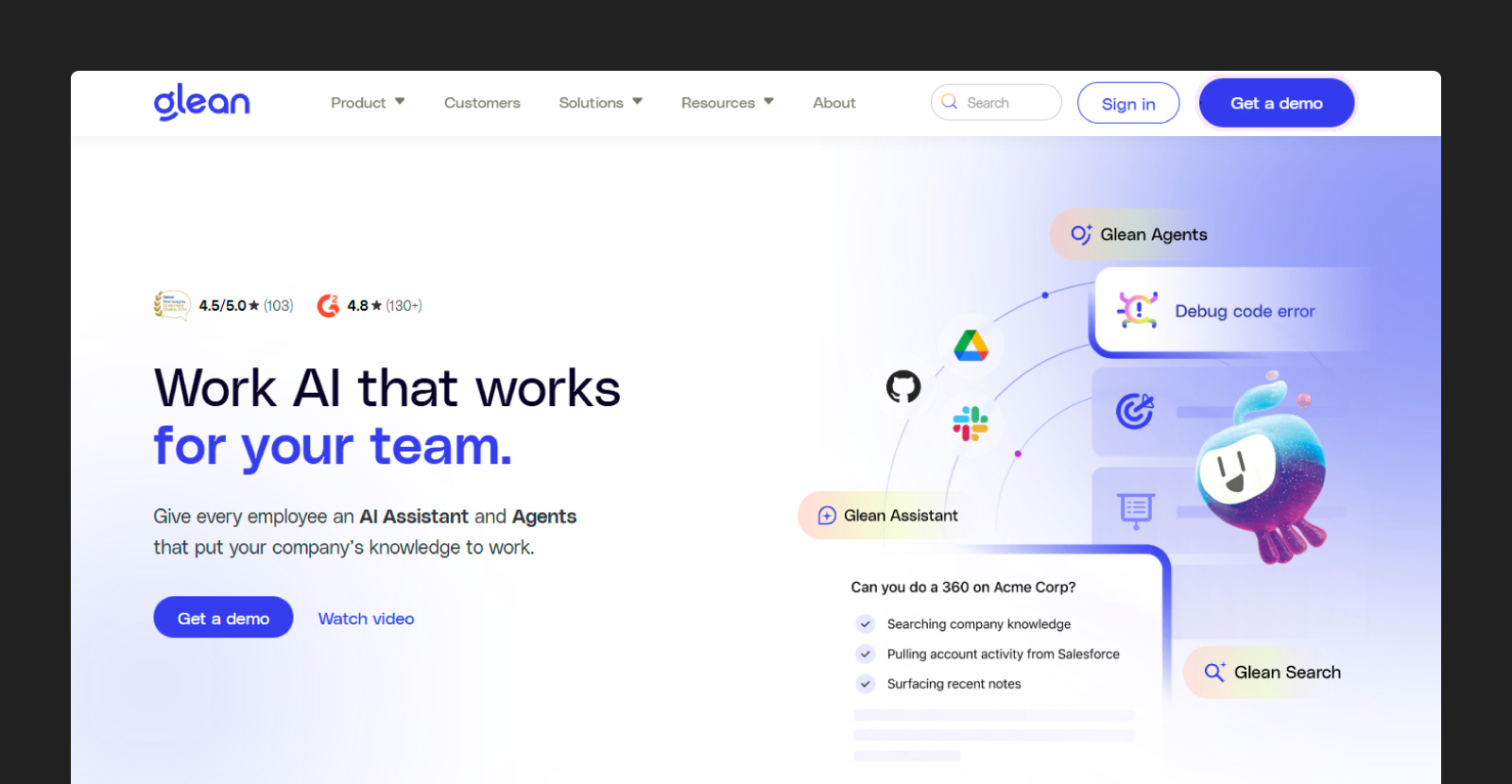
Glean is an AI-powered enterprise search and knowledge management layer that connects a firm’s entire internal tech stack. Serving as the institutional memory of an organization, it enables analysts to instantly retrieve past deal memos, internal research, and historical forecasts.
The platform is exceptionally strong at breaking down internal data silos, which is critical for large investment banks and global asset managers.
However, Glean is a knowledge discovery tool rather than a financial modeling platform. You'll get the data you need to build a forecast, but it doesn't have the native mathematical engines required to execute it.
Key features:
- Unified search layer across Slack, Teams, Drive, and internal databases: Glean indexes every piece of internal documentation, providing a single search bar for the entire firm’s collective knowledge.
- Context-aware AI assistant for retrieving internal research and memos: The AI understands the context of your query and can surface relevant research memos or meeting notes that you might have otherwise overlooked.
- High-security data indexing tailored for enterprise-scale firms: Built with a focus on data governance, Glean respects all existing document permissions, ensuring that analysts only see the data they are authorized to access.
7. Anaplan
Best for: Global enterprise-level modeling and massive dataset consolidation
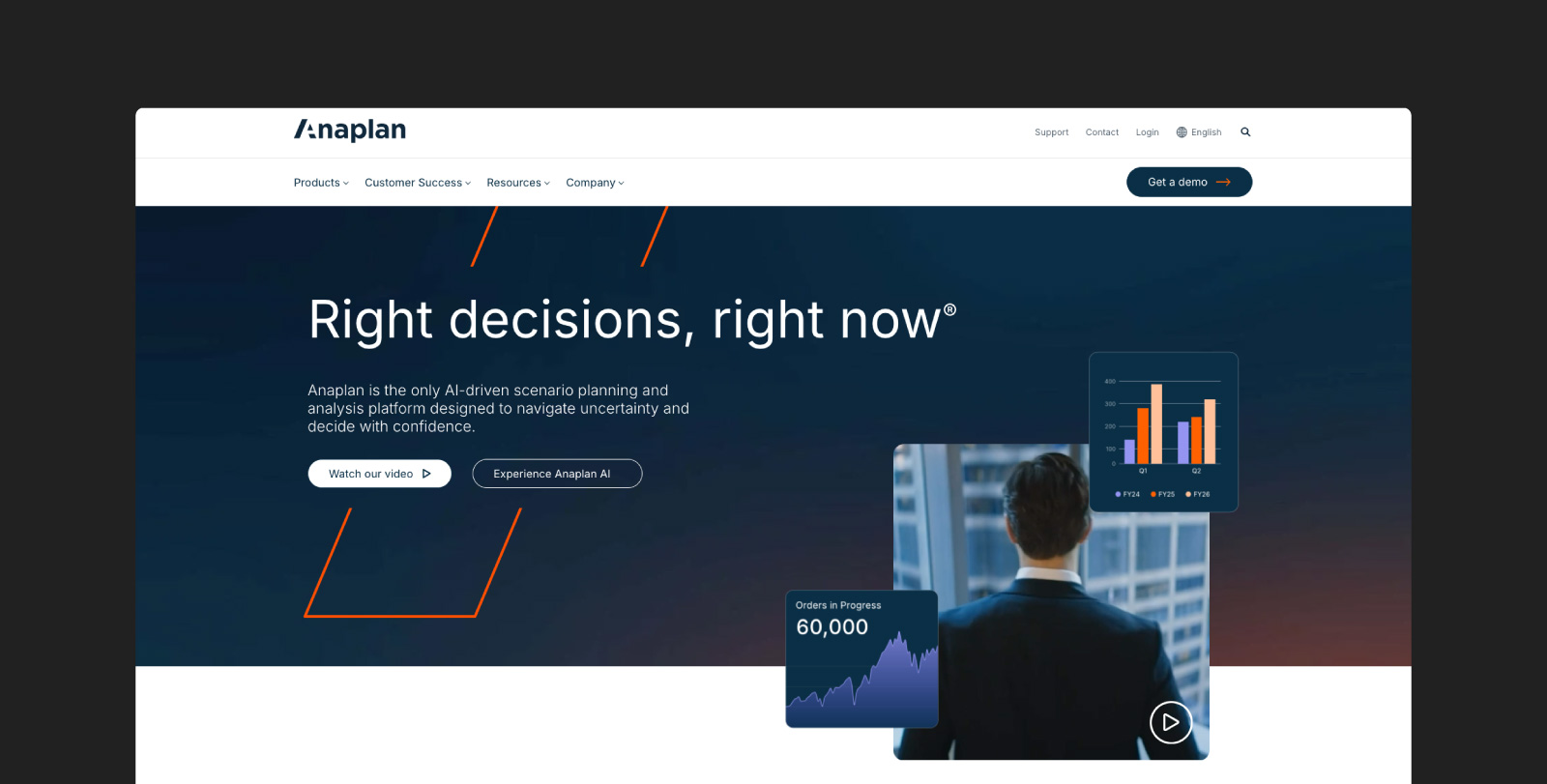
Anaplan remains the standard for large-scale, connected planning across global organizations. The Hyperblock engine allows global firms to link financial forecasts with operational data across hundreds of business units and geographies simultaneously.
Anaplan’s primary strengths are its enterprise-grade reliability and massive scalability. The downside is that it carries significant technical debt compared to newer AI-native platforms. Implementations can take several months, and the interface feels dated. It is a power user tool that often requires specialized in-house experts to maintain and update the models as market conditions change.
Key features:
- Hyperblock engine for processing massive, multidimensional datasets: Anaplan is one of the few platforms capable of handling billions of cells and complex calculations across global organizational structures.
- Connected planning across finance, operations, and HR units: The platform breaks down departmental barriers, ensuring that changes to the hiring plan or supply chain are reflected in the master financial forecast.
- Enterprise-grade scalability for global firms with hundreds of business units: Anaplan provides the security, auditability, and data capacity required for Fortune 500 companies and the world’s largest financial institutions.
8. Visible Alpha
Best for: Granular consensus data and line-item forecasting
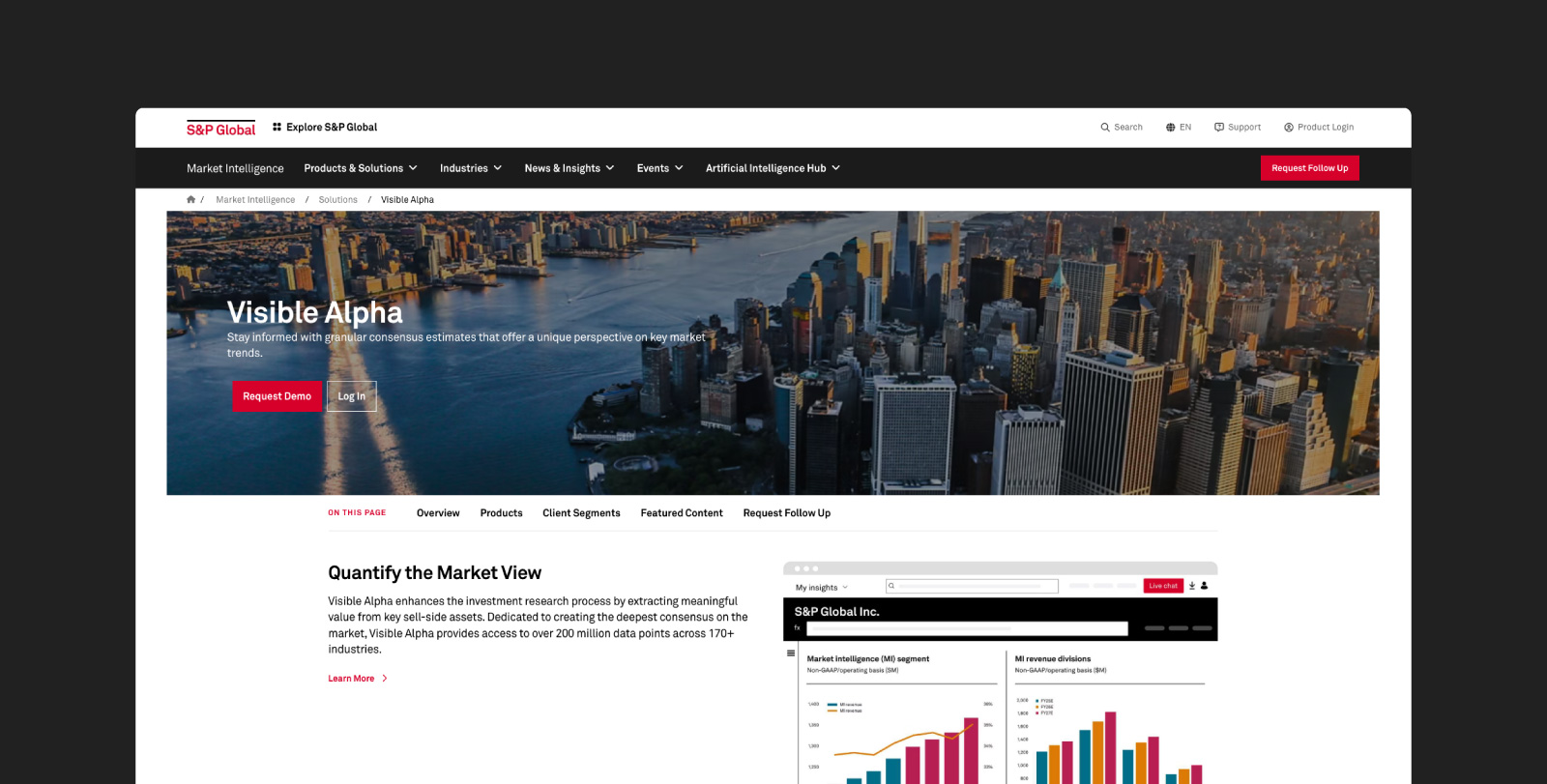
Visible Alpha is used by institutional teams to access the detailed data within sell-side financial models. The platform pulls specific line items from over 1,000 research firms, revealing exactly how different analysts project revenue drivers, margins, and key performance indicators (KPIs).
This process provides a clear, data-driven view of market expectations at a much deeper level than simple earnings-per-share estimates. The platform is also highly effective at identifying where specific analyst assumptions diverge from the pack.
However, its utility is largely limited to public markets and the specific companies covered by its contributor network. While it remains the gold-standard data engine for consensus forecasting, it lacks the AI-driven document analysis and reasoning found in newer, agentic AI platforms like Hebbia.
Key features:
- Detailed analyst data from over 1,000 research firms: Analysts can access deep-dive metrics that include segment-level revenue, geographic breakouts, and specific operational KPIs.
- Line-item detail for segment-level and KPI-specific forecasting: The platform standardizes data across thousands of models, allowing you to compare specific line items to understand the drivers behind various market projections.
- Automated data comparison to identify divergent analyst assumptions: Visible Alpha’s tools highlight where specific analyst projections differ from the average, helping teams identify potential mispricings or overlooked risks.
Features To Look for in AI Financial Forecasting Tools
To move beyond the limitations of legacy tools, firms should prioritize platforms that combine autonomous research with rigorous auditability. The following are essential capabilities for building a fast, secure, and precise forecasting workflow.
AI Analysis at Scale
Look for platforms that understand your goal and perform end-to-end research, rather than just following rigid, pre-set commands. These autonomous systems manage entire workflows, such as monitoring earnings calls and updating financial models in real-time. This capability allows your team to move away from manual data entry and focus entirely on high-level strategy.
Deep Customizability
Every firm has a unique internal framework for evaluating opportunities. Your software should be flexible enough to accommodate standard quantitative methods—such as percent of sales, straight-line, moving average, and linear regression—while allowing you to overlay your own proprietary logic.
The technology must adapt to your firm’s specific investment approach rather than forcing you to change how you work.
Enterprise-Grade Governance and Auditability
In a high-stakes environment, explainability is the new baseline. Ensure the tool provides a clear audit trail for every forecast, with logic and traceability that allows you to reconstruct any chain of reasoning for internal audits or regulatory reviews.
Institutional Document Indexing
A modern tool must be able to ingest millions of proprietary documents and index them alongside public market data. This centralization turns your firm’s collective memory into a searchable, synthesized database that informs every new forecast.
Proactive Alerts and Notifications
Top-tier software should act as an "always-on" monitor, anticipating downstream effects before they hit. Look for real-time signals that flag nuanced risks, sector-wide disruptions, or specific headline triggers, so you can pivot your strategy before the market reacts.
Why Leading Firms Choose Hebbia To Power Financial Forecasting
Building a reliable forecast is a high-stakes balancing act that requires processing an overwhelming volume of information. Analysts are expected to connect the dots across thousands of documents to maintain strategies that actually hold up under market pressure.
Hebbia has spent over five years perfecting an AI architecture that gives sophisticated firms a clear advantage through high-accuracy synthesis and rapid speed-to-insight. Serving as a unified hub for both your proprietary research and external data feeds, the platform handles the heavy lifting of document analysis so your team can focus on making high-conviction moves.
Schedule a demo to discover why 40% of the largest asset managers by AUM rely on Hebbia for their most critical work.


