
Finance Professionals Trust AI More Than Their Coworkers — But There’s a Catch
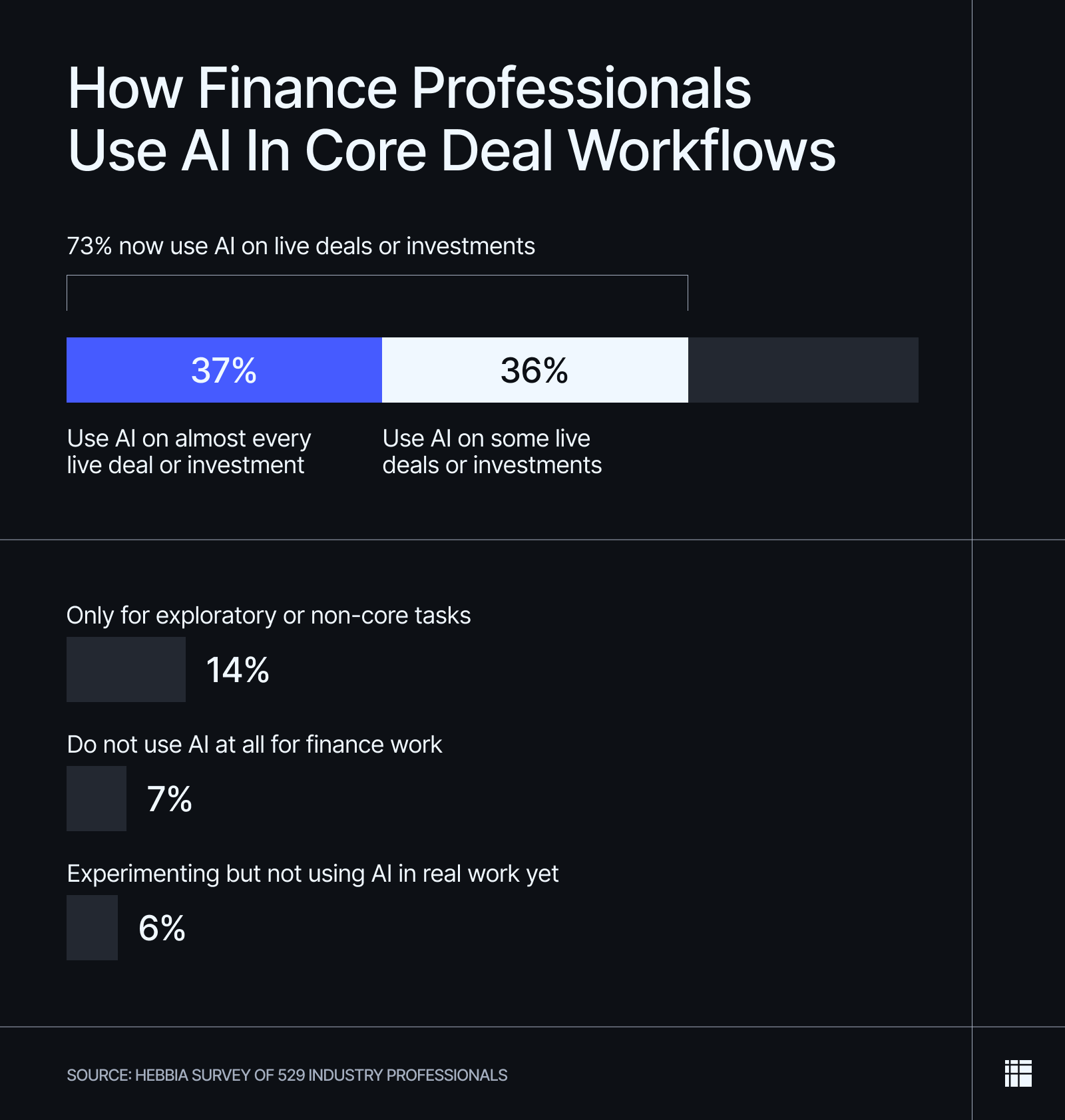
AI has crossed a threshold in finance. Nearly three-quarters (73%) of professionals are already using AI in live deals or investments — transactions where the decisions carry weight. More than half of respondents hold Managing Director, Partner, or C-suite titles.
To get a clearer picture of the finance industry's trust in AI today, Hebbia surveyed over 500 U.S.-based finance professionals who make deals and investments across different disciplines.
The results reveal that while trust in AI is rising sharply, financial professionals are hesitant to rely on it completely.
Key Takeaways
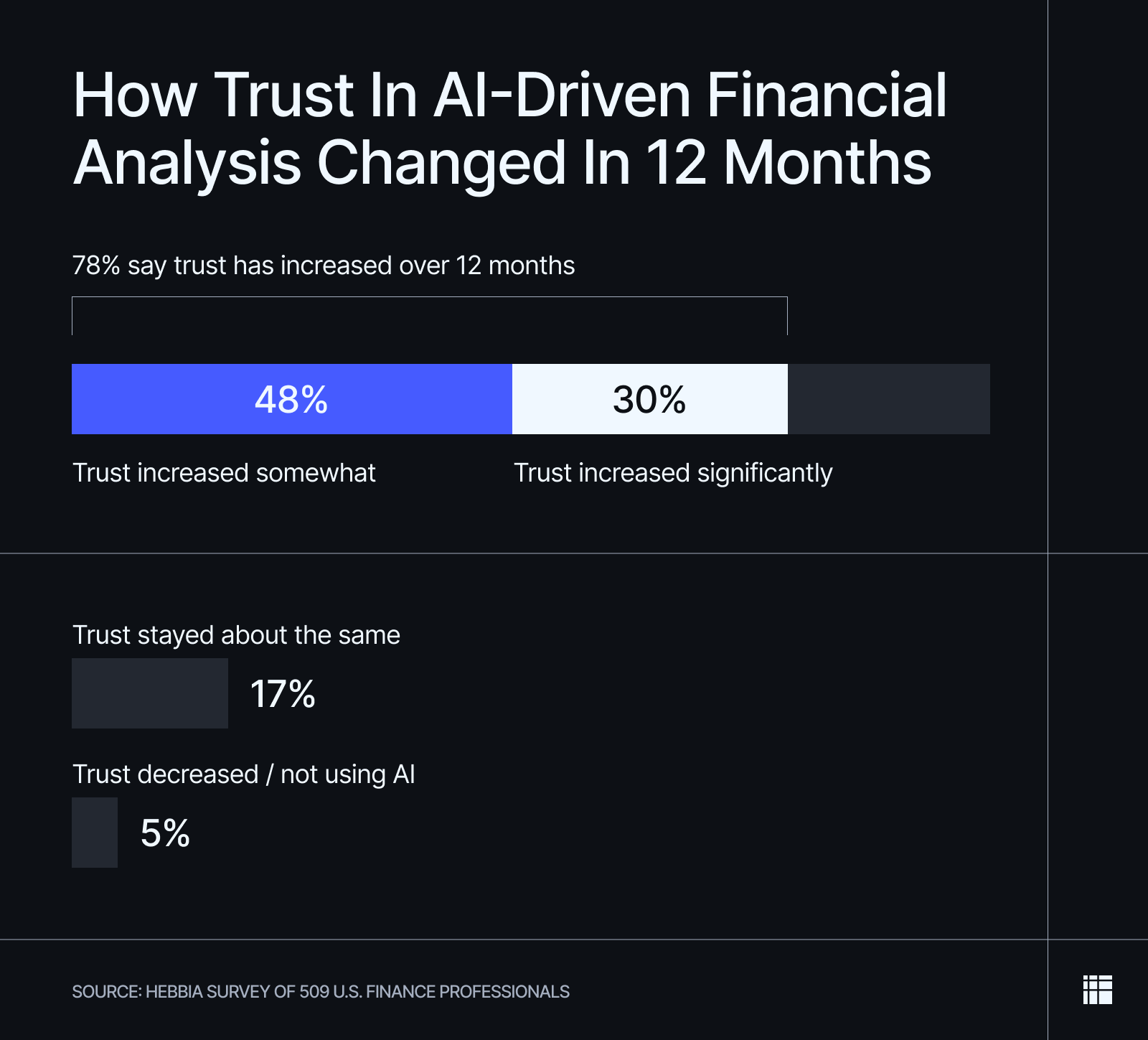
- 78% of financial professionals say their trust in using AI for financial analysis has grown over the past 12 months.
- 63% of financial professionals trust AI more than a human coworker to quality check things like broken links, formula errors, or inconsistent assumptions in models.
- 58% of financial professionals say AI must be completely accurate before they’ll use it at work. 36% are comfortable with imperfect accuracy for the tasks they use AI for today.
- 89% of financial professionals expect to legitimately collaborate with AI on core parts of their job in the future.
73% of Professionals Are Using AI on Live Transactions
Nearly three-quarters of financial professionals (73%) say they use AI tools on at least some live deals, investments, or client portfolios.
Nearly 4 in 5 (78%) financial professionals say their confidence in AI-driven financial analysis has grown over the past 12 months, with 30% reporting a significant increase.
Model quality has improved substantially, making AI meaningfully more reliable on the specific tasks finance professionals actually run — reading earnings call transcripts, extracting assumptions from virtual data rooms (VDRs), flagging covenant issues across hundreds of documents — and building the kind of intelligence that drives conviction.
As security and auditability tooling matures, the compliance barrier that once kept cautious firms on the sidelines of AI advancement is dissolving. With 63% of finance professionals now reporting they save more than six hours per week using AI — the question has shifted to how far to incorporate AI usage.
Firms see potential in this new technology. When asked how they feel about using AI for financial analysis today, 87% of finance professionals surveyed said they were excited or confident compared with just 11% who said they were anxious. The professionals closest to the work are focused on speed and insight — not on what AI might replace.
AI is Perceived as More Trustworthy Than Humans for Some Tasks
63% of financial professionals would trust an AI tool over a human coworker to check financial models for broken links, formula errors, or inconsistent assumptions. Here’s how that trust extends across other core tasks:
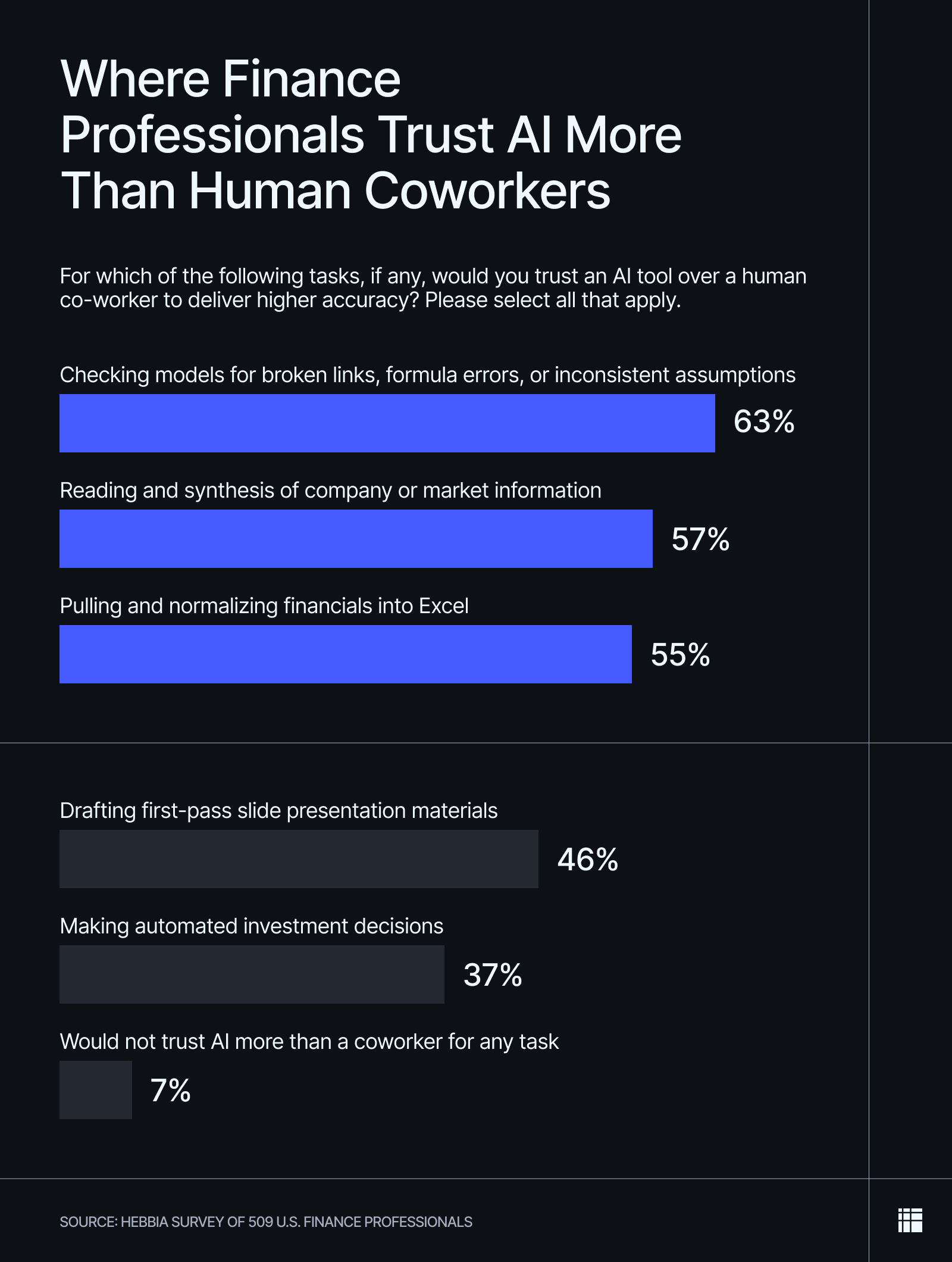
These respondents aren't using AI for peripheral tasks — financial models are how Investment Committee memos are built and how teams decide what to pursue. The fact that a majority of financial professionals now trust AI tools for financial analysis over human peers suggests that AI might handle more critical financial tasks in the future.
But the bar for full reliance on AI is high. More than half (58%) of finance professionals say AI must be completely accurate before they'll actually use it at work. Most finance teams will lean on AI to catch errors and synthesize information, but they haven't lowered their standards to do it.
Most Finance Pros Think the Industry Is Already Over-Relying on AI
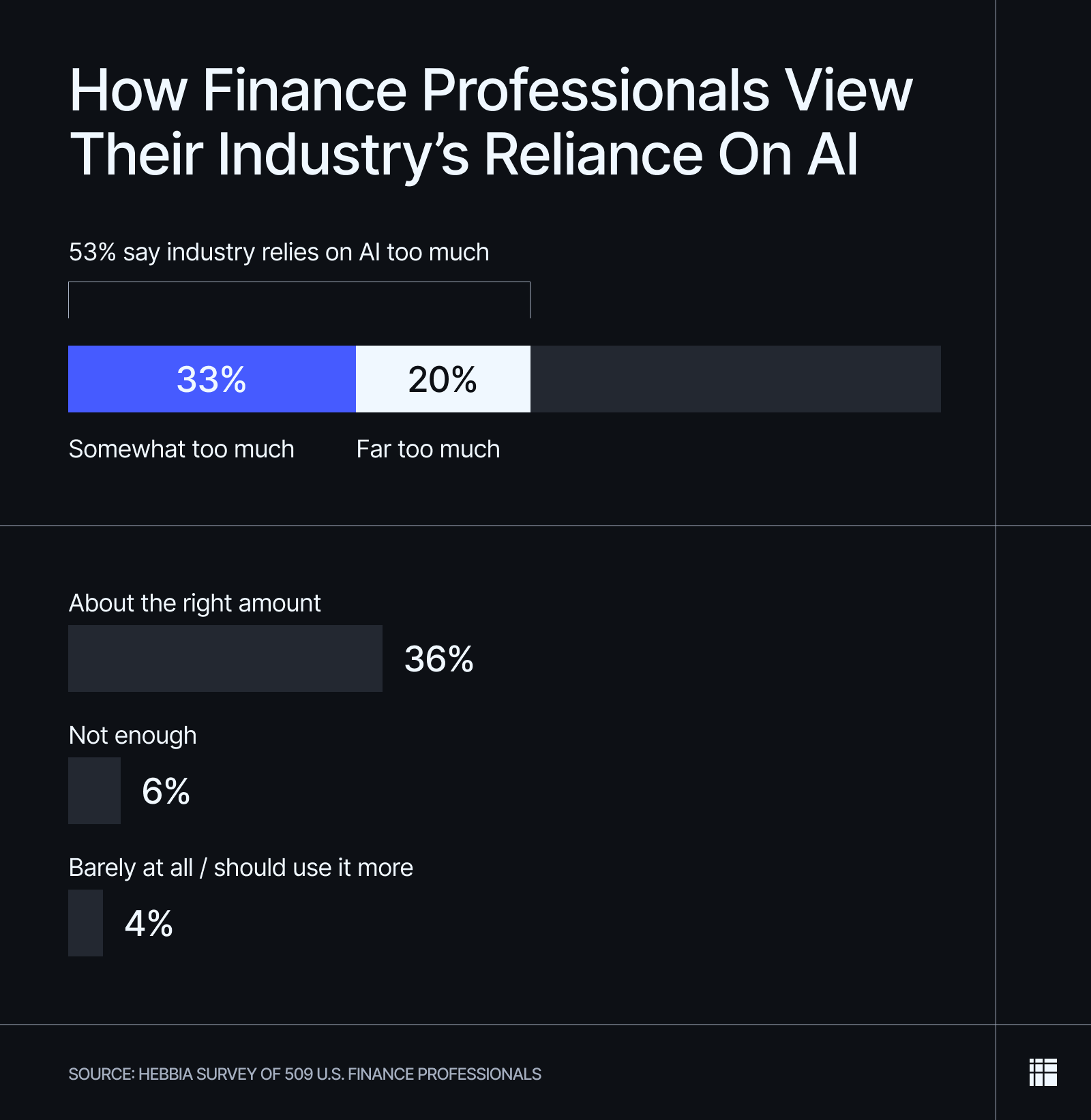
More than half (53%) of respondents say the industry is relying on AI too much, but that hasn't stopped them from using AI tools.
Most financial professionals still keep a human in the loop for keen attention to detail: 26% say they remain accountable for the output and can't delegate that risk; 25% cite compliance or firm policy; and 23% say AI regularly misses nuance or context in complex situations. Human intervention can create room for AI in finance while also maintaining transparent reasoning and citations that teams can stand behind.
89% Expect to Genuinely Collaborate With AI on Core Responsibilities
Despite the caution, there’s a decisive long-term outlook. Nearly 9 in 10 (89%) financial professionals expect to genuinely collaborate with AI on core parts of their jobs in the future, such as client advice, deal decisions, and work that ends up before an investment committee.
Financial professionals are already using AI on real transactions and they expect the relationship to deepen. But it isn't always clear which AI financial research platforms have earned that trust through rigorous accuracy, auditability, and quality.
The Bar Is High — Here's What It Takes to Clear It
AI is being used extensively, trust has risen sharply, and 89% of finance professionals expect deeper collaboration ahead. But not everyone agrees on how accurate AI tools should be before they're used in finance.
AI chatbots designed for the general public aren't held to the accuracy standards financial firms require. The firms that lead the way in technological advancement will be the ones using tools specifically built to use AI in investment banking. Every output should be cited, audit-ready, and built to satisfy the scrutiny of investment committees and regulators.
Hebbia is built specifically for that standard. Our tools are designed for financial teams to help them move faster on real transactions without sacrificing the rigor, transparency, and control that investment committees expect.
Methodology
The survey was conducted by Centiment for Hebbia. The survey was fielded between February 20, 2026, and March 2, 2026. The results are based on 509 completed surveys. To qualify, respondents were screened as residents of the United States, over 18 years of age, and investment bankers or asset managers/financial advisors. Data is unweighted, and the margin of error is approximately +/-3% for the overall sample with a 95% confidence level.


