
AI for Data Extraction in Finance: How It Works and the Best Tools to Try
Before any real investment judgment can be made, someone has to do the extraction work. Combing through filings, transcripts, and data rooms to get the data and the terms into a usable format is where investment workflows either slow down or scale up.
AI for data extraction has fundamentally changed what's possible here. Where rule-based tools and optical character recognition (OCR) once required manual template setup and broke down on complex documents, modern AI tools for data extraction can process thousands of pages of unstructured financial content, pull structured data with source-level citations, and deliver outputs that analysts can actually stake their models on.
This guide covers what AI data extraction is and how it works across the most common finance workflows. It ends with a shortlist of the top four platforms most used by institutional teams today.
What Is AI Data Extraction?
AI data extraction uses natural language processing, machine learning, and large language models to identify and structure information buried in unstructured or semi-structured documents.
Traditional OCR and template-based tools rely on manual templates, so they break the moment a document's layout shifts or its language gets ambiguous. AI-based extraction reads for meaning instead, adapting to new formats the way an experienced analyst would.
That distinction makes a difference in finance, where the underlying material isn't a clean database to query. Credit agreements, Securities and Exchange Commission (SEC) filings, virtual data rooms (VDRs), earnings transcripts, expert calls, and broker research can run for hundreds of pages. They're dense with proprietary detail, and no two documents are structured the same way.
In this world, a missed clause or misread footnote can reshape a credit decision or an investment thesis.
How Finance Teams Use AI for Data Extraction
Data extraction looks different depending on where a professional sits in the investment process. Across public equities, private equity, and credit, pulling structured signals from unstructured documents adapts to each workflow's specific inputs and stakes.
Financial Statement and Filing Analysis
Public equity and long-only analysts spend hours each week parsing 10-Ks, 10-Qs, and earnings call transcripts for the details that move a thesis. AI extraction pulls these out automatically and structures them for direct comparison, so analysts can track shifts across multiple periods or peer sets without rereading each filing by hand.
From these filings, AI extraction typically surfaces:
- Financial metrics, structured for period-over-period and company-to-company comparison
- Management commentary, tracked for shifts in tone or emphasis across calls
- Risk factor language, flagged when new disclosures appear or existing language changes
Example: An analyst comparing this year's 10-K risk factors against last year's can catch a newly disclosed supply chain risk the market hasn't priced yet. The same approach applied across eight quarters of earnings calls with AI can reveal a shift in management's tone on margin pressure long before it shows up in guidance.
Credit Agreement and Loan Document Review
A single credit agreement can run past 200 pages, with the terms that actually determine risk scattered across sections, exhibits, and cross-references rather than being stated in one place. Reconciling those terms across a portfolio of loans by hand means paging through every agreement individually.
AI extraction and document analysis tools cut that work down, pulling out and standardizing:
- Covenant definitions, including maintenance vs. incurrence structures
- Lien restrictions and collateral carve-outs
- EBITDA addback caps
- Baskets and restricted-payments capacity, where value can quietly leak outside the collateral package
With that structure, credit teams get a clear view across the portfolio, without having to reread every clause by hand.
Example: A credit analyst comparing covenant packages across a portfolio of loans can pull every EBITDA addback definition and basket capacity side by side in minutes with AI extraction, instead of having to page through each agreement individually. What used to take an afternoon per loan becomes a single structured comparison across the whole book.
VDR and CIM Screening
During private equity due diligence, teams comb through virtual data rooms holding thousands of documents to find the handful of data points that actually shape a deal decision. AI extraction screens VDR contents and confidential investment memoranda (CIMs) simultaneously, surfacing key metrics without requiring an analyst to open every file by hand.
A typical VDR includes:
- Management presentations
- Financial statements
- Contracts
- Operational reports
In a tight auction, the team that reaches conviction first usually wins the deal. Screening a VDR and a CIM at the same time, rather than one after the other, buys back days to give teams an edge on speed.
Example: A PE team can cross-reference VDR materials against a CIM in real time during a tight auction process, flagging where the seller's narrative and the underlying documents don't line up. Catching that gap before an IC meeting can be the difference between a defensible bid and an uncomfortable surprise post-close.
Expert Call Transcripts and Broker Research
Expert call transcripts and broker research carry signals that rarely show up in public filings. AI extraction pulls those signals from proprietary research and triangulates them against public filings to surface variant views the market hasn't yet caught on to.
From this research, AI extraction typically surfaces:
- Thematic signals across a sector or company
- Management sentiment shifts
- Specific data points, checked against public filings for discrepancies
An offhand comment from an expert call becomes a specific claim that an analyst can verify and defend in committee.
Example: An analyst can cross-reference 20 expert call transcripts against a company's 10-K to identify discrepancies in supply chain or margin claims that point to a variant view. Surfacing that kind of discrepancy across dozens of transcripts by hand would take days. AI extraction does it in minutes.
Key Benefits of Using AI Solutions for Data Extraction
AI data extraction changes more than turnaround time. Here's what matters most when finance teams evaluate these tools:
- Auditability: Source-linked citations mean every output is defensible. Analysts can verify any extracted figure before it enters a model or investment committee presentation.
- Accuracy: By eliminating manual re-keying of data, AI reduces the chance of error and the risk of missing a footnote that changes a number's meaning.
- Scale: AI enables teams to run extraction workflows across hundreds of documents simultaneously, covering more ground without adding headcount.
- Speed: AI with sentence-level citations reduces data extraction from days to hours—or hours to minutes—freeing analysts to focus on judgment rather than mechanics.
The 4 Best AI Data Extraction Tools for Finance
The four platforms below are the ones institutional finance teams evaluate most often, with each having been purpose-built for financial workflows rather than general-purpose document processing.
Between them, they cover public equity research, IB deliverables, and financial modeling—but only one handles the private-side diligence and credit work that doesn't leave a public paper trail.
1. Hebbia

Best for: Large-document reasoning across private deals, diligence, and credit
Hebbia's Matrix platform runs on Iterative Source Decomposition (ISD), reasoning across an entire document set instead of chunking it and losing context. It's built to handle VDRs with thousands of files, credit agreements past 200 pages, and diligence sets too large to read cover to cover, which is why Hebbia ranks first for private deals, diligence, and credit.
After the reasoning is done, Hebbia separates itself from its competitors. Every output carries a sentence-level citation, deal teams get a shared Projects workspace, and Skills package firm-specific workflows into reusable modules. Native integrations with PitchBook, S&P Capital IQ Pro, and Preqin keep the platform running on the data that credit and PE teams already trust.
Key features:
- Iterative Source Decomposition (ISD) for full-document reasoning: ISD breaks a document apart only to reconstruct full context across all of it, so a 300-page credit agreement or an entire VDR gets reasoned over as one document.
- Sentence-level, clickable citations on every output: Every answer links back to the exact sentence, cell, or datapoint it came from, so analysts can verify a figure before it enters a model or memo.
- Shared Projects workspace for firm-wide deal collaboration: A live activity feed and accumulated analysis sit in one place, so anyone joining a deal mid-stream has full context.
- Integrations with PitchBook, Preqin, and S&P Capital IQ Pro: These connectors let Hebbia analyze deal, investor, and fund data alongside a firm's internal documents in one workflow.
2. AlphaSense
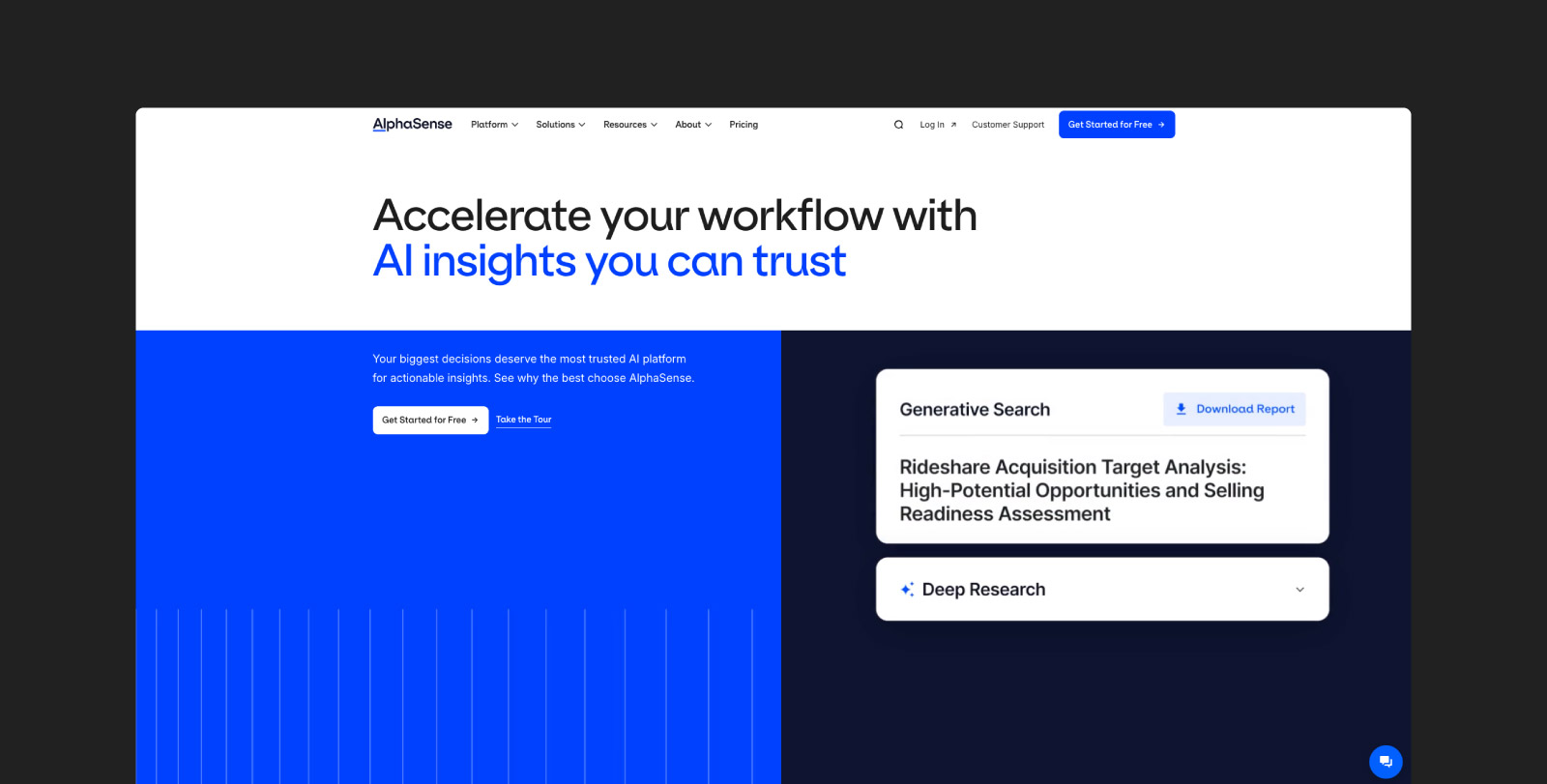
Best for: Public-market research across filings, transcripts, and broker research
AlphaSense is built for public market research, covering SEC filings, earnings transcripts, and a broker library of 1,700+ sell-side sources, including Goldman Sachs and Morgan Stanley. Its strength is fast search across a massive content library for any public company or sector.
Smart Synonyms pushes it past basic keyword search, catching related terms like cost inflation when an analyst searches for margin pressure, for example. But that search stays external, since AlphaSense has no internal document layer—it can't synthesize a finding into a deal perspective grounded in a firm's own prior work.
Key features:
- Earnings transcript and filing search across a large content library: AlphaSense indexes filings, transcripts, and other public documents at scale for fast search across a huge library.
- Smart Synonyms for thematic and sentiment-based search: The platform's natural language processing (NLP) connects a plain-English query to related terms and industry jargon.
- Expert call transcript repository: A library of 260,000+ expert call transcripts gives analysts management, competitor, and customer perspectives without them needing to commission a new call.
- Broker research and sell-side notes integration: Wall Street Insights brings in research from 1,700+ broker sources, putting sell-side commentary next to filings and transcripts.
3. Daloopa
Best for: Financial model updates and KPI extraction into Excel
Daloopa's single job is getting financial statement data out of filings and into Excel without manual re-entry. It covers thousands of public companies, pulling data from 10-Ks, 10-Qs, earnings releases, and investor presentations straight into a model template.
Every extracted number hyperlinks back to its original filing, so analysts can trace and verify each cell. That auditability makes Daloopa a go-to for public-market model maintenance, though its scope stops at public filings, meaning it can’t cover the private VDRs and credit agreements that Hebbia handles.
Key features:
- Automated financial statement extraction directly into Excel: Daloopa pulls data from filings and earnings materials straight into a model through a native Excel add-in.
- Cell-level source links back to the original filing: Every data point links to the exact filing it came from, so a number can be traced and verified with a click.
- Coverage across thousands of global public companies: The platform covers thousands of tickers globally, giving analysts a consistent feed regardless of company.
- Historical financial data tracking across periods: Daloopa maintains years of history per company for multi-year trends without rebuilding from old filings.
4. Rogo
Best for: Investment banking research deliverables
Rogo is built for the IB workflow, from company research to client-ready deliverables under tight deadlines. Its 2025 acquisition of Subset added an AI spreadsheet engine that builds, explains, and fixes financial models.
It connects to LSEG, FactSet, S&P Global, and PitchBook, letting bankers research and model against sources they already use. That breadth suits IB deliverables like pitch materials and comparables, though its foundation is public and licensed data, not the private diligence documents that Hebbia processes.
Key features:
- Pre-built IB workflow templates: Rogo ships with templates for common IB deliverables, like company primers and comps, cutting setup time.
- Excel model automation via Subset acquisition: The Subset technology lets Rogo build, explain, and fix financial models directly in Excel.
- Integration with LSEG, FactSet, and S&P Global: Rogo connects to these licensed data providers, alongside PitchBook, for a single interface on market and company data.
- AI search across filings and public research: Rogo's search layer covers filings and public research, so analysts can pull a data point without leaving the platform.
Run Institutional-Grade Data Extraction with Hebbia
Finance teams that can fully process the document set — not skim it — make more defensible calls, whether that's an IC memo, a credit decision, or an investment thesis. The edge isn't getting there first; it's getting there with nothing missed.
With 5+ years of focused development for institutional finance, Hebbia is the largest AI platform for the rigor that finance demands. Unlike general-purpose extraction tools, it's purpose-built to process entire document sets at once — no context loss, no chunking, no missed footnotes.
Book a free demo to see what institutional-grade data extraction looks like in practice.
FAQ
What's the difference between AI data extraction and OCR?
OCR converts an image of text into machine-readable characters using a fixed set of rules, with no sense of what the document actually means. AI data extraction uses language models to read for context, meaning, and structure, so it adapts to a new layout instead of requiring a manual template.
In practice, OCR breaks the moment a document's format changes, while AI extracts correctly regardless.
How do I know if an AI data extraction tool is accurate enough for finance?
To verify accuracy, ask whether every extracted output links back to the exact sentence or cell in the source document. That lets an analyst verify a number before it goes into a model, rather than taking a vendor's accuracy claim on faith.
A tool that can't produce granular citations doesn't clear the bar for work that ends up in an IC memo, a credit decision, or an LP report.
Is AI data extraction secure enough for confidential financial documents?
AI data extraction can be secure enough for confidential financial documents, but only on a platform built to meet institutional security standards. The concern itself is legitimate, since VDRs, credit agreements, LP materials, and expert transcripts are among the most sensitive documents a firm handles.
Look for zero data retention, role-based access controls, SOC 2 compliance, end-to-end encryption, and a guarantee that proprietary documents won't train public models. Purpose-built finance platforms like Hebbia are built to meet that bar. Generic AI tools typically aren't.


