
The Top 10 AI Solutions for Due Diligence
One mid-market acquisition can bury a deal team under thousands of documents and weeks of manual review. Analysts spend late nights hunting for a change-of-control clause hidden on page 47, while partners wait for answers that decide whether a deal moves forward.
AI solutions for due diligence are changing that, with tighter diligence timelines helping 63% of users save six or more hours per week. Teams can now scan entire virtual data rooms (VDRs) in hours instead of weeks and catch risks that manual review would have missed.
This article breaks down the AI due diligence tools that deal teams rely on today, covering platforms built for M&A document review, legal contract analysis, and compliance screening. We compare the leading vendors and explain what each does best, so you can match the right tool to your workflow.
The Best AI Solutions for Due Diligence at a Glance
Ten platforms lead the market in AI due diligence, each with its own strengths. Here is a side-by-side look at the top solutions and their features.
Platform | Tool Type | Best For | Key Features |
|---|---|---|---|
Hebbia | M&A and deal intelligence | Private equity (PE) and finance teams needing precise, auditable document synthesis | - Large language model (LLM) agents for reasoning across large document sets - Inline citations linking every output to its source - Builds deal memos, confidential investment memorandum (CIM) analyses, and strip profiles - Cross-references data across thousands of documents to verify consistency |
Datasite | M&A and deal intelligence | Managing the end-to-end VDR process on mid-to-large cap deals | - AI-assisted document scanning and redaction - In-platform Q&A - Standardized workflows across the deal lifecycle |
AlphaSense | M&A and deal intelligence | Financial research and market intelligence | - AI-powered search across earnings calls and filings - Expert transcript library - Smart summarization |
Kira Systems (Litera) | Legal contract review | Bulk contract review in cross-border M&A | - Machine learning (ML) models trained by M&A lawyers - Automated clause and provision extraction - Discrepancy flagging across contract sets |
Harvey | Legal contract review | Enterprise legal teams and law firms | - AI-assisted document review and research - Drafting support - Scales across large document sets |
Luminance | Legal contract review | Automated contract risk flagging | - Pattern recognition for non-standard clauses - Anomaly detection - Visual risk mapping |
Keye | Financial analysis and modeling | PE firms building financial models from deal data | - Direct VDR integration - Converts raw data into Excel-ready models - Zero-data-retention (ZDR) policy |
MindBridge | Financial analysis and modeling | Financial statement analysis | - Anomaly detection across accounting data - Automated risk scoring - Trend analysis |
ComplyAdvantage | Compliance, Anti-Money Laundering, and risk vetting | Ongoing AML and sanctions monitoring | - Real-time entity recognition - Adverse media monitoring - Hidden ownership structure mapping |
LexisNexis | Compliance, Anti-Money Laundering, and risk vetting | Know Your Customer (KYC) and regulatory screening | - Sanctions screening - Beneficial ownership checks - Adverse media searches |
Mergers and Acquisitions (M&A) and Deal Intelligence Solutions
M&A and deal intelligence tools read across an entire data room and synthesize what matters. These solutions enable teams to answer diligence questions, with each answer traced back to its source.
1. Hebbia
Best for: Private equity (PE) and finance teams needing precise, auditable document synthesis
Hebbia is an automated due diligence solution whose core product, Matrix, reasons across large data and document sets, tracing every finding back to its exact source. For deal teams, this replaces summaries you have to re-check by hand with answers you can actually defend.
In private equity due diligence, Hebbia assembles the inputs that feed an investment committee memo, from filings and transcripts to confidential information memorandum (CIM) summaries and internal notes. Hebbia also cross-references data points across separate workstreams, creating the audit trail your committee needs.
Its partnership with Fitch Solutions also brings credit ratings and market intelligence to the platform, helping leveraged finance teams use Hebbia to analyze credit agreements and update model inputs with source-linked data. Built for AI due diligence, where accuracy carries more weight than speed alone, Hebbia makes every finding traceable and defensible.
Key features:
- Large language model (LLM) agents for reasoning across large document sets: Reasons over any volume of documents with complete traceability back to every finding.
- Inline citations linking every output to its source: Statements stay citation-linked, so teams can verify each claim against the original document.
- Builds deal memos, CIM analyses, and strip profiles: Centralizes filings, transcripts, CIM summaries, and expert calls, then returns structured, citation-linked outputs that map to the original pages, with analysts still retaining final judgment on deliverables.
- Cross-references data across thousands of documents to verify consistency: Indexes the full data room and checks isolated data points across separate workstreams for consistency.
2. Datasite
Best for: Managing the end-to-end VDR process on mid-to-large cap deals
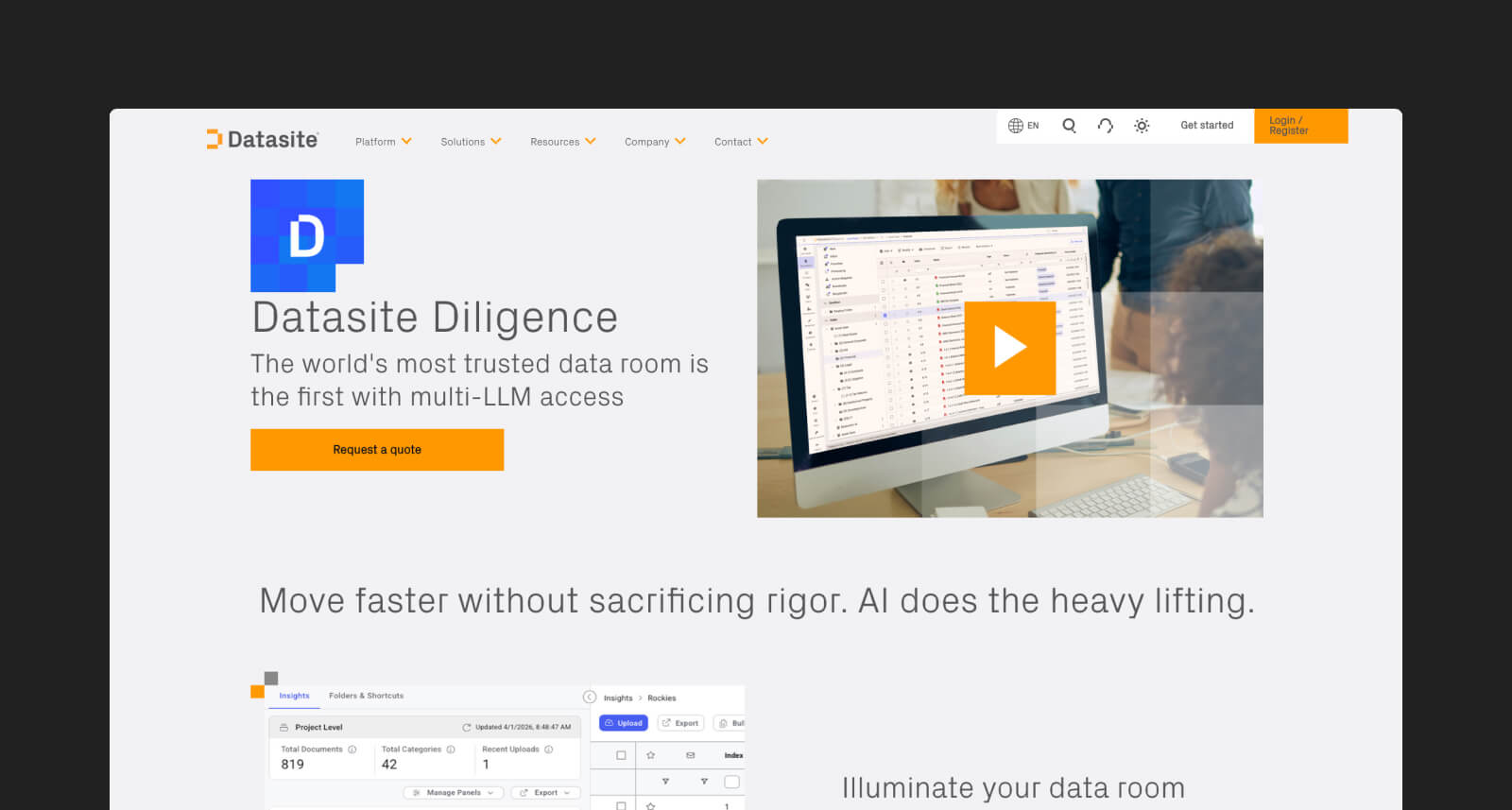
Datasite is a virtual data room (VDR) provider with AI built directly into the deal workspace. As an M&A workflow platform and a secure repository where buyers and sellers can exchange documents during a transaction, Datasite runs the document side of a live process rather than analyzing a target from the outside.
Teams using Datasite’s AI can redact sensitive terms across thousands of files at once or ask questions and receive answers with source links. This activity stays within the data room, which keeps confidential documents in a single, governed space.
Key features:
- AI-assisted document scanning and redaction: Finds and redacts sensitive information across large document sets, including text inside images.
- In-platform Q&A: Assistant-answered questions across permitted files and bulk Q&A responses by spreadsheet upload.
- Standardized workflows across the deal lifecycle: Keeps diligence, redaction, and Q&A inside a single data room throughout a deal.
3. AlphaSense
Best for: Financial research and market intelligence
AlphaSense is a market intelligence and financial research platform that searches across more than 500 million premium and proprietary documents. It is a research and monitoring tool, not a document-diligence platform, so its role in a deal is commercial and market due diligence.
With its expert call transcripts and filing search, AlphaSense helps teams test whether a target's market and customers support the investment thesis. Its transcripts provide perspectives from customers and competitors on a target's competitive position, while the filing search pulls and compares financial data quarter over quarter, enabling teams to regularly check market and industry trends.
Key features:
- AI-powered search across earnings calls and filings: Searches earnings transcripts, broker research, global filings, and press releases across its library.
- Expert transcript library: Holds more than 280,000 expert-call transcripts from pre-qualified experts.
- Smart summarization: Returns synthesized answers with sentence-level citations using generative search.
Legal Contract Review Solutions
Tools for legal contract review extract clauses and flag non-standard terms across hundreds of agreements at once. Legal teams can then find risk in a target's contracts without reading every page line by line.
4. Kira Systems (Litera)
Best for: Bulk contract review in cross-border M&A
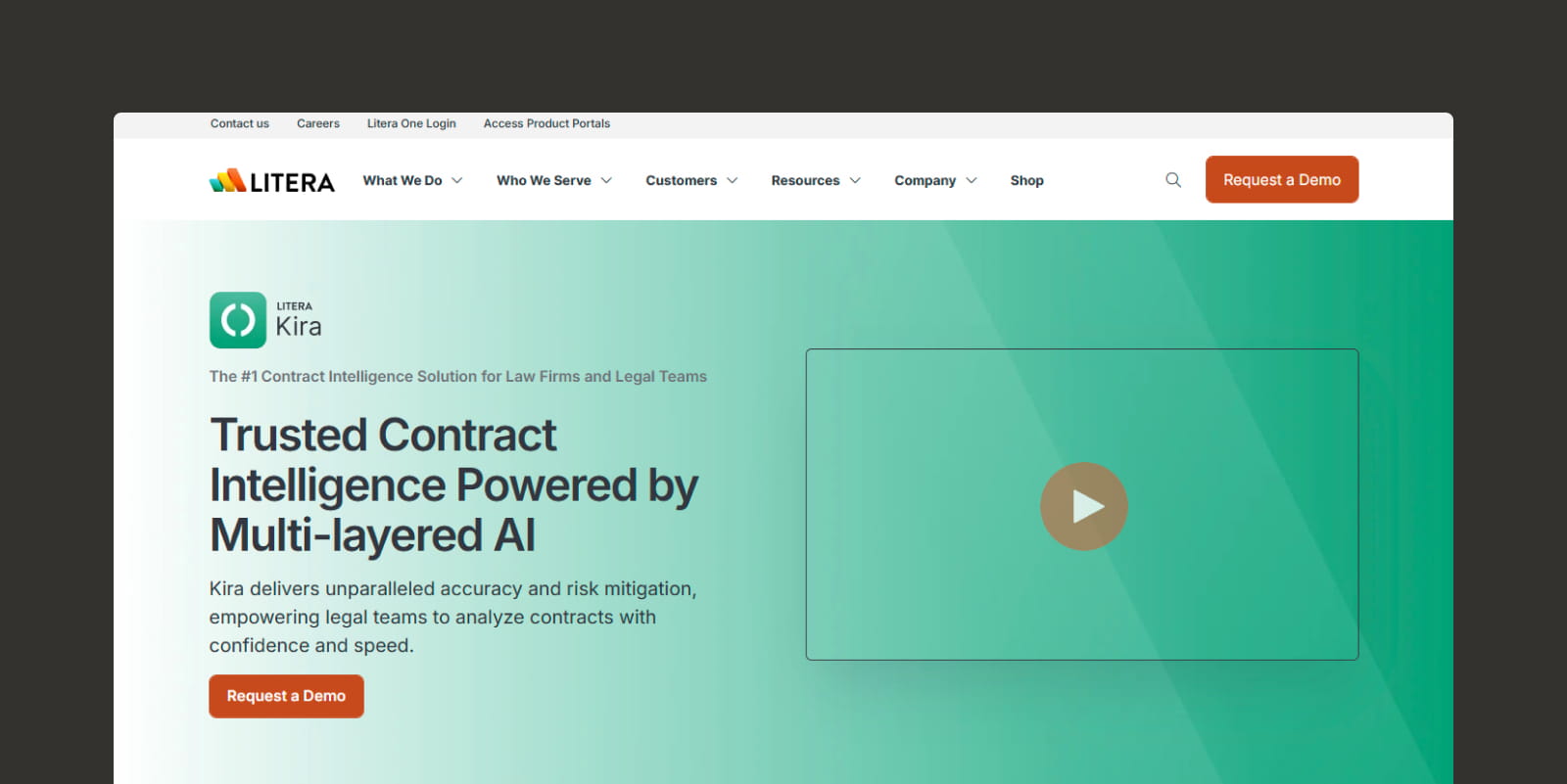
Kira Systems, now branded Kira by Litera, is a contract review and AI document analysis platform for legal teams. Across large sets of contracts, Kira extracts the clauses and provisions a reviewer needs to assess, which is the core task in legal due diligence. Litera also positions Kira for M&A, real estate, finance, and corporate work.
Kira's AI was trained on 45,000 lawyer-hours of expert input, so it recognizes common clause types out of the box and can be extended to find provisions specific to a deal. For a cross-border transaction with hundreds of agreements, it turns a full manual read into a targeted review of the terms that carry risk.
Key features:
- ML models trained by M&A lawyers: Proprietary and multi-layer AI trained on lawyer hours with governance-first controls.
- Automated clause and provision extraction: Extracts clauses and identifies key provisions across large contract sets.
- Discrepancy flagging across contract sets: Rapid clause analysis compares provisions across agreements to flag inconsistencies.
5. Harvey
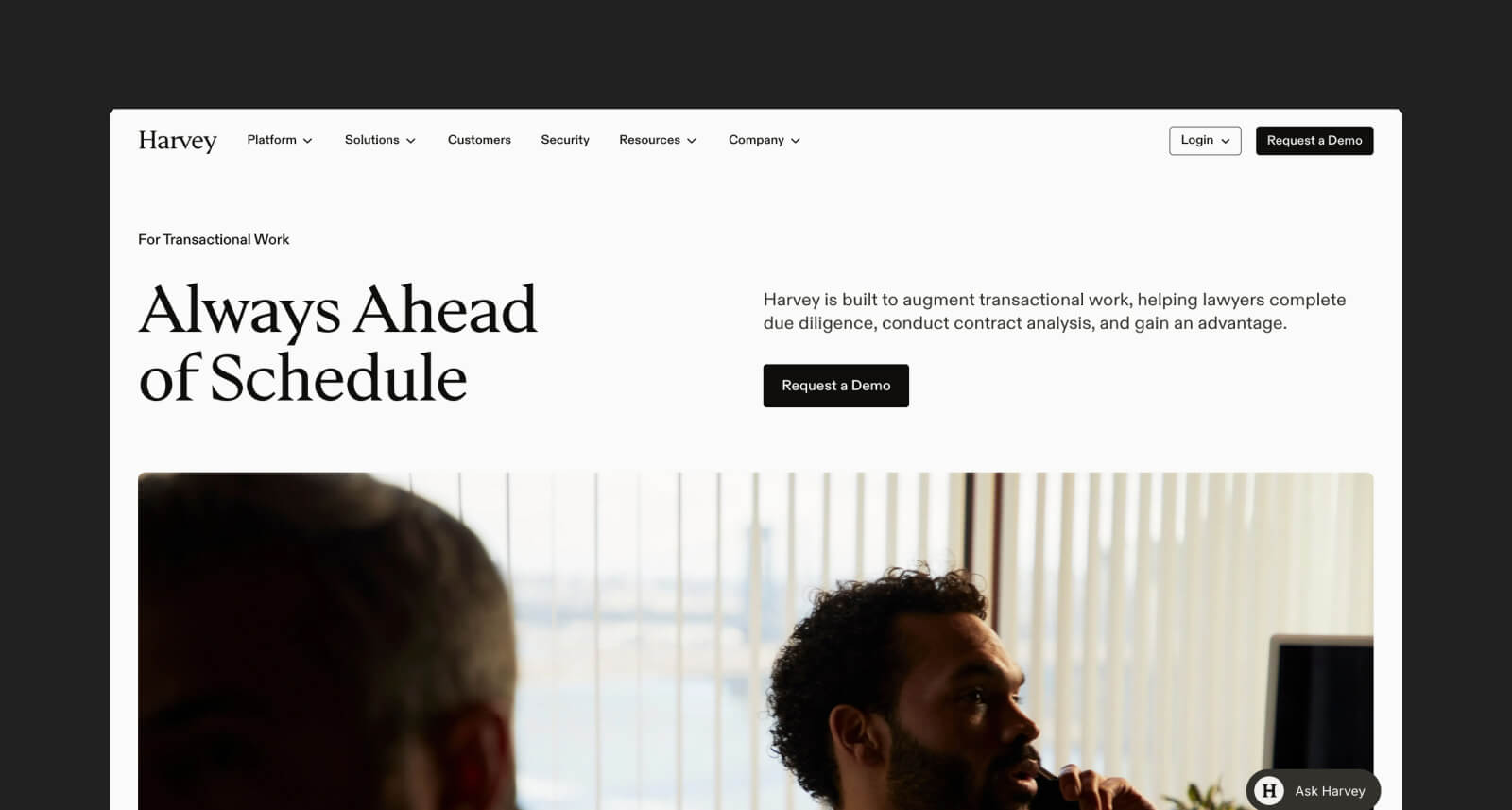
Best for: Enterprise legal teams and law firms
Harvey is an AI platform for legal and professional services, built for the work transactional lawyers do on a deal. It reveals insights and supports drafting while pulling in public company filings from the SEC's EDGAR database. Law firms and enterprise legal teams can use it to navigate due diligence and contract work within deal timelines.
On the review side, Harvey inspects thousands of documents at once and flags the risks that matter, including content in multiple languages and jurisdictions. It also checks for inconsistencies against precedents and playbooks for drafting, so a lean team can cover more ground.
Key features:
- AI-assisted document review and research: Reviews thousands of documents at once to flag insights and identify risks.
- Drafting support: Strengthens clauses and checks drafts for inconsistencies against deal points.
- Scales across large document sets: Expands a team's capacity to review more documents without increasing headcount.
6. Luminance
Best for: Automated contract risk flagging
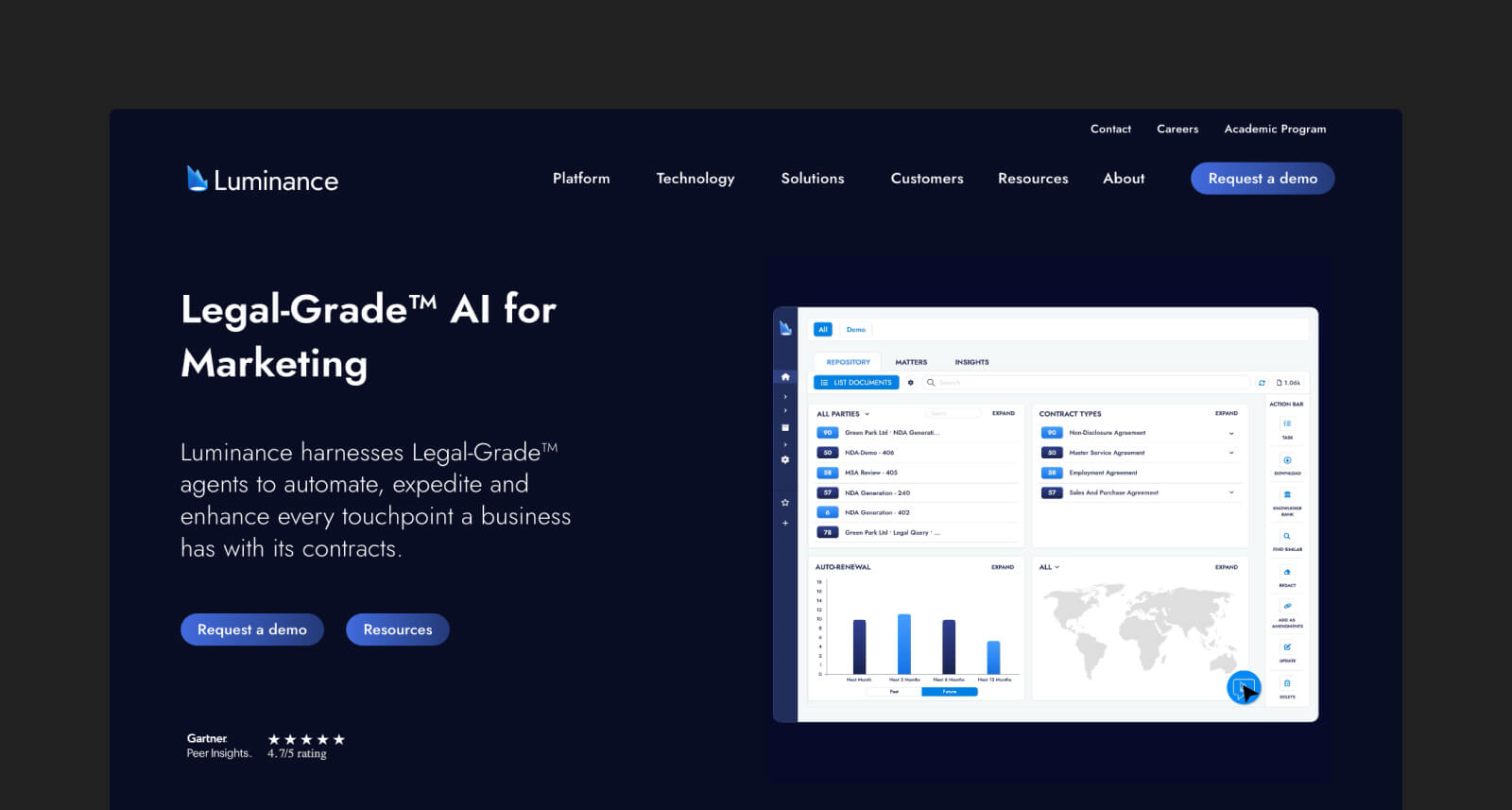
Luminance applies AI to contract review across the deal lifecycle, with a diligence use case built for M&A. Pointed at a data room, it automatically analyzes the structure, labeling document types, contract types, clauses, languages, and governing laws. Reviewers learn what the data room contains before reading a page.
From there, Luminance's AI identifies anomalies and deviations that signal risk, such as a missing clause or unusual wording. It draws on more than 1,000 prebuilt legal concepts, quickly flagging non-standard terms across a large set of contracts.
Key features:
- Pattern recognition for non-standard clauses: Flags non-standard clauses and unusual wording against a legal concepts library.
- Anomaly detection: Automatically identifies anomalies, trends, and deviations to catch risks a reviewer might not think to search for.
- Risk surfacing: Raises and organizes flagged risks across the data room so reviewers can see where the exposure lies.
Financial Analysis and AI Modeling Solutions
Teams can turn raw deal files and financial statements into structured models and risk scores in minutes using AI-driven financial modeling and analysis tools.
7. Keye
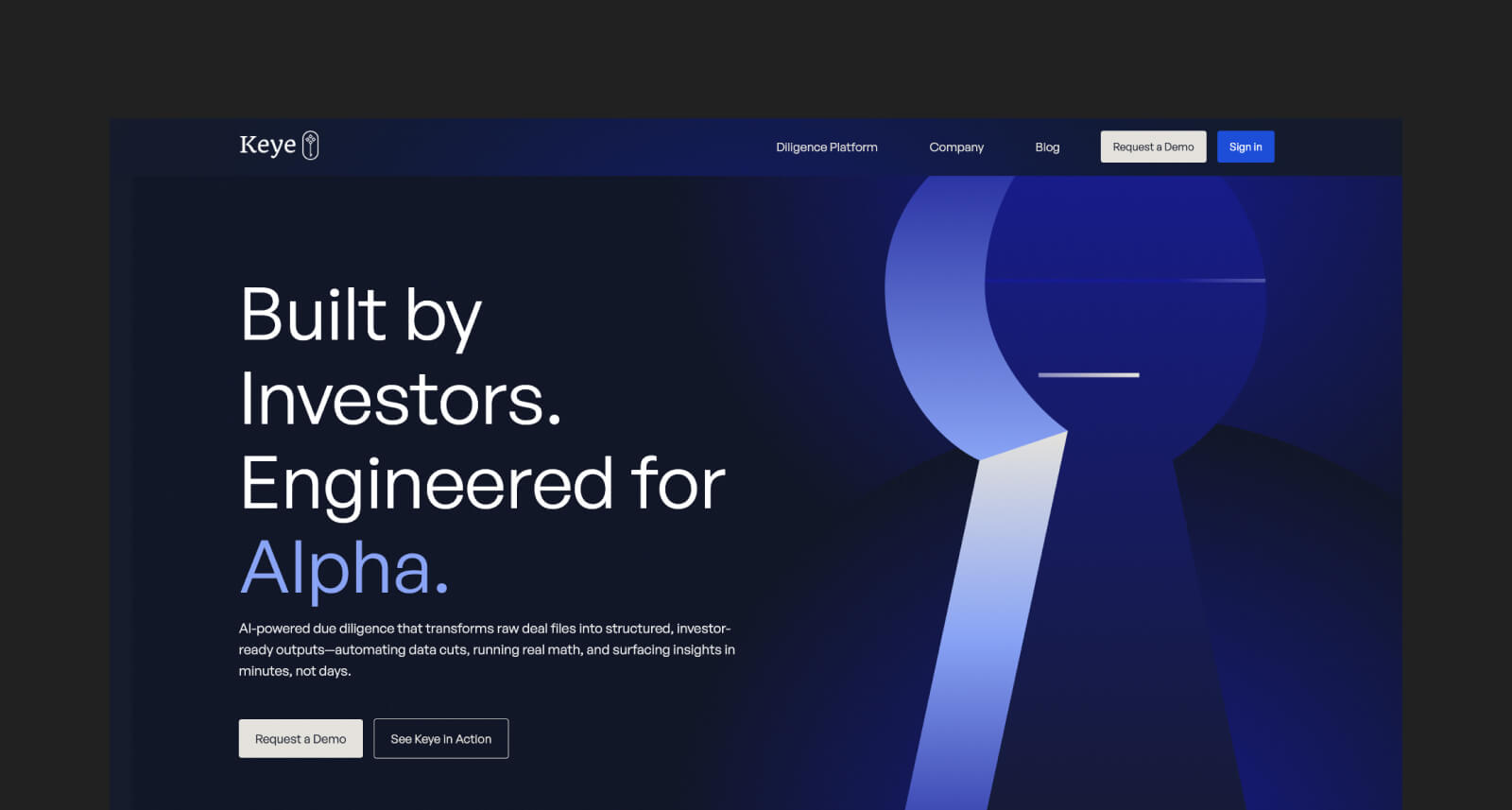
Best for: PE firms building financial models from deal data
Keye is an AI due diligence platform built by private equity investors for the number-heavy side of a deal. It takes raw deal files, including documents pulled straight from the VDR, and turns them into structured, investor-ready outputs. The aim is to compress the days an associate would otherwise spend cleaning data and building models into minutes.
After scanning the VDR files and making the data usable in tables, Keye exports a spreadsheet with dynamic formulas. It links every output back to the raw source to maintain an audit trail, and it operates under a zero-data-retention (ZDR) policy with SOC 2 Type 2 certification.
Key features:
- Direct VDR integration: Scans VDR files and makes the data instantly usable in tables and models.
- Converts raw data into Excel-ready models: Exports spreadsheets with dynamic formulas instead of hardcoded cells.
- ZDR policy: Retains no customer data, encrypts end to end, and doesn't use your data to train models while holding SOC 2 Type 2 certification.
8. MindBridge
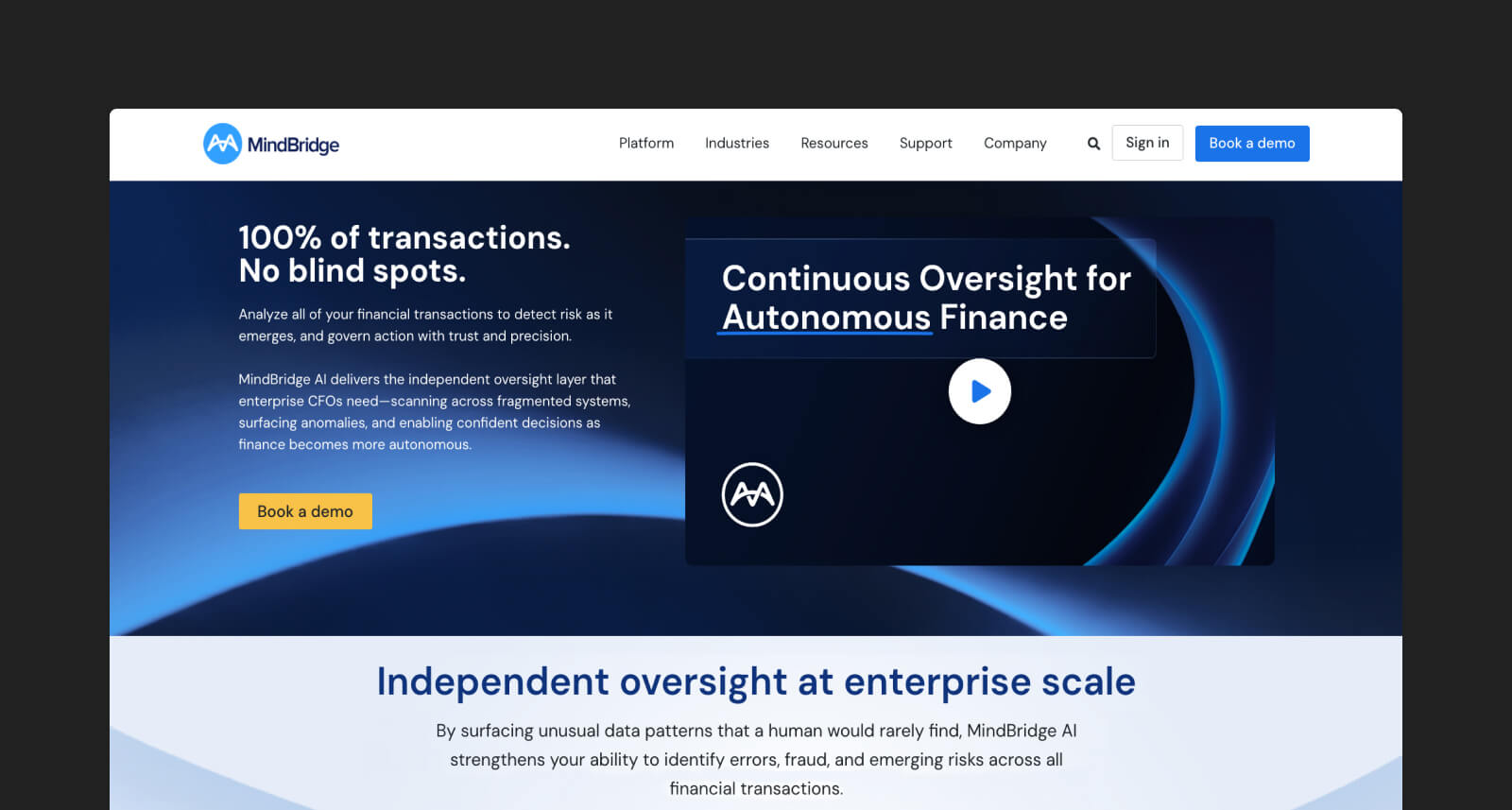
Best for: Financial statement analysis
MindBridge is an AI-based anomaly detection and financial risk management platform used by finance and audit teams. It analyzes all entries in a financial data set, spanning the general ledger through accounts payable and receivable. In diligence, it reaches beyond a spot check and gives you a read on the quality of a target's numbers.
MindBridge scores transactions for risk using machine learning and a mix of statistical and rule-based tests, then explains why each flagged item stands out. That makes it useful for financial statement analysis, where you need to find the unusual entries and understand them.
Key features:
- Anomaly detection across accounting data: Analyzes entire transaction datasets to find anomalies in financial figures.
- Automated risk scoring: Calculates a risk score for every entry flowing through the general ledger.
- Trend analysis: Surfaces period-over-period trends across ledger, payables, and receivables data.
Compliance, Anti-Money Laundering (AML), and Risk Vetting Solutions
Compliance and risk tools screen the entities behind a deal against sanctions lists and ownership records for know-your-customer (KYC) and AML checks, surfacing hidden risks.
9. ComplyAdvantage
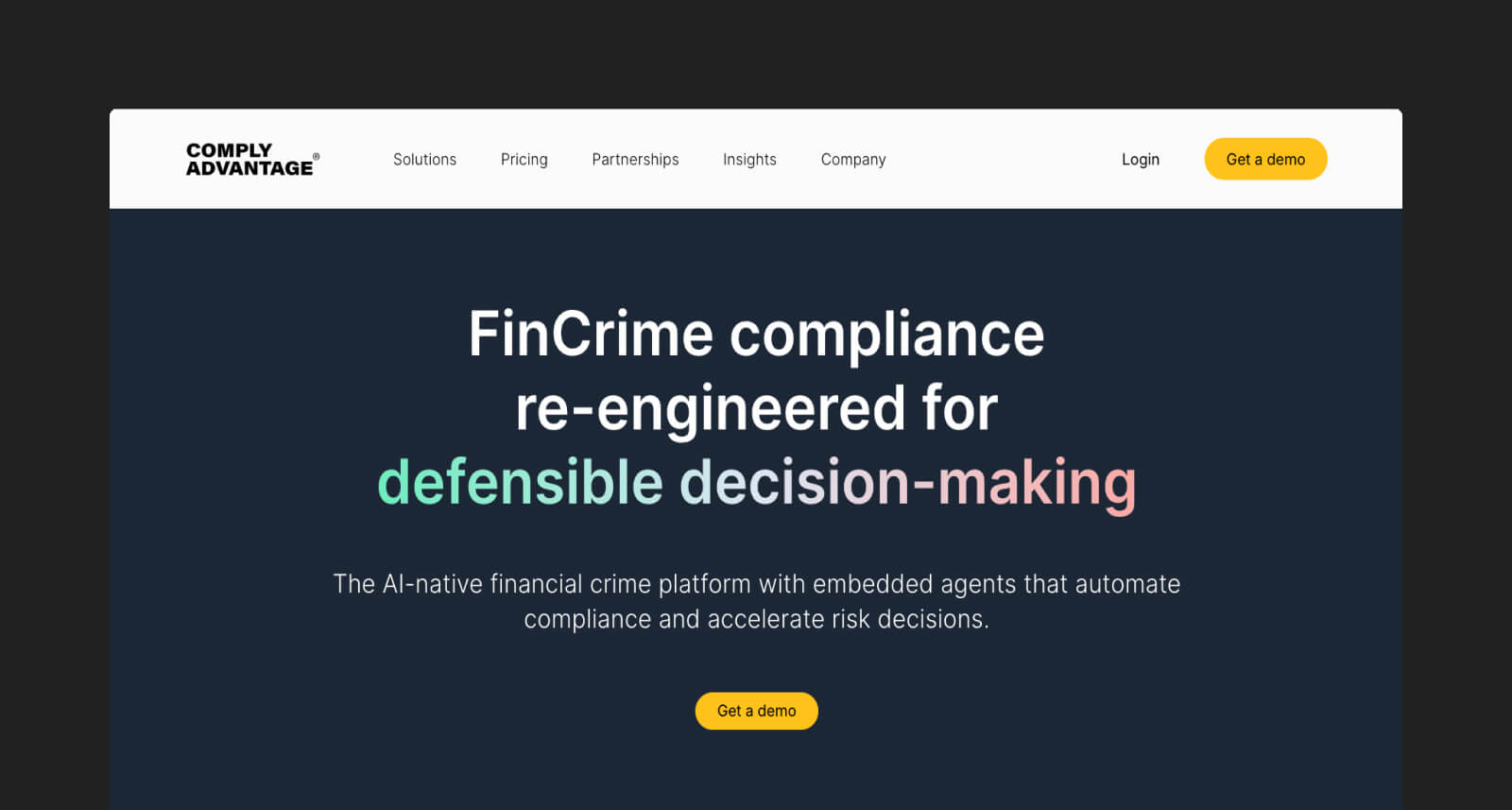
Best for: Ongoing AML and sanctions monitoring
ComplyAdvantage is an AI-driven financial crime risk and compliance platform. It screens the entities behind a deal against sanctions lists, watchlists, politically exposed person (PEP) lists, and adverse media, drawing on a real-time risk database.
Teams use ComplyAdvantage for the compliance side of diligence and for the ongoing monitoring that continues after a deal closes. Its risk detection graph maps relationships among more than 400 million companies and their directors, helping it reveal buried connections and beneficial ownership risks.
Key features:
- Real-time entity recognition: Monitors people and companies in real time across a global risk database to contextualize their relationships.
- Adverse media monitoring: Screens for negative news, with categories aligned with Financial Action Task Force (FATF) and EU money-laundering directives.
- Hidden ownership structure mapping: Uncovers ultimate beneficial owners and the ownership chain behind an entity.
10. LexisNexis
Best for: KYC and regulatory screening
LexisNexis, through its Nexis Diligence+ software, investigates the people and companies behind a deal. It pulls negative news, sanctions, watchlist data, and company records into one place, so a team can vet a counterparty before signing. Firms often use it for third-party risk alongside KYC and AML compliance.
Drawing on more than 36,000 news sources for adverse media and 270 million company and people records, Nexis Diligence+'s data runs deep. An AI-powered summary condenses adverse media so a reviewer can clearly and cleanly read the risk, and an integrated report builder turns each check into an auditable record.
Key features:
- Sanctions screening: Screens against 2.5 million profiles, including global sanctions lists and enforcement actions.
- Beneficial ownership checks: Uncovers ultimate beneficial ownership and state ownership behind a counterparty.
- Adverse media searches: Catches adverse media on individuals from a large library of global news sources.
AI Due Diligence Solutions vs. Traditional Workflows
Traditional due diligence runs on manual review. A team divides a data room among analysts, who each cover a portion of the documents within the timeframe. The approach works, but it's limited by which documents get pulled and how sharp the reviewer's attention is. Coverage remains partial, and turnaround times run into weeks, while multiple reviewers can reach different conclusions on the same contract.
AI due diligence changes the inputs and increases efficiency. AI reviews the entire document population and applies the same criteria to every file, then links its findings back to the source. It does not replace judgment, and a human still decides what a flagged clause means for the deal, positioning AI-driven risk management alongside the analyst. This partnership allows analysts to spend less time identifying issues and more time determining what they mean.
Factor | Traditional due diligence | AI due diligence |
|---|---|---|
Document coverage | Manual sampling, often covering only a fraction of available documents | Reviews the full document population, no sampling required |
Turnaround time | Weeks of manual review for large deals | Hours to days for the same document volume |
Risk detection | Depends on reviewer experience, prone to missed clauses | Flags non-standard clauses and liabilities consistently |
Auditability | Findings tied to reviewer notes, hard to trace back to the source | Outputs linked to source documents through inline citations |
Cost structure | Scales with headcount and outside advisor fees | Scales with software licensing, with a lower marginal cost per document |
Scalability | Limited by team size and available hours | Handles spikes in deal volume without adding headcount |
Consistency | Varies by reviewer and firm | Applies the same review criteria uniformly across every document |
How to Choose the Best AI Due Diligence Software for Your Team
As 93% of finance professionals use AI, the question is not whether you should adopt AI due diligence software, but which tool is the best fit. The right choice for your team depends on the kind of diligence you run most and the tools your team already uses.
Weigh these factors before you commit:
- Data security and retention: Deal data is confidential and often covered by a nondisclosure agreement, so check for a ZDR policy and for certifications such as SOC 2 and ISO 27001.
- Integration with your existing tools: The best due diligence tools work inside the systems your team already uses, from the VDR to your financial modeling software.
- Auditability: Confirm that every output traces back to a source document so you can prove the origin of your findings.
- Document coverage: Full coverage is the main advantage AI has over manual review, so opt for a full review over a sample.
- Use case fit: Match the platform to your work, whether it's M&A document review, legal contract analysis, compliance and AML screening, or financial analysis.
- Team size and deal volume: Some tools are built for a single associate, and others for a firm running many deals at once. Pick one that fits your throughput.
- Pricing model: Map the model to how often you run diligence, as vendors price per deal or user, and as an enterprise license.
See What Hebbia Surfaces in Your Next Deal
AI solutions for due diligence have moved from a nice-to-have to a competitive advantage for deal teams. Instead of relying on manual sampling and stretched analyst hours, firms now review entire data rooms with tools built for document and data intelligence.
The right platform depends on your workflow, but the strongest options trace every output back to a source document and hold up to scrutiny when a deal is on the line.
Hebbia brings that standard to due diligence. Built for private equity and finance teams, it reasons across massive document sets and links every finding back to its source, so your team can trust what it surfaces and defend it under review.
If you want to see how Hebbia handles your next deal, request a demo today and put it to the test on your own documents.


