
The Best Credit Agreement Software for Faster Covenant Tracking
A single credit agreement can bury a deal team in cross-referenced covenants and dense amendment language for days. Analysts have to comb through hundreds of pages by hand while deadlines close in.
The cost shows up in Hebbia's own research on deal team workflows, with 62% of teams reporting losing four or more days per deal to manual re-checks and leadership review alone. Every one of those days raises the odds of missing a red flag.
This article ranks the top credit agreement software platforms built to speed up that review process, drawing on how real deal teams evaluate their options today. Each entry explains what the tool does, who it fits best, and the standout features that set it apart.
The Best Credit Agreement Software at a Glance
Platform | Tool Type | Best For | Key Features |
|---|---|---|---|
Hebbia | AI covenant and tools analysis | Credit due diligence and deal team research | - Covenant and term extraction - Cross-agreement benchmarking - Sentence-level citations - Natural language search across deal documents |
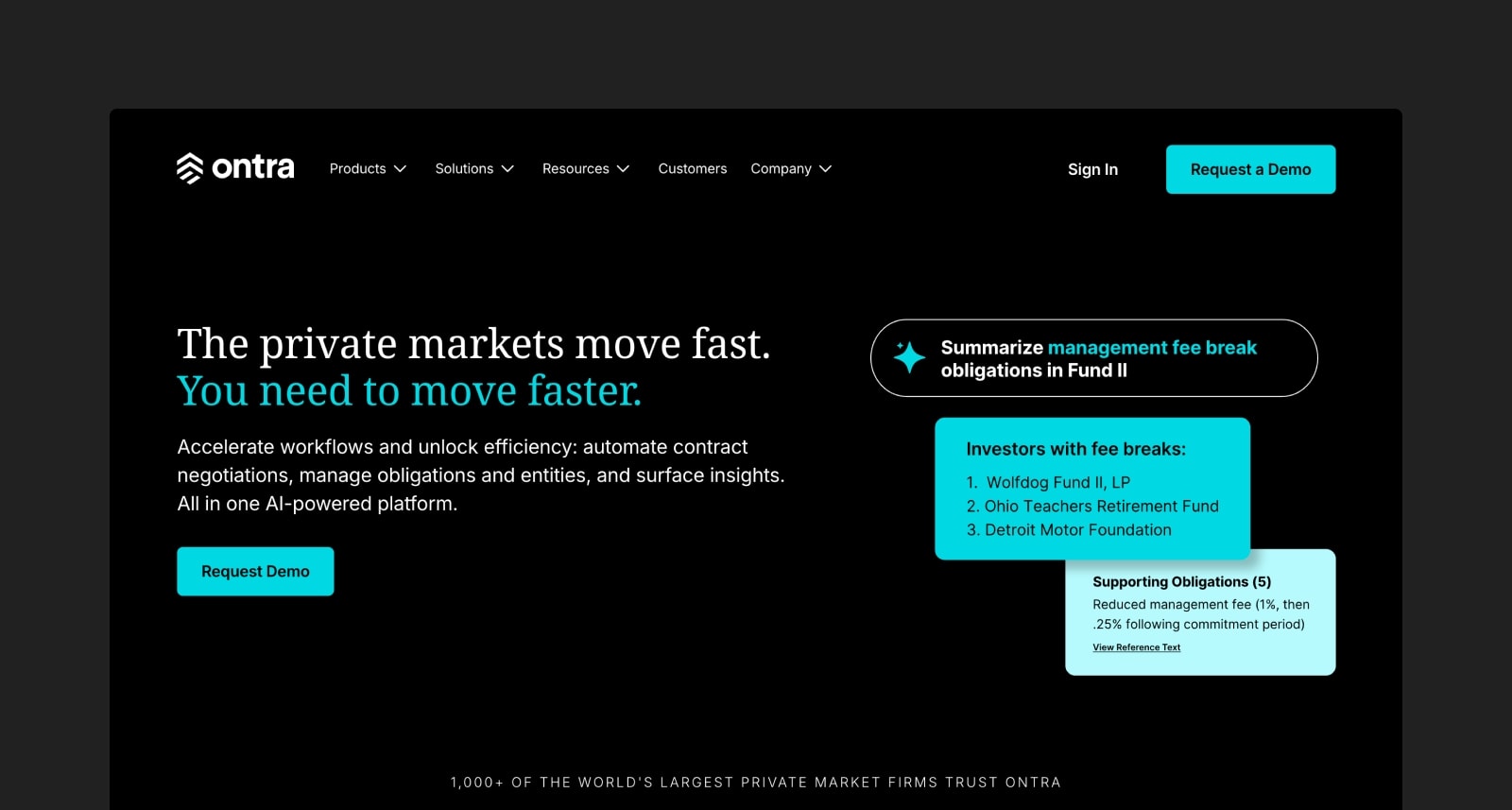
Ontra | AI covenant and tools analysis | Legal and private markets operations teams comparing terms across agreements | - Covenant tracking - Key term comparison - Legal ops workflows - Integration with broader contract lifecycle management (CLM) suite |
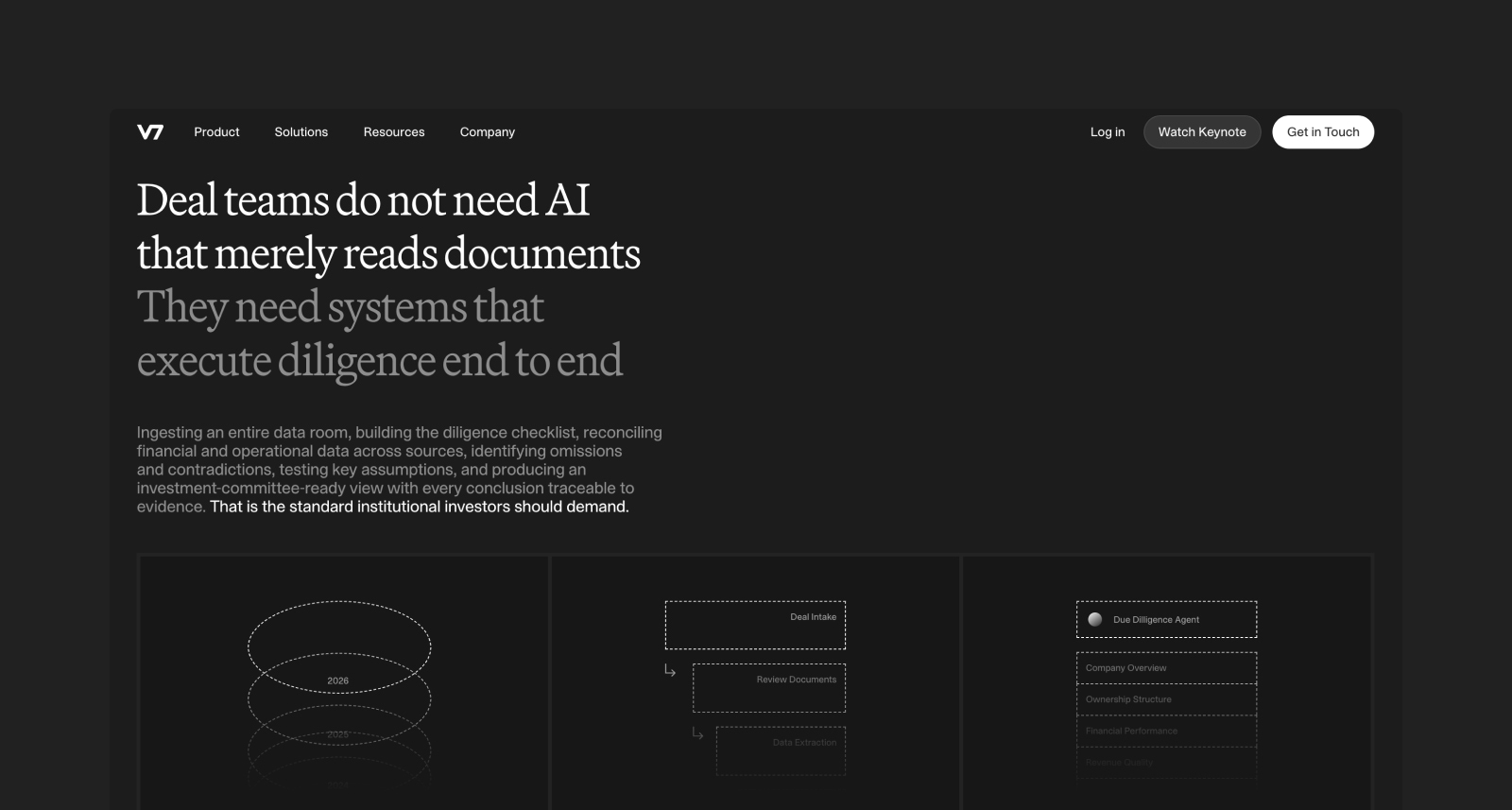
V7 Go | Document automation and extraction | High-volume agreement extraction and document workflow automation | - Covenant and compliance threshold identification - Automated violation flagging - 30-45 minute agreement turnaround - Structured term extraction |
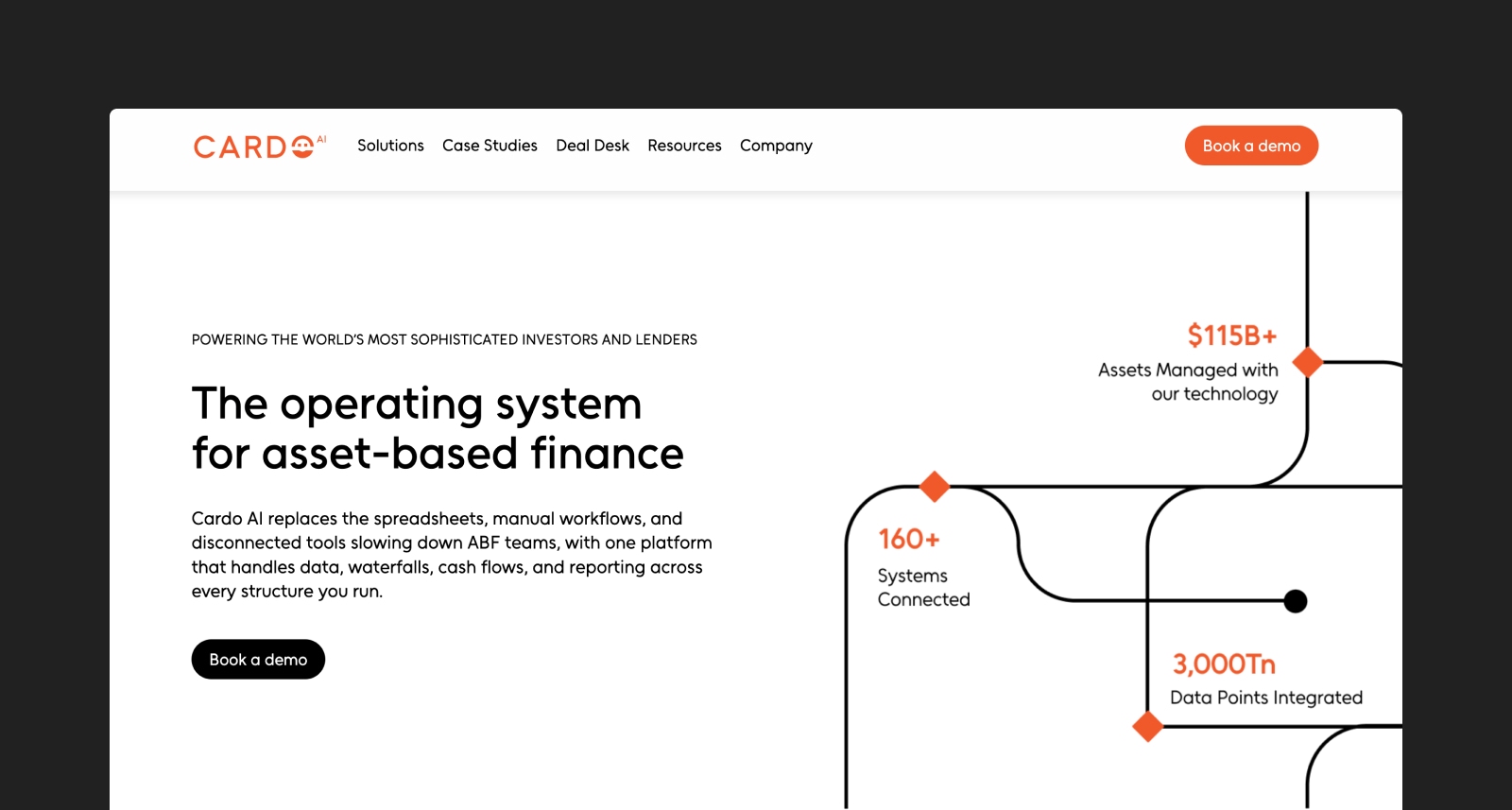
Cardo AI | Debt capital and loan portfolio management | Private credit and asset-based finance portfolio monitoring | - Automated financial data ingestion - Real-time covenant updates - Clause-level document Q&A - Trend tracking over time |
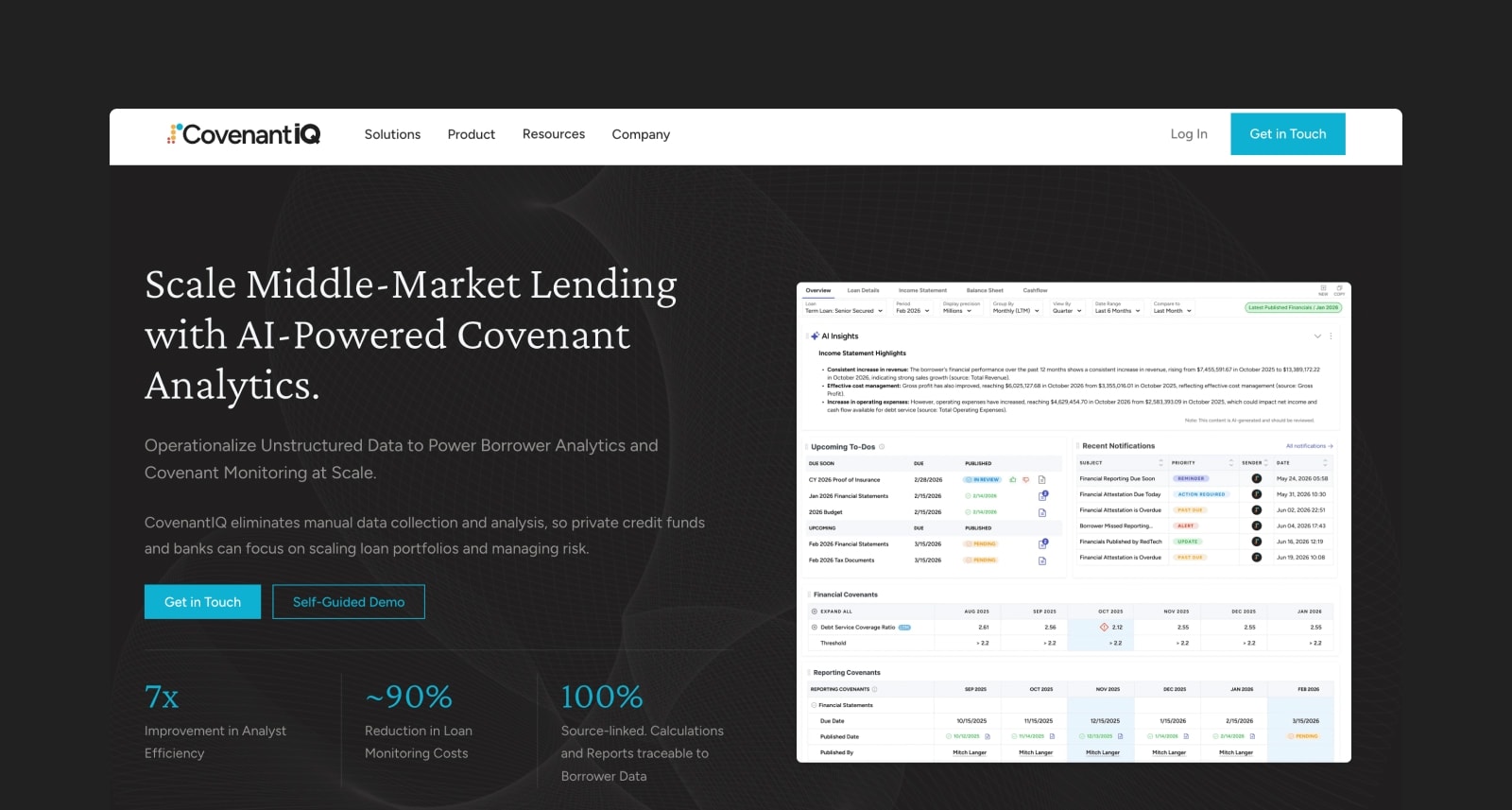
Covenant IQ | AI covenant and tools analysis | Covenant benchmarking and portfolio covenant monitoring | - Covenant and reporting requirement extraction - Financial normalization across formats - Automated monitoring schedules - Early risk surfacing |
Finley | Debt capital and loan portfolio management | Borrower and lender debt capital operations and covenant compliance | - Credit agreement digitization - Funding request automation - Collateral/compliance certificate generation - Enterprise resource planning (ERP) and bank integrations |
Sirion | Document automation and extraction | Contract lifecycle management for credit and collateral documentation | - Credit agreement and collateral documentation management - Extraction and workflow automation - Contract lifecycle tracking - Audit trail support |
Moody's Lending Suite | Debt capital and loan portfolio management | Banks and agent banks managing large loan portfolios | - AI-driven risk identification - Automated covenant document tracking and validation - Portfolio-level risk prioritization - Core banking integrations |
1. Hebbia

Best for: Credit due diligence and deal team research
Hebbia runs on large language models tuned specifically for financial documents, giving deal teams a way to get a defensible answer out of a credit agreement instead of a best guess. Every extraction ties back to a sentence-level citation in the source document, so analysts can check any covenant or term the platform surfaces against the exact clause it came from rather than trusting an unsourced summary.
G2 reviewers consistently name this as the platform's standout strength, with one reviewer claiming such auditability is "severely lacking in open source LLMs."
Hebbia's engineers built the platform specifically for institutional finance, spending five years refining workflows such as covenant and terms analysis. Firms use it as a shared system where one team's due diligence on a borrower becomes searchable context for the next deal instead of a starting point that resets with every new hire.
This combination of domain-specific accuracy and firm-wide reuse is what separates Hebbia from point solutions built for a single agreement at a time.
Key features:
- Covenant and term extraction: Hebbia identifies covenants, conditions, and key terms directly within a credit agreement and surfaces them as structured, searchable data. It also converts agreement tables, like cash flow schedules, into usable spreadsheets.
- Cross-agreement benchmarking: Through Matrix, analysts can pull the same term, like a leverage covenant or change of control provision, across every agreement in a portfolio and view the results side by side.
- Sentence-level citations: Every extracted term links back to the exact sentence it came from, so an analyst can verify the source without reopening the full document.
- Natural language search across deal documents: Teams can ask questions in plain English across an entire deal room or portfolio and get an answer sourced to the specific document and page.
2. Ontra
Best for: Legal and private markets operations teams comparing terms across agreements
Ontra built Insight for Credit as an extension of its private markets legal operations platform, turning credit agreements into structured, searchable data. Its differentiator is term benchmarking for negotiation.
The platform shows how a covenant or provision compares across the portfolio. Ops teams can argue from precedent rather than memory. That makes it a better fit for legal and compliance functions than for deal teams running initial due diligence.
Task workflows track lender commitments and default triggers against deadlines, reducing manual tracking. That said, the platform's AI-native enterprise search feature was still marked "coming soon" as of this research, so it's worth confirming current capabilities directly with Ontra. For firms already using Ontra's other private markets legal tools, Insight for Credit fits naturally into an existing workflow rather than adding a new vendor relationship.
Key features:
- Covenant tracking: Insight for Credit auto-identifies affirmative, financial, and negative covenants within a credit agreement and tracks them against compliance deadlines and lender commitments.
- Key term comparison: The platform summarizes and compares key terms across multiple agreements, enabling teams to benchmark provisions before negotiating a new deal.
- Legal ops workflows: Task-based workflows flag default triggers and route lender obligations to the right team member, replacing manual tracking in spreadsheets or email.
- Integration with broader CLM suite: Insight for Credit is part of Ontra's private markets legal operations platform.
3. V7 Go
Best for: High-volume agreement extraction and document workflow automation
V7 Go is one of several document analysis agents built on V7's broader AI platform, covering everything from loan agreements to general contract review. It applies the same extraction engine V7 uses across contract types to covenants, compliance thresholds, and other key terms in a credit agreement.
That breadth cuts both ways. Its extraction engine comes from a general document-automation lineage rather than credit-specific modeling built from scratch, so results are worth validating against a known agreement before scaling up. That same general-purpose design does give teams more flexibility on the back end, with support for core banking system integration and multiple large language models, including OpenAI and Gemini.
Key features:
- Covenant and compliance threshold identification: V7 Go flags covenant and compliance thresholds as it processes an agreement, tying each flag to the exact language it was pulled from.
- Automated violation flagging: When a threshold is breached, the platform routes an alert instead of requiring a manual re-read of the full agreement.
- 30-45 minute agreement turnaround: V7 cites review times dropping from four to six hours to 30 to 45 minutes per agreement.
- Structured term extraction: Terms pulled from PDFs, spreadsheets, and presentations, including amendments and exhibits, are organized into a consistent structured format across more than 50 languages.
4. Cardo AI
Best for: Private credit and asset-based finance portfolio monitoring
Cardo AI is replacing spreadsheets as the default way private credit and asset-based finance shops track their loan books, pitching itself as a single operating system for their portfolios.
The platform pulls in loan tapes and borrower financials directly, calculates leverage and coverage ratios, and flags a covenant issue as soon as new numbers land rather than at the next quarterly check-in.
The tradeoff is scope. Cardo AI is built around portfolio-level monitoring after a loan closes, so it fits surveillance better than the term-by-term review of a brand-new credit agreement. Its Document Reader feature lets users ask plain-language questions and get answers tied to the exact clause, narrowing that gap for one-off diligence work.
Key features:
- Automated financial data ingestion: Cardo AI's Loan Data Agent pulls loan-level data directly from core systems, feeding borrowing-base calculations and analytics across more than 30 asset classes.
- Real-time covenant updates: As new borrower financials come in, the platform recalculates leverage and coverage ratios and flags a covenant issue immediately, with a full audit trail.
- Clause-level document Q&A: The Document Reader tool answers plain-language questions about a credit agreement and links each answer back to the specific clause it came from.
- Trend tracking over time: Portfolio dashboards track borrowing base, covenant status, and other metrics across the life of a loan rather than as a single point-in-time snapshot.
5. CovenantIQ
Best for: Covenant benchmarking and portfolio covenant monitoring
Private credit funds and regional banks that do middle-market lending use CovenantIQ to replace spreadsheet-based covenant tracking. The platform maps covenant definitions directly from credit agreements to normalized borrower financials. Reporting cadences, borrower attestation requests, and overdue-deliverable alerts all run through the platform automatically, with each calculation traceable back to its source.
As a newer venture capital-backed platform, Covenant IQ has a narrower track record than the larger established players on this list. Public information about its client base is limited. Third-party reviews note it performs well on extraction, but results still depend on the data fed into the system.
CovenantIQ's normalization layer helps by connecting directly to accounting systems, like QuickBooks and NetSuite. Borrower financials arrive in a consistent format from the start.
Key features:
- Covenant and reporting requirement extraction: The platform maps covenant definitions and reporting requirements directly from a credit agreement into structured, normalized borrower data.
- Financial normalization across formats: Application programming interface (API) connections to accounting systems such as QuickBooks, Xero, and Sage Intacct standardize chart-of-accounts formats into a single taxonomy for portfolio-wide comparison.
- Automated monitoring schedules: Configurable reporting cadences, borrower attestation requests, and deadline alerts replace manual, email-based tracking, with a full audit trail.
- Early risk surfacing: The platform flags emerging covenant issues ahead of scheduled deadlines, with calculations linked back to the underlying financials.
6. Finley
Best for: Borrower and lender debt capital operations and covenant compliance
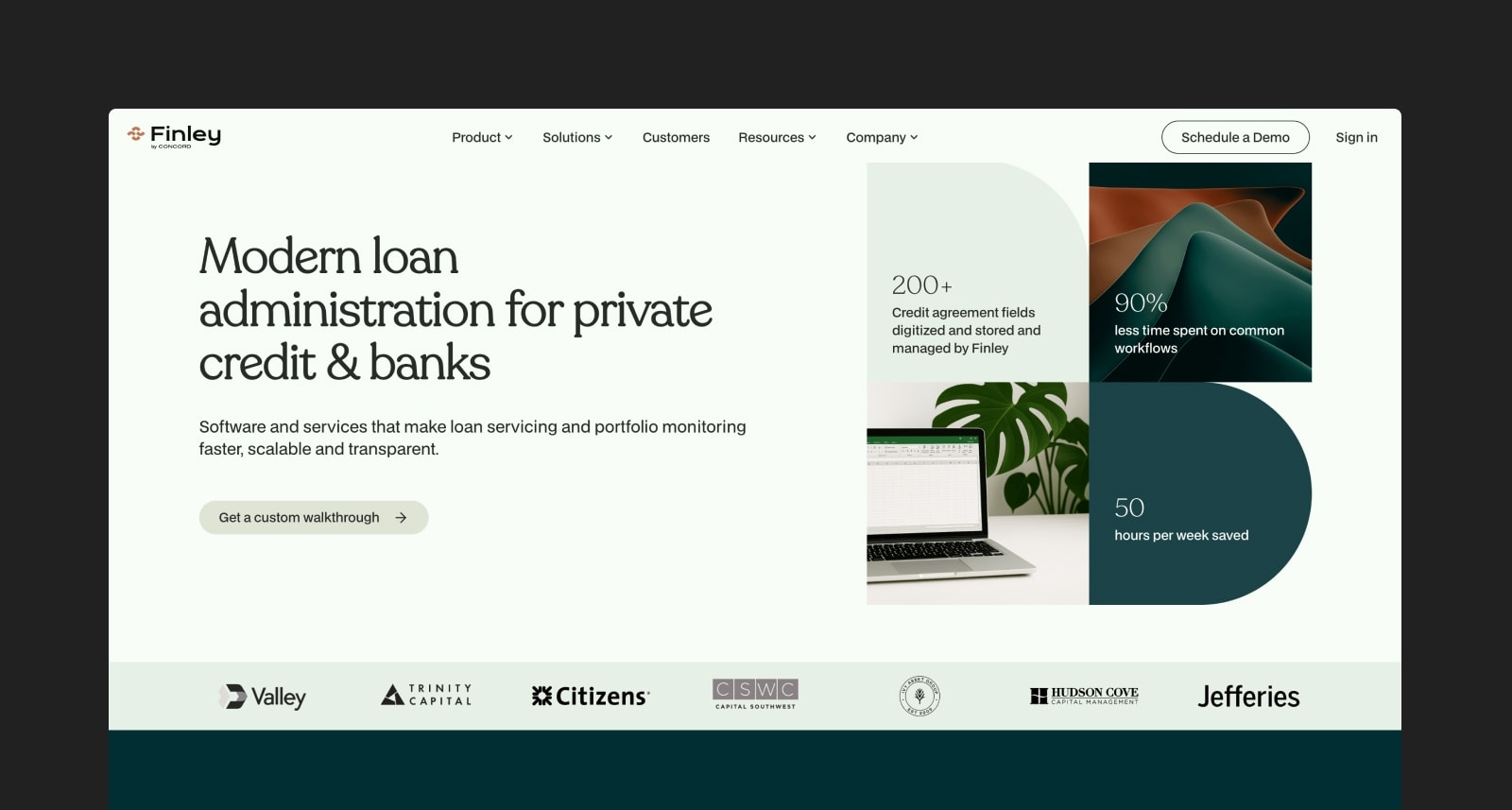
Finley serves both sides of a credit relationship, providing borrowers and lenders with shared visibility into the same credit agreement rather than two separate systems. The platform automatically converts agreement terms into structured data. It then uses that data to run borrowing base calculations and generate funding requests without manual spreadsheet work.
Finley was acquired by Concord, a credit administration servicer, in February 2026, and its technology is being folded into Concord's broader platform. Readers evaluating it as a standalone tool should confirm current availability and positioning directly, since a company mid-integration can shift quickly.
Key features:
- Credit agreement digitization: Finley converts credit agreement terms into structured, centralized data instead of a static PDF, so borrower and lender teams reference the same fields.
- Funding request automation: Borrowers can generate funding requests and borrowing base reports in lender-ready formats in a few clicks instead of building them from scratch each time.
- Collateral/compliance certificate generation: The platform automates compliance certificate creation and covenant-monitoring workflows, with alerts routed by email or Slack.
- ERP and bank integrations: Finley connects to enterprise resource planning (ERP) software, core banking systems, and bank or asset data sources, so credit data stays current without manual re-entry.
7. Sirion
Best for: Contract lifecycle management (CLM) for credit and collateral documentation
Sirion treats credit agreements as one of many contract types on its broader platform, using the same AI-native finance tools across standardized loan and derivatives documentation. Legal and contract ops teams at lending institutions use it to extract terms from PDFs and scanned agreements without needing to build a template for each document type first.
Sirion's strength is breadth across contract types rather than a narrow focus on lending. Credit-specific workflows end up sitting within a much larger CLM product designed for legal and procurement teams in general.
Teams already running LoanIQ, SharePoint, or Xceptor have built-in integration paths, but a firm without an existing CLM footprint may find onboarding a full platform to be more than the credit-agreement use case warrants.
Key features:
- Credit agreement and collateral documentation management: Sirion automatically classifies incoming documents, such as loan agreements, amendments, and collateral schedules, as they're uploaded.
- Extraction and workflow automation: The platform extracts key terms from PDFs and scanned documents without a preset template, then routes tasks like drawdowns and rate changes through automated workflows.
- Contract lifecycle tracking: Agreements move through a defined lifecycle in the platform, from execution through amendments, rather than living as static files in a shared drive.
- Audit trail support: Every extraction and workflow action is logged with a confidence score and full audit trail, supporting review and compliance requirements.
8. Moody's Lending Suite
Best for: Banks and agent banks managing large loan portfolios
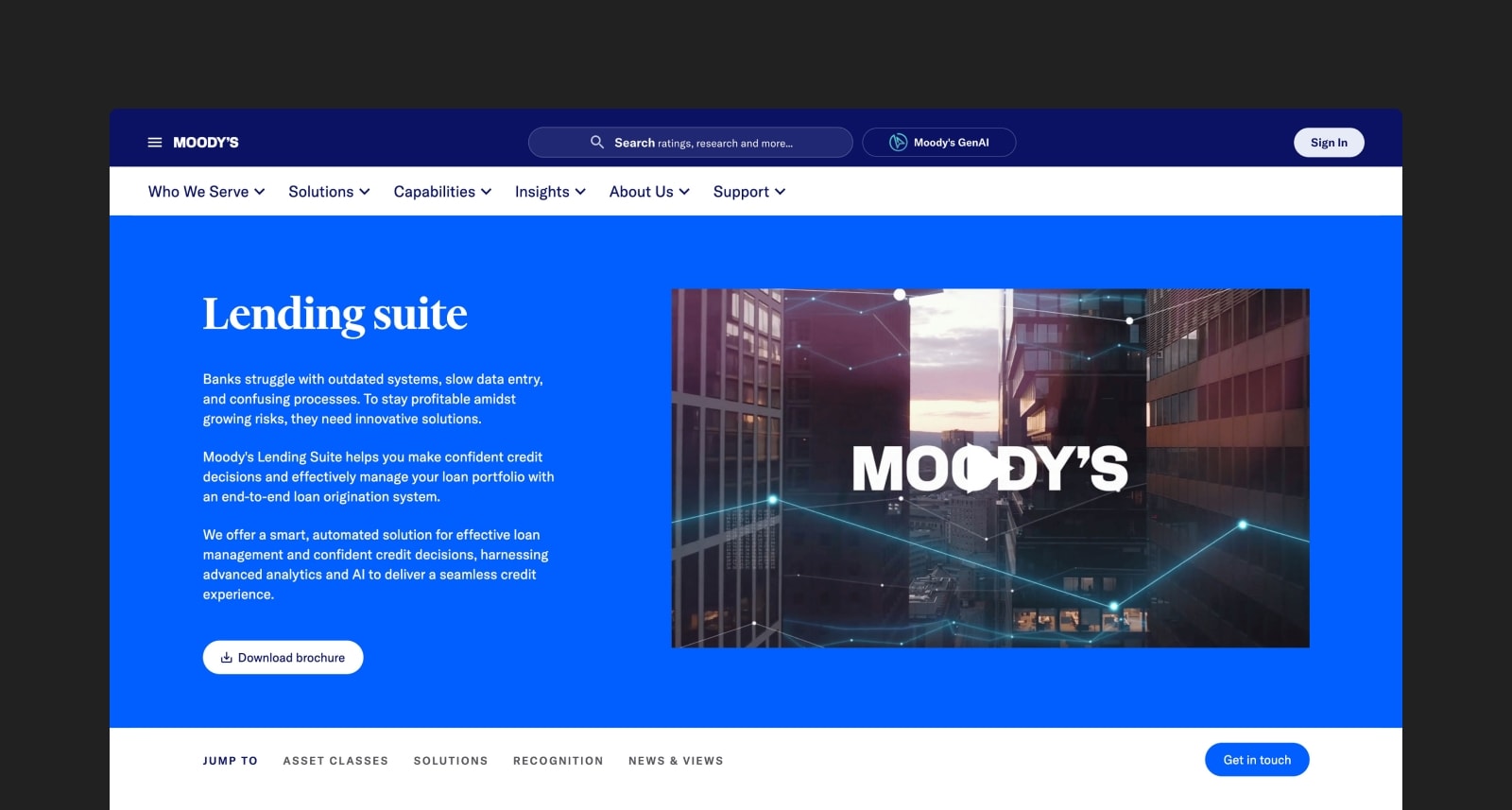
Moody's Lending Suite extends Moody's Analytics' ratings and data business into loan portfolio monitoring, applying the same risk-modeling foundation the company uses for credit ratings.
Banks and agent banks managing large loan portfolios can automate requesting, tracking, and validating covenant documents instead of chasing them by email. Pattern-based alerts flag early signs that a loan is drifting outside its risk tolerance.
Moody's built Lending Suite for a wide swath of commercial lending, covering everything from small-business loans to complex syndicated books. It competes more directly with core banking and loan origination systems than with dedicated credit agreement analysis tools.
The platform’s data ingestion layer uses machine learning to parse unstructured financial and tenant documents, extending coverage beyond credit agreements to the broader paperwork generated by a loan.
Key features:
- AI-driven risk identification: Pattern and anomaly-based alerts flag a loan breaching its risk tolerance early, before it shows up in a routine portfolio review.
- Automated covenant document tracking and validation: The platform requests, tracks, collects, and validates covenant documents automatically, replacing manual, email-based follow-up.
- Portfolio-level risk prioritization: A centralized view surfaces assets, market data, and benchmarks, enabling risk teams to prioritize which loans in the book need attention first.
- Core banking integrations: Lending Suite connects to a bank's existing core banking systems, so loan data doesn't need to be re-entered or reconciled separately.
How To Choose the Best Credit Agreement Platform for Your Workflow
A portfolio monitoring team, a back-office funding desk, and a deal team conducting due diligence pull the same credit agreement apart for different reasons, even though every vendor in this space claims to track covenants.
More than half of financial professionals say AI must be completely accurate before they'll use it at work. A tool built for the wrong workflow rarely clears that bar, no matter how capable it looks on paper.
This short set of questions helps narrow the list to what actually fits your team:
- What's the primary workflow? Covenant monitoring, agreement digitization, funding automation, and deal diligence each call for a different tool.
- How much volume are you handling? A handful of agreements can be tracked manually. A growing portfolio needs automated extraction and alerts.
- Do you need audit-ready transparency? Teams reporting to investment committees or lenders need every extracted term traceable back to the source document.
- What does the tool need to connect to? ERP systems, loan origination platforms, and treasury software each add integration requirements that should be confirmed upfront.
- Is credit agreement analysis your only need, or one of several? Teams that also diligence other deal documents benefit from a platform built for broader research, not just credit agreements.
Teams whose work stops at covenant tracking can get by with a narrower tool built for that one task. Those whose diligence spans credit agreements, purchase agreements, financial statements, and everything else in a deal room need a platform built for all their research, not just one document type.
Hebbia fits that second group, since the same citation-backed extraction that works for a credit agreement applies to any document in the deal.
Get More out of Every Credit Agreement With Hebbia
For teams that need to compare terms across a dozen agreements before a deal closes, the right credit agreement software is a platform built for that level of diligence, not a generic tool that forces every workflow through one lens.
Hebbia turns credit agreements into searchable, citation-backed data. A compliance analyst can trace a covenant back to the exact clause, while a deal team benchmarks pricing across the portfolio in minutes instead of days.
Book a demo with Hebbia to see how it fits your team's next agreement.


