
Enterprise Value to Equity Value Bridge: A Step-by-Step Guide
The enterprise value to equity value bridge is a calculation that converts a business's total value into the value owned exclusively by its shareholders, adjusting for items such as debt and cash.
Deal timelines keep compressing, but the manual work behind valuation hasn't changed. Investment bankers and credit teams still spend hours hunting through debt schedules, management presentations, and public filings to piece together the adjustments needed for a clean equity value.
One misplaced line item, like an overlooked convertible note or a minority stake, can throw off your entire valuation and undermine your credibility with clients.
The enterprise value (EV) to equity value bridge is the framework that connects a company's total enterprise value to the equity it actually owns. This article walks through each component of the bridge, explains common pitfalls that lead to valuation errors, and shows real examples from mergers and acquisitions (M&A) and credit transactions.
We'll also explore how AI financial analysis platforms can automate the data extraction and calculation process, cutting what used to take hours down to minutes while reducing the risk of manual errors.
What Is the Enterprise Value to Equity Value Bridge?
The enterprise value to equity value bridge equation translates a company's total business value into the true value owned by shareholders. To do this, it adjusts for financial claims sitting above or below the equity in the company's capital structure.
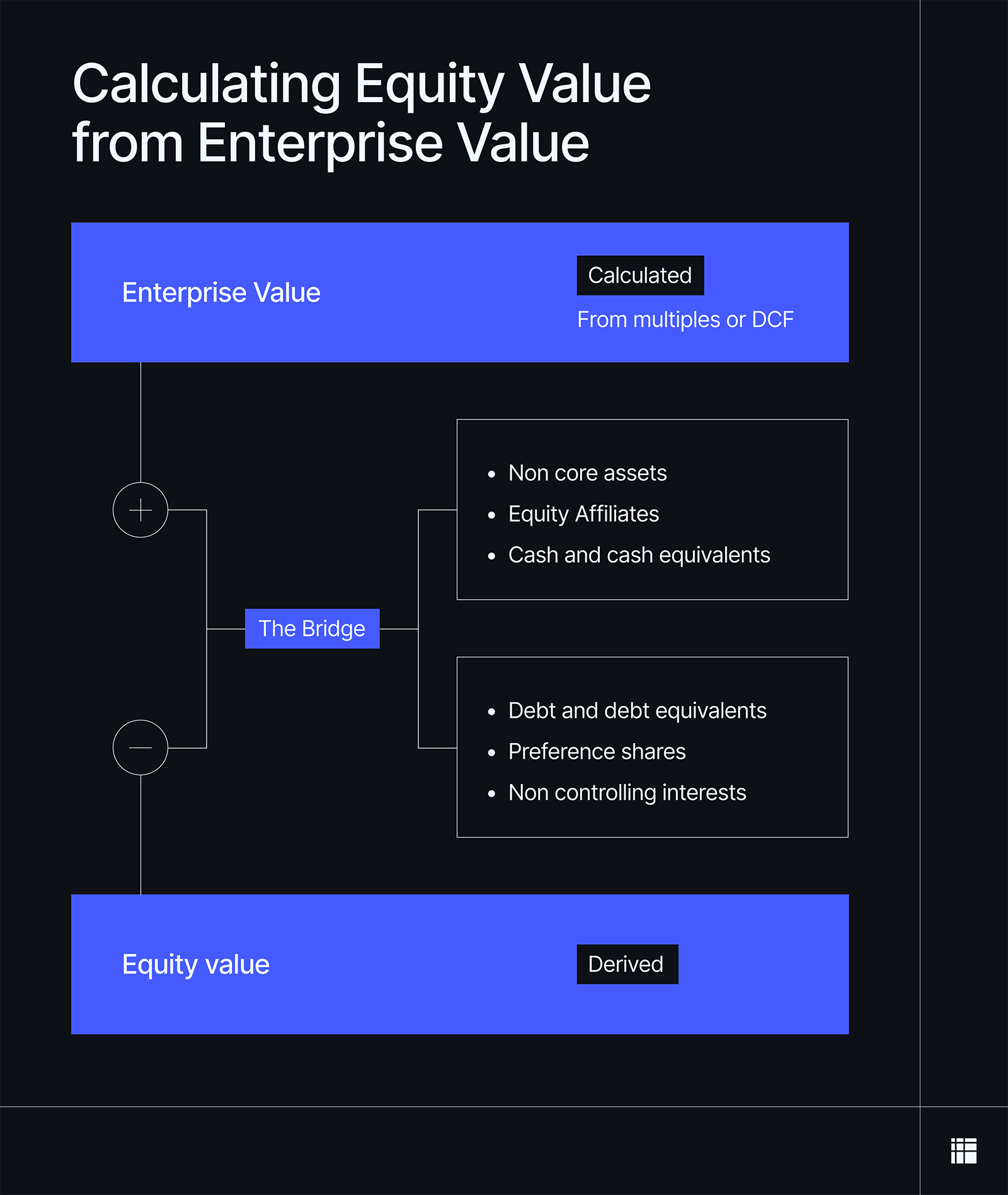
While the concept itself is straightforward, the execution is where errors happen. Teams often miss crucial line items buried deep in financial footnotes, miscategorize complex hybrid securities, or accidentally rely on stale balance sheet data.
In complex situations—such as companies with multiple debt tranches, cross-holdings, or off-balance-sheet liabilities—building an accurate bridge can be a massive data-gathering effort. It requires pulling and verifying information from ten or more different sources, including credit agreements, 10-Ks, investor presentations, and management discussions.
Why the Bridge Matters in Deal Analysis
Whether you're an investment banker advising on a sale, a credit analyst structuring a loan, or a private equity professional modeling a buyout, the way you use and defend this bridge changes significantly.
Here is a look at why getting it right is crucial for each of these key players:
For Investment Bankers
Investment bankers operate in a high-stakes environment where flawless execution is expected. The bridge is a core component of their daily deliverables, such as:
- M&A and pitch decks: The bridge is foundational to any M&A workflow. If your equity value is wrong, your valuation multiples, deal comparables, and precedent transactions are all off.
- CIM creation: Buyers expect accurate, defensible equity values. Errors in a confidential information memorandum (CIM) will inevitably get caught in diligence and erode your credibility with both the client and potential acquirers.
- Client-facing materials: Your reputation depends on 100% accuracy. Mistakes are highly visible and scrutinized by senior private equity leaders and corporate C-suites.
For Credit Teams
For credit professionals, downside protection—rather than upside potential—fundamentally shapes their mindset. The bridge is a vital tool for understanding exactly where their debt sits within the capital structure and what risks they are taking on.
- Risk assessment: Understanding the bridge is crucial for practical credit risk modeling and downside risk assessment. It allows you to clearly quantify downside protection by showing exactly how much debt sits ahead of you and what recovery looks like in distress.
- Loan structuring: Knowing the exact size of the equity cushion helps you price risk appropriately and set effective covenants.
- Portfolio monitoring: As companies take on more debt or pay dividends, the bridge shifts. You need to meticulously track this to stay ahead of covenant breaches and assess ongoing risk.
For Private Equity
Private equity professionals rely on the bridge to determine exactly how much they need to pay for a business and to map out their expected returns. It is a critical, heavily scrutinized component of their structured investment process.
- LBO modeling: The bridge connects your exit enterprise value to the equity value that actually flows back to your fund, which is absolutely critical for internal rate of return (IRR) calculations in a leveraged buyout (LBO).
- IC memos: A precise bridge acts as your primary shield during investment committee (IC) reviews. Having these numbers perfectly mapped allows you to defend your valuation assumptions against the scrutiny of internal stakeholders.
What's the Difference Between Equity Value and Enterprise Value?
Enterprise value is the total value of a business's core operations, representing what it would cost to acquire the entire company (including both debt and equity).
Equity value is the residual portion belonging strictly to common shareholders, calculated only after paying off creditors and adding back cash.
Think of it like buying a house—enterprise value is the total purchase price of the property, while equity value is that price minus the mortgage.
Enterprise value allows you to compare the operational scale of companies regardless of how they are funded, while equity value dictates the actual bottom-line price of their shares.
Breaking Down the Formula: Key Components
Building an accurate bridge means digging into the financial statements and finding the exact numbers for each adjustment. Consider the breakdown below an essential roadmap for moving from the business's total value all the way down to its final equity value.
At its core, the EV to equity value formula looks like this:
Equity Value = Enterprise Value
- Total Debt
+ Cash & Cash Equivalents
- Minority Interest
- Preferred Stock
+/- Other Adjustments
(-) Pensions & Unfunded Liabilities
(+) Equity Investments
(+) Non-Core Assets
And now, here's a detailed look at how to handle each specific component of that formula.
Total Debt
Total debt includes all of a company's short- and long-term borrowings. Because lenders get paid first, you must subtract what is owed to them from enterprise value to isolate the remaining value that belongs to the equity holders.
- Where to find it: The liabilities section of the balance sheet (10-K, 10-Q), the detailed debt footnotes, and the underlying credit agreements
- Common mistakes: Analysts often fail to properly classify capitalized leases—now labeled as lease liabilities—or overlook revolving credit facilities that have not been fully drawn.
Cash and Cash Equivalents
Cash and cash equivalents represent the most liquid assets on a company's balance sheet. Because enterprise value focuses strictly on the core, unlevered operational business, any cash on hand is treated as a non-operating asset.
You must add this figure back because it represents tangible, liquid value that ultimately belongs to the equity holders, whether it is distributed directly as dividends or used to pay down outstanding debt.
- Where to find it: Top of the current assets section on the balance sheet, with further detailed breakdowns sometimes provided in the liquidity and capital resources section of the 10-K
- Common mistakes: Analysts frequently forget to distinguish between operating cash (which is tied up in running the daily business) and truly excess cash, or they fail to discount "trapped cash" held in foreign subsidiaries that cannot be repatriated easily without incurring steep tax penalties.
Minority/Non-Controlling Interests
A minority interest represents the outside equity stake in a subsidiary that your company controls but does not own entirely. For example, if your firm owns 80% of a subsidiary, the remaining 20% belongs to outside investors and is classified as a minority interest.
Because your calculated enterprise value automatically consolidates 100% of that subsidiary's value, you must subtract the 20% you do not actually control to accurately reflect your true equity value.
- Where to find it: The equity section of the balance sheet and the consolidation footnotes in the 10-K.
- Common mistake: The most frequent error is completely forgetting to subtract this line item or confusing it with equity method investments.
Preferred Stock
Preferred stock sits directly above common equity in a company's capital structure, meaning these shareholders have a priority claim on assets and dividends.
Because preferred holders must be paid out before common equity holders see any return, this amount reduces the total value available to common shareholders and must be subtracted.
- Where to find it: The balance sheet equity section and 10-K footnotes.
- Common mistake: Analysts often fail to account for accrued but unpaid dividends on the preferred stock, which act as an additional claim against the equity value.
Other Adjustments
While the standard bridge focuses heavily on debt, cash, minority interest, and preferred stock, several other items require adjustment depending on whether they act like hidden debt or extra non-operating value:
- Pensions and unfunded liabilities: When a company promises future pension payments without setting aside enough assets to cover them, these obligations act exactly like debt. You must subtract these binding liabilities because they directly reduce the residual value left for equity holders.
- Equity investments/affiliates: If the company owns a minority stake (usually 20% to 50%) in another business, that value is typically left out of the main enterprise value calculation. You must add it back to ensure you capture all the value that actually belongs to the shareholders.
- Non-core assets: Assets not actively used to generate the company's core operating cash flows—such as vacant real estate or discontinued operations—hold standalone value. You must add these back to arrive at the final equity value since they are not captured in the core enterprise value calculation.
- Miscellaneous Items: Other items require a case-by-case approach. You add the cash received from exercised stock options. You treat convertible debt as either debt or equity depending on the stock price. And you subtract lingering obligations, like deferred taxes or restructuring costs, just like you would normal debt.
Building the Bridge: A Step-by-Step Example
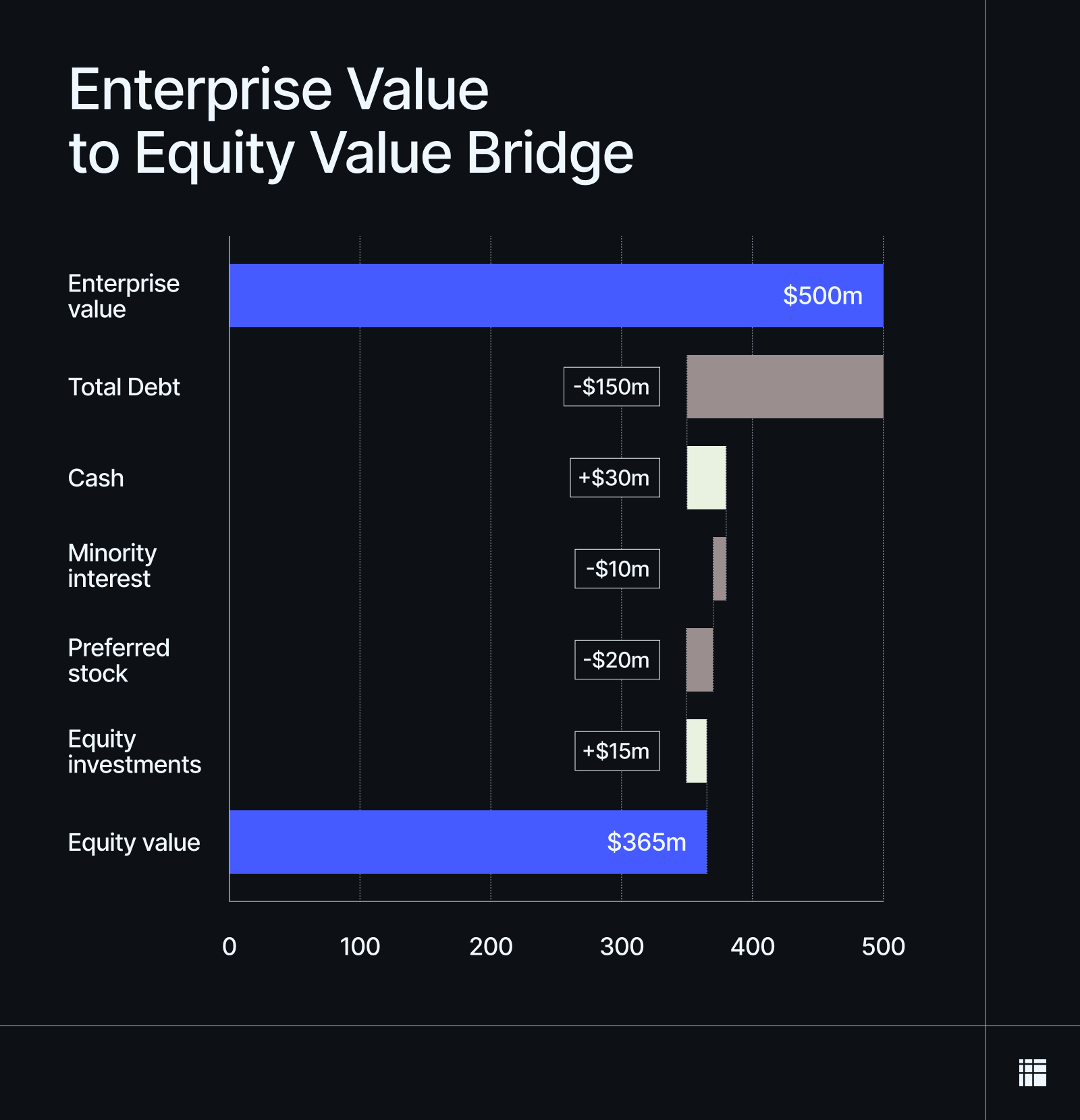
Let's look at how this plays out in the real world using a hypothetical B2B SaaS company, "TechCo." Imagine TechCo is being acquired, and based on a recent discounted cash flow (DCF) analysis and comparable company metrics, its enterprise value is set at $500M.
To find the actual purchase price for the equity, we need to build the bridge using the company's financial filings:
Common Pitfalls
For finance teams that need 100% accuracy to protect their reputations, even minor errors can have major consequences. Here are the most common mistakes professionals make when navigating these complex calculations:
- Stale or inconsistent data: Mixing Q2 balance sheet data with a Q3 enterprise value creates impossible-to-reconcile timing mismatches. Whether pulling comparables or updating financials, these errors instantly damage your credibility.
- Missed footnotes and buried line items: Payment-in-kind (PIK) debt and contingent consideration are easily overlooked in dense 10-K footnotes. Missing these means blown diligence for bankers and mispriced risk for credit analysts.
- Misclassifying hybrid securities: Confusing whether instruments like convertible preferred stock should be treated as debt or equity skews your entire capital structure analysis and leads to material valuation errors.
- Ignoring post-balance-sheet changes: If a company pays down debt after the quarter ends, but you rely on the outdated balance sheet figure, your bridge is already broken. This derails live deal pitches and ongoing covenant compliance tracking.
- No single source of truth: Debt schedules in 10-Ks rarely match credit agreements perfectly. Analysts waste hours manually reconciling conflicting data across loan documents, investor presentations, and data platforms like PitchBook.
- Risk created by manual processes: Building bridges in Excel by parsing dozens of PDFs makes it dangerously easy to transcribe numbers incorrectly. Manual workflows simply don't scale, letting errors slip through offshore reviews and overwhelming the analysts monitoring quarterly compliance.
How AI Platforms Automate the Bridge
Building an EV to equity bridge manually is a labor-intensive exercise in data wrangling. It typically requires opening 10 to 15 different documents—from 10-Ks and investor decks to dense credit agreements—just to hunt for buried line items, cross-check conflicting numbers, and hope nothing was overlooked.
This manual approach inherently creates the exact risks of stale data and missed footnotes that lead to deal-breaking valuation errors. Whether building a bridge for a single live transaction or updating it quarterly across an entire portfolio, the process is repetitive, painfully slow, and difficult to scale.
Ultimately, teams need faster speed to insight, flawless accuracy, and the elimination of manual bottlenecks. Here's how AI finance platforms can help:
- Automated data extraction: AI document analysis tools like Hebbia instantly pull debt schedules, cash balances, minority interests, and other line items from across all your documents without you having to manually flip through PDFs. The platform reads everything and surfaces the relevant numbers in seconds.
- Cross-document synthesis: When data conflicts (like a debt number in the 10-K versus an investor deck), AI flags discrepancies and helps you reconcile them. Bankers no longer waste time cross-referencing PitchBook, CapIQ, and company docs, while credit analysts can reconcile loan docs with public filings in seconds instead of hours.
- Real-time calculations: Once data is extracted, the platform automatically calculates the bridge—no Excel formulas, no risk of transpose errors. Bankers can generate valuation bridges for 20+ comps in minutes instead of days, and credit analysts can update entire portfolio bridges quarterly with a few clicks.
- Audit trail and citations: Every number is cited back to the source document with page numbers and line items, so you can verify accuracy and show your work. This is critical for bankers creating client-facing materials and credit analysts preparing IC memos that require transparency and compliance standards.
Build Better Bridges With Hebbia
The enterprise value to equity value bridge is a foundational calculation in deal analysis, but manual execution introduces risk at every step. As deal timelines compress and portfolio monitoring requirements expand, the traditional approach of pulling data from dozens of PDFs simply doesn't scale.
Hebbia automates the entire process by extracting debt schedules, minority interests, and other line items from across your documents and calculating accurate bridges in minutes instead of hours. Every number is cited back to the source, giving you the audit trail you need for client-facing materials and IC memos.
Whether you're building valuation comparables for 20+ companies or updating quarterly portfolio bridges, Hebbia eliminates manual work while reducing the risk of errors that cost deals and damage reputations.
Ready to see how Hebbia can streamline your valuation workflow? Request a demo today.


