
Mid-Market PE Technology: Key Tools for Every Stage of the Deal
Mid-market private equity firms operate in one of the most competitive environments in finance. With more firms chasing the same assets, the difference between a firm that sees the whole picture and one that misses it often comes down to its technology.The right tech stack lets a lean team source better deals, run tighter diligence, and manage a portfolio without drowning in manual work.
This guide breaks down what mid-market PE technology is, how firms use it across the deal lifecycle, and a shortlist of the four platforms most commonly found in mid-market PE tech stacks today.
What Is Mid-Market PE Technology?
Middle-market PE technology is the software firms use to:
- Source deals
- Manage pipelines
- Run due diligence
- Monitor portfolios
- Report to limited partners (LPs)
It refers specifically to technology used by firms targeting companies with enterprise values from roughly $10M to $1B, spanning the lower middle market (~$10M–$100M EV), core middle market (~$100M–$500M EV), and upper middle market (~$500M–$1B EV)—too large for most venture-backed strategies, too small to draw mega-fund attention. These firms run lean deal teams that need technology to multiply their output, but don't need enterprise IT infrastructure to maintain.
While large-cap firms typically build custom systems with dedicated technology teams, mid-market firms instead rely on purpose-built software-as-a-service (SaaS) platforms that they can quickly set up and scale the fund with. The strongest tech stacks are built around a few high-impact tools rather than a sprawling suite, with each platform covering a core workflow without adding integration debt.
Key Categories of Mid-Market PE Technology
Mid-market PE technology breaks down into four core categories that map to the deal lifecycle: sourcing, diligence, pipeline management, and portfolio monitoring.
Firms don't need a tool for every category to stay competitive, but skipping one usually means losing ground on the workflow it covers.
Category | What It Solves |
|---|---|
Deal sourcing and market intelligence | - Identifying target companies - Mapping relationship paths - Running proprietary outreach before deals reach auction |
Diligence and document analysis | - Extracting insights from virtual data rooms (VDRs), confidential information memorandums (CIMs), credit agreements, and supporting documents without losing context across long files |
Pipeline management and deal tracking | - Tracking deal status - Managing follow-ups - Preserving deal history |
Portfolio monitoring and LP reporting | - Collecting and normalizing portfolio company data ]- Tracking key performance indicators (KPIs) - Producing quarterly limited partner (LP) reports |
Deal Sourcing and Market Intelligence
Mid-market deal-sourcing software relies more on proprietary outreach and relationship networks than on inbound deal flow. Tools in this category help teams:
- Identify target companies
- Map ownership and management
- Track relationship paths
- Systematize outreach to owners and intermediaries
The goal is a more organized network, not a faster one.
The core platforms here are customer relationship management (CRM) systems with relationship intelligence for managing that network, paired with company search databases for identifying private targets that match a firm's investment criteria.
Proprietary sourcing matters more at this deal size because fewer quality assets reach auction. Firms with the strongest origination process typically win a deal before a formal process ever starts.
Diligence and Document Analysis
Virtual data rooms (VDRs) were built to store and organize documents, not make sense of them. That gap shows up hardest in the mid-market, where two- to five-person deal teams have to work through the same volume of unstructured material as a much larger firm, on the same timeline.
Diligence tools now fill that gap by acting as an intelligence layer on top of the VDR, helping teams:
- Extract figures and terms from confidential information memorandums (CIMs), credit agreements, and supporting documents
- Cross-reference claims across management presentations and expert call transcripts
- Trace every extracted figure back to its exact source
- Cover full document sets rather than a sampled subset
Accuracy and auditability decide whether a tool earns a place in this workflow. A figure that teams can't trace back to its source creates risk at the investment committee (IC) level, and later on if it's challenged post-close.
Pipeline Management and Deal Tracking
A mid-market deal team can evaluate dozens to hundreds of opportunities in a single year, and losing track of one often means losing the deal. Pipeline tools give teams a single system to:
- Track deal status across every active opportunity
- Manage follow-ups with owners and intermediaries
- Preserve deal history as team members change
DealCloud (Intapp) is the standard for firms that want enterprise-grade deal and relationship management, while Affinity is more common among teams built around relationship-driven sourcing. Smaller funds sometimes get by on lighter tools like Attio or a customized Airtable setup. For firms with 5 to 15 deal team members, the pipeline tool needs to stay collaborative without adding a layer of administrative overhead.
Portfolio Monitoring and LP Reporting
Closing a deal shifts the work from evaluation to oversight. Post-close, mid-market firms need to:
- Collect and normalize financial and operational data from portfolio companies
- Track KPIs across the portfolio
- Produce quarterly reports for limited partners (LPs)
Portfolio company data rarely arrives in a consistent format, and normalizing it by hand eats into the time a lean team could spend analyzing the numbers instead. AI platforms like Hebbia are closing that gap, ingesting non-standardized portfolio company reports and extracting comparable metrics across the portfolio without manual reformatting.
The 4 Best Mid-Market PE Technology Platforms
The four platforms below cover the most critical workflows in a mid-market PE tech stack, from sourcing through diligence to portfolio management. They're also the tools most commonly evaluated by firms operating at this deal size.
1. Hebbia
Best for: AI-powered diligence and document analysis across mid-market deals
Hebbia is an AI finance platform built for the document-heavy analytical work that sits at the center of a mid-market PE tech stack. Without losing context across long documents, its Iterative Source Decomposition (ISD) simultaneously reasons across full VDRs, credit agreements, and CIMs.
That lets a 2- to 5-person mid-market diligence team cover the same ground on a data room that would otherwise require a much larger staff.
Hebbia is backed by Andreessen Horowitz, Index Ventures, and Peter Thiel, and is already in use at firms such as Charlesbank and Centerview Partners.
More than 40% of the largest asset managers by AUM run deal and portfolio work through the platform. Firms with the most at stake when it comes to an extracted number being right have already built Hebbia into how they work.
Key features:
- Iterative Source Decomposition (ISD) for full-document reasoning: ISD breaks long documents into structured components and reasons across all of them at once, so nothing gets summarized away before analysis.
- Sentence-level, clickable citations on every output: Every extracted figure or claim links back to the exact sentence it came from, making outputs auditable before they reach the IC memo.
- Shared Projects workspace for firm-wide deal collaboration: Deal teams work from the same documents and outputs in one space instead of passing spreadsheets and PDFs back and forth.
- Hebbia Skills for firm-specific diligence workflows: Firms build repeatable, saved workflows for tasks like covenant extraction or CIM screening, so the process doesn't start from scratch on every deal.
See how private equity investors use Hebbia to run deeper diligence and build conviction on every deal. Explore Hebbia for institutional investing.
2. Affinity
Best for: Relationship-driven deal sourcing and pipeline management
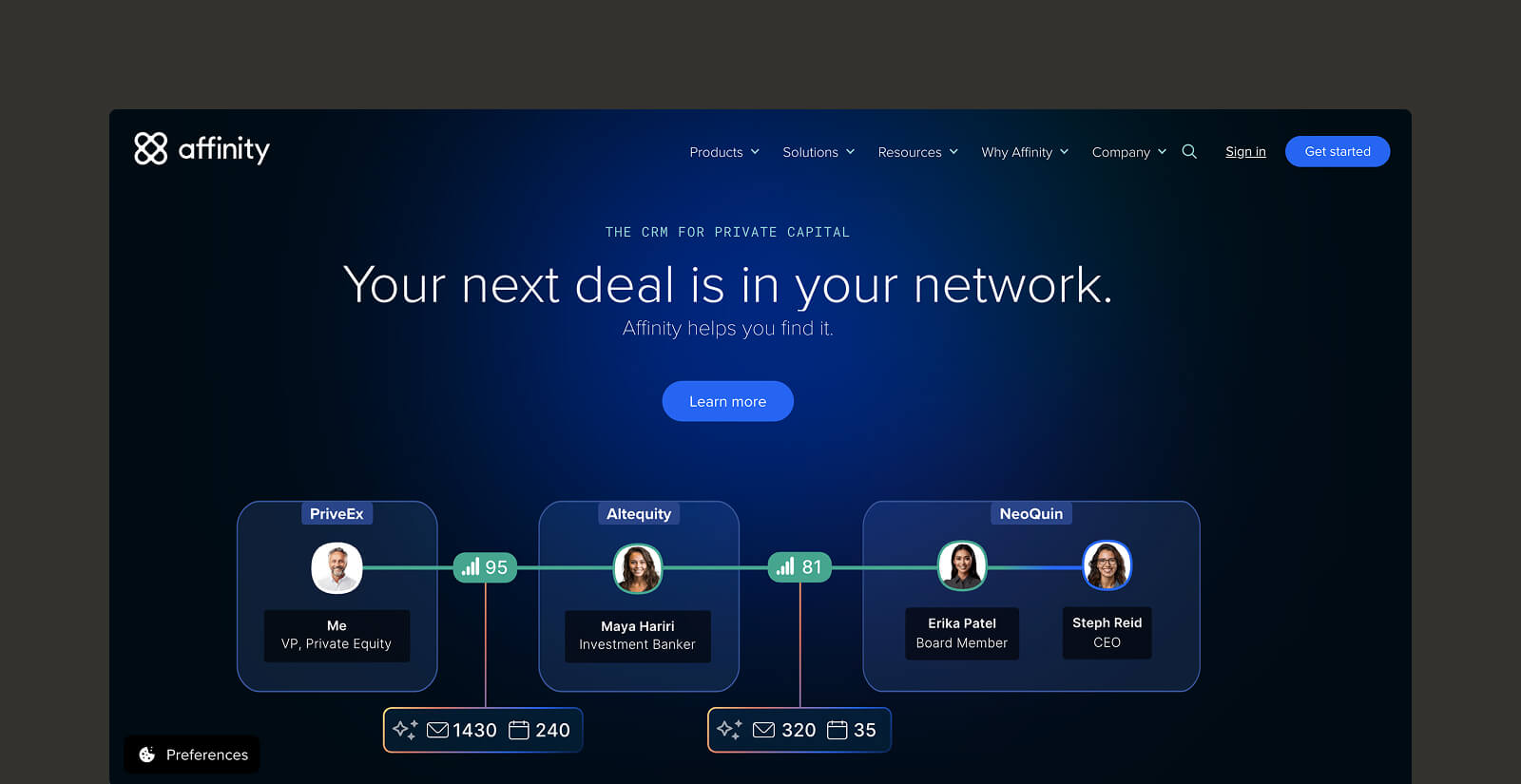
Affinity is a CRM built for private capital, mapping a firm's email and calendar activity into a picture of who already knows whom at a target company.
That relationship intelligence surfaces warm paths to decision-makers before a deal reaches a formal process. More than 250 PE buyout teams, from mid-market firms to large multi-strategy shops, run sourcing through the platform.
It also gives deal teams a single pipeline to track stages and hand off deals without losing context. For firms already leaning on relationship-led origination, it's a natural home for both the network and the pipeline built on it.
Key features:
- Automated activity capture from email and calendar: Affinity logs meetings, calls, and email activity automatically, so relationship history builds without manual data entry.
- Relationship intelligence and warm introduction mapping: The platform scores each contact's connection strength and surfaces the shortest path to a warm introduction at a target company.
- Pipeline management built for PE deal workflows: Deal stages, tasks, and notes are structured around how PE teams actually source and track opportunities, not a generic sales pipeline.
- Integrations with PitchBook, Salesforce, and communication tools: Affinity connects to PitchBook for market data and to Salesforce and email or calendar tools, so relationship data stays in sync across the stack.
3. DealCloud
Best for: Deal pipeline management and firm-wide workflow orchestration
DealCloud, part of Intapp, is built as an operating layer across origination, execution, approvals, and reporting, bringing deal data and workflows into one configurable environment. Firms choose this solution when pipeline management needs to scale across the full firm, not just a single deal team.
The platform also extends to fundraising and LP communications through Dispatch, its email marketing layer, which draws on the same deal and relationship data to run deal announcements and investor updates. Co-investor and LP relationships get tracked alongside deal activity rather than in a separate system.
Key features:
- Purpose-built deal pipeline and CRM for PE: The software tracks sourcing, staffing, and deal progress in one system built around private equity workflows rather than a generic sales pipeline.
- Customizable deal stages and approval workflows: Firms configure stages, gates, and sign-offs to match their own investment process instead of adapting to a fixed template.
- Co-investor and LP relationship tracking: Relationship data for co-investors and LPs lives alongside deal records, so context carries through fundraising and reporting.
- Dispatch email marketing for LP and deal communications: Deal announcements, newsletters, and investor updates run from the same platform as the underlying deal and relationship data.
4. Allvue
Best for: Portfolio monitoring, fund accounting, and LP reporting
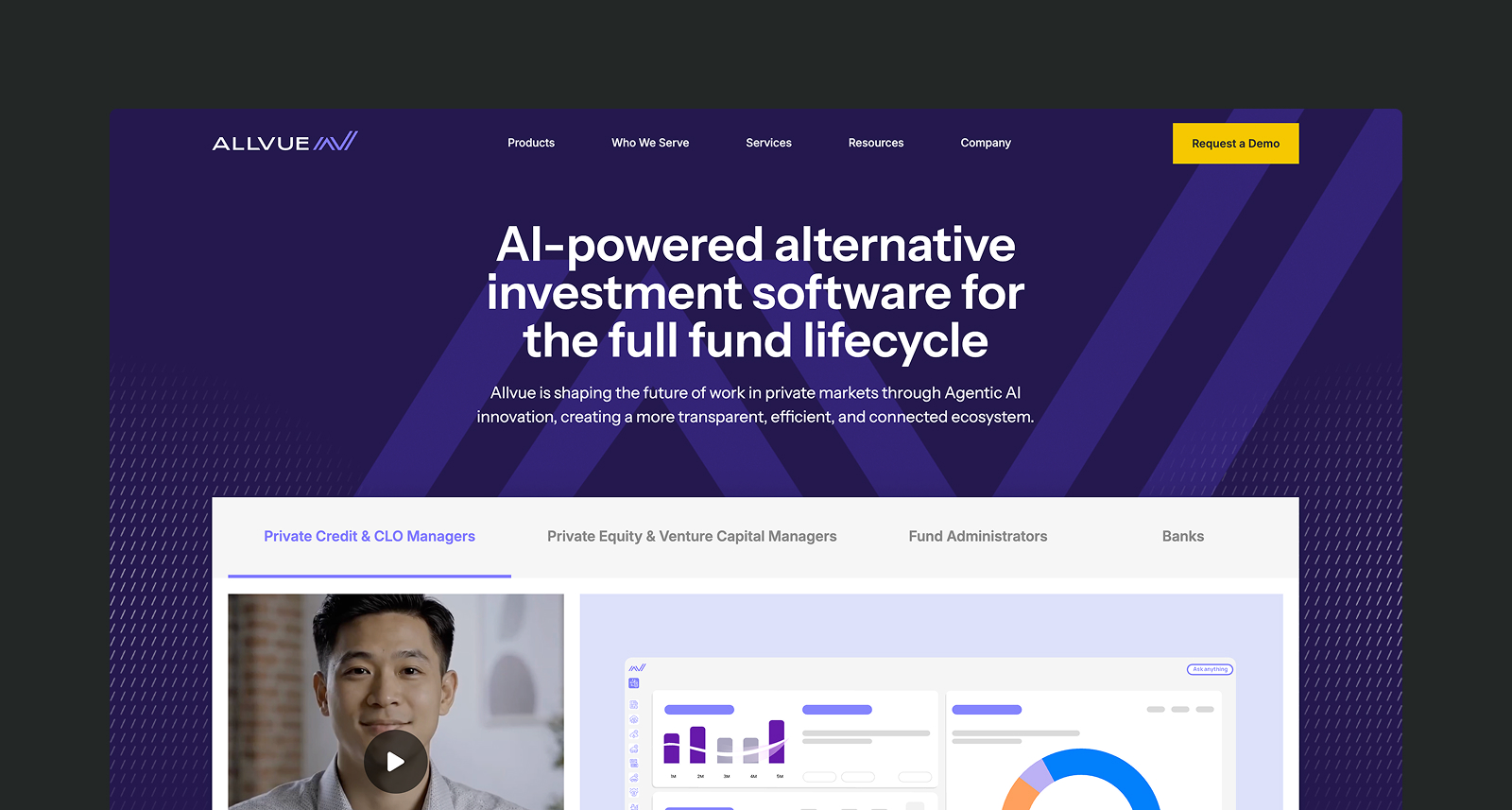
Allvue Systems covers the back-office side of the fund lifecycle, with fund accounting, portfolio company data collection, and investor reporting in one platform. The Private Equity Essentials package is built specifically for GPs managing under $1 billion in committed capital, giving emerging mid-market managers institutional-grade reporting without building out a full back-office team.
Portfolio company data, once collected, flows directly into Allvue's accounting and LP reporting modules, eliminating the need for manual re-entry. The platform ships with pre-built Institutional Limited Partners Association (ILPA) v2.0 templates and capital call and distribution notices, so quarterly reporting stays standardized as the portfolio grows.
Key features:
- Fund accounting and net-asset value (NAV) calculation: The software handles fund-level, investment-level, and management company accounting, with NAV calculated directly from the underlying ledger.
- Portfolio company KPI monitoring and benchmarking: Allvue collects financials, operational metrics, and custom KPIs from portfolio companies on a configurable schedule, then benchmarks them across the fund.
- LP portal for investor reporting and capital account statements: Investors access capital account statements, capital call notices, and quarterly reports through a dedicated portal.
- Waterfall calculations and distribution management: The platform automates distribution waterfalls and capital call and distribution notices in line with ILPA-standard templates.
What To Look For in Mid-Market PE Tech Tools
Not every platform above will fit every mid-market firm's stack. These five qualities can help firms identify the right tools for their team:
- Purpose-built for PE workflows: Generic CRMs and analytics platforms require heavy customization to fit deal workflows. Look for platforms designed specifically for private markets.
- Integration with the rest of the stack: No single platform covers every workflow. The best mid-market PE tech stacks feature tools that connect to each other, such as CRM to pipeline, pipeline to data room, and data room to the AI analysis layer.
- Auditability and source traceability: Any tool used in diligence or IC preparation needs to link outputs back to their source. An unverifiable extracted figure or synthesized summary is a liability, not an asset.
- Enterprise-grade security: Mid-market deals involve highly confidential information. Look for zero data retention policies, SOC 2 compliance, role-based access controls, and guarantees that proprietary documents won't be used to train public models.
- Scalability without complexity: Mid-market firms move fast and can't afford lengthy implementation cycles. The right tools should be operational quickly and scale with the fund without requiring a dedicated technology team to maintain.
Build a Smarter Mid-Market PE Tech Stack with Hebbia
The firms winning in mid-market PE aren't necessarily the ones with the biggest teams. They're the ones that see more of the document, surface the right risks early, and back every conclusion to its source. The right technology is what makes that possible.
With 5+ years of focused development for institutional finance, Hebbia is the largest AI platform in the industry. Mid-market deal teams use it to run diligence workflows that were previously only possible with a much larger team, processing full VDRs, extracting covenant terms, and cross-referencing CIM claims against underlying documents, all with clickable citations on every output.
Book a free demo to see how Hebbia fits into your mid-market PE tech stack.
Mid-Market PE Technology FAQ
What technology do mid-market private equity firms use?
Most mid-market PE firms run a stack covering four core areas:
- A CRM for deal sourcing and relationship management
- A pipeline tool for tracking active deals
- An AI platform for diligence
- A portfolio monitoring and fund administration system for post-close work
The most commonly evaluated platforms are Affinity or DealCloud for sourcing and pipeline, Hebbia for AI-powered diligence, and Allvue for portfolio and fund ops.
How is mid-market PE technology different from large-cap PE technology?
Large-cap firms often build custom internal platforms and employ dedicated technology teams to maintain them. Mid-market firms need purpose-built SaaS tools that a lean team can use without that infrastructure, prioritizing high impact per user over deep customization.
The trade-off is less flexibility, but the best mid-market platforms are built specifically for PE workflows and require little configuration to be useful from day one.
What should mid-market PE firms look for in an AI diligence tool?
Mid-market firms considering an AI due diligence tool should look for zero data retention, role-based access controls, encryption, and a guarantee that proprietary documents won't train public models. Purpose-built platforms like Hebbia are built to meet that bar, which is why finance teams tend to choose specialized tools over generic AI.


