
7 in 10 Finance Teams Say AI Is Faster — But Most Still Double-Check Its Outputs
Finance teams have a trust problem — and it's not with each other.
Nearly 71% of deal professionals say AI has made their research and diligence faster over the past year, speeding up the document-intensive analysis that drives every transaction decision. Most now use AI for execution-level work, going well beyond summarization to populate financial models and draft IC memos. The AI adoption story in finance, on paper, looks like a success.
But a new Hebbia survey of over 500 banking and investing professionals reveals what’s underneath. Most teams are still manually re-checking AI outputs, citing concerns about hallucinations and missing citations. And senior leadership often requires a human-only audit before sign-off, turning AI time savings into new bottlenecks on live deals.
Underneath the verification problem is a knowledge problem. Only 27% of respondents say their team's deal logic lives in any kind of centralized platform, and just 7% say that platform is AI-powered. The rest say it lives in email threads and personal files, none of which survive the analyst cycle.
Firms are using AI everywhere, but trusting it almost nowhere. This report quantifies that disconnect — and what separates the firms running individual AI tools from those building institutional AI infrastructure.
Key Takeaways
- Almost 71% of deal teams say AI has made their research and diligence faster in the past 12 months.
- Yet 59% still manually verify or re-create AI outputs all or most of the time.
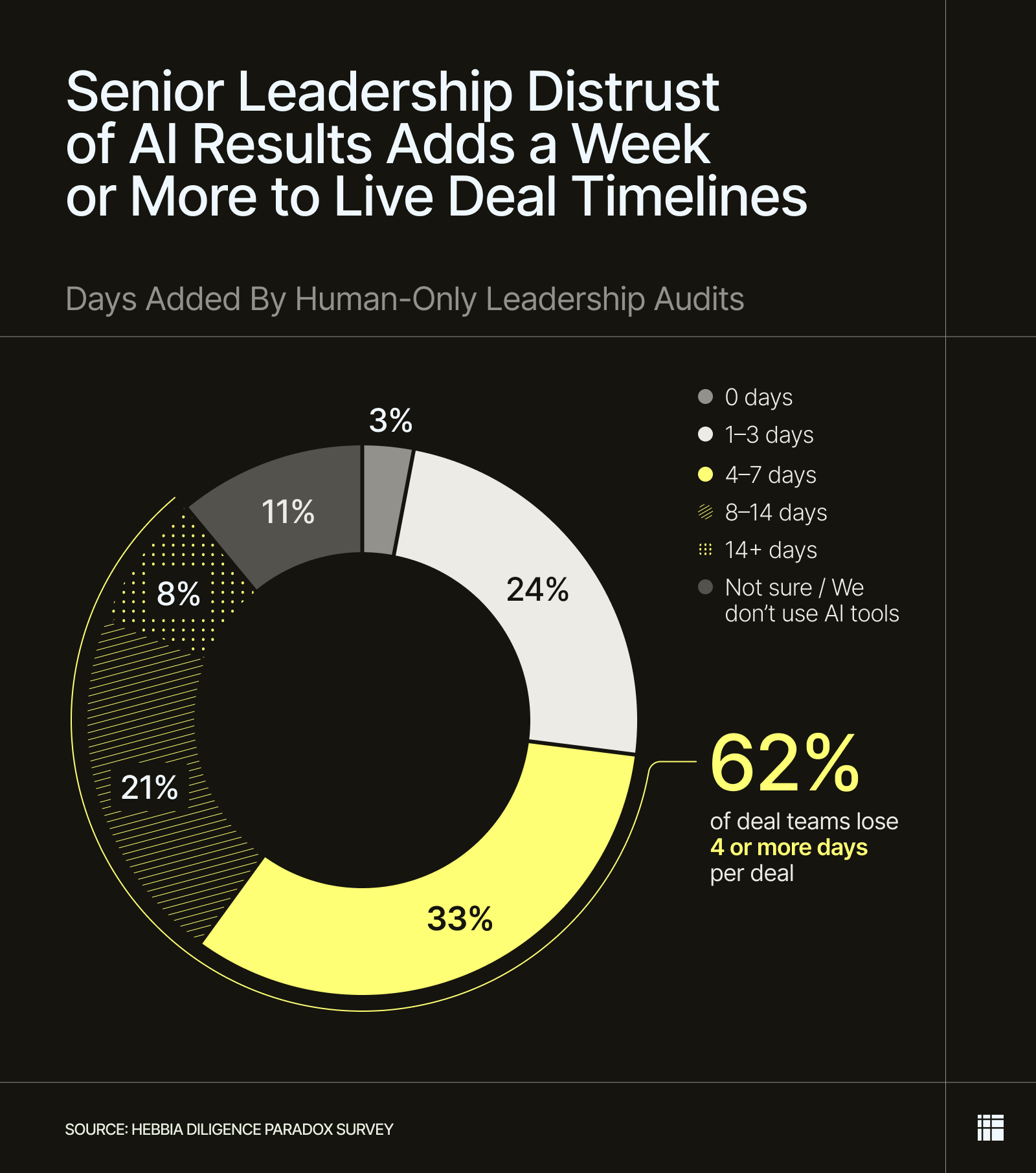
- Senior leaders who rely on manual review add 4+ extra days to timelines for 62% of respondents.
- Roughly 68% of deal teams say the majority of their institutional knowledge lives in personal notes, email threads, or non-AI shared drives.
AI Is Already Executing the Work — Not Just Summarizing It
The common assumption is that finance teams use AI the way most knowledge workers do: search faster, summarize documents, draft first cuts of emails. But that's not what our new data shows.
Most professionals in this survey have moved AI into their actual deal workflows. Almost half (48%) use it for multi-document comparable analyses — the kind of cross-document synthesis that used to eat analyst hours. Roughly 43% have AI populating and updating financial models with cited inputs, while 40% use it to draft IC memos or deal summaries and 39% for first-pass redlines on legal and transaction documents. Only 13% say their team limits AI to summarizing documents or answering questions.
That's a significant shift from where most firms' official AI policies still sit. Just 29% describe their firm as having a robust, firm-wide AI strategy on a standard platform. 32% are limited to general-purpose chat apps, 28% are still in a pilot phase — yet their teams are already running execution-level work through those tools.
That leaves most firms playing catch-up as they try to build institutional confidence around tools their analysts are already running on live deals.
84% of Firms That Fully Trust AI Still Verify Every Output Anyway
Most finance professionals believe AI is capable of handling complex research. About 62% of respondents say their firm fully or mostly trusts AI to complete complex tasks, with manual checks described as minimal or targeted.
But stated confidence and actual behavior aren't lining up. According to the survey, 59% of respondents manually verify or re-create AI outputs all or most of the time, citing concerns about hallucinations and missing citations.
Among firms that report full trust in AI, 84% are still re-checking outputs at that same frequency. This is costing teams real labor: AI produces a draft, but a human re-runs the work. So both exist, but neither is fully replacing the other.
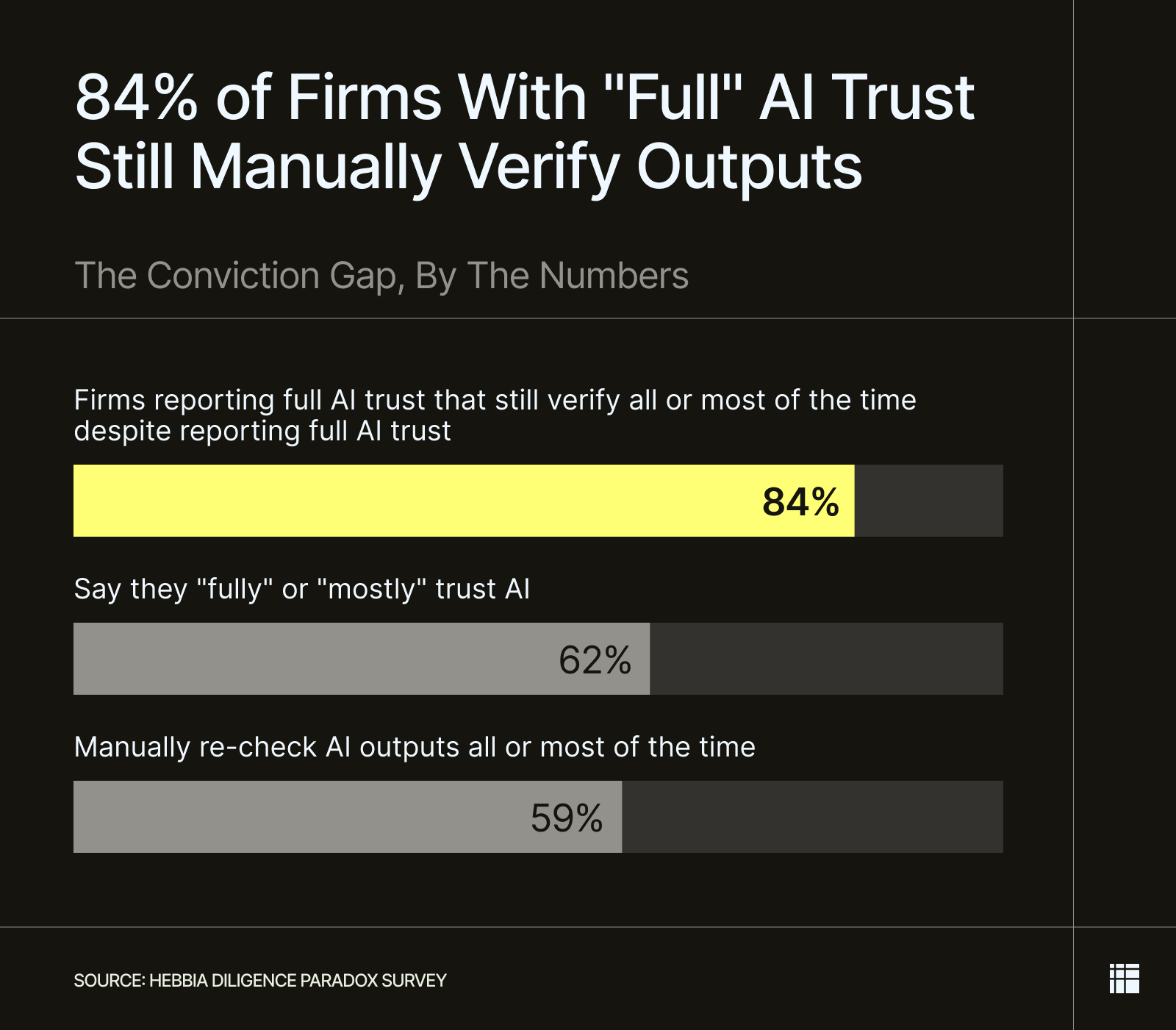
This cuts into the real speed gains from AI. According to the survey, 71% of respondents say AI has made their research and diligence faster over the past year. But those gains are eaten up every time a team must verify the output before anyone can act on it.
This tracks with the findings from our AI Finance Trust Survey, which found that even though finance professionals trust AI more than many colleagues for research tasks, they still demand verification at the operational level.
When an AI output can't be traced back to a source, a full manual re-check becomes the only defensible option. Sign-off from senior leadership requires being able to point to the reasoning, and if that trail doesn't exist in the output itself, someone has to reconstruct it. That's where the extra hours go.
Senior Leadership's Distrust of AI Is Adding a Week to Live Deal Timelines
Human review isn't going away, nor should it. Senior oversight is a legitimate part of high-stakes decision-making, and most finance professionals expect it on live deals. The problem is how much time it's consuming.
Even where AI is fast and analysts trust the outputs, deals are slowing down at the top of the house. A third of respondents say a leadership-required human-only audit of AI-assisted research adds 4 to 7 extra days to a typical live deal timeline. Another 21% say it adds 8 to 14 days, and 8% say more than 14. In total, 62% of deal teams are losing four or more days per deal to this review layer alone.
On a 6- to 8-week deal timeline, that's roughly 10% to 15% of total deal time spent reconfirming work that AI already did.
The irony is that the capacity gains are real and measurable. Nearly three-quarters (73%) of respondents say AI lets their team meaningfully screen 6 or more additional opportunities per quarter. That throughput only compounds when AI output can be put straight into action rather than back through a verification cycle.
Line-level citations and auditability directly solve this issue. When every output is tied to a source, senior sign-off becomes a review of the reasoning rather than a reconstruction of it.
68% of Deal Teams Say Critical Knowledge Lives Where No One Can Find It
Finance firms have always had an institutional knowledge problem. The analyst cycle churns, people leave, and the reasoning behind past decisions goes with them. AI hasn't fixed that yet, and for most firms, it's brought the reality of the problem into sharper focus.
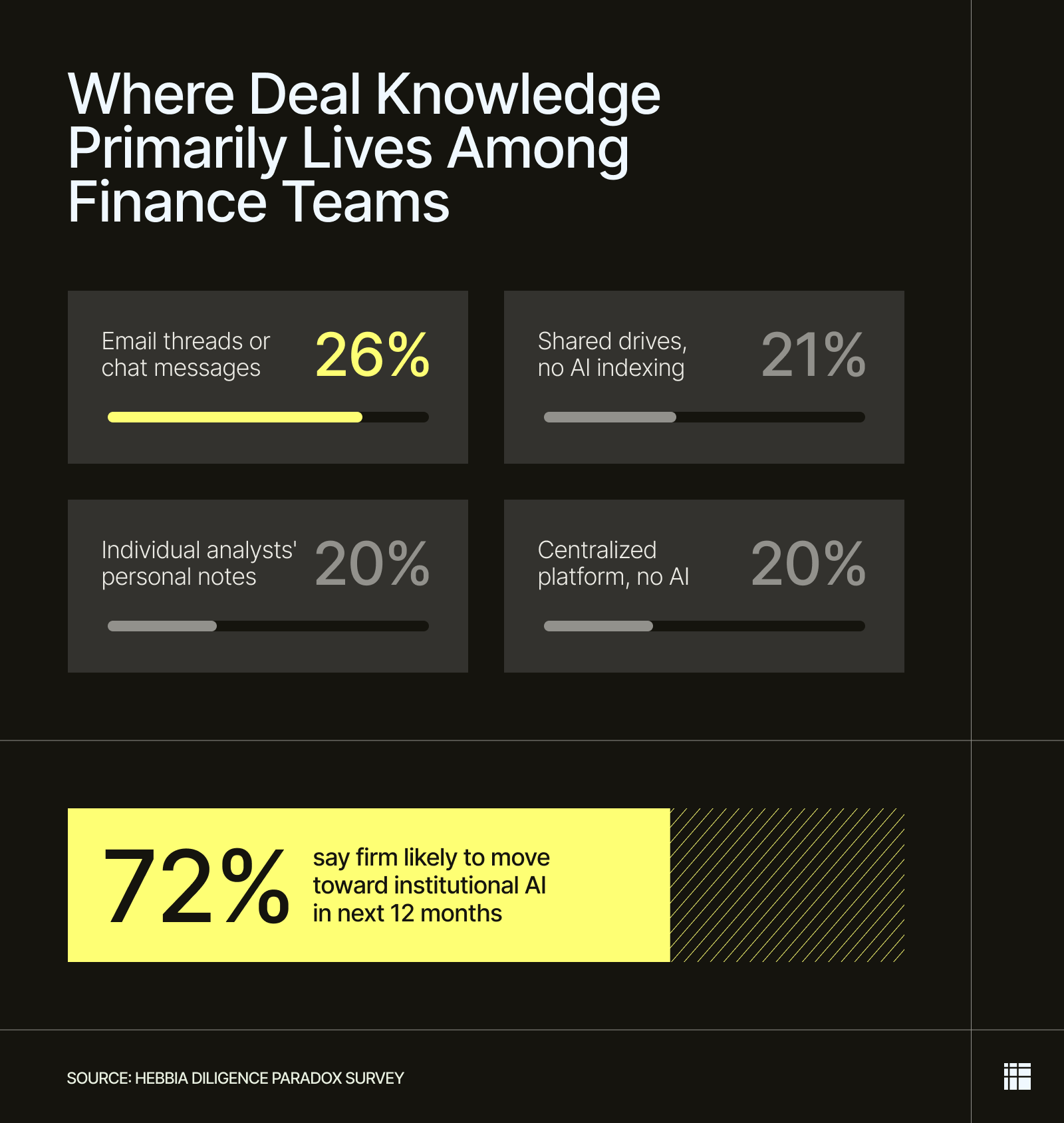
Nearly half (68%) of respondents say the majority of their team's deal-specific knowledge lives in email threads, chat messages, or non-AI shared drives. Another 20% say it lives in individual analysts' personal notes or files. That's 68% of deal logic sitting in systems with no indexing, no memory, and no continuity when someone walks out the door. That finding is consistent with our financial documentation survey, which measured how much time is lost to document retrieval.
Many firms do have multiple retention practices in place. Our survey found that 44% use centralized AI-powered platforms, 44% run regular training sessions or knowledge-sharing meetings, and 43% rely on standardized playbooks designed to capture accumulated institutional knowledge across deal teams.
But having a practice and actually capturing reasoning are two different things. Only 7% say the majority of their deal knowledge lives in a centralized AI-powered platform.
The costs add up with every deal and every quarter. Firms redo analysis that has already been done, re-learn what the last analyst already knew, and start from scratch on deals that rhyme with ones they've closed before.
Looking ahead, 72% say their firm is very or somewhat likely to move toward institutional, firm-wide AI in the next 12 months. The appetite is there. The infrastructure, for most, still isn't.
How the Conviction Gap Gets Closed
Speed gains, verification cycles, and knowledge loss are all symptoms of the same underlying shift. AI has moved into execution-level finance work faster than the infrastructure around it has matured. The tools exist, but building firm-wide confidence in them is still a work in progress.
Closing that distance requires AI output that senior leaders can actually audit and trace back to a source without having to rebuild the reasoning from scratch.
That's what Hebbia is built for. From AI due diligence workflows that make every output defensible to shared infrastructure that retains team knowledge across deals, Hebbia gives senior leaders what they need to sign off with confidence and gives analysts back the time they're currently spending on verification.
Methodology
The survey was conducted by Centiment for Hebbia. The survey was fielded between April 28, 2026, and May 9, 2026. The results are based on 510 completed surveys. In order to qualify, respondents were screened to be residents of the United States, over 18 years of age, and finance professionals (investment banking, asset management, and financial advisors). Data is unweighted, and the margin of error is approximately +/-3% for the overall sample with a 95% confidence level.


