
The 10 Best Credit Risk Management Software Tools
Missing a single red flag in a thousand-page agreement is a risk no finance professional can afford. Your information advantage depends on extracting signals from dense documentation faster than the competition. Modern credit risk management software provides the unmatched clarity needed to uncover hidden liabilities and protect risk-adjusted returns.
This list covers the top 10 credit risk management platforms that are redefining debt monitoring through intelligence and accuracy at scale. These tools automate repetitive workflows, allowing your team to focus on higher-level analysis and downside protection.
The Best Credit Risk Management Tools at a Glance
Here are the top credit risk management systems designed to give your team unmatched clarity on hidden risks.
Software | Best for | Notable features |
|---|---|---|
Hebbia | Downside protection, covenant monitoring, and private credit due diligence | - Matrix reasoning to track covenant compliance across thousands of agreements - Sentence-level citations delivering auditable transparency for every insight - Automated extraction of risk signals from dense legal agreements and virtual data rooms (VDRs) - Multi-agent architecture for drafting investment committee (IC) memos and risk assessments |
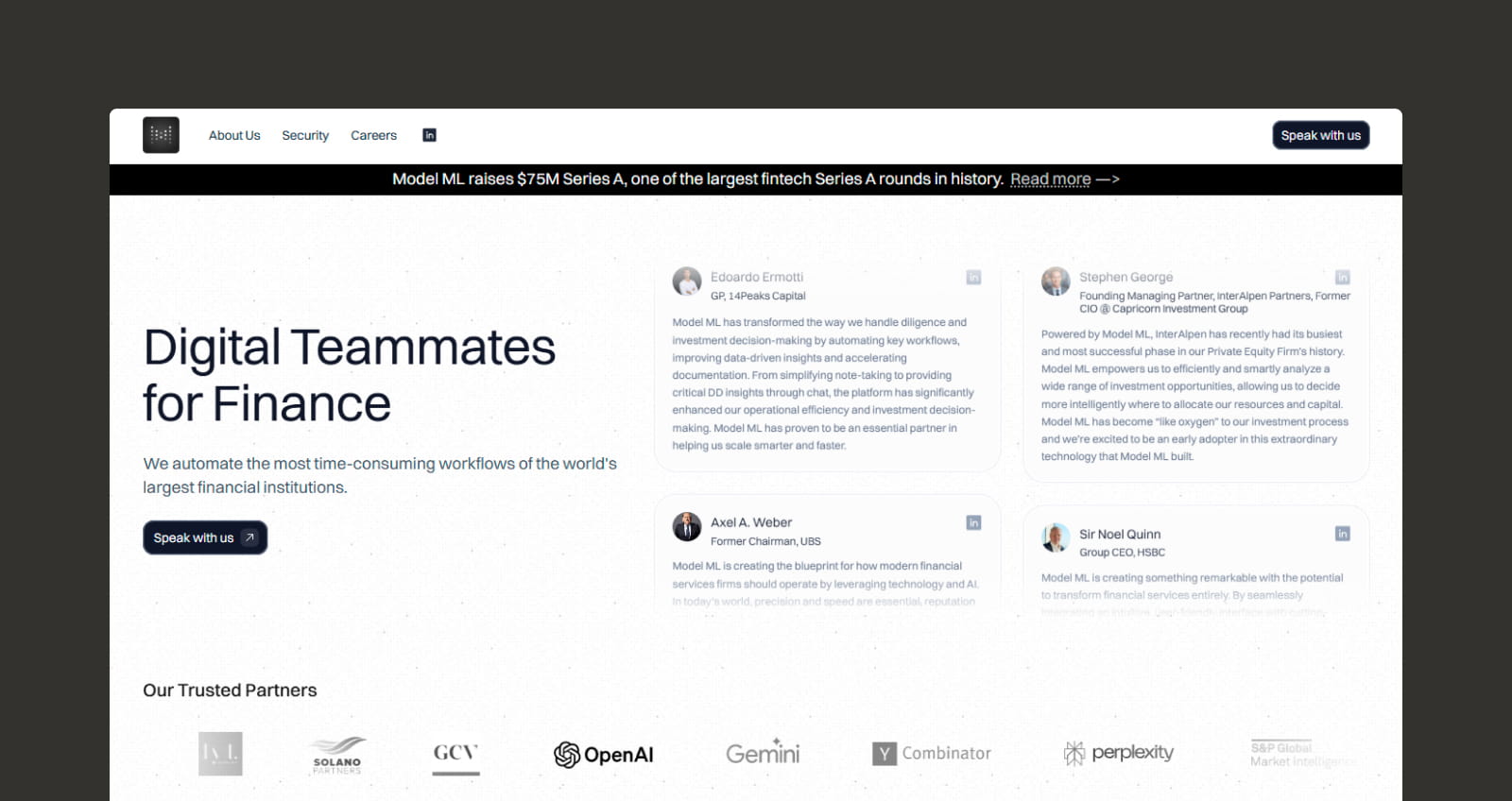
Model ML | Automated credit underwriting and process automation | - Automated spreading for faster financial statement analysis - Covenant analysis flagging breaches across borrower portfolios - Artifact generation for drafting internal credit memos and models |
Blueflame | Alternative data sourcing and firm-wide knowledge management | - Datasite VDR integration for real-time diligence monitoring - Multi-agent research combining FactSet and S&P Cap IQ data - Agentic content creation for Excel and boardroom-ready visuals |
Rogo | M&A sourcing and investment banking workflow automation | - Deterministic screening to surface companies and transactions at scale - Project Sharing for context-aware team collaboration on live deals - Integrations with Salesforce and Box for document-heavy workflows |
Bloomberg Terminal | Obligor-level analytics and market-implied default modeling | - MARS Credit Risk for distance-to-default and credit default swap (CDS) spread modeling - 90%+ accuracy ratios for early warning credit signals - API-first delivery for custom reporting and firm-wide workflows |
Moody's Analytics | Unified risk management and global entity screening | - Maxsight™ platform for end-to-end risk orchestration - Agentic AI screening for sanctions, political exposure, and adverse media - Holistic visibility across supply chain and third-party risk |
OakNorth | Mid-market credit intelligence and explainable AI | - Learning to Rank models for granular comparable business analysis - Explainable AI (XAI) using game theory for model transparency - Data triangulation between alternative and traditional sources |
S&P Capital IQ Pro | Private market intelligence and fundamental debt data | - Granular debt data and non-public operational metrics - Consensus estimates for over 100,000 public companies - Sector intelligence covering M&A and PE/VC deal structures |
AlphaSense | Market intelligence and cross-sector sentiment tracking | - Smart Summaries for instant company and industry overviews - Real-time monitoring of regulatory filings and earnings guidance - Premium library of broker research and expert transcripts |
Kira (Litera) | High-volume contract review and legal due diligence | - Analysis Grid for side-by-side scanning of document sets - Generative smart fields for natural language insight extraction - 1,400+ trained models identifying clauses across 40 practice areas |
1. Hebbia

Best for: Downside protection, covenant monitoring, and private credit due diligence
Hebbia is the AI platform that gives your team an edge at every stage of the credit lifecycle, from initial diligence to continuous portfolio monitoring. By automating routine workflows and connecting your team’s expertise with your firm’s institutional knowledge and real-time market signals, Hebbia helps you uncover hidden liabilities, move faster, and protect risk-adjusted returns.
While legacy tools often focus on manual data entry, Hebbia provides the structural intelligence required to catch loopholes before they impact yield. The platform transforms the most grueling parts of risk assessment—parsing dense credit agreements or navigating VDR chaos—allowing credit professionals to shift their focus to higher-level analysis of downside scenarios and mitigants.
Key features:
- Matrix reasoning to track covenant compliance across thousands of agreements: Hebbia’s Matrix allows professionals to perform high-level reasoning across millions of pages of unstructured data, from internal research to global regulatory filings. This enables analysts to ask complex, cross-portfolio questions regarding covenant terms and financial benchmarks that traditional search tools would take days to process manually.
- Sentence-level citations delivering auditable transparency for every insight: Using proprietary Iterative Source Decomposition (ISD), the platform provides sentence-level citations that map every risk assessment directly back to its origin in the source document. This level of transparency virtually eliminates hallucinations and ensures your team maintains a perfect audit trail for every figure used in your IC memos and reporting.
- Automated extraction of risk signals from dense legal agreements and VDRs: The platform is built to handle the messy data of private credit, effortlessly pulling structured metrics and covenant language out of dense credit agreements and scanned PDFs. Whether you are interrogating a massive VDR or comparing years of 10-K filings, Hebbia organizes unstructured chaos into clean, actionable intelligence for your risk models.
- Multi-agent architecture for drafting IC memos and risk assessments: Hebbia utilizes autonomous AI agents that can be programmed to execute end-to-end credit workflows, from initial deal screening to final risk reporting. These agents work in parallel to decompose complex research tasks, allowing your firm to scale its expertise and focus on higher-level strategy without increasing headcount.
2. Model ML
Best for: Automated credit underwriting and process automation
Model ML specializes in the end-to-end automation of the underwriting lifecycle. The platform is designed to ingest high volumes of borrower documentation, including financial statements, tax returns, and legal agreements, to extract structured data with high precision. Automating data entry and initial analysis allows credit officers to focus on high-level risk adjudication and deal structuring.
User reviews highlight the platform’s ability to supercharge junior analysts by automating tedious tasks such as comparable transaction analysis and market mapping in minutes.
Key features:
- Automated spreading for faster financial statement analysis: The platform extracts data from tax returns and audited statements, mapping them directly into a specific chart of accounts. This process calculates core credit ratios, such as leverage, without manual input.
- Covenant analysis flagging breaches across borrower portfolios: An orchestration layer monitors portfolio performance against contractual thresholds to identify early signs of financial distress. The system evaluates transactional data alongside traditional financials for dynamic risk assessment.
- Artifact generation for drafting internal credit memos and models: The software populates internal templates to generate formatted investment committee memos and presentation decks. This automation standardizes deliverables and reduces time spent on administrative document preparation.
3. Blueflame
Best for: Alternative data sourcing and firm-wide knowledge management
Blueflame focuses on alternative data sourcing and firm-wide knowledge management by integrating proprietary information such as expert calls, broker research, and VDR partnerships. The platform provides an incremental AI layer for organizations that already possess these primary data sources.
The tool is designed to consolidate disparate research inputs, though it lacks the depth and true workflow automation found in more specialized institutional platforms. It primarily functions as a data-intensive intelligence solution rather than a transformative automation system.
Key features:
- Datasite VDR integration for real-time diligence monitoring: The platform links directly to virtual data rooms to analyze live deal documents without requiring manual exports or downloads. This helps deal teams instantly identify relevant clauses and monitor updates to data rooms as they occur.
- Multi-agent research combining FactSet and S&P Cap IQ data: Professionals can cross-reference management numbers against fundamental datasets from major providers to validate financial claims during due diligence. These agents also help teams navigate complex corporate hierarchies and build comparable peer sets through natural language queries.
- Agentic content creation for Excel and boardroom-ready visuals: The software automates financial model and pitch deck generation by integrating AI directly into Microsoft Office. This allows firms to produce polished pitch materials and visuals for investment committees that adhere to specific brand standards.
4. Rogo

Best for: M&A sourcing and investment banking workflow automation
Rogo is an AI finance platform tailored for the standardized workflows of investment banks and advisory firms. It aggregates data from major providers like S&P Capital IQ and FactSet, allowing users to conduct market research and generate preliminary analysis through a chat-based interface. The tool is designed to replace manual data collection for high-volume tasks like market mapping and precedent transaction searches.
Despite its strong data partnerships, Rogo is often viewed as a top-down corporate mandate due to its high enterprise costs. Its performance can be limited by the context windows of underlying models, making it less reliable for analyzing thousands of proprietary documents simultaneously. Furthermore, while it provides response-level citations, it lacks the sentence-level granularity that many buy-side firms require for rigorous audit trails and regulatory compliance.
Key features:
- Deterministic screening to surface companies and transactions at scale: The platform uses specialized logic to filter through millions of data points, ensuring consistent, reliable results for M&A targets and transaction history. This allows deal teams to identify potential opportunities across global markets without risking missing critical records due to standard search limitations.
- Project Sharing for context-aware team collaboration on live deals: Team members can share specific project workspaces, allowing junior and senior professionals to collaborate on the same live deal data with shared context. This centralized environment ensures that all participants have access to the latest research and analysis in real-time.
- Integrations with Salesforce and Box for document-heavy workflows: The software connects directly with internal customer relationship management (CRM) and storage systems to pull relevant deal documents and contact information into the research process. This integration streamlines the management of large document sets and ensures that deal tracking remains up to date across the organization.
5. Bloomberg Terminal
Best for: Obligor-level analytics and market-implied default modeling
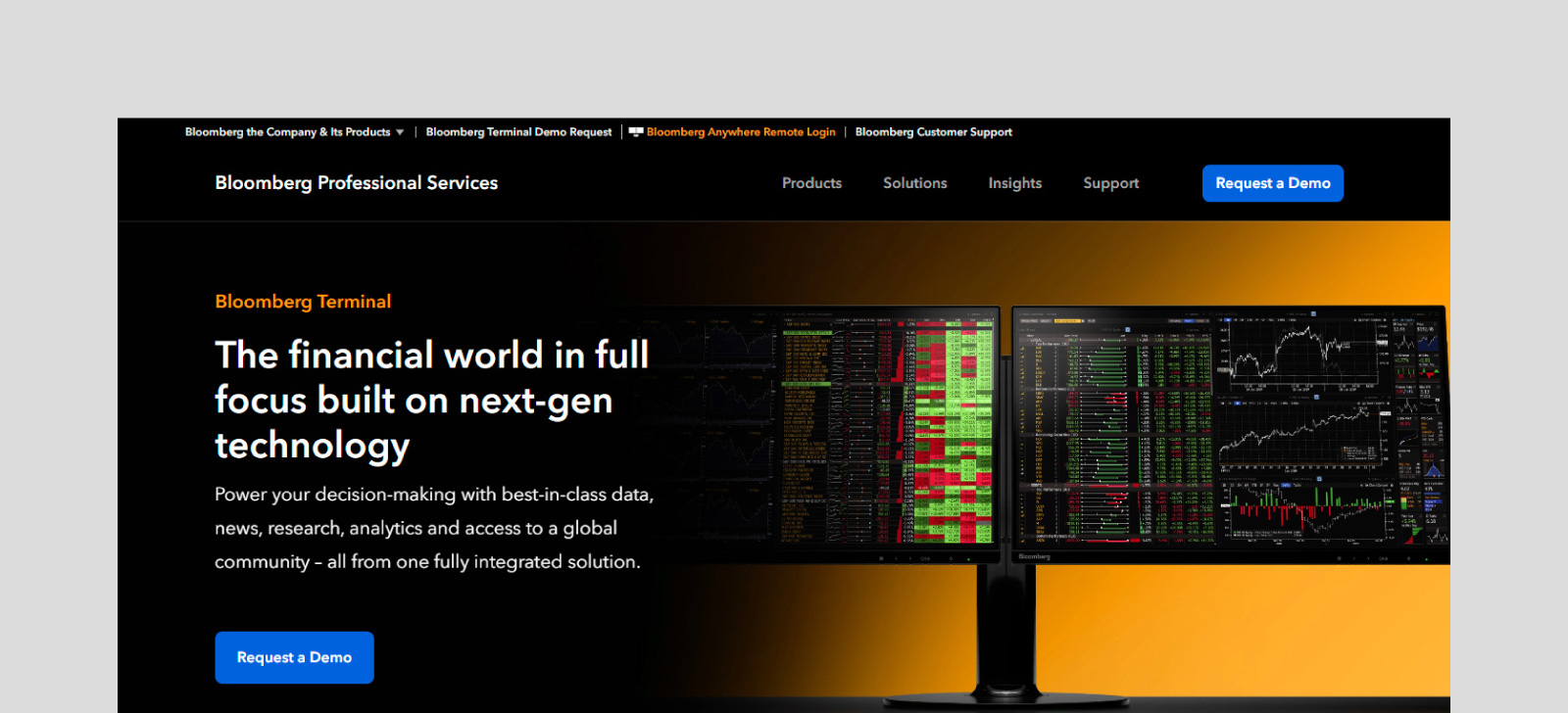
Bloomberg Terminal provides credit risk solutions centered on its Multi-Asset Risk System (MARS) and massive proprietary datasets. The platform assesses creditworthiness by combining market-derived indicators with fundamental company data across both public and private sectors.
The system's enterprise-wide delivery ensures consistent risk metrics across all offices, which is critical for standardized regulatory capital planning. However, the legacy terminal interface is often difficult for non-specialists to navigate, and the high entry cost creates a significant barrier for smaller firms. Despite these usability hurdles, Bloomberg remains the primary benchmark for fixed-income data and continues to lead the market in private direct lending transparency.
Key features:
- MARS Credit Risk for distance-to-default and CDS spread modeling: MARS uses structural models to calculate distance-to-default and model-implied CDS spreads for over 485,000 companies. It provides a transparent view of credit quality by combining equity signals with balance sheet fundamentals.
- 90%+ accuracy ratios for early warning credit signals: These predictive models identify credit deterioration before it appears in formal ratings. This allows managers to identify outliers and adjust portfolios before market stress materializes.
- API-first delivery for custom reporting and firm-wide workflows: Analytics are accessible via API for direct ingestion into internal proprietary systems. This supports automated reporting and ensures a single source of intelligence across the organization.
6. Moody's Analytics

Best for: Unified risk management and global entity screening
Moody’s Analytics provides an integrated risk management environment that combines global entity datasets with AI-driven credit risk modeling, screening, and monitoring tools. The platform is designed to consolidate fragmented risk data, providing a unified view of entities to support compliance and strategic decision-making across large organizations.
While its enterprise-grade depth offers unmatched accuracy, the platform’s high licensing costs and complex implementation requirements can be a significant hurdle for smaller firms with limited technical resources. However, its native integration with internal CRMs and procurement systems remains a gold standard for teams needing to streamline investigative workflows and maintain continuous oversight of third-party networks.
Key features:
- Maxsight™ platform for end-to-end risk orchestration: Maxsight™ serves as a centralized orchestration layer that unifies disparate datasets into a single risk management workflow. It allows different departments to access shared intelligence on entities, facilitating consistent risk assessments across the entire client and supplier lifecycle.
- Agentic AI screening for sanctions, political exposure, and adverse media: The platform utilizes AI-enabled screening to automate the identification of politically exposed persons (PEPs), sanctioned entities, and negative news in real-time. This system uses natural language processing to reduce false positives and prioritize high-risk alerts for manual analyst review.
- Holistic visibility across supply chain and third-party risk: Moody's provides a comprehensive view of risk beyond direct counterparties, extending visibility into deep-tier suppliers and complex ownership structures. It quantifies multiple risk dimensions—including financial, cyber, and sustainability factors—to help organizations anticipate and mitigate disruptions across their global networks.
7. OakNorth

Best for: Mid-market credit intelligence and explainable AI
OakNorth is a financial risk management software that specializes in lending to the missing middle of small and medium-sized enterprises. The platform utilizes a software-as-a-service model to help commercial banks and lenders perform forward-looking credit analysis through granular subsector data and macroeconomic scenario modeling.
The platform is widely praised for providing lenders with deep industry benchmarks across hundreds of specific business segments, enabling rapid stress-testing and underwriting. However, its effectiveness is primarily concentrated on the SME segment, and larger institutions may find its models less applicable to complex, multi-national corporate debt.
Key features:
- Learning to Rank models for granular comparable business analysis: OakNorth uses machine learning to rank lists of businesses based on their comparability for specific credit analysis needs. This allows analysts to identify the most relevant peer sets across multidimensional data points, including unstructured text descriptions, to improve the accuracy of benchmarking.
- Explainable AI (XAI) using game theory for model transparency: The platform uses Shapley values to provide clear explanations of its non-linear models' predictions. This approach highlights exactly which variables or data segments influenced a specific credit score, ensuring that automated insights remain transparent for human review and regulatory audit.
- Data triangulation between alternative and traditional sources: The system continuously cross-checks and validates alternative data against traditional financial sources to ensure real-time accuracy. This triangulation process allows lenders to maintain a valid, up-to-date view of a borrower's financial health even when historical correlations are disrupted by market shifts.
8. S&P Capital IQ Pro
Best for: Private market intelligence and fundamental debt data
S&P Capital IQ Pro is a foundational intelligence platform that combines massive public market datasets with deep transparency into private company financials. It serves as a primary data source for institutional firms requiring high-fidelity fundamental data to support global credit analysis and risk management.
The platform is widely regarded as the industry standard for standardized financial data and robust credit modeling through its advanced Workbench environment. However, many users find the web interface cluttered and note that the Excel plugin can significantly slow down when processing complex, multi-tabbed workbooks.
Key features:
- Granular debt data and non-public operational metrics: The platform provides detailed capital structure breakdowns and security-level ownership insights for over 4 million structured instruments. This enables credit analysts to track institutional positioning and identify concentration risks across global bond markets with high specificity.
- Consensus estimates for over 100,000 public companies: S&P offers standardized financial data and analyst consensus forecasts for nearly all global market capitalization. This scale ensures that credit teams can benchmark a borrower’s financial performance against industry-wide expectations and historical trends.
- Sector intelligence covering M&A and PE/VC deal structures: The software delivers comprehensive mapping of corporate hierarchies and transaction histories to validate valuations and identify strategic deal structures. It tracks precedent transactions and private equity activity to provide a statistical foundation for deep fundamental due diligence.
9. AlphaSense

Best for: Market intelligence and cross-sector sentiment tracking
AlphaSense aggregates millions of data points—including SEC filings, broker research, and expert transcripts—into a centralized environment for cross-sector research. It allows teams to search across a vast universe of unstructured data to identify emerging themes and monitor corporate performance at scale.
The platform is highly effective at accelerating the qualitative stages of credit modeling by surfacing risk factors from its massive library of proprietary broker research and expert calls. That said, some users find that the sheer volume of results can lead to information overload, requiring significant manual filtering to isolate the most relevant data points for a specific credit case.
Key features:
- Smart Summaries for instant company and industry overviews: The platform utilizes generative AI to provide structured takeaways from earnings calls and regulatory filings, highlighting specific shifts in management sentiment. This allows researchers to understand the core narrative of a company’s performance without reading through hundreds of pages of source material.
- Real-time monitoring of regulatory filings and earnings guidance: Analysts can set up automated alerts to track disclosures from over 68,000 global companies, ensuring they are notified of material events as they happen. This visibility supports proactive risk management by surfacing changes in financial guidance or regulatory status before they impact market positioning.
- Premium library of broker research and expert transcripts: Through the integration of Tegus and the Wall Street Insights library, the platform provides access to millions of expert interviews and reports from 1,700+ research firms. This access allows credit teams to validate financial models against professional valuations and unfiltered industry perspectives that are typically behind individual paywalls.
10. Kira (Litera)
Best for: High-volume contract review and legal due diligence
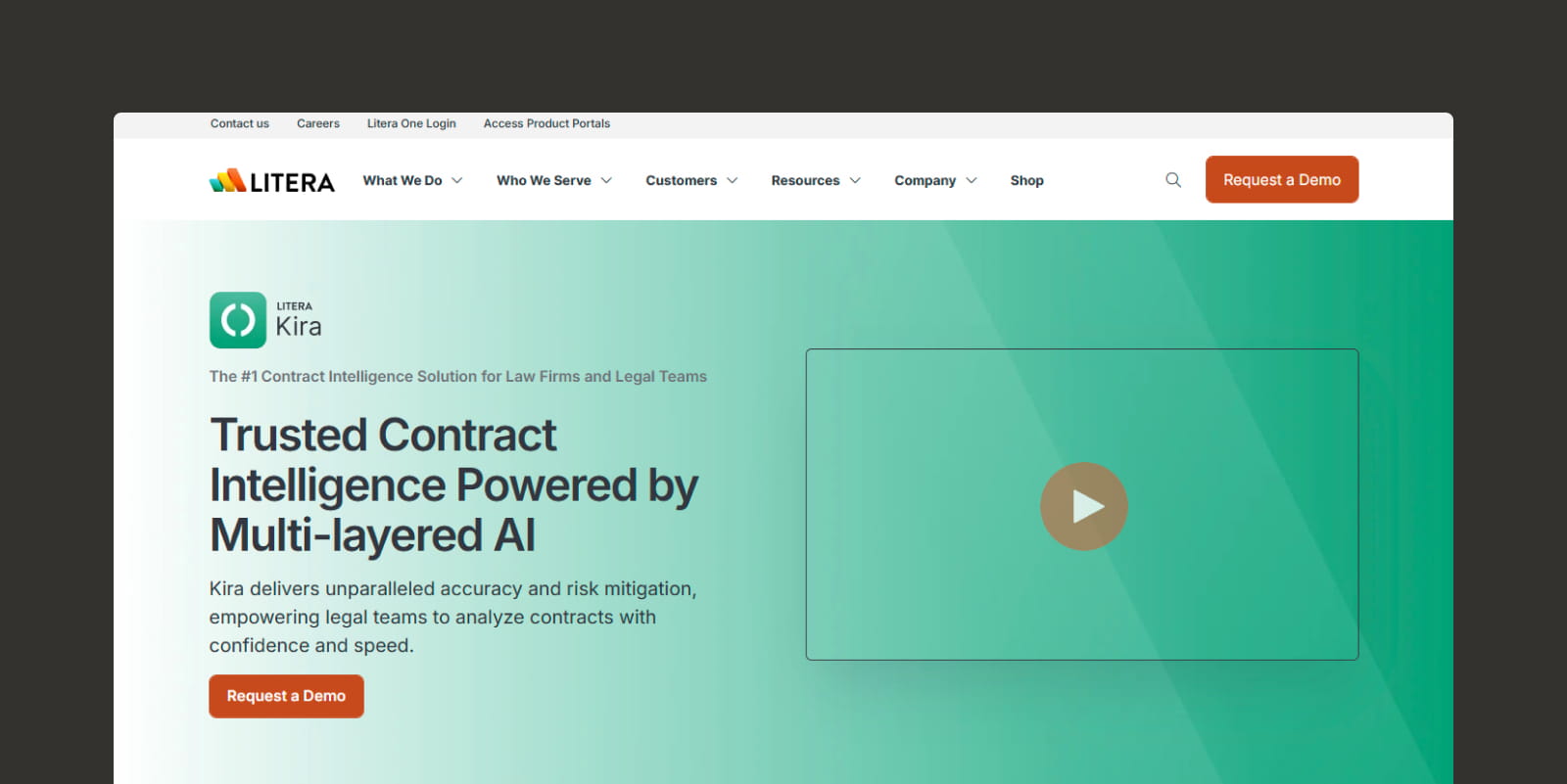
Kira is an AI-powered contract intelligence platform designed to automate data extraction and analysis from large sets of legal documents. It is primarily used by law firms and corporate legal departments to accelerate due diligence, M&A, and regulatory compliance by identifying critical clauses and provisions with high precision.
The platform utilizes a hybrid AI approach that combines generative AI with proprietary models trained on over one million legal contracts, achieving a consistent 90% accuracy rate. While it significantly reduces manual review time, users frequently note that the platform is not competitively priced compared to smaller niche tools and still requires a final layer of human verification for high-stakes interpretations.
Key features:
- Analysis Grid for side-by-side scanning of document sets: The Analysis Grid provides a tabular visualization of extracted fields across an entire project, allowing users to spot patterns and inconsistencies without switching screens. This centralized view helps teams quickly search, sort, and tag documents based on specific trends or missing provisions.
- Generative smart fields for natural language insight extraction: Users can ask natural language questions to extract specific insights across a document set without requiring manual training or pre-built models. This feature allows for the instant identification of complex provisions and helps teams navigate unique legal questions during time-sensitive diligence.
- 1,400+ trained models identifying clauses across 40 practice areas: Kira includes a massive library of built-in models specifically trained to recognize and extract common clauses like change of control, indemnification, and governing law. These models cover specialized fields including banking, finance, and real estate, ensuring comprehensive coverage for institutional risk assessments.
Features to Look For in Credit Risk Software
Selecting the right platform requires looking beyond basic data aggregation to identify tools that offer deep analytical reasoning and automated oversight. The following features are essential for modernizing your credit stack and maintaining a competitive edge in volatile markets.
- Intelligence at scale: Modern software must be capable of processing millions of pages of unstructured data, such as private credit agreements and virtual data rooms, without manual intervention. Hebbia excels in this area by allowing teams to run complex reasoning tasks across their entire coverage universe simultaneously, effectively multiplying the output of a traditional analyst team.
- Deterministic transparency: As AI becomes more integrated into risk workflows, tracing every insight back to its original source is essential for audit and regulatory compliance. Hebbia’s proprietary ISD technology provides sentence-level citations that link every data point directly to the source document, ensuring the full transparency required for institutional due diligence.
- Institutional memory and indexing: A top-tier tool should function as a centralized knowledge hub that indexes every deal, memo, and expert transcript your firm has ever produced. This ensures that past due diligence and institutional lessons are instantly searchable and can be automatically cross-referenced against new market data.
- Structural risk monitoring: Effective monitoring moves beyond simple financial ratio alerts to track the underlying "structural" language of a credit agreement, such as asset leakage or complex covenant baskets. This allows risk managers to identify potential breaches and credit deterioration months before they show up in lagging financial statements.
- Speed to signal: The ultimate goal is to shorten the time between a market event and a portfolio adjustment, turning raw information into actionable intelligence in real-time. By automating the most tedious parts of the research process, firms can achieve a "speed to signal" that allows for proactive risk mitigation rather than reactive damage control.
Protect Downside Yield with Institutional-Grade Intelligence
Managing credit risk requires the structural intelligence to identify signals that others miss within dense, complex agreements. Hebbia transforms unstructured documentation into a predictive advantage, ensuring your team maintains a consistent information edge. By automating repetitive workflows, Hebbia empowers you to focus on high-conviction decisions and risk-adjusted returns.
Schedule a demo to learn how Hebbia transforms weeks of manual document review into days of high-conviction analysis without sacrificing the accuracy your reputation depends on.
FAQ
Searching for a credit risk solution often leads to more questions than answers. Here are the most common things institutional teams ask when trying to modernize their risk stack.
What is the difference between traditional and AI-driven credit risk analytics software?
Traditional software relies on static historical data and manual underwriting, resulting in point-in-time assessments that lag behind market shifts. These systems are limited by a narrow set of financial ratios and require extensive human labor to process complex documentation.
AI-driven platforms provide continuous monitoring by synthesizing unstructured data, such as legal agreements and real-time news. They use agentic reasoning to identify risk signals—like covenant loopholes—months before they appear in lagging financial statements.
How do these platforms ensure compliance with evolving 2026 regulations?
Modern platforms meet 2026 requirements, such as the FS AI Risk Management Framework and Basel III capital re-proposals, by providing full transparency into their underlying logic. Tools like Hebbia use sentence-level citations to link risk assessments directly to source documents, meeting the strict audit standards of federal regulators.
To comply with mandates like the GENIUS Act (stablecoin reserves) and state-level AI bias laws, these systems offer real-time compliance monitoring. This continuous oversight allows firms to track exposure and liquidity 24/7, ensuring they remain within legal limits even as rules change.
What are the primary challenges when implementing new risk management technology?
Implementing modern risk tools requires overcoming structural and technical hurdles that go beyond simple software installation. The transition is often delayed by the following key challenges:
- Data fragmentation: AI projects frequently fail because data is siloed across inconsistent legacy systems. According to our data, 46% of finance professionals struggle to extract information from multiple sources, which leads to models producing unreliable results based on incomplete or conflicting information.
- Model drift: Unlike static legacy software, AI systems evolve over time. This requires continuous monitoring to detect bias drift or declining accuracy as real-world market conditions change.
- The governance gap: There is often a disconnect between the engineering teams building the AI and the risk functions responsible for governing it. This fragmentation prevents firms from having a real-time, enterprise-wide view of their actual risk exposure.
- Specialized skills shortage: A lack of internal training and expertise remains a major barrier to scaling technology across the firm. This gap slows down deployment and makes it difficult to meet the technical audit requirements of current regulations.
To navigate these hurdles, firms should establish cross-functional committees that align technical teams with risk officers from the start. Prioritizing platforms with auditable data lineage and continuous monitoring ensures that systems remain accurate as market conditions shift. This alignment turns potential implementation bottlenecks into a reliable foundation for enterprise-wide risk management.


