
The Deal Lifecycle: What It Is, How It Works, and Where AI Fits In
Managing the deal lifecycle from origination through close demands speed and precision at every stage—screening fast enough to act, running due diligence to catch any deal-killing issues, and producing the materials that determine whether the deal moves forward.
The common thread is unstructured information: hundreds of documents scattered across systems that have to be synthesized under time pressure. This article covers the stages where that research and analysis work is hardest, and how AI platforms like Hebbia are helping PE firms and investment banks get it right.
What Is the Deal Lifecycle?
The deal lifecycle covers each stage a transaction moves through, from initial identification of an opportunity to close. At any given time, a PE firm or investment bank is managing multiple deals at different points in that lifecycle, each with its own research, analysis, and documentation demands.
The mechanics differ by firm type:
- Private equity teams build conviction over weeks or months across financial, commercial, and operational workstreams before committing capital.
- Investment banks manage client mandates and competitive pitches, where the pressure is on to assemble accurate, client-ready materials fast.
The Core Stages of the Deal Lifecycle
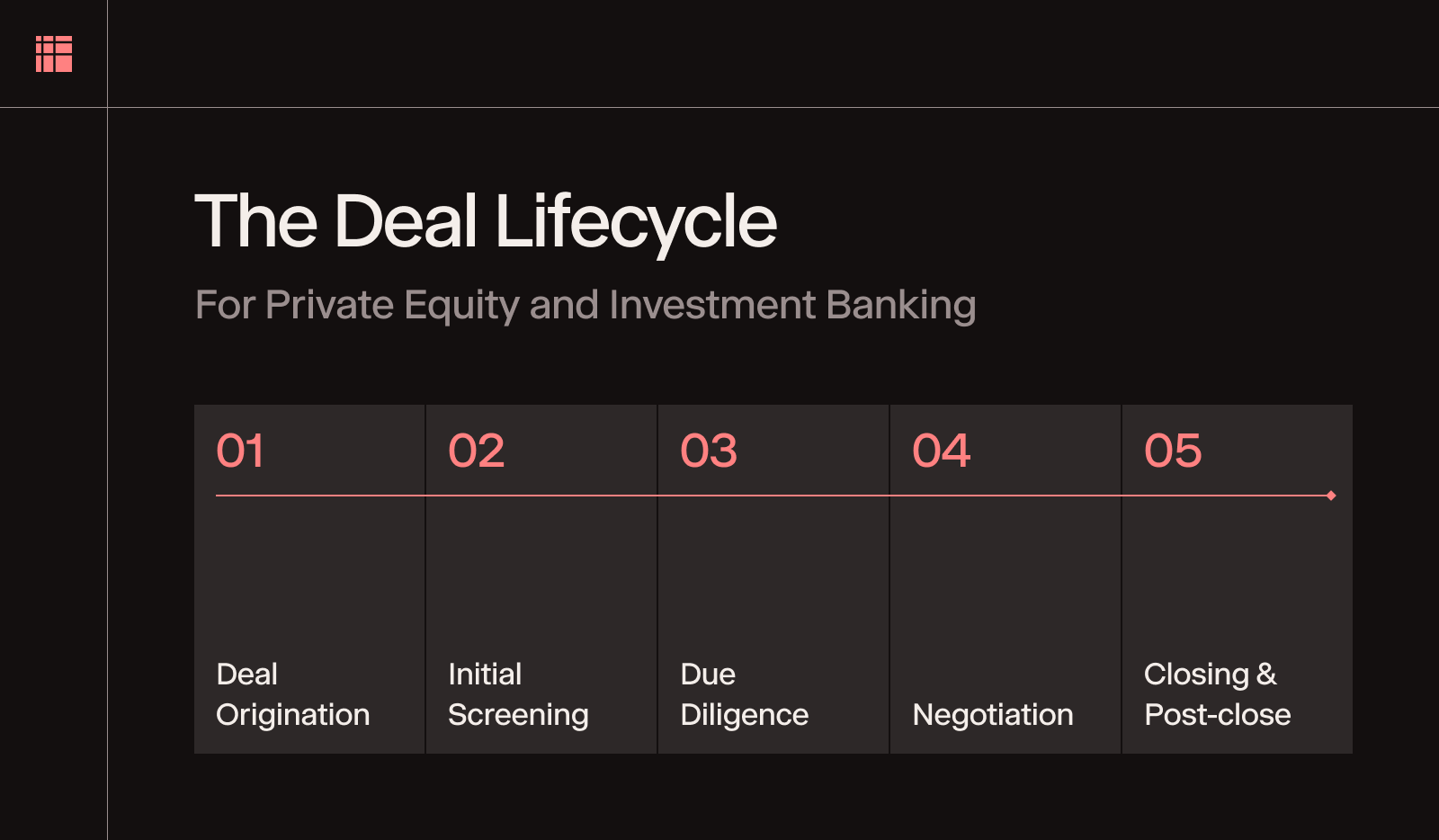
Every deal moves through the same core stages, though the pace, documentation, and decision-makers differ between PE and investment banking. Here's how each stage breaks down.
Stage | Purpose |
|---|---|
Deal origination | Identify and surface potential investment targets or transaction mandates through networks, research, and market monitoring |
Initial screening and qualification | Filter opportunities against fund or mandate criteria to determine which ones are worth deeper analyst time |
Due diligence | Validate the target through financial, commercial, legal, and operational analysis before committing to a transaction |
Negotiation | Establish deal terms (price, structure, governance rights, and contractual obligations) informed by diligence findings |
Closing and post-close management | Execute the transaction and, for PE, track portfolio company performance against the original investment thesis |
1. Deal Origination
Every deal starts when a firm identifies an opportunity worth pursuing. When sourcing deals, firms rely on a mix of data terminals and intelligence platforms like Bloomberg and PitchBook, proprietary networks, and institutional relationships built over years, but the mechanics differ by firm type.
Private equity sourcing runs primarily through:
- Banker relationships and intermediaries
- Sector mapping and direct outreach for smaller or off-market situations
- Conferences and proprietary networks
Investment banking origination flows through:
- Existing client relationships, with senior bankers monitoring strategic situations and capital needs for the right window to propose a transaction
- Competitive pitches for new mandates, often triggered by market events, strategic shifts, or financial pressure
The challenge is the same across verticals: identifying the right opportunities early, before competitors do. While AI can’t replace the relationships that primarily drive origination, it can support the research and prioritization work at this stage.
2. Initial Screening and Qualification
Before a deal gets analyst time, it has to clear a first-pass filter. Screening determines which opportunities are actionable enough to pursue and which ones get passed on quickly so the team can focus on what matters.
The criteria differ by firm type:
Private equity analysts screen acquisition candidates against fund thesis criteria:
- Sector fit and geographic focus
- Revenue and EBITDA range
- Valuation expectations and deal type (control buyout, growth equity, minority stake)
The output is typically a company summary and an initial investment thesis that determines whether the opportunity moves forward.
Investment banking teams assess incoming mandates for fee potential, strategic fit, execution feasibility, and conflict checks. Analysts and associates support the process with company research, comparable transactions, and the financial work that informs whether the bank pitches at all.
This is where AI platforms like Hebbia really start to earn their place. The research work at this stage (including pulling company profiles, screening against criteria, and surfacing comparable transactions) is time-consuming but highly repeatable.
AI accelerates it, letting analysts cover more ground without adding headcount or cutting corners on quality.
Pro tip: Using Hebbia for initial screening
Upload your target list, internal research, and prior deal notes into Hebbia, then run natural language queries like "which of these companies fall within our EBITDA range and have recurring revenue?" or "surface any prior research we have on this sector."
Hebbia's AI agents pull answers across all uploaded documents simultaneously, with source-linked citations so you can verify every output. What typically takes an analyst a full day of desk research can be turned around in under an hour.
3. Due Diligence
Due diligence is the most document-intensive stage of the deal lifecycle — a structured investigation spanning regulatory filings, legal contracts, historical financials, and management commentary. Document volumes can run into the thousands, yet the timelines to get through all of it are unforgiving.
Private equity diligence covers financial, commercial, operational, and legal workstreams, with deliverables including the investment committee (IC) memo, risk matrices, quality of earnings (QoE) reports, valuation models, and a 100-day plan.
Investment banking teams build the confidential information memorandum (CIM), management presentation, and supporting materials from virtual data room (VDR) contents, management call notes, and historical financials. The CIM alone typically runs 6–8 weeks across multiple review cycles.
Hebbia's architecture matters most here. Most AI tools break large documents into fragments before processing them, dropping critical context along the way. The Iterative Source Decomposition (ISD) processes files whole, preserving full context across thousands of pages simultaneously and backing every finding with clickable, in-line citations that the deal team can verify in the source document.
4. Negotiation
Negotiation is where the key deal terms get established. Pricing, structure, governance rights, and contractual obligations are all on the table. Both parties work from the same data room but draw different conclusions. The quality of diligence work directly impacts how well-informed your position is.
Competitive processes add pressure. In contested situations, the speed and accuracy of responses to term sheet revisions and information requests can determine the outcome.
Private equity negotiations center on purchase price and deal structure and are held directly with sellers and their advisors. Key terms include:
- Valuation multiples and equity to debt split
- Management rollover and earnouts
- Representations and warranties and governance rights
Investment banks advise clients throughout the process, managing counterparty dynamics and coordinating across financial and legal teams.
5. Closing and Post-Close Management
Closing is the final execution phase. Both parties sign definitive agreements, funds transfer, and all regulatory and legal requirements are completed.
For private equity, this means coordinating across legal counsel, lenders, and management teams.
For investment banks, it means ensuring all closing conditions are met and that the transaction closes cleanly.
Post-close marks the transition from deal work to a new phase. For PE firms, the focus shifts to managing the acquired company and tracking performance against the investment thesis, including:
- EBITDA trajectory and return profile relative to IC memo assumptions
- Management execution against the operating plan
- Market conditions that could affect the original thesis
When a portfolio company underperforms, teams need fast access to the original diligence materials to determine whether the thesis has changed or the variance is temporary. Hebbia's centralized knowledge base makes that retrieval immediate.
For investment banks, post-close means executing the signing, coordinating with legal and financing counterparties, and clearing the closing checklist. Ongoing client coverage is a separate workflow handled by senior bankers, outside the deal lifecycle itself.
Common Challenges in Deal Flow Lifecycles and How To Avoid Them
Even well-run firms run into the same friction points across the deal lifecycle. Most come down to data, documentation, and institutional knowledge that live in people's heads rather than shared systems.
Fragmented Data and Siloed Systems
Deal information rarely lives in one place. Research notes sit in shared drives, deal context gets buried in email threads, financial models live on individual desktops, and CRM entries capture only what someone remembered to log. When a new deal kicks off, teams spend hours reconstructing context that already exists somewhere in the firm.
Specialized finance platforms like Hebbia centralize all deal documents, research, and outputs in a single searchable database. Anyone on the team can query across everything the firm has worked on, without needing to know exactly where to look.
Inconsistent Analysis Quality
When screening criteria, evaluation frameworks, and analysis templates vary by analyst or team, the output varies too. That inconsistency creates risk in the conclusions that inform investment decisions.
The right AI platform enforces the firm's own standards by encoding specific workflows, templates, and criteria into repeatable agents. Each deal goes through the same process, regardless of who runs it.
Slow Document Review During Diligence
Manual document review is the biggest time sink in the deal lifecycle. Analysts working through hundreds of pages of VDR materials, credit agreements, and third-party research are limited by how fast they can read. Cognitive fatigue creates real risk of missing the detail that changes a deal.
AI platforms like Hebbia replace that bottleneck with agents that process thousands of pages simultaneously and return context-informed, source-linked answers to complex queries. Work that used to take days gets done in hours, with every finding traceable to its source document.
Deliverable Production Under Time Pressure
The final push on a deal—assembling the IC memo, CIM, or pitch deck—happens under the tightest deadlines. Synthesizing completed analysis into a polished, properly formatted deliverable with accurate citations, firm branding, and a coherent narrative takes significant time even after the hard analytical work is done.
Hebbia produces first-draft scaffolds from the research and analysis already in the platform, conforming to firm-specific templates with proper formatting, colors, and logos. The deal team refines from there.
Hebbia's Matrix platform encodes your firm's deal workflows into automated agents—screening targets, synthesizing diligence documents, and generating first-pass deliverables with full citations.
Book a demo to see how it works.
How AI Is Changing the Deal Lifecycle
AI in finance is transforming how PE firms and investment banks handle the research, analysis, and documentation work that runs through every stage of a deal. Here is where it's making the biggest difference:
- Faster research and target screening: Analysts can query across internal research, public filings, and prior deal notes in natural language. Candidates get screened and comparables get surfaced in minutes rather than hours.
- Deeper document analysis during diligence: Sophisticated AI platforms can process thousands of pages simultaneously, preserving full context across documents. Hidden risks and cross-document inconsistencies get flagged, with every finding backed by source-linked citations.
- Consistent, standardized analysis across deals: AI encodes firm-specific workflows and criteria into repeatable agents. Each deal goes through the same analytical process, regardless of who runs it.
- First-draft deliverable scaffolds (IC memos, CIMs, pitch decks): AI assembles structured first drafts of IC memos, CIMs, and pitch decks from the research already in the platform. Deal teams refine from there.
- Firm-wide intelligence that builds with each deal completed: Every document and query gets indexed into a shared knowledge base. Future deal teams have the full benefit of everything the firm has worked on before.
Strengthen Your Deal Lifecycle Capabilities With Hebbia
Managing deal flow requires both speed and accuracy. Lose one, and deals fall through. But balancing both is nearly impossible without the right tools.
Hebbia enhances each stage of a deal. Developed specifically for finance, our platform helps firms identify and capitalize on the best opportunities at scale with customizable AI agents that automate your firm’s workflows exactly as they are.
And with each deal, documents and analysis are retained in a shared, searchable database, so teams can call on a full library of institutional knowledge when starting a new deal.
Book a free demo to see Hebbia in action and find out how leading firms use our platform to enhance all of their deals from beginning to end.


