
Distressed Debt Investing Strategies Explained
The best distressed debt opportunities rarely announce themselves. They emerge from the wreckage of over-leveraged balance sheets and credit downgrades. For specialized funds that know how to read the situation, that's when the work begins.
Distressed debt investing is the strategy of buying a financially troubled company’s debt—bonds, leveraged loans, trade claims—at a steep discount to par, betting that the debt is worth more than the market believes. The thesis might rest on a turnaround, a restructuring that converts debt to equity, or a liquidation that pays debt holders before equity holders ever see a dollar.
Here's what to know about how the strategy works, the key approaches funds use, and what separates the teams that execute it well.
What Is Distressed Debt Investing?
Distressed debt investing is the strategy of buying a financially troubled company's debt at a steep discount to par, on the thesis that the market has mispriced the risk.
Debt is generally considered distressed once it yields 1,000+ basis points over the risk-free rate or carries a credit rating of CCC or lower. That threshold marks the point at which the market is pricing in a real probability of default or restructuring, not just a remote one. This debt can take a few different forms:
- Bonds
- Leveraged loans
- Trade claims
- Other debt instruments such as Debtor-in-Possession (DIP) financing or litigation claims
Oaktree Capital popularized the framing that best describes the opportunity: a "good company with a bad balance sheet." The underlying business may still generate cash or hold real market share; in some cases, it's the capital structure that's broken, not necessarily the enterprise.
Distressed debt investors are betting the balance sheet gets fixed before the market catches up.
What Makes Debt "Distressed"
Several warning signs typically show up before a company's debt crosses into distressed territory, including:
- Covenant violations, though these are less reliable signals in today's largely covenant-lite market
- Inability to refinance maturing debt on reasonable terms
- Cash flow shortfalls that threaten interest or principal payments
- Impending default or bankruptcy filing
Most leveraged loans issued today carry minimal maintenance covenants, so distress rarely announces itself through a tripped covenant anymore. It shows up instead through refinancing pressure, looming maturity walls, and liability management maneuvers that shift value away from existing creditors well before a covenant would ever trip.
Distressed debt is a subset of high-yield debt, not a synonym for it. All high-yield debt trades below investment grade. Most junk bonds, however, trade at yields well short of the 1,000+ basis point threshold that defines genuine distress. A company can carry a junk rating for years without ever becoming distressed.
Distressed opportunities also move in cycles, expanding during recessions, credit tightening, and periods of rising rates that strain leveraged borrowers. And certain sectors tend to show distress ahead of the broader market: Retail and energy have historically led prior cycles, with healthcare following more recently.
Who Invests in Distressed Debt?
Distressed debt investing is dominated by specialists:
- Dedicated distressed hedge funds, built specifically around stressed and defaulted paper
- Special situations arms of private equity firms often pursuing control positions through the process
- Credit managers running strategies focused on distressed and special situations credit, often leaning on AI for private credit to extract and monitor covenant terms at scale
- Institutional allocators, including pension funds and insurance companies, typically through fund commitments rather than direct positions
Reading a credit agreement, modeling a recovery waterfall, and navigating a bankruptcy process each require specialized expertise. Few investors outside dedicated teams have the legal, financial, and operational depth to do all three well.
How Distressed Debt Investing Works
Distressed debt investors buy a company's debt at a discount to its face value, betting that the underlying claim is worth more than the price they paid. Debt holders sit above equity holders in the capital structure, so they get paid first in a bankruptcy or restructuring. That gives the trade a built-in layer of downside protection that equity investors don't have.
The core bet is simple. Recovery value, whether through price appreciation, a new instrument, or cash proceeds, ends up higher than the discounted price paid today.
Here's a quick example of how that math plays out in practice:
A $1,000 bond trading at 40 cents on the dollar costs an investor $400. If the company reorganizes and creditors recover 70 cents on the dollar, that same claim is worth $700. That's a $300 gain on a $400 investment, or a 75% return.
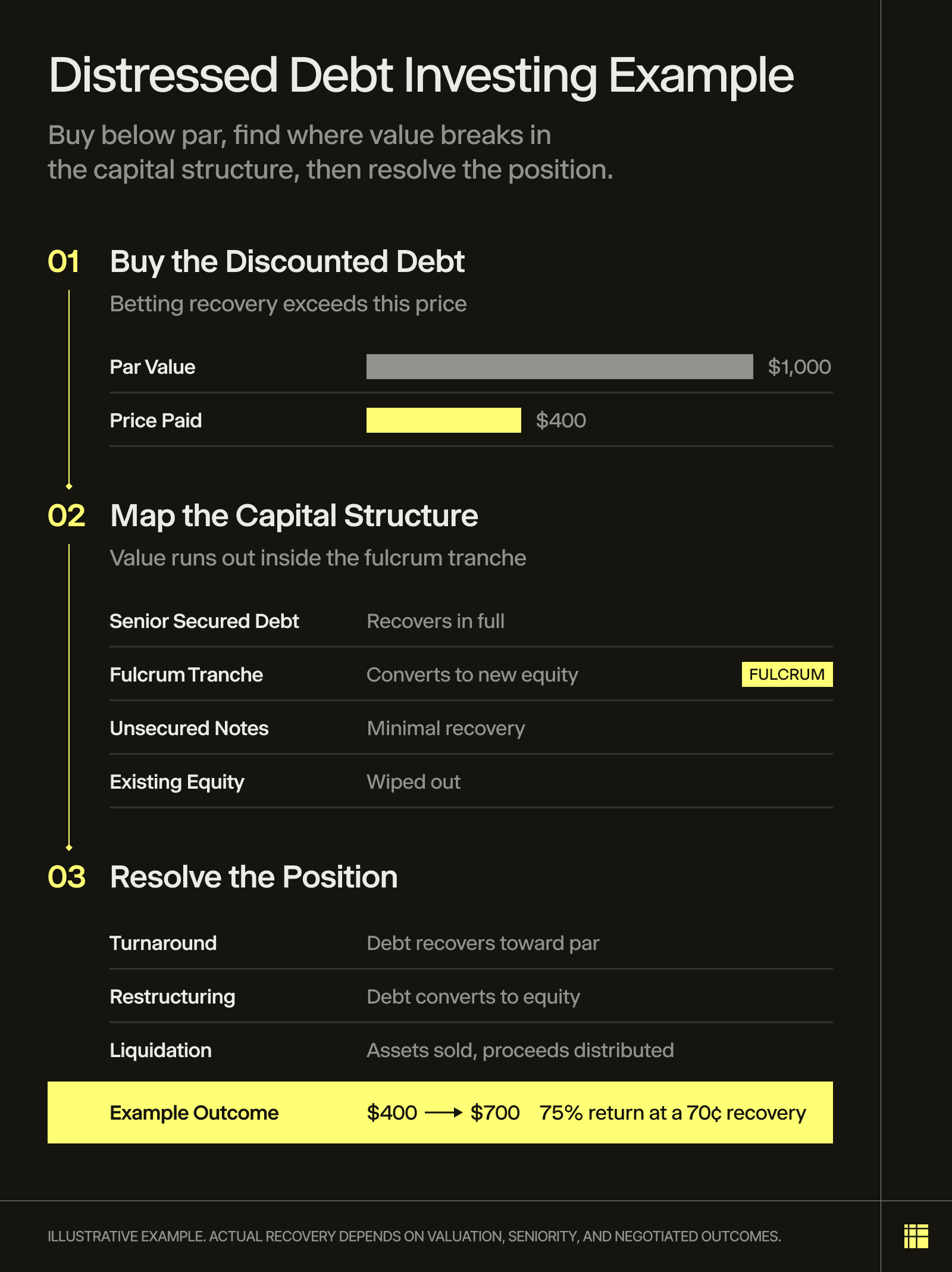
A distressed position typically resolves in one of a few ways.
- Turnaround: The company's operations improve enough to meet its obligations, and the debt appreciates back toward par.
- Restructuring: The company reorganizes its capital structure, often converting debt into equity, and creditors emerge holding a stake in the reorganized business.
- Liquidation: The company's assets are sold off, with proceeds distributed to creditors in order of seniority.
The Role of the Fulcrum Security
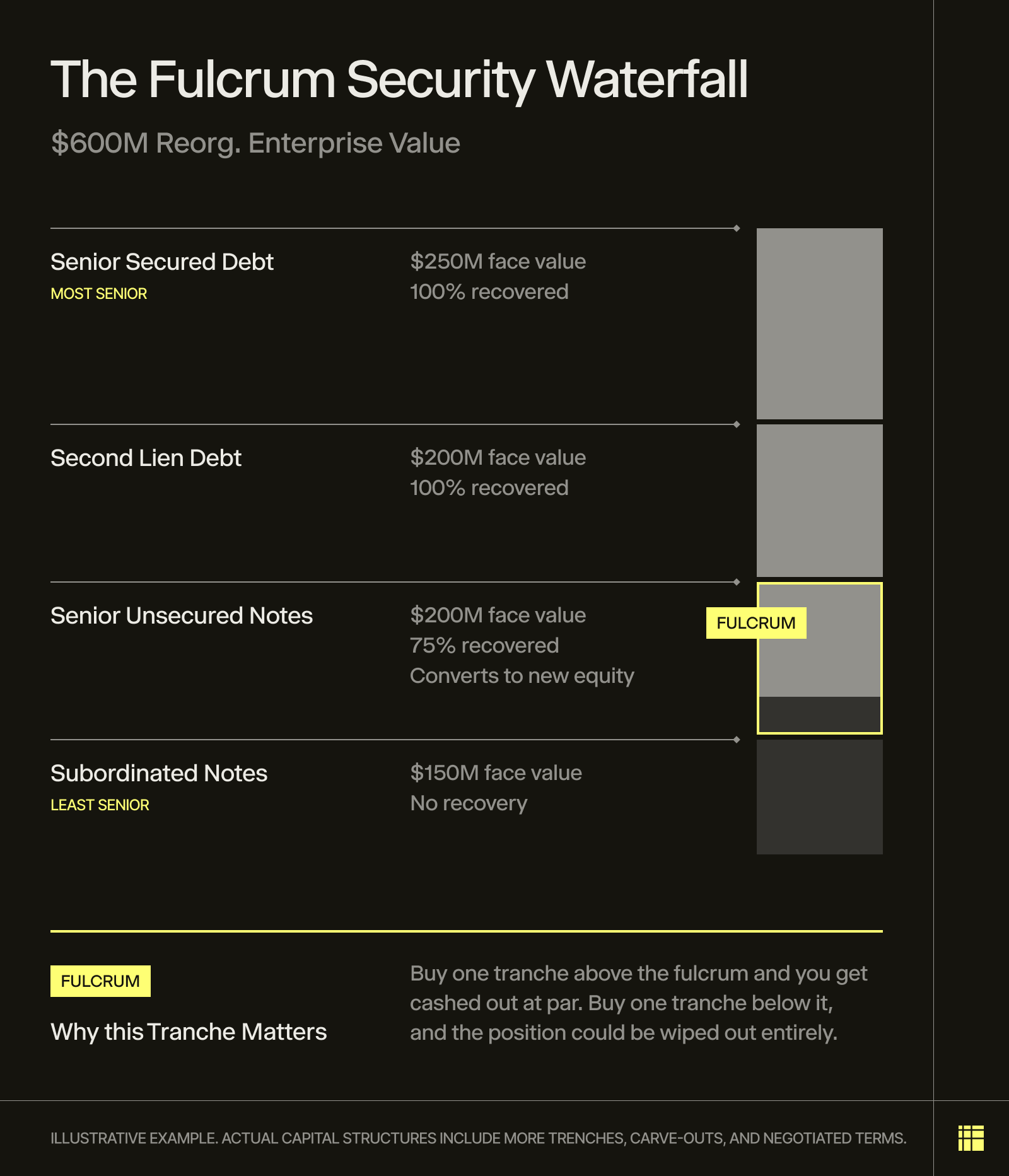
The fulcrum security is the tranche of debt most likely to convert into equity when a company reorganizes.
Finding it starts with valuing the reorganized enterprise, then walking down the capital structure from the most senior claim to the most junior. At some point along that walk, the value runs out.
The tranche sitting right at that break is the fulcrum security. It's the last claim to be paid in full and is typically where new equity ownership is created in the restructuring.
For control-oriented strategies, identifying and buying the fulcrum security is the whole game. Investors who accumulate a large enough position in that tranche can end up as the largest shareholder of the reorganized company once the process closes. That gives them a direct say in how the business is run going forward.
Getting the valuation wrong by even one tranche means buying above the fulcrum and getting cashed out, or buying below it and ending up with a loss.
Here's how that plays out across an actual capital structure:
Distressed Debt Investing Strategies
Distressed strategies fall along a spectrum, from passive trades that require no involvement in a company's affairs to control positions that put a fund in charge of the outcome. Many funds run a hybrid of these approaches depending on the situation.
Strategy | Control Level | Typical Holding Period | Primary Return Driver |
|---|---|---|---|
Distressed Debt Trading (Passive) | No control or influence | Short-term | Price recovery as the market's overreaction corrects |
Active Non-Control | Influence without control | Medium- to long-term | Negotiated recovery through restructuring talks |
Loan-to-Own (Control) | Full control via the fulcrum security | Long-term | Equity value created through debt-to-equity conversion |
Distressed Debt Trading (Passive)
Distressed debt trading is a short-term bet on price recovery. A fund buys debt at a discount and sells it once the market's overreaction corrects, without ever engaging in the company's restructuring process.
It's the most liquid strategy here and requires no influence or control over the outcome.
Active Non-Control
Active non-control investors build a large enough creditor position to gain a real voice in restructuring negotiations, without seeking outright control of the company. The holding period runs longer than a pure trading strategy, and the analysis grows more complex once a fund is working on the actual negotiation rather than just the price. Litigation risk also rises as engagement deepens.
Loan-to-Own (Control)
Loan-to-own investors acquire a controlling position in the fulcrum security, then convert that debt into equity through the bankruptcy process. Once the reorganization closes, they emerge as the company's new majority owner.
It's the most hands-on and longest-horizon approach of the group. Positions are typically built quietly, since moving too fast can push up the price of the paper or tip off competing funds before a blocking or controlling stake is in place.
Restructuring and Turnaround
Restructuring and turnaround work sits on top of a control position rather than standing apart as its own strategy on the spectrum. Once a fund has taken control through the loan-to-own process, it brings in a plan to fix the business itself, not just the balance sheet. That takes operational expertise on top of the credit and legal knowledge the rest of the strategy already demands.
Benefits and Risks of Distressed Debt Investing
Like any strategy that trades on complexity, distressed debt cuts both ways. The same features that create outsized return potential also carry risks that are easy to underestimate from the outside.
Benefits
Distressed debt investing carries real structural advantages beyond the headline return numbers. Here's what holds up under closer scrutiny:
- High return potential: Buying below par creates room for significant upside, whether through price recovery, a favorable restructuring, or liquidation proceeds that exceed the purchase price.
- Capital structure seniority: Debt holders are paid before equity holders in bankruptcy, which provides a structural layer of downside protection that equity investing doesn't offer.
- Low correlation over a full cycle: Returns depend heavily on idiosyncratic credit events and restructuring outcomes, which can offer diversification over time. Keep in mind that distressed debt is cyclical by nature and highly correlated with credit spreads and liquidity conditions in a downturn.
- Influence over outcomes: Investors who accumulate meaningful creditor positions can shape restructuring negotiations, an unusual degree of agency compared to most fixed income strategies.
- Cyclical opportunity: Distressed deal flow expands during credit stress, giving disciplined managers the chance to deploy capital when assets are mispriced, and competition is lower.
Risks
Distressed debt investing carries risks that are structural to the strategy itself. Understanding where they concentrate is part of underwriting the trade correctly:
- Legal and restructuring unpredictability: Bankruptcy proceedings can take years. Outcomes depend on court rulings, creditor negotiations, and management decisions, all of which are hard to predict.
- Illiquidity: Distressed securities can be difficult to exit quickly, especially in control positions.
- Future distress: A successful restructuring doesn't guarantee that the reorganized company won't face distress again.
- Competition among creditors: Other distressed investors may be acquiring the same debt simultaneously. Becoming "accidental partners" in a restructuring can limit your influence.
- Priming and intercreditor risk: Modern credit agreements often permit liability management maneuvers, like uptiering existing lenders or moving collateral out of reach via drop-down transfers that can subordinate creditors who read the documents too late. Catching these structural risks early is what disciplined credit risk modeling is built to do.
How Hebbia Accelerates the Diligence Process
Distressed debt diligence is bottlenecked by extraction. Analysts spend days pulling covenant terms and cross-default provisions out of credit agreements, indentures, and virtual data rooms (VDRs) before they ever get to the analysis that actually drives a decision.
Hebbia handles the extraction layer, so analysts can focus on the judgment calls that separate a good trade from a bad one (instead of manually working through the documents that inform those decisions).
Here's what that looks like in a distressed debt context:
- Cross-document querying: Hebbia allows teams to ask a single question across hundreds of credit agreements simultaneously and receive answers in seconds.
- Clause-level citations: Every output is traced back to the exact source document and provision, so analysts can verify findings and defend them to the investment committee without retracing the research. That matters especially when recent Hebbia survey data found that most finance teams still manually re-check AI outputs they don't trust enough to act on directly.
- Covenant extraction and comparison: Hebbia can surface and compare covenant terms across a deal's full document set, identifying variations, restrictions, and structural risks that might not surface in a manual review.
- Capital structure mapping: Teams can process VDRs, prior filings, and intercreditor agreements together to build a complete picture of lien priority, subordination risk, and recovery scenarios.
The same workflow extends into special situations, leveraged finance, and investment banking diligence. See how Hebbia supports investment banking teams.
The Edge in Distressed Debt Is in the Details
Distressed debt investing rewards the teams that get to conviction faster and with fewer blind spots. The opportunities are buried in dense credit agreements, intercreditor arrangements, and bankruptcy filings that demand close reading under tight timelines. Getting that analysis right before anyone else does is where returns are actually made.
Hebbia is built for exactly that work, helping distressed debt and special situations teams query across hundreds of deal documents simultaneously, with every output cited back to its source.
If you're working through complex credit situations and want to see what that looks like in practice, request a demo with Hebbia today.


