
What Makes a Good Equity Research Report—And How To Enhance Yours with AI
For many investors, an equity research report is the guiding light for investment decisions, distilling thousands of pages of filings, earnings calls, and market data into one definitive signal: buy, sell, or hold.
For equity analysts, producing these reports is a highly repeatable but increasingly time-consuming process. You cover a defined universe of companies and continually refresh your models and theses as new information hits the tape. Yet with dozens of documents to analyze for every update, analysts spend a disproportionate amount of time hunting through notes, transcripts, and news to justify price targets rather than sharpening their industry view or developing differentiated insights.
AI is changing that workflow. In this guide, we’ll break down the components of a high-impact equity research report, the main types of reports, and the core differences between sell-side and buy-side outputs. We’ll then show how leading research teams are using AI to automate manual review, surface decision-ready evidence, and generate source-grounded, audit-ready equity research reports at scale, without sacrificing rigor or compliance.
What Is an Equity Research Report?
An equity research report (also called an equity analyst report) is a comprehensive evaluation of a public company that provides a recommendation on whether investors should buy, sell, or hold their shares.
To contextualize the recommendation, equity research reports include an investment thesis and detailed information on the company’s structure, financial performance, and industry risks.
An equity research report usually includes the following:
- Company overview: A basic overview of a company, typically including information on its products and services, current and historical leadership, key markets, current stock price, target stock price, and market capitalization.
- Recent news: Recent updates from the company, including press releases, financial reports (usually quarterly or annual earnings reports), major contracts, and other fresh news from the company.
- Industry and market data: An analysis of the industry in which the company operates. This typically includes coverage of broad sector trends, performance benchmarking, and an analysis of the company's positioning relative to its primary competitors.
- Investment recommendation: The recommendation to either buy, sell, or hold shares of the company. “Buy” (or overweight) signals confidence that a stock will perform well, “sell” (or underweight) signals concern about a stock’s downside risk, and "hold” (or neutral) signals a neutral assessment.
- Investment thesis: A summary of the analyst’s reasoning behind the investment recommendation. It explains why the analyst chose the price target and what they believe will cause the stock to over- or underperform to reach it.
- Financial performance: A neutral analysis of a company’s financial performance based on historical data, such as income statements, cash flows, and balance sheets. It also usually includes forecasts for revenue, margins, cash flow, and return on equity.
- Risk factors: All risks and potential downside drivers associated with the stock. It could include operational, financial, regulatory, and/or market risks—any factor that could reduce the stock’s value.
- Valuation: An accurate valuation of the company derived from a financial model, with the goal of determining whether a stock is overpriced, underpriced, or performing as expected. Valuations are derived from a mix of absolute models (such as discounted cash flow) and relative models (such as comparables).
Equity Research Report Example
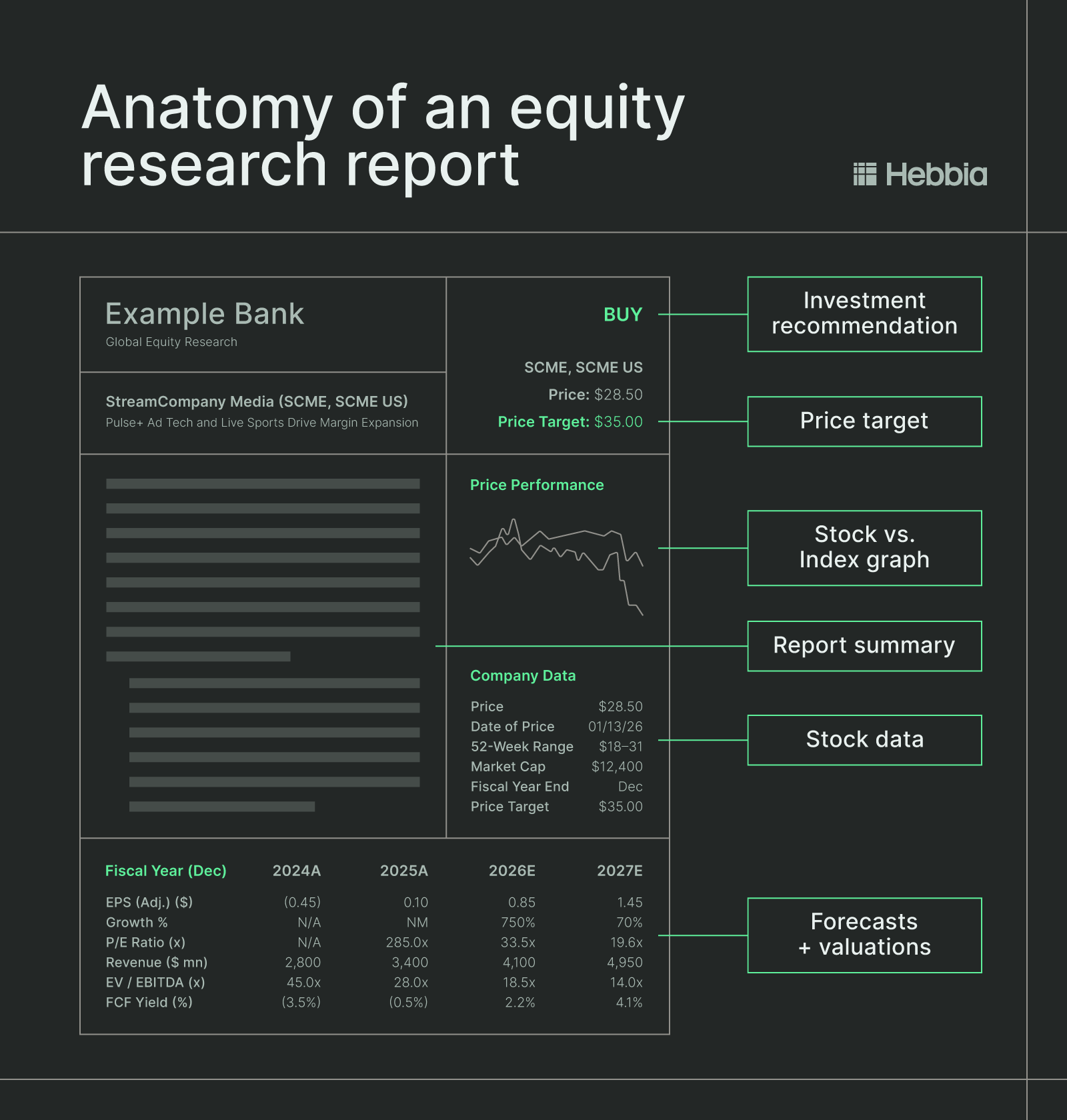
Below is an example of a coverage initiation report for a fictional company, modeled after an industry-standard template. It shows the first page of the report, which always includes the investment recommendation, price target, stock data, valuation, and summary. Detailed breakdowns of each element, along with the investment thesis, financial performance data, risk factors, and recent news, are typically included in the body of the report.
5 Types of Equity Research Reports
Equity research reports come in a variety of formats depending on the author, company, and function, each serving its own purpose. Examples of different types of equity research reports include:
- Coverage initiation reports: A comprehensive report published when a firm first starts covering a stock. These often reach up to dozens or hundreds of pages with a complete breakdown of the company and its performance.
- Revisions: An upgrade or downgrade to the investment recommendation or an adjustment to the price target with updated rationale. Changes could be based on new market data (such as industry trends or events) or newly publicized company data (such as earnings reports).
- Flash reports: Quick reactions and updates based on the latest news, announcements, or company reports, often no longer than one or two pages unless there are major changes.
- Sector reports: An in-depth look into a sector or industry, containing information, updates, and projections for a set of companies within an industry rather than just one company.
- Macroeconomic reports: A broad view of trends across an entire economy, providing an analyst’s insight into how macro factors like inflation, trade news, or interest rates affect markets.
Buy-Side vs. Sell-Side Equity Research
Equity research serves different purposes depending on whether it's conducted on the sell-side or buy-side, with key differences in audience, distribution, and strategic intent.
Sell-Side Equity Research
Sell-side firms, such as investment banks, conduct equity research to provide timely, public recommendations that help investors guide their decisions and identify potentially lucrative opportunities. They aim to appeal to a broad audience, from clients (primarily buy-side institutional investors) to individuals and communities.
While investment bankers are strictly prohibited from executing quid-pro-quo deals via equity research reports or influencing analysts’ conclusions, banks can strategically choose sectors to cover to establish thought leadership and gain/reinforce credibility where needed.
Buy-Side Equity Research
Buy-side firms, such as hedge funds and asset managers, conduct equity research for a different purpose. Buy-side analysts produce investment memos to help portfolio managers and investment committees within their own firm decide to buy, sell, or hold a stock.
While sell-side reports are public, buy-side equity analysis is purely confidential and treated as intellectual property. Buy-side firms seek to protect their alpha-generating investment strategies to maintain their edge and achieve higher returns than competitors.
Sell-side (investment banks) | Buy-side (institutional investors) | |
|---|---|---|
Goals | Establish credibility and build relationships | Generate alpha for their firm with accurate recommendations that yield risk-adjusted returns |
Audience | External clients and the public market | Internal portfolio managers, investment committees |
Deliverable | Published equity research report | Investment memo |
Success indicators | Analysis accuracy and depth of information provided to clients | Portfolio performance relative to the market and competitors |
How Artificial Intelligence Improves the Equity Research Report Creation Process
The introduction of AI in investment banking is changing how firms produce equity research reports. Teams can rely on AI to automate administrative tasks and initial analysis, freeing up hours to spend on work that adds more value. This allows teams to spend more time building stronger reports that establish thought leadership, present a differentiated perspective, and cultivate client relationships.
Below are some ways AI is improving the process of creating an equity research report.
1. Data Ingestion and Synthesis for Faster, Higher-Quality Analysis
AI platforms can ingest a high volume of disjointed documents, from regulatory filings and earnings call transcripts to SEC filings and research reports. And with the right platform, professionals can use AI agents to rapidly analyze information across dozens of documents at once, surfacing hidden insights (such as sentiment shifts or market risks) that can strengthen financial models and shape investment recommendations. All this is done in a fraction of the time it normally takes manually.
Faster speed-to-insight and deeper analysis mean banks can scale equity research while keeping their teams lean, equipping analysts to meet strict quality standards and provide extremely valuable recommendations even under tight deadlines.
2. Improved Source Traceability
Finance-specialized AI platforms can link insights and takeaways to specific sources, helping equity researchers verify claims and correct potential errors without having to re-run arduous analysis or manually retrace their steps. Source-linked takeaways and audit logs also help supervisory analysts and compliance staff vet reasoning and outputs during review cycles.
The ability to produce verifiable analysis and complete review cycles faster helps banks produce complete equity research reports at a much higher clip than those relying on traditional, manual processes. Scale becomes achievable through process optimization and auditability rather than expanding headcount.
Most AI platforms rely on retrieval-augmented generation (RAG), which often leads to inaccuracies and hallucinations.
Hebbia uses proprietary iterative source decomposition (ISD) technology instead, which provides an infinite context window and automatically links all outputs with clickable, in-line citations.
Book a demo to see Hebbia’s market-leading accuracy in action.
3. Better Predictive Analytics for Accurate Forecasting
Accurate forecasting is the backbone of equity research. It’s a deep process involving quantitative and qualitative analysis based on present-day and historical information to come up with predictions that investors can understand and trust.
AI can compress hours of Ctrl+F searches and manual reading into minutes with one simple prompt. As a result, teams can skip the administrative work and get right into the details, perfecting their analysis and testing scenarios to turn over more defensible valuations and recommendations.
4. Deliverable Generation
AI in finance has come a long way—some AI platforms can now support end-to-end workflows. For example, platforms with advanced generative capabilities can build full equity research reports from scratch.
Instead of manually synthesizing analysis and takeaways into documents that can be thousands of words long, teams can query an AI agent to build a first-pass report complete with accurate data and context-informed text.
Pro tip: AI is meant to augment human intelligence, not replace it. Avoid developing an overreliance on AI-generated outputs by keeping humans in the loop at every stage of building an equity research report, ensuring that every output is vetted by a seasoned professional.
Why Equity Research Professionals Choose Hebbia To Power Their Workflows
Investors look to equity research to inform their decision-making. They expect accuracy, credibility, and a differentiated perspective that helps inform their final decision to buy, sell, or hold a stock.
Delivering that level of quality has always required deep domain expertise and careful judgment from analysts, but too often, they are pulled into repetitive manual workflows that slow them down. Every hour spent hunting through filings, transcripts, and models is an hour not spent refining a thesis or pressure-testing assumptions
Right now, equity research teams are using Hebbia to flip that equation. By automating the most tedious parts of the research process and grounding outputs directly in the underlying source material, Hebbia lets analysts scale their coverage, refresh reports faster, and generate higher-quality insights with less administrative overhead.
Book a demo to see how Hebbia can help you produce high-quality equity research reports on tight deadlines and stay ahead of the competition.


