
IC Memo Best Practices for Private Equity and Private Credit
The investment committee (IC) memo is the most consequential document that private equity and private credit investors produce. Teams send it to an investment committee for review, where each claim is scrutinized to get a deep understanding of the case for committing capital.
Investment committee memos need to highlight key risks, paint a cohesive narrative in the context of financial analysis, and place the investment thesis front and center. Preparing a memo that holds up under pressure, earns trust, and moves deals ahead requires a deliberate framework.
The following guide for IC memo best practices covers the structure and content that separates the memos that get approved from those that generate more questions than they answer. It also includes common mistakes (and how to avoid them), as well as a synopsis on how AI helps teams enhance their IC memos.
What Is an Investment Committee Memo?
An investment committee memo is the internal document a deal team submits before a firm commits capital. It presents the investment thesis, summarizes due diligence findings, identifies material risks, and recommends a course of action on proposed terms.
The people reviewing it are senior partners, managing directors, and, on the credit side, a dedicated credit committee. A memo that buries its recommendation, leaves assumptions unsupported, or requires follow-up to verify any figures creates friction at exactly the wrong moment.
The memos that advance deals present a clear, evidence-backed recommendation in a structure that the committee can audit quickly.
For a closer look at how Hebbia supports the deal lifecycle from initial screening through IC memo preparation, check out how private equity teams use Hebbia.
The Core Structure of a Strong IC Memo
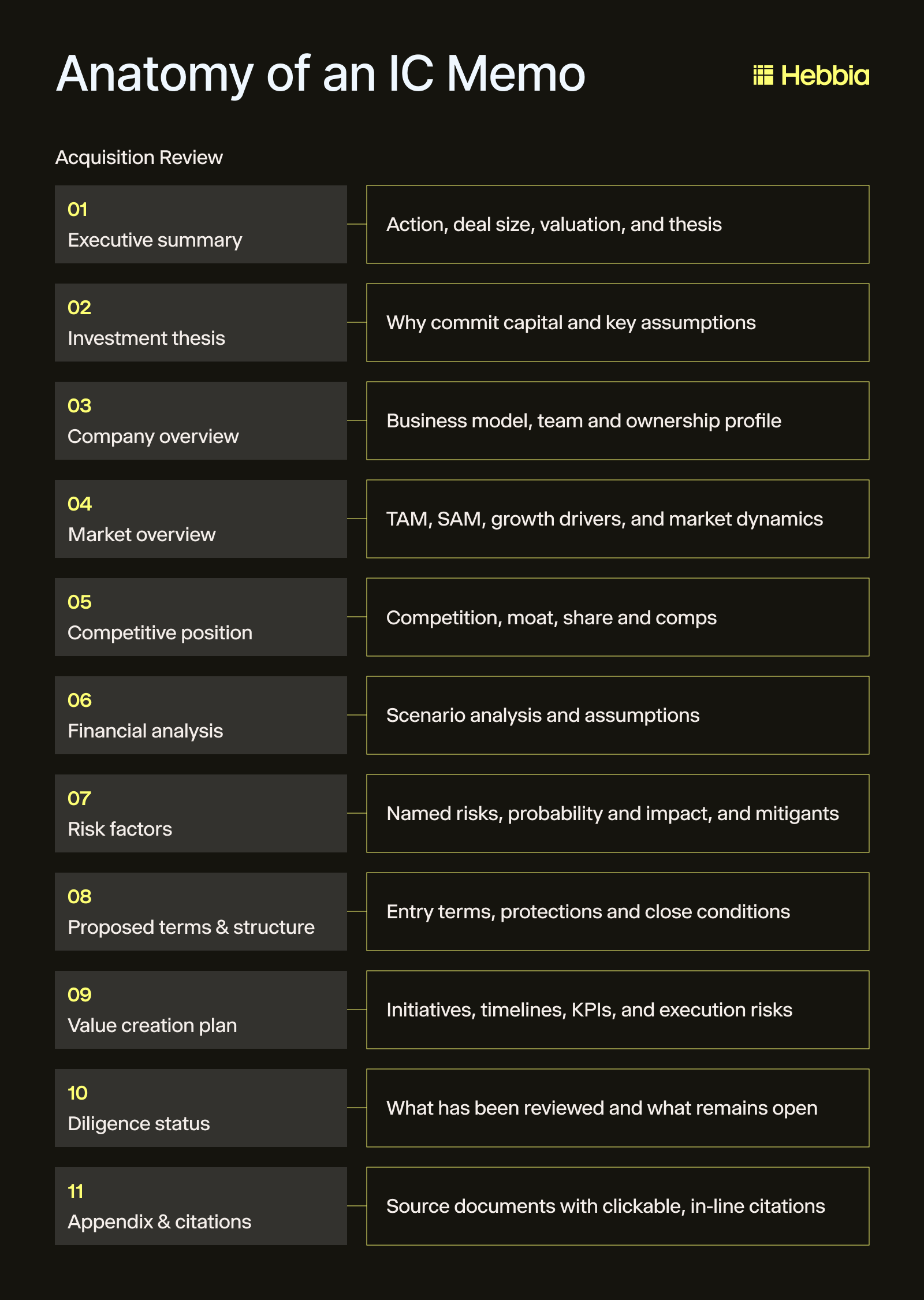
A strong IC memo follows a consistent structure that lets the committee move from thesis to evidence to risk without having to hunt for information.
The sections below cover what belongs in each part and what to leave out.
Executive Summary
The executive summary is the first thing the investment committee reads and should give them everything they need to understand the recommendation before they get to the details. Keep it to one page.
A well-structured PE executive summary covers:
- Recommended action (invest, pass, or approve with conditions)
- Deal size and entry valuation or key pricing terms
- Two-to-three sentence investment thesis
Private credit IC memos should also include
- Facility type
- Leverage
- Pricing
- Collateral/security
- Covenant highlights
What doesn't belong here is a lengthy company history or market overview—include only enough context to frame why the recommendation makes sense.
Investment Thesis
The investment thesis justifies a firm's commitment of capital to a specific deal. In one to three pages, it makes a direct claim about why the investment will generate attractive returns and lays out what has to be true for that to happen.
Every claim needs a source. An unsupported assertion in a thesis invites pushback from the committee and slows the approval process.
For private credit, the thesis functions as a repayment thesis. It answers three questions:
- Why the borrower will service and repay the debt across a base case and a downside case
- What protects the lender if performance deteriorates (collateral, covenants, structural seniority)
- What recovery looks like in a stress scenario
The strength of a credit thesis is measured by how clearly it addresses the downside, not just the base case.
Company Overview
The company overview gives the investment committee enough context to evaluate the thesis, not a comprehensive company biography. If a detail doesn't help the committee assess the investment, it doesn't belong here.
For private equity investment memos, cover:
- Business model and core value proposition
- Products and services
- Management team and references
- Ownership and sponsor profile
- Brief company history
For private credit, this section does additional work. Credit committees are less interested in the company's growth story and more interested in whether the business can service its debt when conditions deteriorate. Include:
- Existing capital structure by tranche and seniority, with maturities
- Sponsor's track record with similar credits
- Free cash flow profile and its stability
- How the business has performed through prior downturns
Market Overview
The market overview sets the stage for the sections that follow, particularly the competitive position analysis. For private equity, cover key metrics like:
- Total Addressable Market (TAM): the total revenue opportunity available if a company captured 100% of its target market
- Serviceable Available Market (SAM): the portion of the TAM a company can realistically reach given its current product, geography, and go-to-market strategy
- Growth drivers and market dynamics
- Market structure and fragmentation or consolidation trends
- Macroeconomic conditions and regulatory changes
- Potential downside drivers
TAM and SAM framing are largely an equity lens. For private credit, the market section should instead focus on:
- Industry cyclicality and demand durability
- How the borrower performs through a downturn
- Regulatory or macro factors that could affect debt serviceability
The question the credit committee is asking is not how large the market could get, but how stable it is when conditions turn.
Competitive Position
The competitive position section gives the committee a clear picture of where the company stands in its market and whether that position is defensible enough to protect returns. For private equity, include:
- Direct and indirect competitor landscape
- Competitive moat and key advantages
- Market share
- Operating comparables to benchmark performance against peers
For private credit, the analysis shifts from market positioning to credit quality indicators. Benchmarking should be against comparable issuers — leverage, spread, and covenant package relative to recent deals in the same sector and from the same sponsor — rather than equity operating comps. The goal is to establish whether the borrower has the pricing power, customer stickiness, and revenue durability to maintain its edge through a downturn.
Private credit teams should include:
- Customer concentration
- Pricing power and switching costs
- Recurring revenue streams
- Comparable issuer benchmarking
Financial Analysis
The financial analysis section presents the financial models that test whether the investment thesis holds under different conditions. At a minimum, the memo should include a base case and a downside case.
Equity deals typically add an upside case, while credit memos weigh the downside and add an explicit recovery analysis—what the lender recovers if the borrower defaults.
Every key assumption should be sourced with a clickable in-line citation so the committee can verify the inputs without requesting a follow-up.
For private equity, the focus is on forecast scenarios and return analysis. For private credit, include:
- Leverage and debt service capacity
- Covenant headroom across scenarios
- Liquidity analysis
- Recovery analysis under a default scenario
Risk Factors
The risk factors section evaluates the principal risks facing the company and the investment. Use financial risk software to uncover market risks, execution risks, credit risks, and competitive risks. For each risk, include:
- Risk name and description
- Probability and impact assessment
- Mitigant or monitoring trigger
The instinct to soften or omit risks that could threaten the deal is worth resisting. Investment committees are evaluating the team's judgment as much as the investment itself, and a memo that glosses over a material risk will lose credibility faster than one that names it directly and explains why the firm is comfortable proceeding.
Proposed Terms and Structure
The proposed terms and structure section summarizes what the firm is agreeing to if the deal is approved. For private equity, include:
- Entry price and ownership stake
- Board seats, information rights, and exit provisions
- Governance rights and key protections
- Closing conditions
- Valuation support through public trading comps and precedent transaction comps
Any terms that deviate from the firm's standard structure should be flagged explicitly, with an explanation of why the deviation is acceptable or necessary.
For private credit, the section should document the full terms package and benchmark it against comparable recent financings—spread, leverage, and structure on similar deals from the same sector or sponsor. Include:
- Facility type, pricing, and leverage
- Covenant package and headroom
- Security package and collateral
- Structural protections
- Where terms deviate from the market or from the sponsor's precedent
Value Creation Plan
The value creation plan (VCP) is a private equity section that lays out how the firm will improve the company during its ownership period. It should present a concrete roadmap—not a general statement of intent—covering the specific initiatives the firm will pursue to generate returns.
A strong VCP includes:
- Revenue growth initiatives and target benchmarks
- Margin expansion opportunities
- Multiple expansion strategy
- Potential add-on acquisitions
- Clear timelines and key performance indicators (KPIs) for each priority
- Resource requirements and execution risks with mitigation plans
Diligence Status
This section gives the investment committee a clear picture of where diligence stands at the time of the memo. List what has been completed and what remains outstanding, including any third-party reports, management calls, legal reviews, or financial analyses still in progress.
Outstanding diligence items should be flagged honestly. If a material item is incomplete, note what it is, when it is expected to be resolved, and whether approval should be conditional on its completion.
Appendix and Citations
The appendix is where all supporting materials live. It should include clickable citations linked to the documents the memo draws from, including financial models, SEC filings, earnings transcripts, the confidential investment memorandum (CIM) summary, expert call notes, internal research, and third-party reports.
Clickable in-line citations matter because they allow the committee to verify any figure or claim without separately requesting the underlying document. A well-organized appendix shortens the review cycle and signals that the analysis is audit-ready.
Common IC Memo Mistakes and How to Avoid Them
Even well-researched deals can stall at the committee stage if the memo has structural or analytical gaps. These are the most common mistakes and how to avoid them:
- Presenting scenarios without conviction: A base case that looks identical to the upside, or a downside that barely dips below base, signals that the team hasn't stress-tested its assumptions. Each scenario should reflect a genuinely distinct set of conditions, with defensible, differentiated assumptions.
- Providing invalid comps: Using comps that are too broad, too old, or from a different sector undermines the valuation and benchmarking sections. Select comps that are recent, deal-size appropriate, and from the same industry, and be prepared to explain why each one was included.
- Describing risks without mitigants: A risk section that lists concerns without pairing each one with a mitigant or monitoring trigger reads as incomplete. For each named risk, include what the firm will do if it materializes and how it will be tracked.
- Omitting diligence gaps: Leaving out incomplete or unresolved diligence items may seem to strengthen the memo, but it erodes committee trust when those gaps surface during review. Flag outstanding items honestly and note when they are expected to close.
- Using generic, unquantified commentary: Phrases like "strong market position" or "experienced management team" without supporting data are just as easy to dismiss as they are to write. Every qualitative claim should be backed by a specific data point, comp, or reference that the committee can evaluate.
- Failing to check financial models: A formula error or broken link in a model can invalidate an entire section of analysis. Before submitting, run a full model audit. Check formulas, trace inputs to sources, and confirm that outputs are consistent across scenarios.
- Not including clickable, in-line citations: A memo that doesn't link claims back to source documents forces the committee to request underlying materials, slowing the review cycle. Every key figure, assumption, and data point should be cited with a clickable link to the source, whether that's a filing, a transcript, or a third-party report.
How AI Helps Teams Prepare Investment Committee Memos
AI for finance doesn't write the memo—it makes sure the analyst writing it hasn't missed anything. The edge comes from accuracy and completeness: every claim traced to a source, every material data point surfaced before the committee asks for it. When teams trust the inputs, they move faster on the judgment.
Here's how AI supports the process across each stage of memo preparation:
Task | Traditional Methods | AI-Powered Tools |
|---|---|---|
CIM and virtual data room (VDR) review | Manual review, taking hours to days per document | Structured queries across full document sets completed in minutes |
Citation and sourcing | Analyst manually traces figures to source documents | Every output links to the exact source passage, cell, or clause |
Credit agreement analysis | Line-by-line legal review for key provisions | AI extracts and flags specific terms and deviations from precedent automatically |
Comps research | Manual data pull from databases and filings | AI assembles trading, transaction, and credit comps with sourced outputs |
First-pass drafting | Analyst builds memo from scratch using notes and models | Analyst starts with a cited first-pass synthesis to refine |
Context preservation | Manual approach that risks missing details across long, multi-document sets | Full documents are processed simultaneously —no chunking, no dropped context |
Audit readiness | Citations are added manually, often after the fact | Every claim is traceable to its source from the first draft |
Advanced AI software like Hebbia is built specifically for this kind of institutional work, processing large volumes of complex documents with sentence-level citations on every output. Every output links back to the exact source passage, cell, or clause, so analysts can verify before anything goes into the memo.
That sourcing discipline carries through to the final deliverable. The analyst's time goes toward judgment and refinement, not assembly, and the committee receives a memo where every input is traceable from the first draft.
Build Strong Investment Committee Memos Faster with Hebbia
Building an IC memo is document-intensive and high-stakes. Hebbia synthesizes across CIMs, credit agreements, filings, and transcripts to produce a fully cited first-pass draft that your team refines, with every figure and clause traceable to its source.
With over five years of focused development for finance, Hebbia has become the largest and most trusted AI platform in the industry, helping teams make faster decisions, conduct deeper analysis, and capitalize on their institutional knowledge. Book a free demo to see Hebbia in action and learn how it can help you create strong IC memos quickly.


