
Top 8 Blueflame AI Alternatives for Finance Teams
For dealmakers seeking an AI solution to power their workflows, BlueFlame AI is popular option—but is it the right one for your team?
BlueFlame AI is Datasite's agentic AI finance platform built for dealmakers, helping private equity and investment banking teams draft memos and pull insights from firm and market data. Founded as a standalone platform in 2023, the tool was acquired by Datasite in 2025, giving it native access to Datasite's virtual data room (VDR) content and to private-company data from Grata, which Datasite also owns.
However, firms are learning that no single tool fits every deal process. Some teams need deeper integration with customer relationship management platforms (CRMs) and data rooms, while others need to reason across far larger, messier document sets than an orchestration layer is built to handle.
This guide breaks down the top Blueflame AI alternatives so that investment professionals can match the right platform to their specific deal-execution needs.
What Is Blueflame AI?
Blueflame AI is an agentic deal workspace built for private equity and investment banking teams. It coordinates tasks such as assembling investment committee (IC) memo sections and running comparables by connecting to the tools a firm already uses, rather than generating the underlying analysis itself.
Here's how that works:
- System integrations: Blueflame connects to CRMs like Salesforce and DealCloud and market data providers like S&P Capital IQ, drawing on the systems that a firm already has rather than owning proprietary research content.
- Datasite acquisition: Datasite acquired BlueFlame in 2025 and folded it into its Intelligence Unit, positioning it as an AI layer built on top of Datasite's virtual data rooms rather than a standalone reasoning platform. That integration ties BlueFlame's roadmap closely to Datasite's M&A-focused ecosystem.
- Scale: Blueflame serves 125+ client firms and 3,000+ users representing more than $2 trillion in AUM.
- Blueprints: Blueflame offers Blueprints, a library of pre-built prompts for alternative investment managers that standardize outputs across a deal team.
Blueflame AI Pros
Blueflame AI has real strengths, particularly for firms that want an AI layer built around the tools they already use rather than a full platform switch. These advantages don't guarantee the right fit for every team, but they explain why the platform has found traction among deal-focused firms.
Here are the pros worth knowing before you look at where it falls short:
- Deep systems integration: Blueflame connects directly to a firm's CRM and data room systems, as well as to market data providers such as S&P Capital IQ, allowing deal teams to work without switching tools.
- Multi-model, LLM-agnostic architecture: Blueflame routes tasks across multiple frontier models rather than locking firms into a single provider, which gives them flexibility as underlying models improve.
- Native content generation: Blueflame produces IC memo sections in Word and PowerPoint and builds financial models directly in Excel, all formatted to financial services standards, which reduces manual formatting.
- Standardized workflows via Blueprints: Blueflame's Blueprints library helps standardize outputs across a deal team and reduces variance in how different analysts use the tool.
- Enterprise-grade security and backing: Blueflame is SOC 2 Type II certified with encryption at rest and in transit and role-based access controls. It also maintains full audit trails and is backed by Datasite's ownership and CapVest's $500 million commitment to expand Datasite's intelligence solutions.
Blueflame AI Cons
Blueflame's strengths come with trade-offs, especially for firms whose needs extend beyond fundraising and deal sourcing. Some of these limitations are structural, tied to how the platform was built and who now owns it, while others are simply gaps that come with a newer product.
Here's where Blueflame runs into limits:
- Narrow workflow coverage: Blueflame is built for fundraising, investor relations, and deal sourcing, but doesn't support corporate or consulting workflows and offers limited coverage of portfolio management or valuation analysis. Firms often need a second platform to fill those gaps.
- Integration-dependent setup: Getting full value requires IT and data setup work, plus integration effort with systems like Salesforce or DealCloud, which can slow time to value for firms without dedicated technical resources.
- Manual template work: Its task management tools help track deals and collaboration, but users still need to fill out templates themselves rather than getting fully automated output.
- Tied to Datasite's M&A ecosystem: Since Datasite acquired Blueflame in 2025, its roadmap and data advantages have increasingly centered on Datasite's own virtual data rooms. That can make Blueflame feel less neutral than a standalone platform for firms not already using Datasite.
- Limited document-level reasoning at scale: Blueflame orchestrates workflows and connects to outside data sources, but it isn't built to process and reason across massive, unstructured document sets the way a dedicated research engine is.
Best Blueflame AI Alternatives at a Glance
The right BlueFlame AI alternative depends on whether a team needs deep document reasoning or a narrower tool built for one specific task, like fund accounting or deal sourcing.
Use the table below to compare categories before going deeper into individual platforms.
Software | Best for | Top features |
|---|---|---|
Hebbia | High-stakes due diligence and complex document interrogation across industries | - Cross-firm collaboration with Projects - Reasoning at scale via Iterative Source Decomposition (ISD) - Finance-specific integrations - Model-input synthesis - Faster confidential investment memorandum (CIM) and deck synthesis |
S&P Capital IQ Pro | Data-rich search | - Institutional-grade company analysis and screening - Consensus estimates via Visible Alpha - Excel plug-in for live data feeds - Comp table generation and peer analysis |
F2 | AI-driven underwriting for private market investors | - Automated financial spreading - Deal-level underwriting analysis - Private market data models |
Transacted | Private equity due diligence automation | - Ingests data rooms directly - Analyzes financial and operating data - Produces IC-ready outputs |
V7 (V7 Go) | Configurable workflow automation across regulated industries | - Visual grounding for audit trails - Coverage extends to legal, insurance, and real estate - Configurable agent workflows |
Allvue Systems | Fund accounting and portfolio monitoring for alternative investment managers | - Integrated fund accounting - Portfolio monitoring - Investor management and reporting automation |
Rogo | Standardized IB workflows like CIM drafting and peer comps | - LSEG, FactSet, and S&P Global data partnerships - Subset-powered Excel rollforward - Single-tenant deployment - IB-specific task templates |
AlphaSense | Supplementing deal diligence with public market and competitive context | - Smart Synonyms search - Expert call transcript library - Generative Grid for scaling prompts across documents - 10,000+ data sources |
1. Hebbia

Best for: High-stakes due diligence and complex document interrogation across industries
Hebbia is built to reason across massive, unstructured document sets rather than orchestrate tasks between other tools, which is the core difference for teams moving off Blueflame.
BlueFlame focuses on deal sourcing and IC workflows for private equity and investment banking. Hebbia serves those same private equity and investment banking teams, along with legal teams, to interrogate data rooms and public filings at scale, with every output traceable back to its source.
For firms running high-stakes due diligence, that scale advantage matters more than workflow templates. Hebbia's Iterative Source Decomposition (ISD) technology breaks complex questions into verifiable sub-tasks across an entire document set, and its Projects feature lets multiple teams collaborate on the same research thread instead of working in silos. It's a stronger fit for firms whose due diligence needs span more than one deal type or department.
Key features:
- Cross-firm collaboration with Projects: Projects enables multiple teams to work within the same research environment, share sources, and build on each other's work rather than duplicating effort. For firms managing overlapping deals or diligence streams, this creates a single source of truth instead of scattered spreadsheets and decks.
- Reasoning at scale via Iterative Source Decomposition: ISD breaks complex financial questions into smaller sub-tasks and works through them against the full underlying document set rather than a limited context window. It allows Hebbia to reason across data rooms containing thousands of files, rather than forcing a firm to shrink the problem to fit a smaller model's constraints.
- Finance-specific integrations: Hebbia connects to the data sources finance teams already use, from internal deal files to external market data, without requiring a separate migration process. Teams can start querying live and historical information on day one.
- Model-input synthesis: Hebbia pulls assumptions and figures directly from source documents into a financial model, reducing the manual work of transcribing numbers from PDFs or transcripts into spreadsheets. That minimizes transcription errors and frees analysts to focus on judgment calls rather than data entry.
- Faster CIM and deck synthesis: Hebbia generates structured CIM sections and pitch decks directly from underlying deal documents in a fraction of the time manual drafting takes, citing the specific source for each claim.
Hebbia vs. Blueflame AI
Feature | Hebbia | Blueflame AI |
|---|---|---|
Primary data advantage | Reasons directly across a firm's own documents, including data rooms, filings, and transcripts, rather than relying on outside data partnerships | Draws on connected systems like CRMs and market data providers such as S&P Capital IQ, plus native access to Datasite's virtual data room content |
Reasoning depth and workflow | Uses Iterative Source Decomposition to break complex questions into sub-tasks and reason across an entire document set | Orchestrates workflows across existing tools, routing tasks like memo assembly and comps through multiple frontier models |
Accuracy and auditability | Every output is traceable back to its exact source document and page, giving teams a verifiable audit trail for high-stakes decisions | SOC 2 Type II certified with a full audit trail of platform activity, though outputs depend on the accuracy of the external models and connected systems it routes through, rather than a single proprietary reasoning layer. |
System integration | Connects to finance-specific data sources and works as a standalone platform across finance, legal, and corporate use cases | Built specifically to plug into a firm's existing CRM, data room, and market data stack |
See how Hebbia handles your firm's own documents. Request a demo to test it against a real data room, deal file, or research question before comparing it to the rest of this list.
2. S&P Capital IQ Pro
Best for: Data-rich search
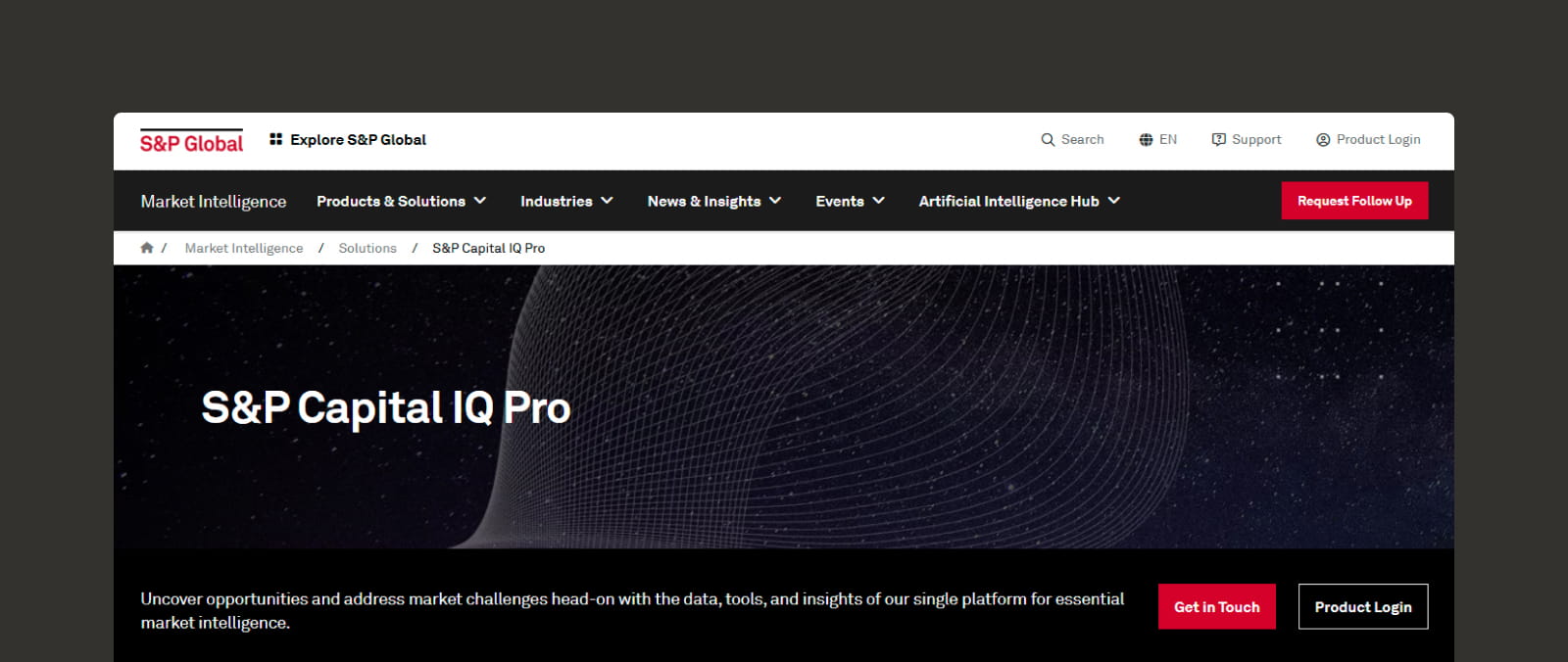
S&P Capital IQ Pro is S&P Global's market intelligence platform, built for company research, screening, and peer benchmarking rather than workflow automation. It covers more than 52 million private companies and 62,000 public companies. That coverage condenses into over 135 billion raw data points a year, feeding research that analysts can pull directly into Excel, from company comps to industry benchmarking.
While Blueflame coordinates tasks across a firm's existing systems, S&P Capital IQ Pro serves as one of the underlying data sources those workflows draw on, including Blueflame's own integrations.
Teams evaluating Blueflame as an alternative should note that Capital IQ Pro solves a different problem. It's a research and screening terminal, not an agentic layer that assembles memos or automates diligence steps.
Key features:
- Institutional-grade company analysis and screening: Analysts can screen companies using financial metrics and industry classifications to quickly build comparable sets. It's a common starting point for equity research and M&A screening workflows.
- Consensus estimates via Visible Alpha: Following its 2025 integration, the platform includes Visible Alpha's granular analyst consensus estimates and financial models, providing users with visibility into how the sell side models a company beyond headline forecasts.
- Excel plug-in for live data feeds: The Office plug-in pulls live financial data directly into spreadsheets, keeping models up to date without manual re-entry.
- Comp table generation and peer analysis: Analysts can build comparable company tables and precedent transaction sets directly within the platform, speeding up benchmarking work that would otherwise require pulling data from multiple sources by hand.
S&P Capital IQ Pro vs. Blueflame AI
Feature | S&P Capital IQ Pro | Blueflame AI |
|---|---|---|
Primary data advantage | Draws on S&P Global's own market data, covering tens of millions of public and private companies and hundreds of billions of data points processed annually | Connects to a firm's CRM and market data providers, including S&P Capital IQ itself, rather than owning proprietary market data |
Reasoning depth and workflow | A research and screening terminal built around structured financial data, not a task-orchestration or reasoning layer | Orchestrates workflows across connected tools, using multiple models to coordinate tasks like memo assembly and comps |
Accuracy and auditability | Data is sourced and maintained directly by S&P Global, giving users a standardized source of truth for financial figures | SOC 2 Type II certified with a full audit trail of platform activity, though outputs depend on the accuracy of the external systems and models it routes through |
System integration | Plugs into Excel and Office tools directly, and is often used as a data layer underneath other platforms, including Blueflame itself | Built to plug into a firm's CRM and market data systems, including S&P Capital IQ |
3. F2
Best for: AI-driven underwriting for private market investors
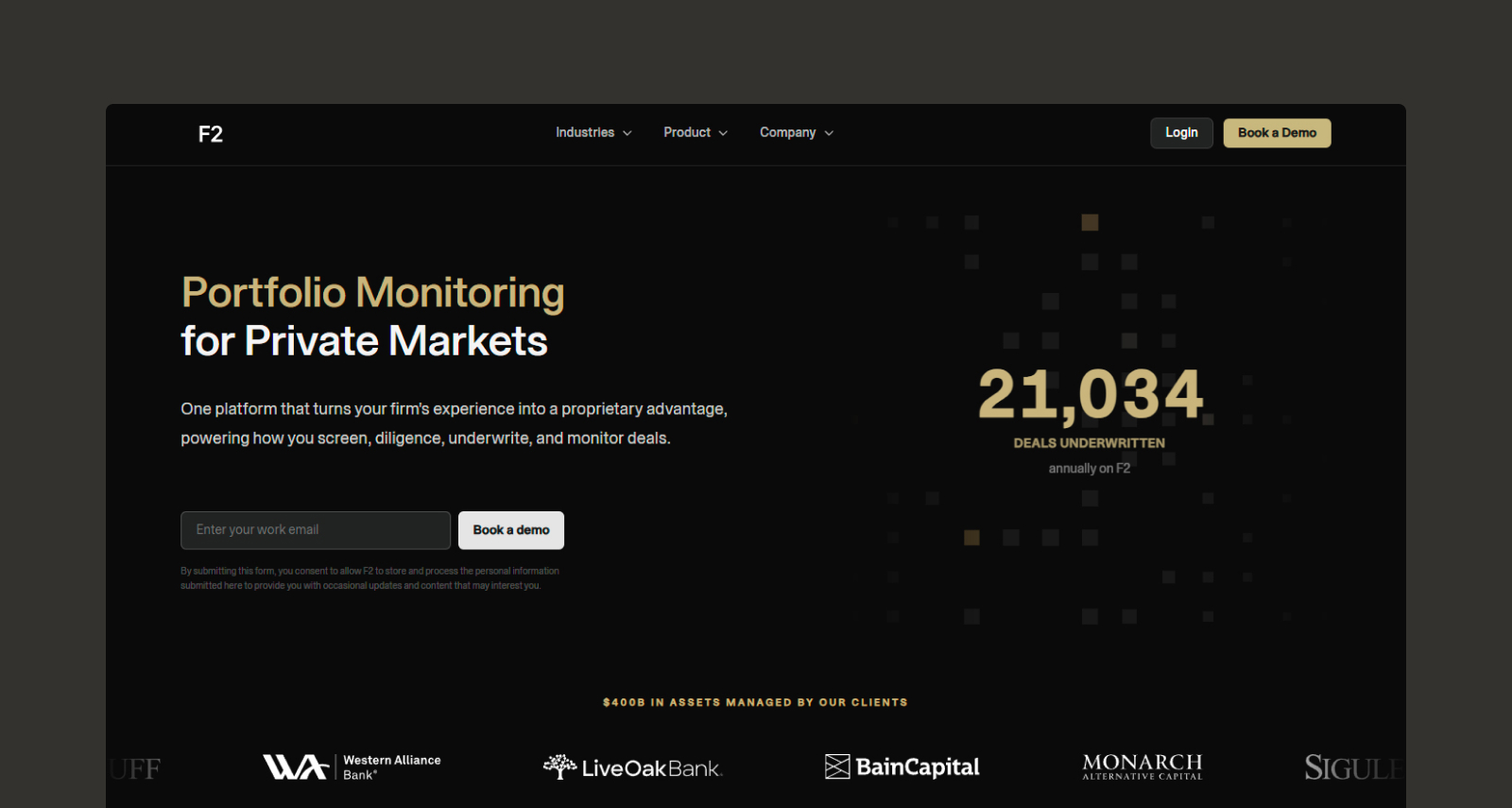
F2 is an AI underwriting platform designed for private markets investors, including private credit and private equity teams. It works within a firm's existing financial model rather than summarizing it from the outside, resolving circular references and preserving cell dependencies as an analyst would.
That's a narrower focus than Blueflame, which orchestrates workflows and deal sourcing across a firm's existing systems instead of working within the underwriting math itself. F2 is built specifically for the computational side of underwriting, while Blueflame is built to coordinate tasks across a broader set of tools.
Key features:
- Automated financial spreading: F2 reads directly from source financial statements and populates spreading templates automatically, cutting down the manual data entry that typically consumes early-stage underwriting work.
- Deal-level underwriting analysis: The platform's Excel-native engine operates within a firm's financial models, resolving formulas and preserving cell dependencies.
- Private market data models: F2's Institutional Knowledge feature builds on a firm's own historical deal data, helping the model apply firm-specific underwriting standards and precedent to new deals.
F2 vs. Blueflame AI
Feature | F2 | Blueflame AI |
|---|---|---|
Primary data advantage | Works directly inside a firm's own financial models and historical deal data via Institutional Knowledge, rather than pulling from third-party market data providers | Draws on connected CRM and market data sources, such as S&P Capital IQ, to inform its outputs |
Reasoning depth and workflow | Focuses narrowly on underwriting math, reasoning inside live Excel models with a three-layer audit trail from claim to formula to source cell | Coordinates broader workflow tasks like memo assembly and comps across connected tools, rather than reasoning inside the underwriting math |
Accuracy and auditability | Every figure traces back through its formula to its original source cell, with F2 scoring 95.25% on the SpreadsheetBench Verified benchmark | Maintains a full audit trail of platform activity and is SOC 2 Type II certified, but doesn't offer the cell-level formula tracing that anchors F2's accuracy claims |
System integration | Built specifically around Excel and existing financial models rather than CRM or data room systems | Built around CRM and market data systems rather than living inside Excel models |
4. Transacted
Best for: Private equity due diligence automation
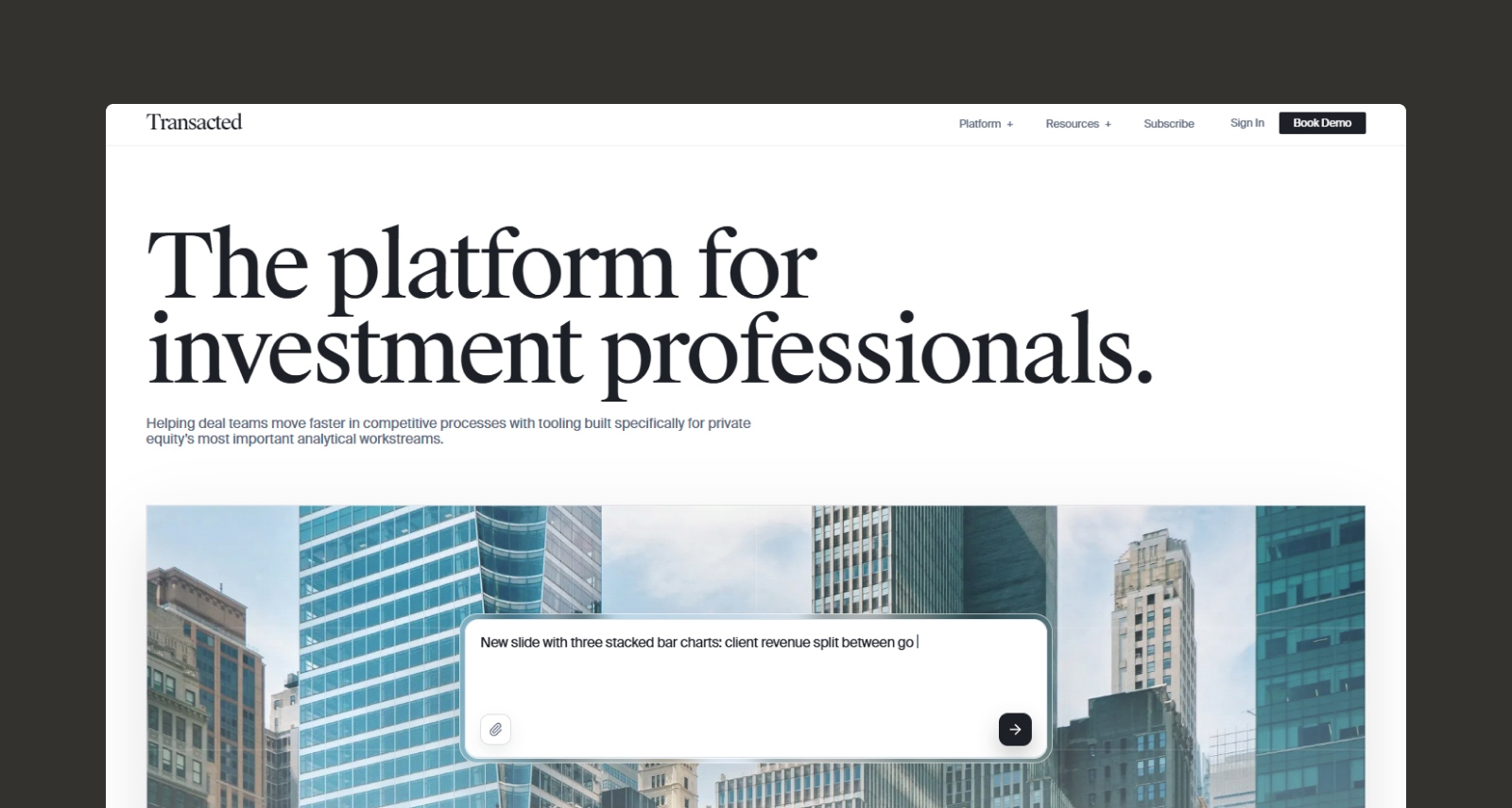
Transacted is a diligence platform built for private equity teams working through messy, large datasets from target companies, such as customer cohorts and retention analyses. Rather than coordinating tasks across a firm's broader tech stack, it concentrates on the live diligence work itself, turning raw deal materials into traceable, presentation-ready analysis.
Every analysis on the platform links back to specific cell ranges in the source files, supporting the traceability required by private equity due diligence. That's a narrower focus than Blueflame, which coordinates broader deal-lifecycle tasks across a firm's connected systems, rather than concentrating on the analytical due diligence itself.
Key features:
- Ingests data rooms directly: Transacted pulls messy deal materials directly from a data room rather than requiring reformatting first, cutting down the manual prep work that usually precedes diligence analysis.
- Analyzes financial and operating data: The platform handles detailed analyses, such as cohort and retention breakdowns, that go beyond standard financial statement review.
- Produces IC-ready outputs: Every analysis links back to specific cell ranges in the source files, so the resulting output is traceable and ready to drop into an investment committee memo.
Transacted vs. Blueflame AI
Feature | Transacted | Blueflame AI |
|---|---|---|
Primary data advantage | Works directly from a target company's own operating data pulled from the data room | Connects to a firm's CRM and market data providers rather than working directly inside a target's operating data |
Reasoning depth and workflow | Concentrates on live diligence execution and analytical work product, with precedent tracing back to source cell ranges | Coordinates broader deal lifecycle tasks, like sourcing and memo assembly, across a firm's connected systems |
Accuracy and auditability | Every analysis links back to specific cell ranges in the original source file, supporting the traceability due diligence requires | Maintains a full audit trail of platform activity, but doesn't offer the same cell-level tracing back to source documents |
System integration | Built specifically around data room ingestion and diligence workflows rather than CRM or broader deal lifecycle systems | Built around CRM, data room, and market data systems to coordinate tasks across the broader deal lifecycle, rather than diligence analysis alone |
5. V7 (V7 Go)
Best for: Configurable workflow automation across regulated industries
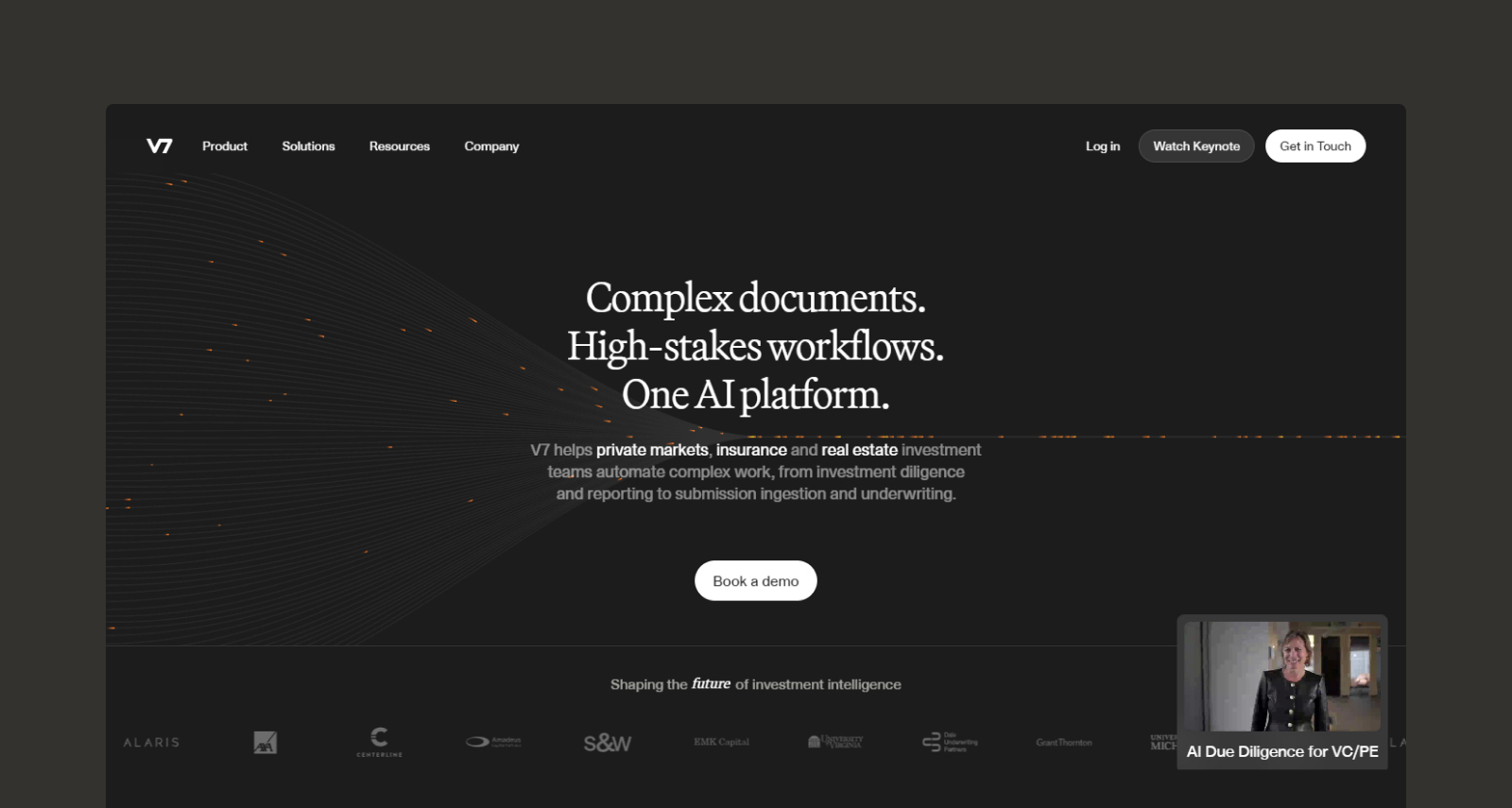
V7 Go is built around visual grounding, a technique that traces every extracted value back to its exact location in the source document. It supports compliance requirements like SOX and HIPAA, giving compliance teams a way to verify outputs without re-reading entire files.
The platform includes more than 300 pre-built agents that use the same underlying framework across finance and other regulated industries, including legal and insurance. These roles range from contract managers and claims processors to financial analysts. Blueflame concentrates specifically on private equity and investment banking workflows, so V7 is the more configurable option for firms that need the same agent framework applied across multiple business lines beyond investment work.
Key features:
- Visual grounding for audit trails: V7 traces every extracted value back to its exact location in the source document, creating a visual audit trail that compliance teams can verify without re-reading entire files.
- Coverage extends to legal, insurance, and real estate: Beyond finance, the platform offers agents built for contract review, claims processing, and other regulated-industry workflows.
- Configurable agent workflows: Teams can build and adjust agents through a graphical workflow editor with role-based permissions instead of relying on a single fixed template.
V7 Go vs. Blueflame AI
Feature | V7 Go | Blueflame AI |
|---|---|---|
Primary data advantage | Doesn't own proprietary market data; its advantage comes from configurable agents applied to a firm's own documents across multiple industries | Connects to a firm's CRM and market data providers, tailored specifically to private equity and investment banking deals |
Reasoning depth and workflow | Uses visual grounding to trace every output to its exact source location, supporting compliance-heavy industries beyond finance | Coordinates workflows across connected systems for deal-related tasks like sourcing and memo assembly |
Accuracy and auditability | Reports 95-99% accuracy on document processing benchmarks, with audit trails built to support regulatory requirements like SOX and HIPAA | Doesn't offer the source-level visual grounding that anchors V7's accuracy claims |
System integration | Includes a graphical workflow editor, role-based permissions, and API access for building custom agents across departments | Built around CRM, data room, and market data systems for dealmaking workflows, not the cross-industry, department-level agent building V7 supports |
6. Allvue Systems
Best for: Fund accounting and portfolio monitoring for alternative investment managers
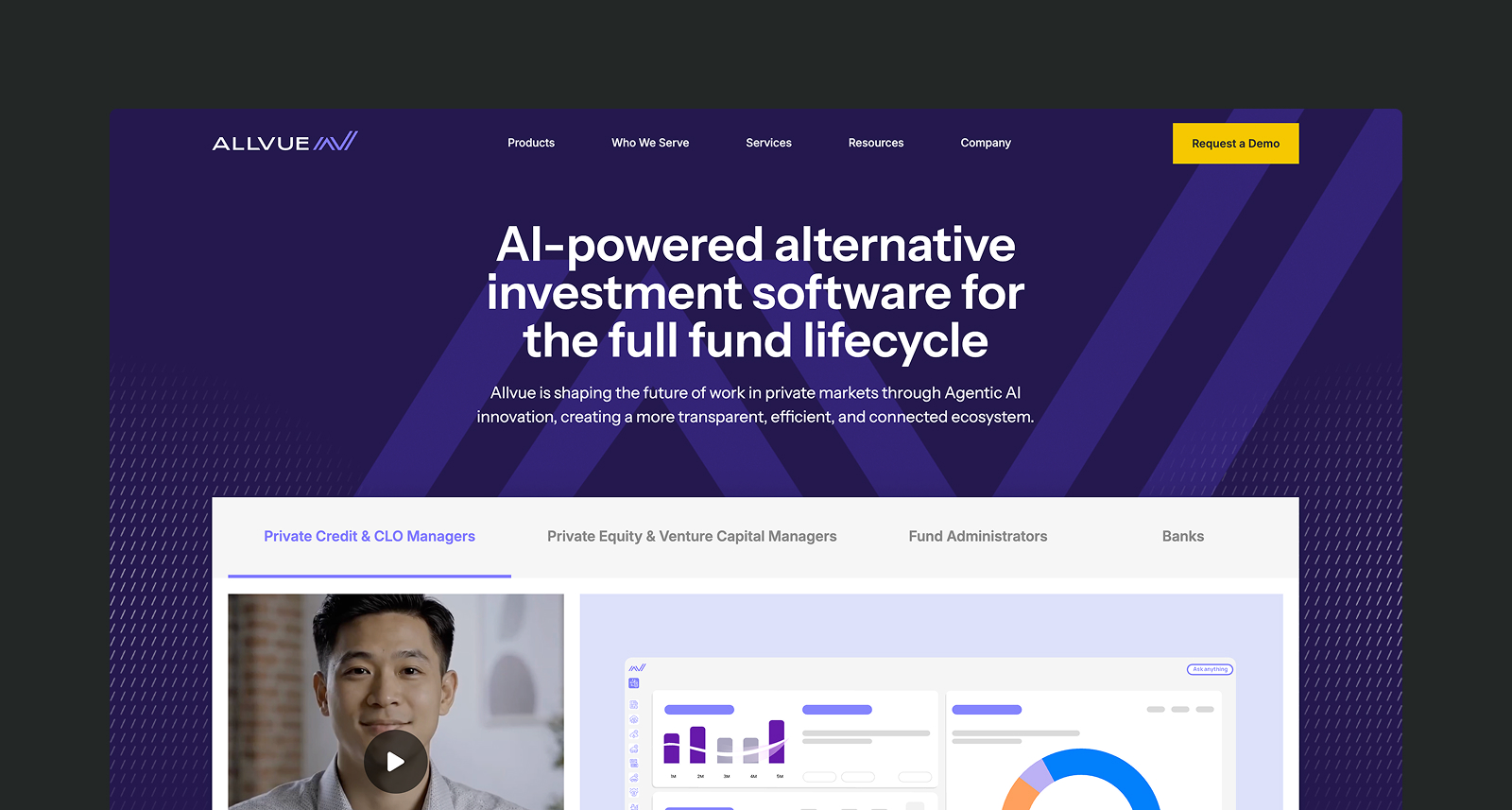
Allvue Systems is built for the back-office side of alternative investing, handling fund accounting and portfolio monitoring for private equity firms and fund administrators. Its Fund Accounting module automates capital call processing and distribution calculations, replacing much of the manual spreadsheet work many finance teams still rely on for quarter-end close.
Across its client base, Allvue supports more than $8.5 trillion in assets and 21,000 funds, reflecting how embedded it is in back-office operations at larger alternative investment firms. While Blueflame focuses on front-office tasks like memo drafting and deal sourcing, Allvue handles the ongoing fund accounting and investor reporting that continue long after a deal closes.
Key features:
- Integrated fund accounting: Allvue automates capital call processing and distribution calculations, replacing much of the manual spreadsheet work behind quarter-end close. An optional waterfall module also handles carried interest calculations under detailed limited partner agreement (LPA) terms.
- Portfolio monitoring: Allvue provides a cloud-based platform with real-time data and dynamic dashboards, so general partners and fund administrators have a single source of truth for portfolio company performance over time.
- Investor management and reporting automation: Firms use Allvue to produce presentation-quality investor reports faster and with fewer errors than legacy Excel-based processes.
Allvue Systems vs. Blueflame AI
Feature | Allvue Systems | Blueflame AI |
|---|---|---|
Primary data advantage | Built around a firm's own fund accounting and portfolio data across its lifecycle, rather than external market intelligence or deal sourcing data | Connects to a firm's CRM and market data providers to support front-office deal work, an area Allvue doesn't cover |
Reasoning depth and workflow | Automates structured, rules-based back-office processes like capital calls and distribution waterfalls rather than open-ended reasoning tasks | Coordinates front-office workflows like memo assembly and comps across connected tools, rather than ongoing accounting work |
Accuracy and auditability | Includes a full audit trail and role-based permissions built around fund accounting and compliance requirements | Auditability is centered on deal workflows rather than fund-level accounting records |
System integration | Built to serve as the back-office system of record for fund accounting and portfolio monitoring across a firm's fund lifecycle | Built around CRM, data room, and market data systems for front-office dealmaking |
7. Rogo
Best for: Standardized IB workflows like CIM drafting and peer comps
Former investment bankers founded Rogo in 2021 to automate repetitive, time-intensive tasks that consume junior analysts' hours. The platform serves as a workflow orchestrator built on top of large language models, designed to streamline outputs such as company profiles and benchmarking analyses.
Rogo's roots in investment banking are both its greatest strength and its main constraint. It was built specifically for IB workflows, and that specificity shows up in features like Excel rollforward through its 2025 acquisition of Subset and single-tenant deployment for banks with strict security requirements. Where Blueflame and other Rogo competitors span private equity and investment banking more broadly, Rogo stays narrowly focused on the standardized tasks that make up a banker's day-to-day work.
Key features:
- LSEG, FactSet, and S&P Global data partnerships: Rogo offers direct, real-time access to these partners' data, letting users query premium datasets without leaving the platform.
- Subset-powered Excel rollforward: Following its 2025 acquisition of Subset, Rogo can automatically roll forward large, multi-tab Excel models and audit formula errors.
- Single-tenant deployment: Rogo runs on isolated, single-tenant infrastructure backed by a dedicated Security Advisory Board, which has helped it achieve standardized status with banks such as Lazard and Jefferies.
- IB-specific task templates: The platform's interface is built around standard banking deliverables like peer comps and CIM drafting, making it easier for junior staff to adopt without extensive training.
Rogo vs. Blueflame AI
Feature | Rogo | Blueflame AI |
|---|---|---|
Primary data advantage | Draws on direct partnerships with LSEG, FactSet, and S&P Global for real-time market data, though it doesn't own that data itself | Connects to CRMs and market data providers geared toward private equity and investment banking deal execution |
Reasoning depth and workflow | Operates as a workflow orchestrator built on top of LLMs, optimized for standardized IB tasks like comps and CIM drafting | Coordinates a similarly broad set of workflow tasks, but across private equity and investment banking rather than Rogo's IB-specific templates |
Accuracy and auditability | Provides auditable, response-level citations, but lacks true sentence-level sourcing back to a specific passage | Maintains a full audit trail of platform activity and is SOC 2 Type II certified, though it doesn't publish citation granularity details |
System integration | Runs on single-tenant infrastructure with a dedicated Security Advisory Board, positioning it for banks with strict compliance requirements | Connects to a broader mix of CRM, data room, and market data systems, reflecting its use across private equity and investment banking |
Comparing Hebbia and Rogo specifically? Read our full breakdown of Hebbia vs. Rogo for a deeper look at how the two platforms handle document reasoning, workflow templates, and enterprise security.
8. AlphaSense
Best for: Supplementing deal diligence with public market and competitive context
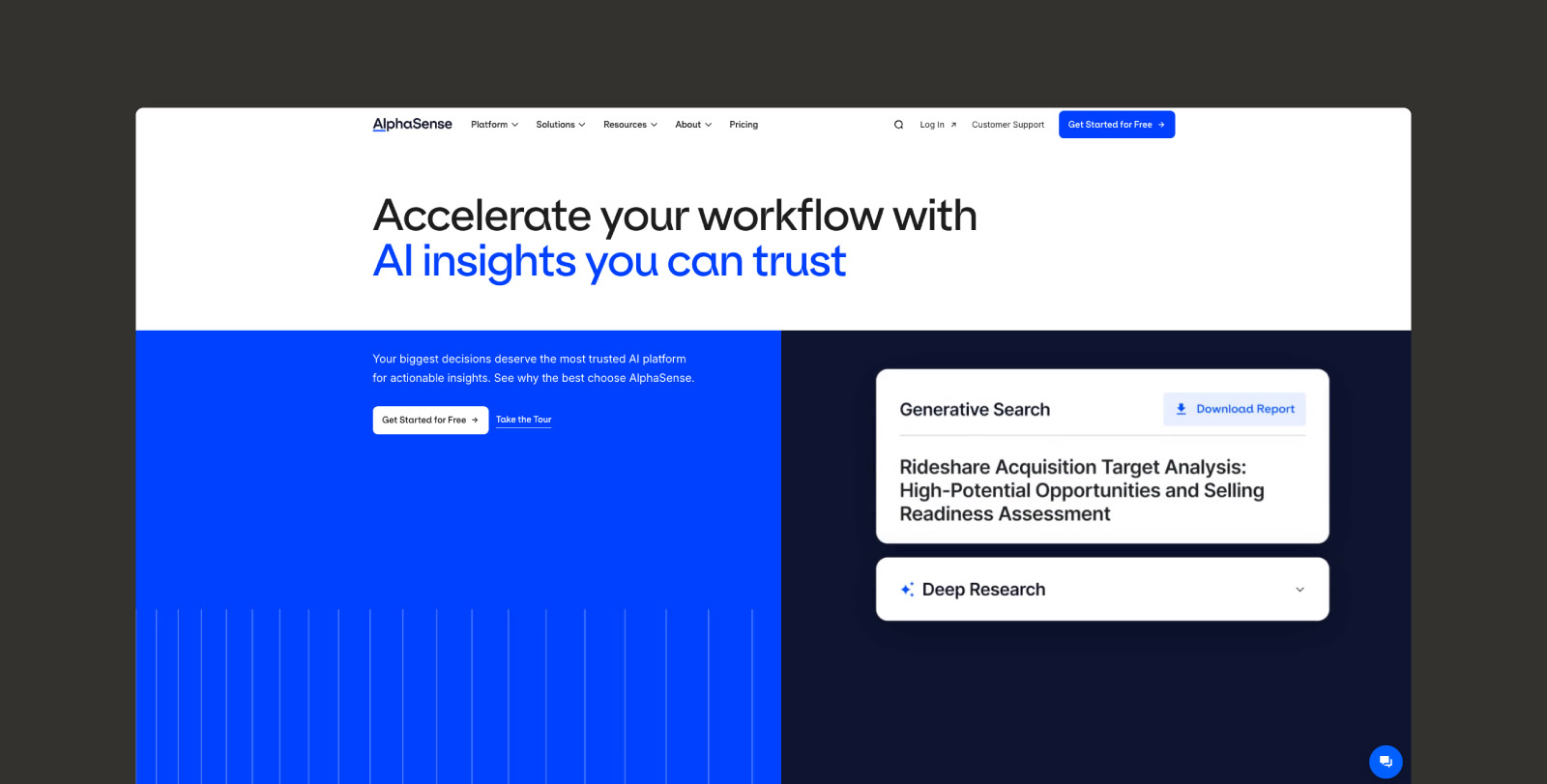
AlphaSense is an investment research platform designed for financial and corporate research, with a search engine that understands context rather than requiring exact keyword matches. Its Smart Synonyms feature recognizes related terms, so a search for margin pressure, for example, also surfaces documents that use language like pricing headwinds or cost inflation.
Through its Tegus acquisition, AlphaSense also provides a library of 280,000+ expert call transcripts, giving research teams a way to source outside perspectives beyond a company's own filings. While Blueflame focuses on private equity and investment banking workflow automation, AlphaSense is built specifically for market and competitive intelligence, making it more of a complement to a workflow-focused platform than a full replacement.
Key features:
- Smart Synonyms search: AlphaSense's search engine automatically recognizes related terms and phrasing, delivering more comprehensive results to queries
- Expert call transcript library: Through its Tegus acquisition, the platform provides access to thousands of expert call transcripts featuring insights from former executives and industry operators.
- Generative Grid for scaling prompts across documents: Generative Grid applies a single prompt across multiple documents at once and returns the results in a table, useful for tasks like scanning several earnings calls in the same reporting season.
- 10,000+ data sources: The platform pulls from company documents, expert transcripts, news, and regulatory filings, giving research teams a single place to search across a wide range of sources.
AlphaSense vs. Blueflame AI
Feature | AlphaSense | Blueflame AI |
|---|---|---|
Primary data advantage | Combines company documents, regulatory filings, and its own library of expert call transcripts | Draws on a firm's own CRM and market data connections rather than AlphaSense's proprietary transcript library and document coverage |
Reasoning depth and workflow | Uses Smart Synonyms and Generative Grid to search and summarize across a broad research library | Coordinates workflow tasks like memo drafting and deal sourcing across a firm's connected systems, an area AlphaSense doesn't cover |
Accuracy and auditability | Provides source citations across its GenAI features, though its focus is breadth of search rather than page-level document interrogation | Maintains a full audit trail of platform activity focused on deal-related outputs rather than research citations |
System integration | Operates largely as a standalone research and search platform rather than a connector into a firm's CRM or deal systems | Built specifically to plug into a firm's CRM, data room, and market data systems for deal execution |
How To Choose the Right Blueflame AI Competitor
No two firms have identical requirements, so the right Blueflame alternative depends on a handful of practical factors. Use the tips below to narrow the list before requesting demos:
- Match the tool to your primary use case: Deep document interrogation across thousands of pages calls for different capabilities than market intelligence research, so start by identifying which problem you're actually solving.
- Evaluate integration requirements: Decide whether your team wants a single consolidated platform or point solutions that integrate with your existing CRM and data room stack, since that shapes onboarding time and total cost.
- Assess your document volume and complexity: If your team regularly works through entire data rooms with thousands of documents, prioritize platforms like Hebbia built for that scale rather than tools designed for smaller, more focused research.
- Consider team size and deployment scope: Per-seat tools built for a single department operate differently from firm-wide platforms designed to coordinate across teams, so match the tool's scope to how broadly you plan to roll it out.
- Test accuracy and source transparency: Request a demo using your own documents and check how easily you can trace any output back to its original source. Page-level citations should be table stakes for financial decisions.
Move Beyond Point Solutions With Hebbia
Choosing among these Blueflame AI alternatives comes down to how your team actually works, not just which platform has the longest feature list. A CRM-integrated tool might suit a firm focused purely on deal sourcing, and a specialist platform makes sense for fund accounting.
But firms that need to reason across massive document sets, coordinate work across multiple teams, and trust every output down to the page level need something built for that scale.
If your current tools can't keep up with the volume or complexity of your due diligence, request a demo with Hebbia. See firsthand how Hebbia processes entire data rooms, generates cited outputs, and helps your firm reason across the full record with outputs you can defend line by line.


