
AI for Financial Document Processing: What It Is, How It’s Used, and More
Every finance professional knows what it feels like to spend countless hours reading, cross-referencing, and pulling insights from dense, complex documents. Whether you’re digging through a virtual data room (VDR) for due diligence or parsing a lengthy credit agreement, document review is time-consuming. However, it is also where the judgment that drives a deal or a thesis actually happens.
Generic AI tools and large-language models (LLMs) provided a starting point for AI-based financial document processing, but it quickly became clear that they don’t cut it for finance, often yielding inaccuracies, missing context, and failing to answer complex queries. Finance firms need specialized, purpose-built platforms to implement AI document processing at scale.
In this article, we’ll break down how specialized AI for financial processing is fundamentally changing the industry, how top professionals are leveraging it today, and what you should look for when choosing a solution for your team.
What Is AI Document Processing for Finance?
In finance, AI document processing refers to the use of AI platforms to review complex financial documents. Finance professionals use AI platforms to ingest, analyze, and extract data from documents. It can include simple tasks, such as pulling figures from a 10-K report, and complex workflows, such as synthesizing key insights and patterns across a full VDR.
Across the industry, finance professionals often have to synthesize tons of complex documents into a single deliverable. As such, they typically use specialized AI document analysis platforms that can analyze multiple documents at once, interface with both public and private data, and answer complex queries while maintaining accuracy and auditability at scale.
How Finance Teams Use AI for Document Processing
Professionals across the industry can leverage AI document processing platforms throughout their workflows. For instance, private equity analysts can use it to conduct AI-powered due diligence, while hedge fund analysts can use it to support investment research analysis.
Due Diligence and VDR Review
A typical VDR contains dozens, or even hundreds, of files, ranging from management call notes and organizational charts to financial reports and legal contracts. AI document processing platforms can ingest full VDRs and synthesize analysis across all documents simultaneously.
Junior investment banking or private equity analysts, with the right AI tool, can surface hidden patterns and insights that represent material risks, opportunities, or discrepancies in minutes rather than hours. This way, senior personnel can adjust deal terms and negotiation strategies faster.
Example: An analyst at a private equity firm uploads a VDR for a software deal into an AI platform. Instead of manually reviewing each customer contract for change-of-control provisions, they query the platform across all agreements at once. In minutes, they have a structured table flagging which contracts require consent, with citations linked to the exact clauses as evidence.
Confidential Information Memorandum (CIM) Screening
Professionals can use specialized AI document processing platforms to reliably surface key insights, such as EBITDA trends, customer concentration, operational KPIs, and risks. They can also flag inconsistencies between management projections and historical performance.
AI tools for financial document processing enable firms to quickly screen CIMs against investment criteria, helping them allocate analyst time most efficiently.
Example: A private equity team using Hebbia, for instance, receives five CIMs. Rather than spending days analyzing the CIMs for patterns and discrepancies, they upload them to the platform and receive structured, citation-linked summaries in minutes.
Credit Agreement Analysis
Credit professionals use AI document processing platforms to surface specific provisions from dense credit agreements that can reach 150 pages or more. A good AI platform can save analysts hours of time by automatically surfacing specific provisions, such as financial covenants, baskets and carveouts, EBITDA definitions and add-backs, change-of-control terms, and more.
Once the relevant provisions are surfaced, professionals can use AI to flag where a new agreement materially deviates from precedent, protecting downside before a deal closes.
Example: A credit analyst receives a proposed credit agreement and needs to assess how it compares with market precedent. They upload the agreement into an AI platform and query the system to flag where the new proposal deviates on key terms. They receive a structured comparison within minutes, highlighting major points of deviation.
SEC Filing and Earnings Transcript Analysis
Teams across the industry, from investment bankers to equity researchers, leverage public documents like SEC filings (10-Ks, 10-Qs, etc.), earnings call transcripts, and equity research reports to identify changes over time.
For instance, analysts can query AI to surface:
- Changes in management tone and hedging from earnings calls
- Edits to risk factors and management discussion and analysis (MD&A) language across filings
- Signals that can be used to update a financial model or investment thesis ahead of the consensus
Example: An investment banking analyst wants to track how management has discussed promotional activity over the past eight quarters. They use AI to query across all earnings transcripts simultaneously, and the platform returns a source-linked timeline of relevant commentary.
Proprietary Research Synthesis and Validation
Expert call notes, site visit reports, and primary research are among the most differentiated types of information a buy-side team can generate. The challenge is that this intelligence is often siloed in scattered folders, separate platforms, or different inboxes.
AI document processing platforms can index and analyze all proprietary research sources and triangulate them against management commentary and public data to surface a variant view.
Example: A hedge fund analyst needs to synthesize proprietary research takeaways to identify current patterns in the U.S. semiconductor industry that the broader market is missing. They can index all of them within an AI platform and query across documents simultaneously to surface hidden insights, such as changes in management tone over time and developing supply chain bottlenecks.
Deliverable Preparation
The best AI platforms in finance also support production, not just document processing and analysis. With the right platform, teams can synthesize their takeaways into accurately formatted first-pass deliverables that conform to their firm’s templates and include accurate data visualizations with citation links.
Building a first draft can take days, weeks, or more. Constant back-and-forth review cycles can slow deals down. Using Hebbia, for example, teams can create audit-ready first-pass deliverables, such as confidential investment memos (CIMs), investment committee (IC) memos, and pitch decks, to streamline senior review and ship to clients with confidence.
Example: An investment banking associate needs to synthesize disparate VDR materials and analysis notes into a compelling CIM. They prompt a specialized AI agent that uses the document and analysis rendered in the user’s AI platform to build the CIM according to their firm’s template. Structure and formatting are flawless, while the narrative developed by the associate is tightened into investor-ready language and supported by inline citations.
Key Benefits of Using AI for Financial Document Processing
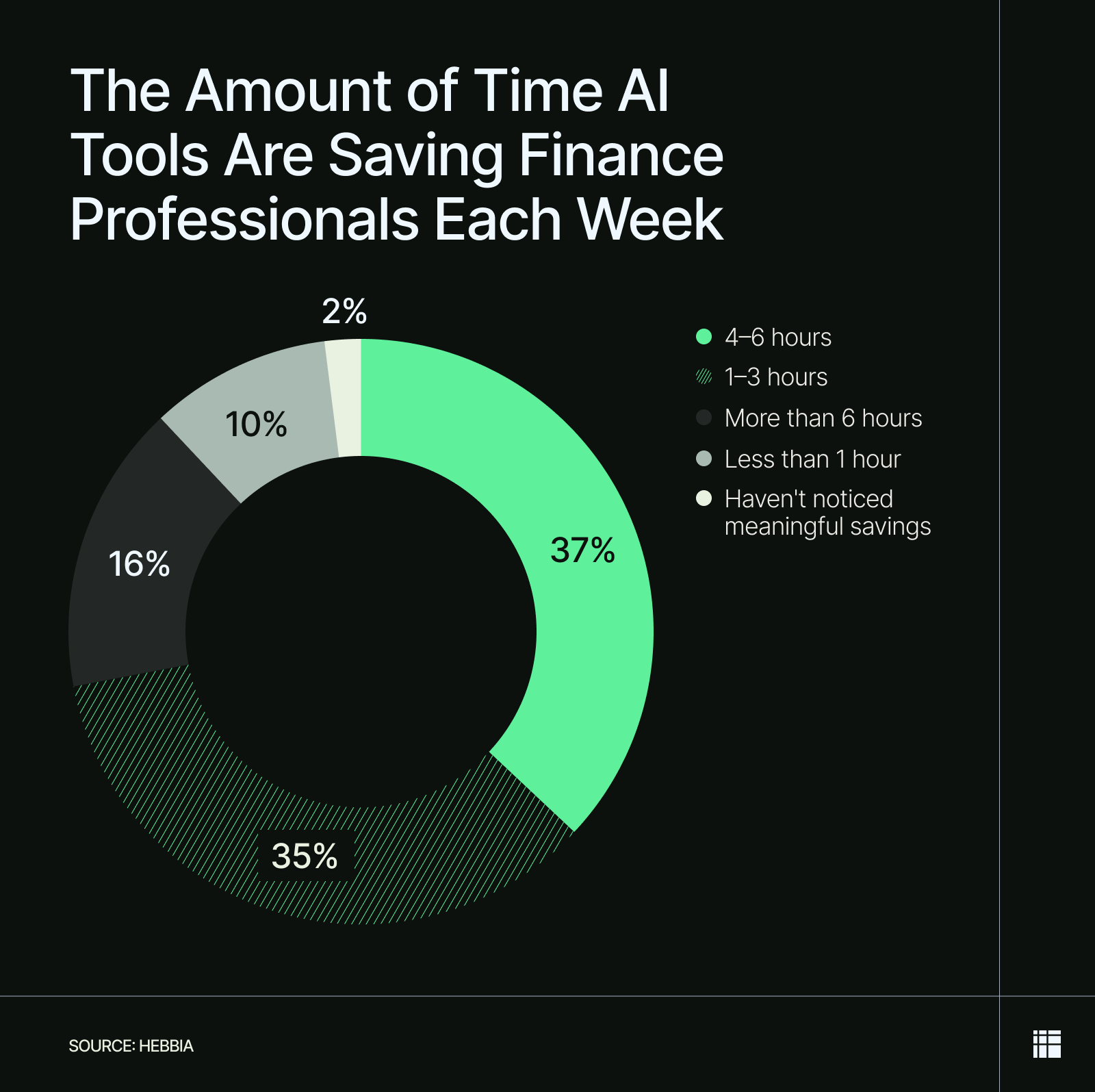
Implementing the right platform for AI financial document processing can result in meaningful benefits, like:
- Faster speed-to-insight in analysis work: In a recent Hebbia study, we found that 50% of finance professionals spend 6 hours or more per week searching for information in documents before analysis. Using AI for financial document processing dramatically speeds up the process, letting professionals get to in-depth analysis and deliverable production faster.
- Improved scalability: The same study found that 76% of finance professionals say document volume affects the accuracy or depth of their analysis at least occasionally. AI financial document processing platforms help teams take on their workload demands without sacrificing accuracy. This way, firms can expand coverage efficiently and adapt to market shifts quickly.
- Greater accuracy across workflows: Even the professionals who are at the top of their line of work can miss important details as they process documents. Our study found that 40% of finance professionals note that important insights and risks get overlooked at least once per month, especially due to time pressures. With the right tool, this is less likely to happen.
Challenges to Watch For When Implementing AI for Financial Document Processing
While implementing document automation for finance can come with a lot of benefits, there are also some challenges associated with it, such as:
- Hallucination risk: Some AI platforms, especially generic tools that rely on a standalone retrieval-augmented generation (RAG) architecture, may produce nonsensical or false outputs. This is an unacceptable risk for virtually all firms in industries where trust and credibility are paramount, like finance. To avoid this, select an AI platform that meets the accuracy standards firms demand.
- Loss of context: The documents that finance professionals work with are long and structurally complex. A CIM, for example, can span 80-150 pages and include dozens of tables and footnotes. AI platforms that rely on basic RAG also tend to struggle with reading documents like these, often pulling information out of context, yielding outputs that are meaningless at best.
- Lack of auditability: Many AI platforms produce outputs with unsupported claims and no audit logs to verify their thought process. It works in some industries, but not in finance, where auditability at scale is a must. Firms should select AI solutions that show their thinking and don’t make claims without backing them up with a source-linked in-line citation.
- Inability to adapt to firm-specific workflows: Part of any finance firm’s competitive edge comes from the proprietary processes they have set up for virtually every task. Most AI platforms, especially those not purpose-built for finance, are incapable of automating these processes perfectly.
5 Qualities an AI Financial Document Processing Tool Should Have
Selecting a platform with the following five qualities will help you overcome the common challenges associated with implementing a financial document automation system.
1. Maintains Accuracy at Scale
With most AI document processing platforms, their limitations get exposed when people try to use them to analyze complex financial documents. You can’t reliably analyze a 150-page credit agreement with a system that relies on standalone RAG architecture. The fact that most platforms don’t show their reasoning only compounds that trust problem.
Hebbia’s proprietary iterative source decomposition (ISD) technology was built specifically to overcome these issues, enhancing trust for finance workflows. It provides:
- Superior context preservation for large and structurally complex documents
- Clickable, in-line citations that link each claim to the exact passage, cell, or clause that it came from
- Immutable audit logs that show agentic reasoning and logic for human review
2. Integrates with Other Data Platforms for In-Context Processing
Processing documents in isolation, without the surrounding context from the public data your firm likely already relies on, means that any AI output is working from an incomplete information set.
The right platform integrates directly with major data providers, so documents can be processed in context. Hebbia integrates with PitchBook, Preqin, FactSet, and other data providers, so analysts can run queries that draw on both proprietary documents and live third-party data simultaneously, as required for most finance analysis workflows.
3. Seamlessly Firm-Specific Workflows and Procedures
Every firm has developed proprietary ways of doing work. The questions a credit team asks during initial covenant review, the format an investment bank uses for its IC memos, and the screening criteria a PE firm applies to CIMs represent institutional IP built over years of experience. Most AI platforms can’t replicate those workflows, forcing firms to choose between implementing automation at scale or retaining their procedural edge.
But with Hebbia Skills, firms can encode their own workflows directly into the platform. This way, you can realize the benefits of automation while retaining the procedural excellence your firm has built up over the years.
4. Includes Enterprise-Grade Security Protections
Much of the content that finance professionals work with is highly sensitive and strictly confidential. Data breaches and unauthorized access can expose firms to compliance risks, compromise deals, damage credibility, and eliminate informational edge.
Security requirements for any AI document processing platform should include:
- A zero data retention policy guaranteeing that large language models (LLMs) are never trained on your proprietary data
- Role-based access controls to manage internal access to documents
- Compliance with international data security laws such as GDPR and CCPA
- End-to-end encryption for a baseline layer of persistent security
5. Enables Shared Firm-Wide Intelligence
Every deal a firm has worked on, every document set it has analyzed, and every output it has produced represent accumulated institutional knowledge. Without a structured way to access that history, new deal teams start from scratch, junior analysts repeat prior research, and the firm's track record exists only in personal memory or scattered folders.
Hebbia indexes all documents and analysis outputs into a searchable, firm-wide database through Projects. When a team begins a new process or deal, they can start from the firm's full institutional base rather than a blank slate.
Process Financial Documents Your Way with Hebbia
Using AI for financial document processing can net you a significant competitive edge, but only if you’re using an AI platform that has been purpose-built for finance workflows.
With 5+ years of focused development for finance, Hebbia is the largest and most trusted AI provider in the industry today. Unlike most platforms, which are made for individuals to process documents in isolation, Hebbia is built for institutions to process documents at scale. With our solution, you can:
- Retain your procedural edge: The platform accommodates your firm-specific processes rather than forcing you into a rigid, non-differentiated workflow.
- Maintain full context: Seamless integration with major data providers ensures you have the whole picture when processing and analyzing documents.
- Empower your team: Build on everything your firm has done before: every document and output is indexed in a shared, searchable database, so deal teams start from institutional knowledge rather than personal memory.
Book a free demo to find out more about its document processing capabilities and learn how it can sharpen your firm’s competitive edge.


