
The 7 Best Financial NLP Tools for Investment Research
Investment decisions carry real consequences when they're based on incomplete or misread information buried in dense financial documents. Hebbia's own research found that 46% of finance professionals cite document volume as a top research bottleneck, and another 46% struggle to pull information from multiple sources into one place.
Financial natural language processing (NLP) tools for investment research help analysts extract specific answers and signals from filings and transcripts, surfacing the detail buried in a footnote or the shift in management's language that manual review misses. Earlier financial NLP tools focused narrowly on sentiment scoring and named-entity recognition, while most platforms on this list now use LLM-based reasoning to answer open-ended questions across entire document sets.
This guide covers the platforms leading the way in NLP-based investment research. You'll gain a better understanding of these tools' capabilities in natural-language query processing, data extraction, and analytical output—and learn how to choose the tool that’s right for your team.
Best Financial NLP Tools for Investment Research at a Glance
Software | Best for | Notable features |
|---|---|---|
Hebbia | Deep document synthesis at scale | - Iterative source decomposition (ISD) for transparent research - Matrix reasoning interface - Automated extraction from unstructured data - Client-ready outputs - Enterprise-grade security and governance |
AlphaSense | Premium external content coverage | - Large library of proprietary, expert-led insights - Generative grid for document comparison - Accepts natural-language research queries |
Rogo | NLP investment research in Excel | - Native Excel automation with in-workbook agent access - Fast NLP outputs - Powered by external data partnerships like S&P Global and LSEG |
Bloomberg Terminal | Real-time market data research | - Natural language search and synthesis for current market research - Large breadth of data vendors, exchanges, and asset classes - Easy to embed in trading and portfolio workflows |
Fiscal.ai | Natural language research queries | - NLP AI copilot with direct connection to S&P Market Intelligence data - MCP connector available for integration with AI chat interfaces like ChatGPT - Enterprise-grade accreditation and history of institutional clients |
Fintool | SEC filing research | - NLP analysis focused on SEC filings - Structured parsing of GAAP line items - Peer benchmarking tables that update as new filings post |
S&P ProntoNLP | Monitoring market tone and sentiment | - NLP tone and sentiment analysis - Hourly NLP-based signal updates - No-code customization |
1. Hebbia

Best for: Deep document synthesis at scale
Hebbia gives you an edge at every stage of investing and deal-making.
The AI finance platform brings natural language processing to finance workflows that used to run on manual document review, automating routine work and connecting your expertise with your firm's institutional knowledge and real-time market data. You uncover the opportunities your peers miss and reach higher-quality decisions faster, without adding hours to your day.
Hebbia operates as a firm-wide platform for institutional intelligence, and every claim ties back to the exact sentence it came from. Pull a number into a model or a line into a memo, and you already know its source.
You can defend it to a portfolio manager or an investment committee without a second pass, because the platform analyzed thousands of financial documents to get there, all cited at the sentence-level.
Key features:
- Iterative Source Decomposition (ISD) for transparent research: Hebbia achieves output transparency with Iterative Source Decomposition (ISD) that cites every statement’s origin. ISD can reduce the risk of hallucinations and allow for clean decks and deliverables.
- Matrix reasoning interface: Query internal and external sources in the same pass—pull a figure from a document and cross-check it against the latest transcript or a peer's filing without leaving the interface.
- Automated extraction from unstructured data: The platform can extract details from complex document sets, including call transcripts, scanned PDFs, and virtual data rooms (VDRs). Hebbia organizes your research data into usable data for decks and deliverables.
- Client-ready outputs: Hebbia generates fully branded slides and reports directly from your research. Everything comes back cited and formatted consistently, so the work needs fewer review cycles before it reaches a managing director or investment committee.
- Enterprise-grade security and governance: Hebbia is built for regulated financial environments, with granular permissioning, audit trails, and compliance controls that let firms track exactly how outputs were sourced and verified before they reach a decision-maker.
2. AlphaSense
Best for: Premium external content coverage
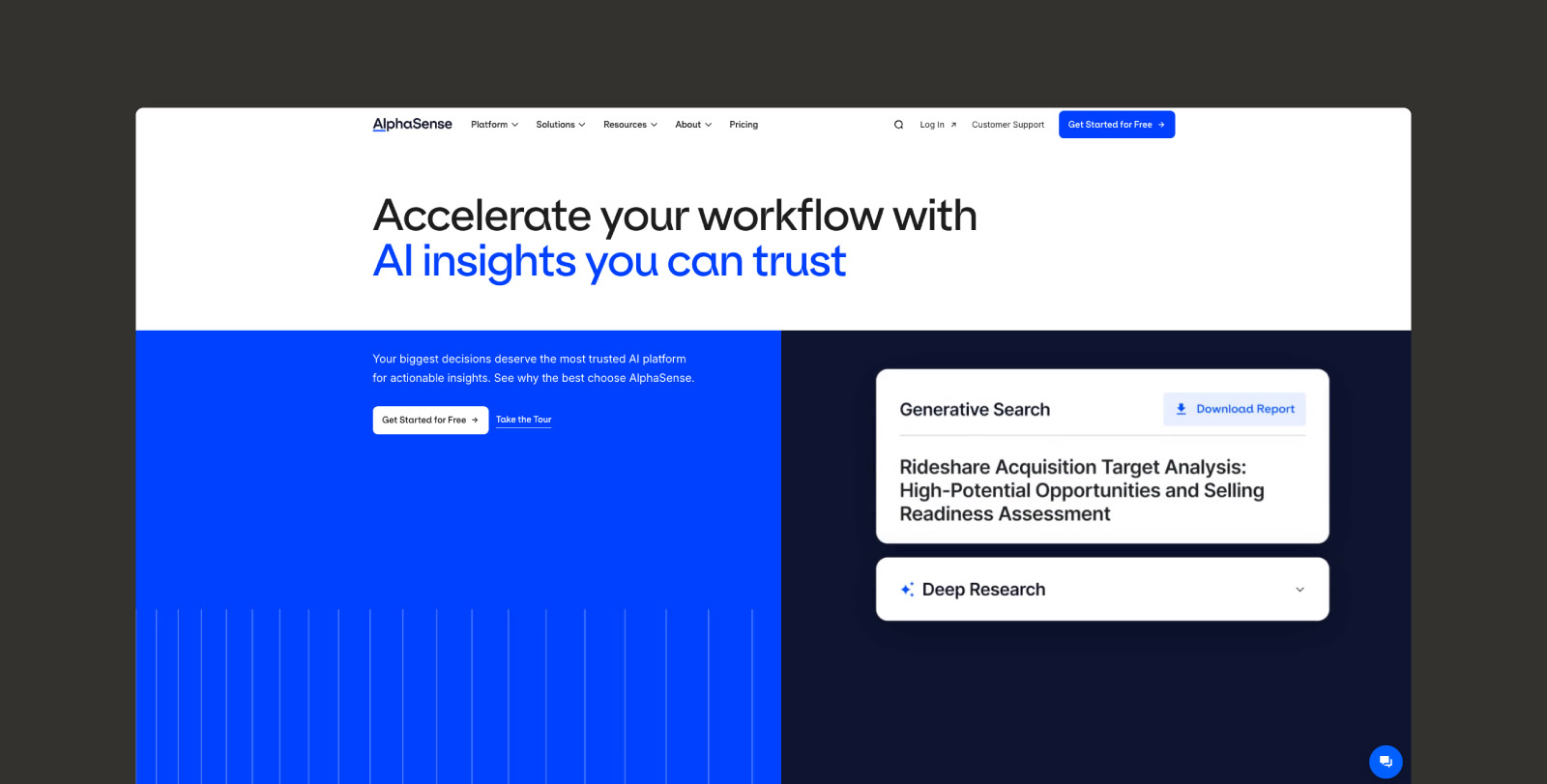
Equity research and competitive intelligence teams use AlphaSense to search a large external content library. The library pairs public filings and transcripts with proprietary expert call recordings gathered through its own research network.
AlphaSense layers generative AI search on top of that library, letting analysts ask research questions in plain language and get sourced answers back instead of a list of documents to read. The platform's scope stays external, though, with no internal document layer to synthesize a finding into a deal perspective grounded in your firm's own prior work.
Key features:
- Large library of proprietary, expert-led insights: AlphaSense pairs public filings and transcripts with a library of expert call transcripts gathered through its own research network. This first-hand commentary gives analysts context they can't get from public documents alone.
- Generative Grid for document comparison: Generative Grid runs a set of natural-language prompts across many documents at once and lays out the answers in a table. Analysts use it to compare how several companies address the same question, such as pricing strategy or supply chain exposure.
- Accepts natural-language research queries: AlphaSense's Generative Search is built to interpret research intent rather than just keywords, so a plain language question returns a direct answer with a citation back to the source document.
3. Rogo
Best for: NLP investment research in Excel
Investment banking teams built Rogo's AI agent, Felix, to run within Excel rather than in a separate browser tab. A native plug-in places Rogo in a side panel next to your workbook, where it can populate financials or stress-test assumptions against your firm's templates and modeling standards. AI finance agents you already set up elsewhere in Rogo carry over automatically, so context does not reset each time you open a new file.
Rogo pulls its answers from data partnerships with S&P Global and the London Stock Exchange Group (LSEG), along with filings and transcripts. NLP outputs come back fast enough to use mid-model. The tool's focus stays close to deal-side banking work like building comparables and prepping confidential information memorandums (CIMs), so coverage outside core M&A workflows runs thinner than that of platforms built for broader research use.
Key features:
- Native Excel automation with in-workbook agent access: Rogo runs from a side panel inside Excel, so you prompt it without leaving your workbook. It can populate cells or audit existing tabs against your firm's templates.
- Fast NLP outputs: Outputs return fast enough to drop straight into a model without a separate search step. You stay in the workbook instead of switching to a browser tab and back.
- Powered by external data partnerships like S&P Global and LSEG: Data partnerships with S&P Global and LSEG, along with filings and transcripts, feed Rogo's answers.
4. Bloomberg Terminal
Best for: Real-time market data research
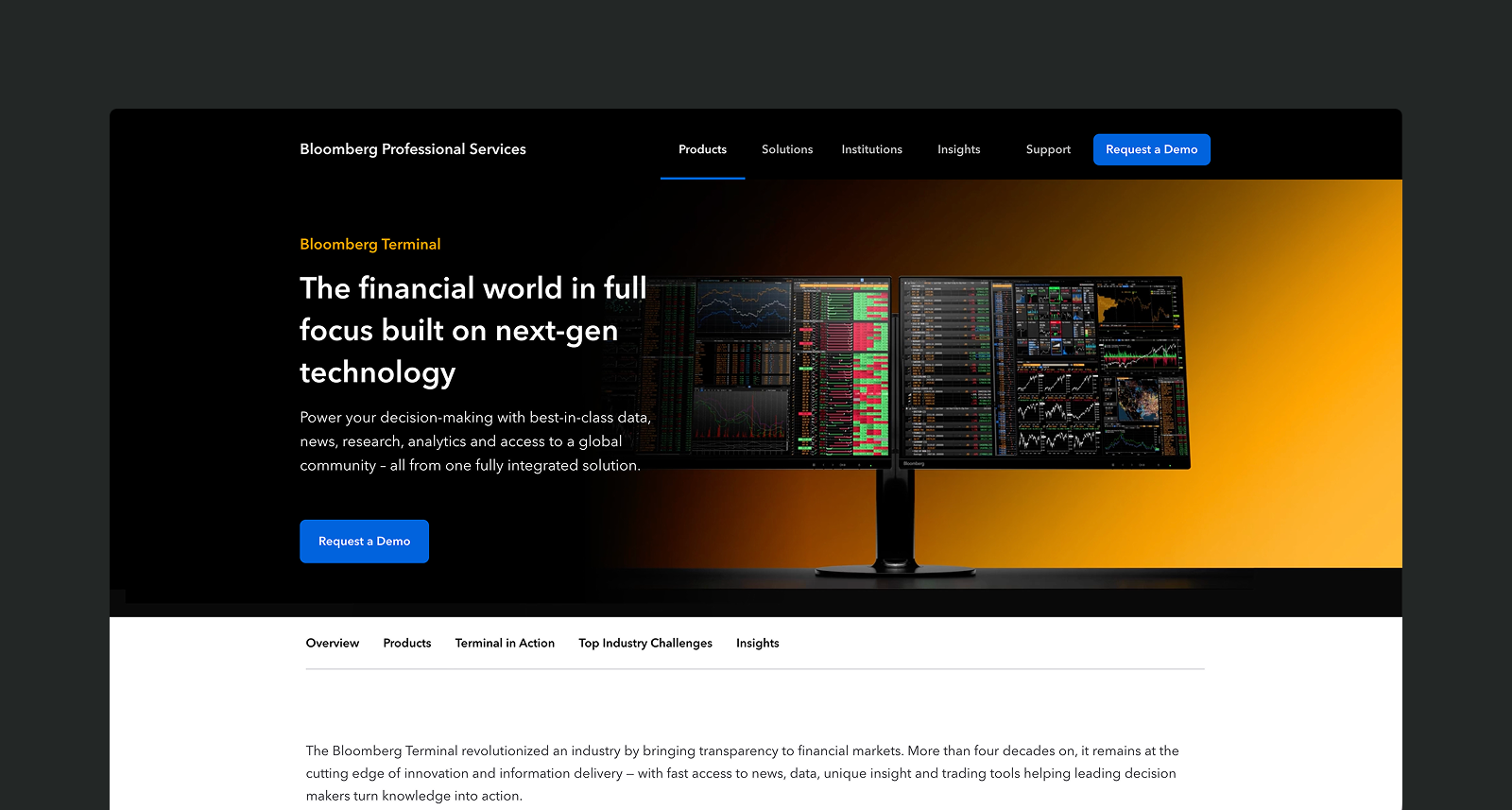
Bloomberg Terminal has long served as the default source for real-time market data, spanning multiple asset classes across thousands of exchanges and data vendors on a single platform. Traders and portfolio managers work on a single screen, moving directly from a data feed to an order ticket or a position review.
Bloomberg's new ASKB interface adds conversational AI search to the workflow, providing an early example of NLP in financial services layered onto a legacy terminal. Analysts can ask questions in plain language instead of digging through Terminal function codes.
ASKB is still in beta and reaches roughly a third of Terminal users. Most of the platform's natural-language capabilities today still run through the established command-and-function code system rather than a chat interface.
Key features:
- Natural language search and synthesis for current market research: A plain language question into ASKB returns a synthesized answer pulled from real-time data instead of a list of tickers to sort through.
- Large breadth of data vendors, exchanges, and asset classes: Coverage spans multiple asset classes and thousands of data vendors and exchanges worldwide, all inside a single Terminal session. This breadth lets you move from a bond screen to an equity chart without switching platforms.
- Easy to embed in trading and portfolio workflows: The Terminal connects directly to the execution and portfolio management tools traders already use within the platform, so an ASKB answer can feed directly into an order or a position review.
5. Fiscal.ai

Best for: Natural language research queries
Fiscal.ai's AI copilot lets users ask questions in natural language and get answers pulled directly from verified financial fundamentals, drawing on its own data feed alongside S&P Global Market Intelligence data.
Earnings transcripts and SEC filings round out the dataset, and coverage runs across more than 100,000 global public companies. Segment-level KPI (key performance indicator) breakdowns go deeper for more than 2,000 major companies within that base coverage.
An MCP (Model Context Protocol) connector lets Fiscal.ai plug directly into ChatGPT and similar AI chat interfaces, so verified financial data flows into the conversation rather than whatever a model has already picked up in training.
Institutional clients run Fiscal.ai's data alongside their own processes, and asset managers and hedge funds use the platform to screen new opportunities or monitor existing positions.
Key features:
- NLP AI copilot with direct connection to S&P Market Intelligence data: The copilot answers questions against a blended dataset of Fiscal.ai's own feed and S&P Global Market Intelligence data instead of guessing from training data. Ask about a company's margin trend or segment growth, and get sourced numbers back instead of a summary you have to double-check.
- MCP available for integration with AI chat interfaces like ChatGPT: An MCP connector brings Fiscal.ai's verified data into ChatGPT and other AI chat tools your team already has open, so financials and filings show up inside the conversation.
- Enterprise-grade accreditation and history of institutional clients: This track record signals the platform has scaled past its retail research roots into enterprise use.
6. Fintool
Best for: SEC filing research
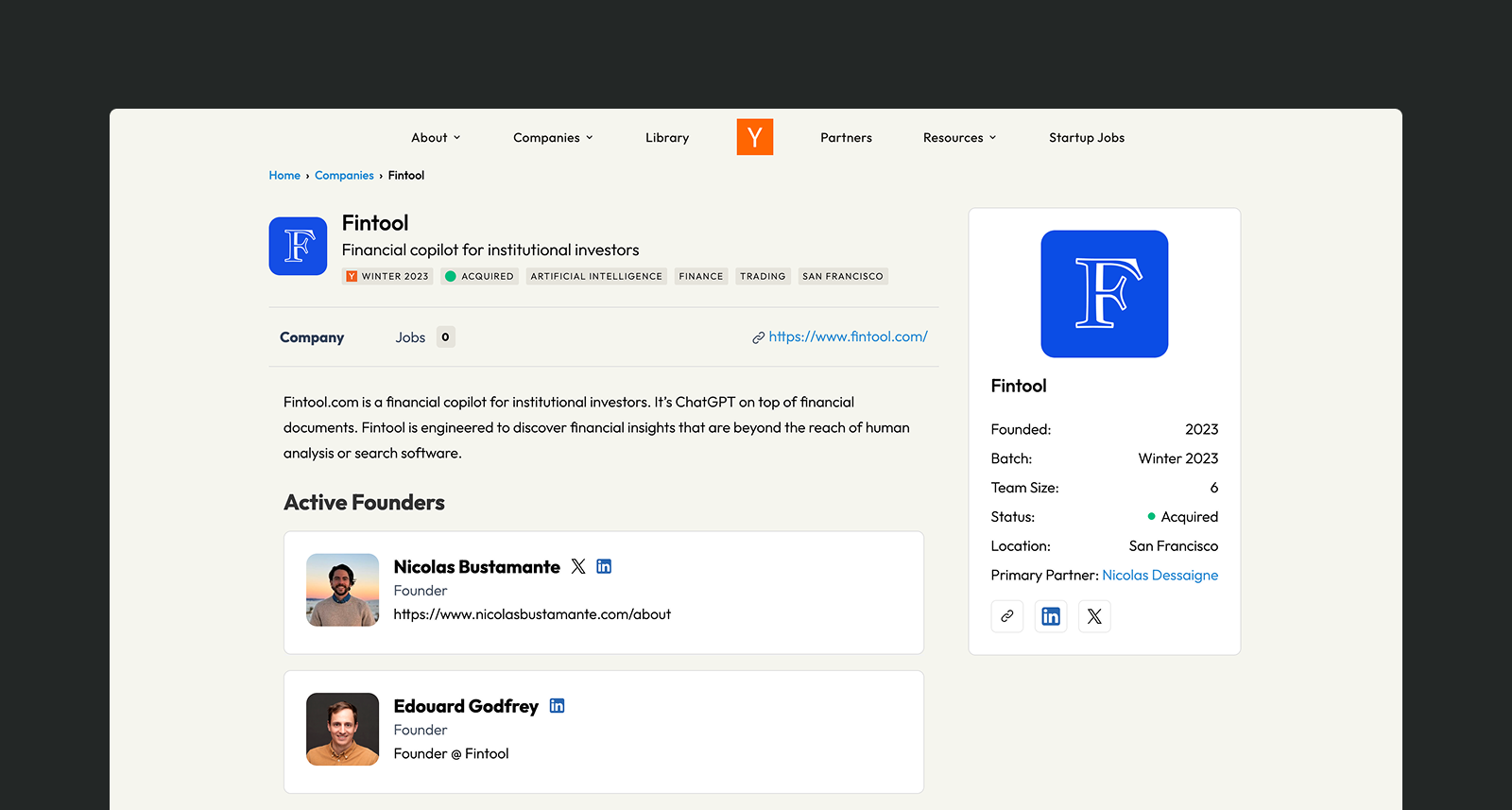
Microsoft acquired Fintool in April 2026, folding its SEC filing research agents into the Microsoft 365 tools that analysts already use to run their day. Fintool's newest agentic capability lets an AI agent build a DCF (discounted cash flow) model in Excel or draft a research memo in Word. The agent works in the background while an analyst handles the judgment calls.
However, the acquisition puts Fintool in transition. Teams evaluating the platform today might question how much of the product will remain available outside the Microsoft ecosystem and what the roadmap looks like going forward, since Microsoft hasn't detailed its plans publicly.
Key features:
- NLP analysis focused on SEC filings: Fintool's assistant reads 10-K and 10-Q filings alongside real-time 8-K disclosures and answers questions in plain language, citing the exact section of each filing referenced.
- Structured parsing of GAAP line items: The platform parses GAAP (Generally Accepted Accounting Principles) line items into a structured format instead of leaving them buried in prose. A specific revenue or expense line gets pulled straight into a model.
- Peer benchmarking tables that update as new filings post: Peer benchmarking tables refresh automatically as new filings post, so a comp set stays current without manual updates.
7. S&P ProntoNLP
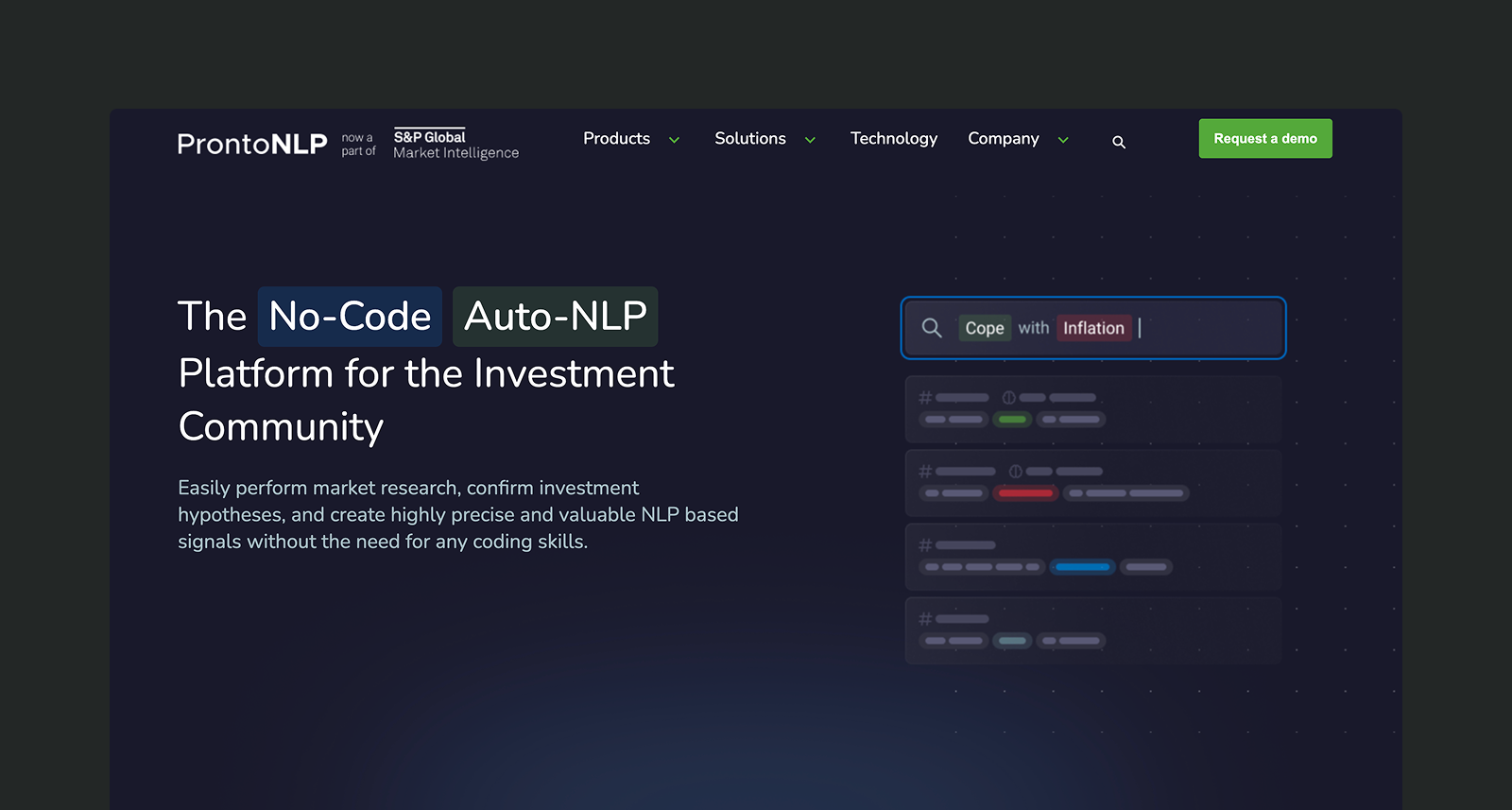
Best for: Monitoring market tone and sentiment
S&P Global folded ProntoNLP into Capital IQ Pro's Document Intelligence tool after acquiring the company in 2025, pairing its language models with the fundamentals and filings that analysts already pull from Capital IQ.
Quantitative funds and systematic strategies use the output to track how executive language shifts quarter over quarter. This approach turns what used to be a qualitative read on management tone into a data series that feeds directly into a model.
Reaching that sentiment layer means working within Capital IQ Pro rather than using a standalone product, so a team that only wants the NLP signal must take on the broader Capital IQ platform as well.
Key features:
- NLP tone and sentiment analysis: The model scores tone and sentiment across earnings calls and filings, turning management language into a number you can plot over time.
- Hourly NLP-based signal updates: Signals refresh hourly as new disclosures and news come in, so a tone shift shows up the same day.
- No-code customization: Analysts adjust event categories and scoring rules through a no-code interface, so a quant team can tune the model without pulling in an engineer.
Features to Look for in Financial NLP Tools for Investment Research
The right NLP platform for investment research does more than summarize documents. It synthesizes across everything a firm has already researched, not just the file in front of you. Avi Upreti, Hebbia's Principal AI Strategist and a decade-long investment banker, put it well: a senior banker's edge comes from synthesis, but even the best banker's memory only covers a fraction of what the firm has already learned. As he wrote, "One senior banker's memory is only a fraction of what the firm holds."
Before you choose a platform, look for these core capabilities:
- Best-in-class NLP analysis: The top NLP tools for investment research use finance models with high traceability and transparency. Hebbia's research found that 58% of finance professionals say AI must be completely accurate before they'll rely on it at work, so there should be no doubt where a tool sources its outputs.
- Enterprise-grade feature availability: A serious tool processes documents at scale with accuracy you can verify—because every output is cited back to its source, you check it rather than trust it. It should also comply with security requirements such as SOC 2 Type II and ISO standards.
- High-quality data with broad coverage: Any external data should be backed by traceable, reputable sources, and a best-in-class NLP platform for investment research also draws from a wide range of them. 70% of finance professionals review 51 or more documents in a single analysis, with over a quarter reviewing more than 100, so coverage needs to scale with that volume.
- Extensive governance: A suitable NLP research tool provides governance measures, such as role-based access control for sensitive documents. It will also allow you to find the model’s chain of reasoning for an output quickly.
Turn Market Intelligence Into a Competitive Edge With Hebbia
Staying ahead of the competition involves identifying market signals before anyone else. Hebbia’s NLP technology processes thousands of filings and transcripts, leading the way with low-error research outputs at scale.
Schedule a demo to see how Hebbia's NLP helps your team research with more accuracy and confidence.


